• Skip to main content

Abbey's Kitchen

Healthy Recipes, Nutrition Myth Busting, Healthy Eating Tips

  • Books
    • HCC™
    • The Mindful Glow Cookbook
    • Recipe eBooks
      • Family
      • Hypothyroidism
      • BLW
      • Vegan Week 1
      • Vegan Week 2
      • Vegan Week 3
      • Keto
      • Gluten Free Week 1
      • Gluten Free Week 2
      • Fitness
      • Paleo
  • Blog
    • Nutrition
    • Recipes
    • Motherhood
    • Life
  • Explore
    • Neue Theory™
    • Bite Back With Abbey Sharp
      • Apple Music
      • Spotify
      • Amazon Music
    • YouTube
  • Abbey
    • About
    • Coaching
    • Contact

Abbey Sharp

Last Updated October 4, 2021. Published May 11, 2017 By Abbey Sharp 2 Comments

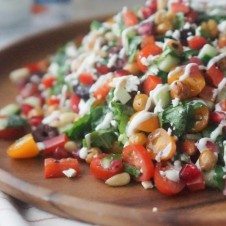
Healthy Crispy Chickpea Greek Salad with Pomegranates & Tzatziki Drizzle

DISCLAIMER: This post was developed in sponsored partnership with Hidden Valley, however, as always, all opinions are genuine.

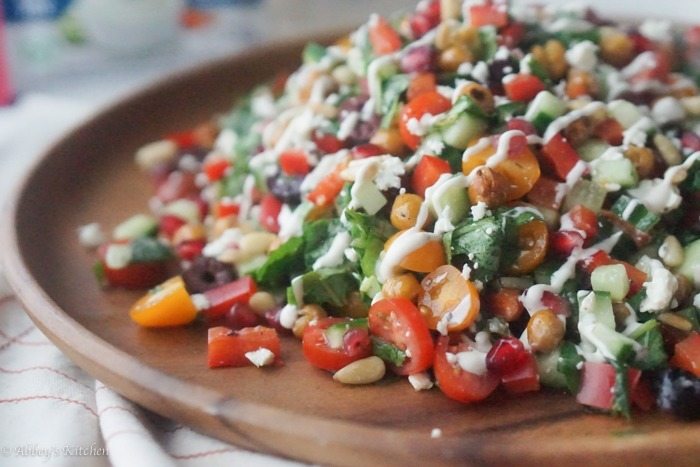
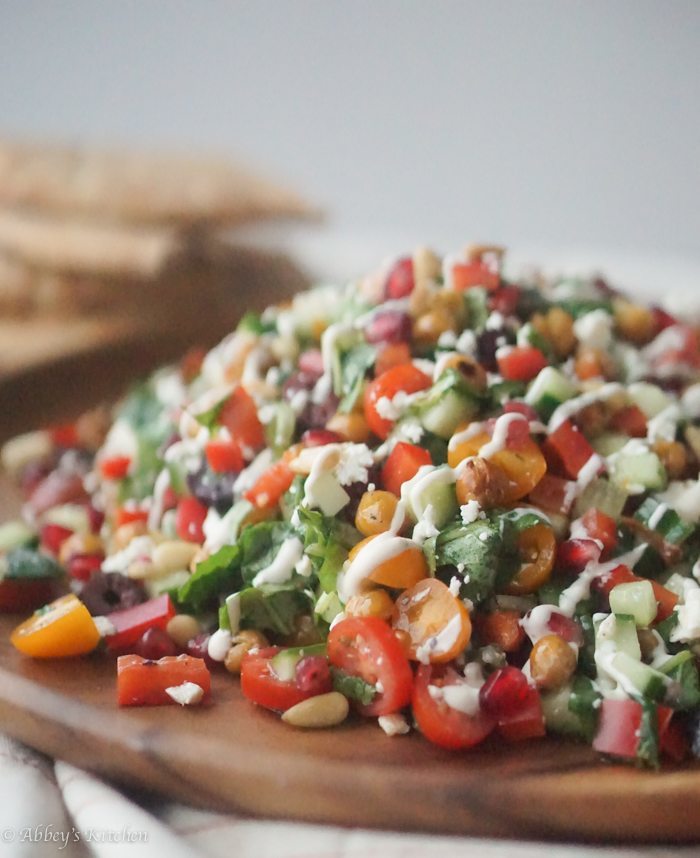
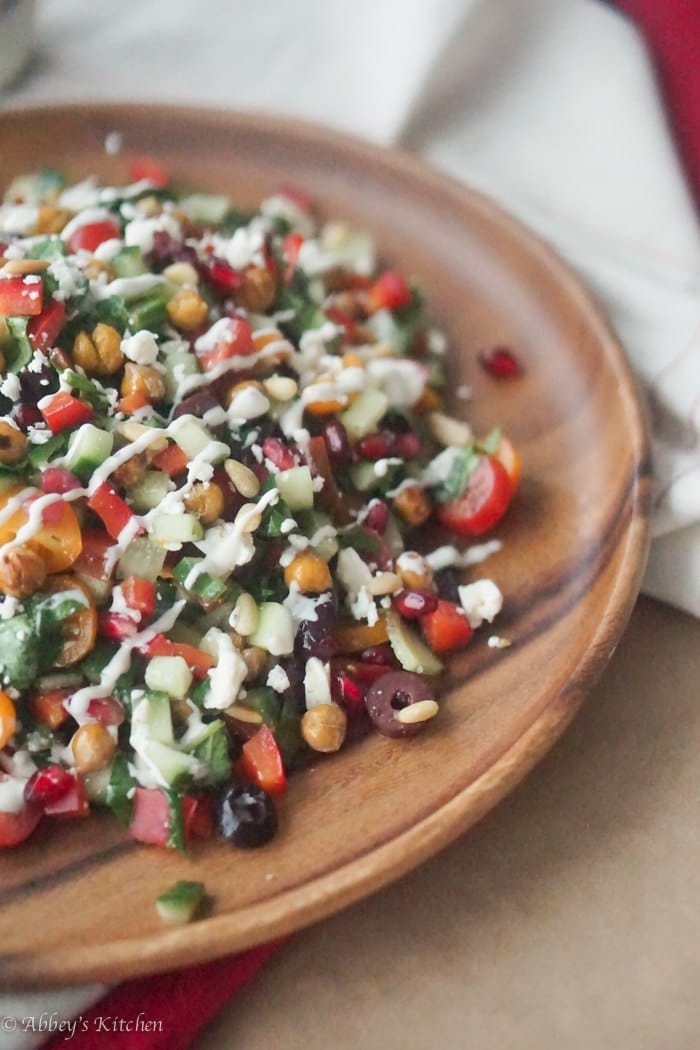
 So, yah, Greek salad is kind of my deal. The combination of fresh vegetables, salty feta and olives, and sharp vinaigrette just really makes me happy.
greek_salad_tzatziki_2_of_13.jpg

And as we officially enter into summer, I find myself longing for a bright, light, crunchy salad to off-set all those casseroles, pies, and candies from winter.
greek_salad_tzatziki_7_of_13.jpg

And not just a token “I need to fit into my wedding dress” salad. I’m talking about my beloved Greek salad that any vegetarian, carnivore, diet Debbie or food-lover will truly get excited about.
greek_salad_tzatziki_9_of_13.jpg

The Ultimate Greek Salad Inspiration

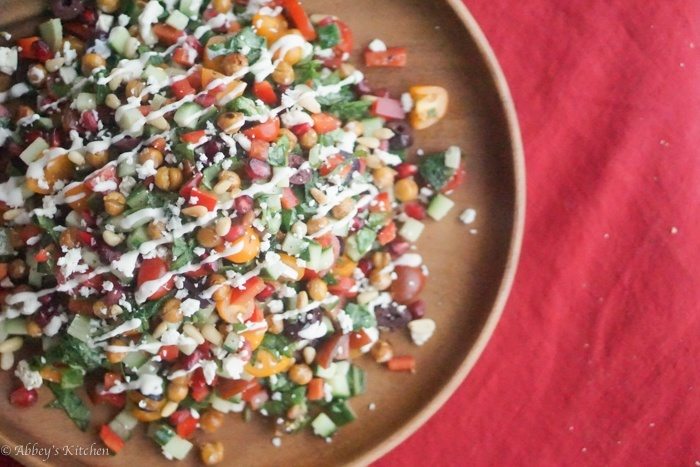
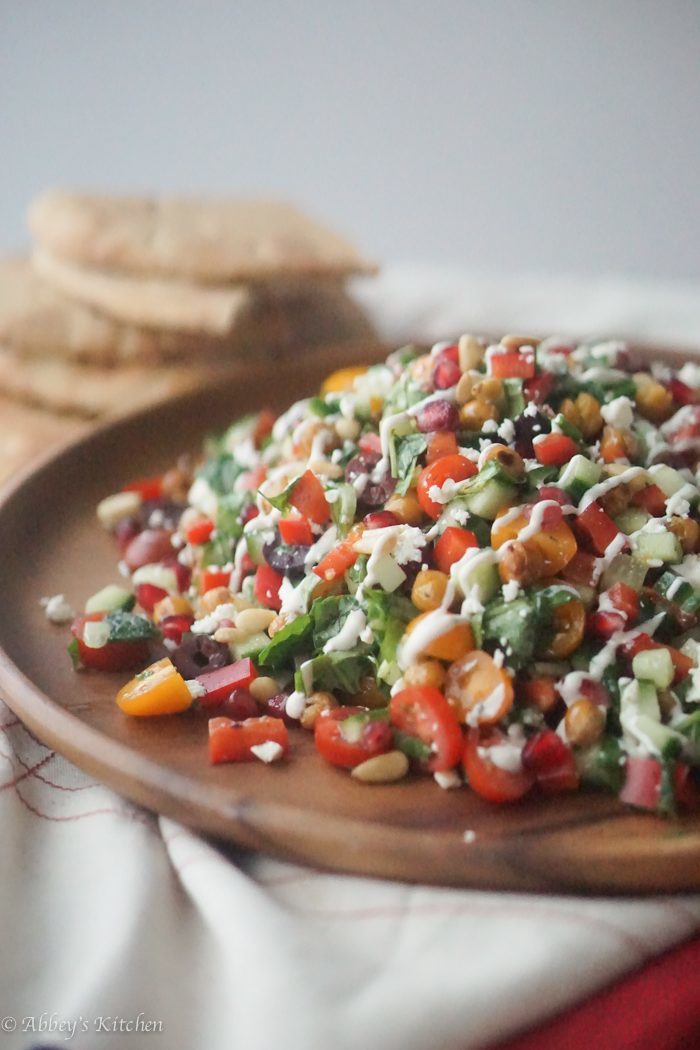
This Greek salad was inspired by one of my favourite salads in Toronto at Rasa Bar on Harbord. Seriously, if I lived super close I would eat it every day. In my version, I made sure there were lots of textures going on and a satisfying balance of salty, sweet and acidic flavours.
greek_salad_tzatziki_6_of_13.jpg

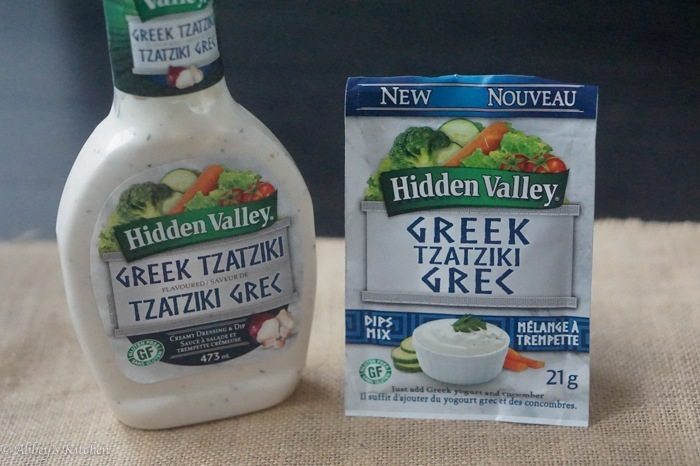
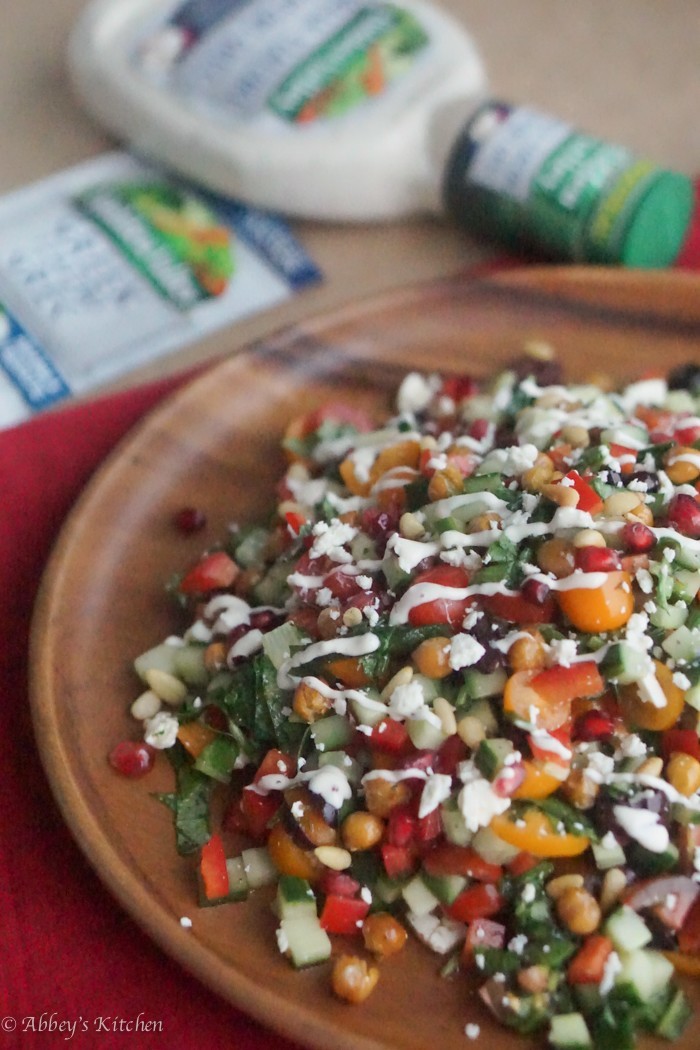
I start by mixing together all of my favourite chopped up veggies, then adding in some crispy flavoured chickpeas with the help of a pack of Hidden Valley’s Greek Tzatziki Dip Mix.
greek_salad_tzatziki_13_of_13.jpg

These little crunchy gluten-free “croutons” add great body and texture to this Greek salad but also are a truly delicious snack all on their own- a perfect alternative to potato chips.
greek_salad_tzatziki_1_of_13.jpg

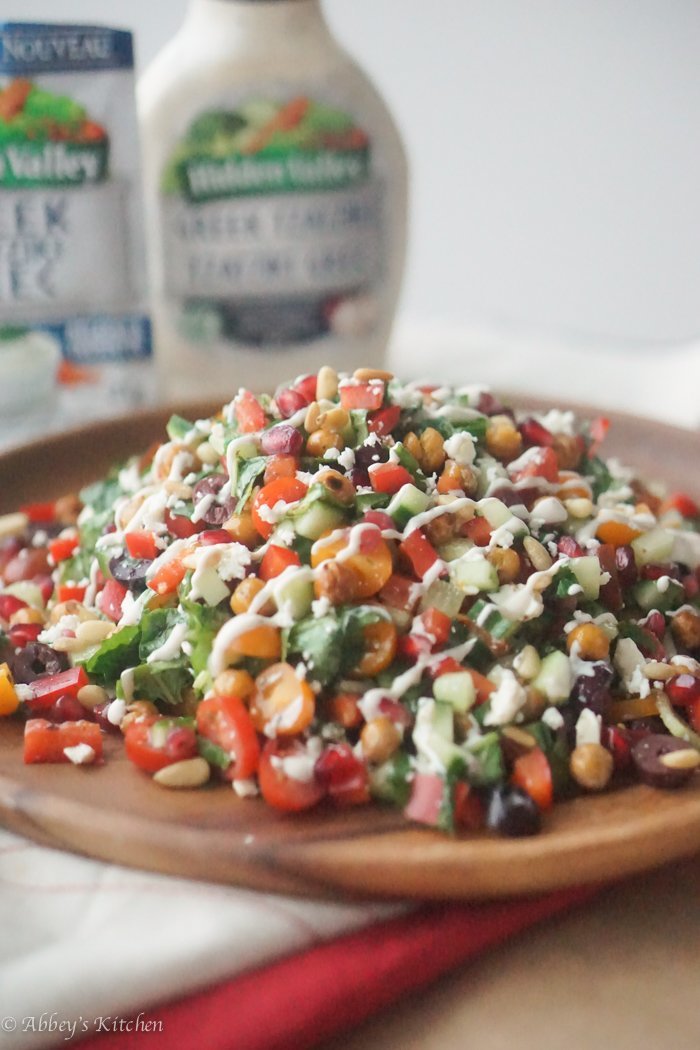
I also use the remaining package of dip mix to make a creamy dreamy (easy) tzatziki drizzle that helps contrast the bright lemon vinaigrette I use to soften up the kale.
greek_salad_tzatziki_3_of_13.jpg

The result is a Greek salad that you’ll get excited about any time of year.
greek_salad_tzatziki_10_of_13.jpg

Don’t you love Greek salad?

What’s you’re go-to salad to welcome the summer?

Leave me a comment below and I’ll try my own take at it.
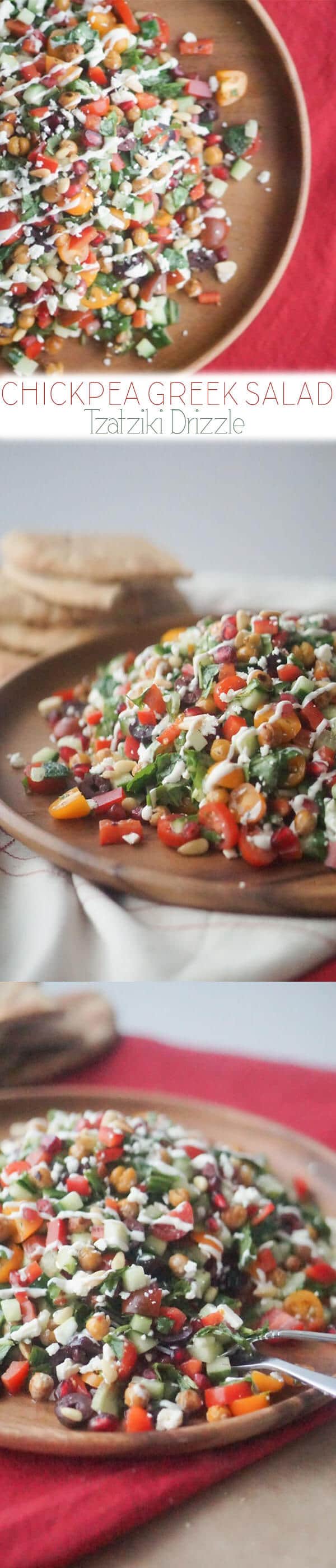
A pinterest image of greek salad on a plate with the overlay text \"Chickpea Greek Salad. Tzatziki Drizzle.\"
Print Recipe
5 from 1 vote

Healthy Crispy Chickpea Greek Salad with Pomegranates & Tzatziki Drizzle

Greek salad is kind of my deal. The combination of fresh vegetables, salty feta and olives, and sharp vinaigrette just really makes me happy.
Prep Time10 minutes mins
Total Time10 minutes mins
Course: Salad
Cuisine: Greek
Servings: 4 people
Calories: 236kcal
Author: Abbey Sharp

Ingredients

Dressing

  • 2 tbsp fresh lemon juice
  • 1 tbsp extra virgin olive oil
  • 1/2 tsp Dijon mustard
  • 1/2 tsp honey
  • Pinch pepper and za’atar pinch of each
  • 1 package of Hidden Valley Tzatziki Dip Mix 1 1/2 tsp reserved
  • 1 1/4 cups Nonfat plain Greek yogurt

Salad

  • 1 can of chickpeas drained, rinsed and dried
  • 1 1/2 tsp Hidden Valley Tzatziki Dip Mix
  • 3 cups baby kale sliced chiffonade
  • 1 English cucumber finely diced
  • 1 cup baby tomatoes sliced or quartered
  • 1 red bell pepper finely diced
  • 1/4 cup kalamata olives sliced
  • 1/4 cup pomegranate arils
  • 3 tbsp feta cheese crumbled
  • 3 tbsp toasted pine nuts
  • Pinch salt, pepper and sumac pinch of each

Instructions

Dressing

  • In a small container, mix together the lemon juice, olive oil, Dijon, honey, salt, pepper and za’atar. Set aside.
  • Set aside 1 1/2 tsp. of the Hidden Valley Tzatziki Dip mix and mix the remaining mix with the Greek yogurt. Transfer to a squeeze bottle and set aside.

Salad

  • Preheat the broiler. Toss the dried chickpeas with the reserved 1 1/2 tsp of dip mix and spread out onto a baking sheet. Broil until golden and crisp. Set aside to cool.
  • Meanwhile, in a medium bowl, mix the kale with the lemon dressing and massage until well coated. Add in the cucumber, tomatoes, bell peppers, olives, pomegranates, feta, pine nuts and a pinch each of salt, pepper and sumac. Toss in the crispy chickpeas.

Assembly

  • Transfer to a serving platter and drizzle with the Tzatziki dip. Enjoy!

Nutrition

Calories: 236kcal | Carbohydrates: 18g | Protein: 14g | Fat: 14g | Saturated Fat: 3g | Cholesterol: 15mg | Sodium: 334mg | Potassium: 674mg | Fiber: 2g | Sugar: 9g | Vitamin A: 6300IU | Vitamin C: 112.9mg | Calcium: 240mg | Iron: 1.9mg

Disclaimer: This recipe was developed in paid partnership with Hidden Valley, however, all opinions are genuine.

Abbey Sharp

Abbey Sharp is a Registered Dietitian (RD), regulated by the Ontario College of Dietitians. She is a mom, YouTuber, Blogger, award winning cookbook author, media coach specializing in food and nutrition influencers, and a frequent contributor to national publications like Healthline and on national broadcast TV shows.
www.abbeyskitchen.com/about-abbey/

Last Updated May 10, 2017. Published May 10, 2017 By Abbey Sharp 36 Comments

A Canadian Culinary History in Meat | Amazing Charcuterie Boards for Canadian Provinces

A serving platter with charcuterie on it, such as grapes, meats, and nuts.

DISCLAIMER: This post was developed in sponsored partnership with Canadian Meat Council, however, as always, all opinions are genuine.

We create a map of Canadian Culinary History in Meat with 5 amazing Charcuterie boards for the Canadian provinces in this visual display of culture.

A serving platter with charcuterie on it, such as grapes, meats, and nuts.

Every once in a while, a project comes along that gets me really excited because I get to put my foodie hat on a geek out. This was that project. This month I partnered up with the Canadian Meat Council to create 5 beautiful charcuterie boards featuring a variety of tasty meats, cheeses and accoutrements unique to each province.

Since each Canadian province is unique in its culinary history, the types of meats, cheeses and other charcuterie board noms should depict those differences. So if you want to learn a bit about Canada the tastiest way I know how, check out these tasty spreads.

A Canadian Culinary History in Meat and Charcuterie Boards

Let’s break each province down and give you a little food history lesson about the regions we call home.

ONTARIO

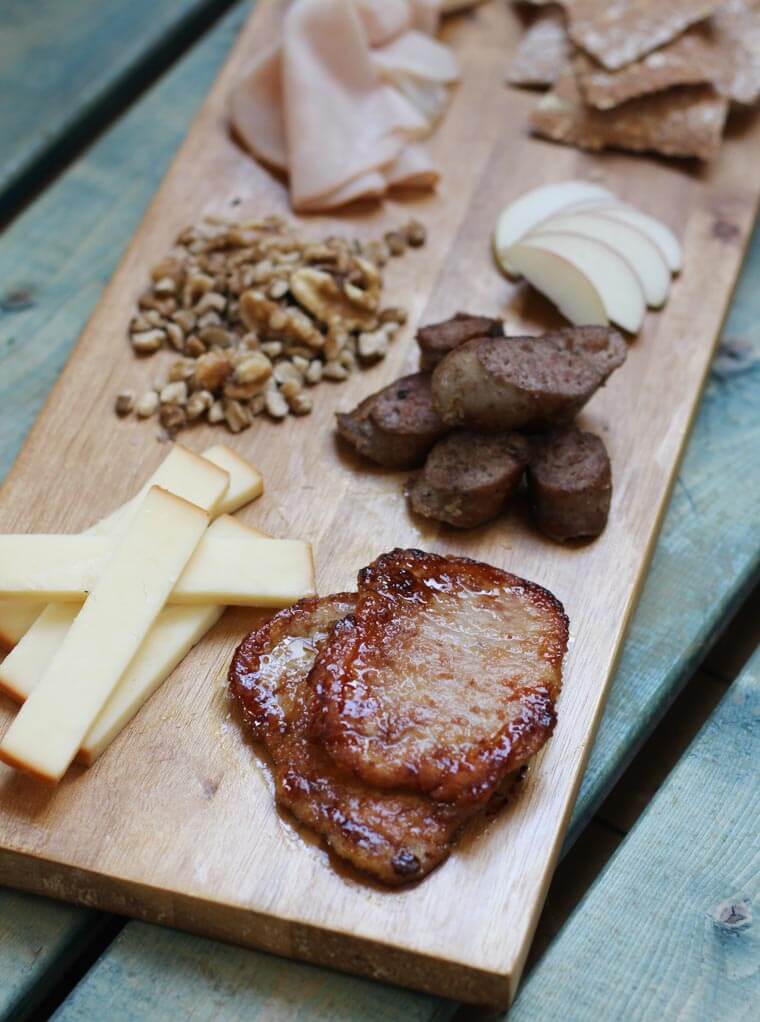
A serving platter with charcuterie on it, such as cheese, meats, and nuts.

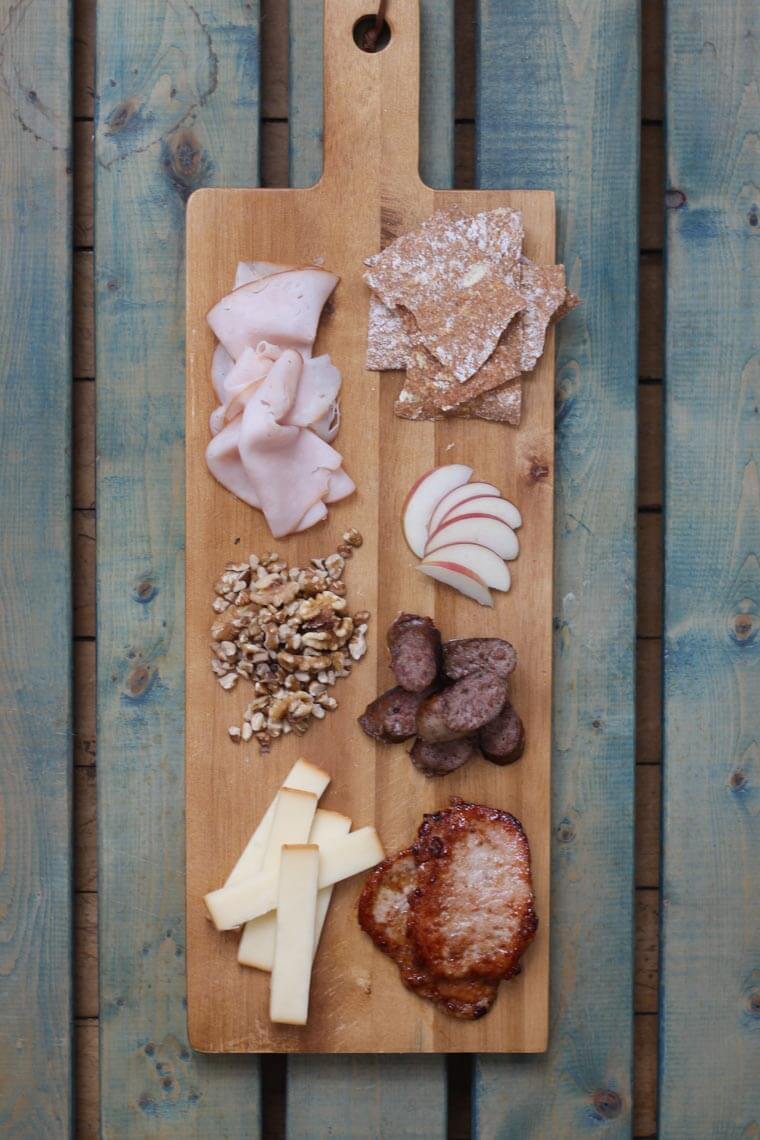
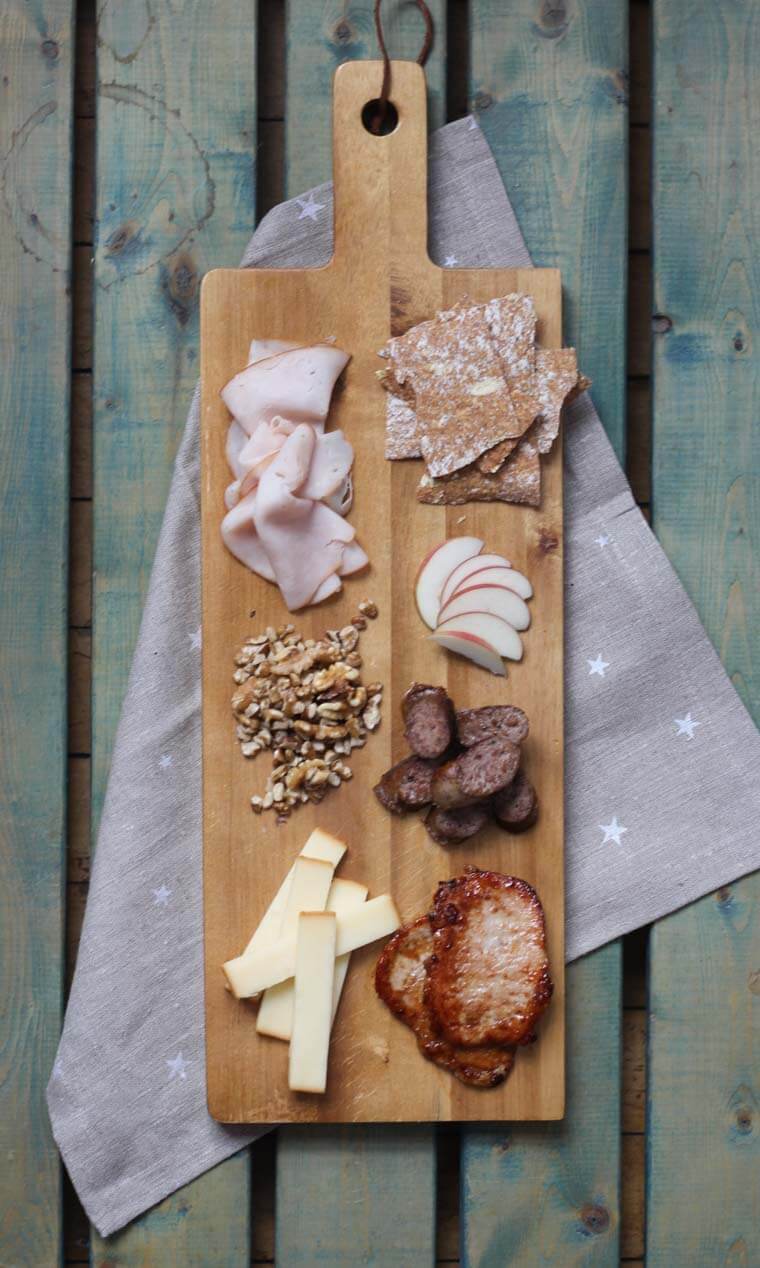
German-Style Sausage: In the 19th century, areas like Kitchener were first settled by German-speaking Mennonite farmers from Pennsylvania which encouraged a huge influx of German immigrants to move to the province.

A wooden serving platter with charcuterie on it, such as cheese, meats, apple slices, and nuts.

Peameal Bacon Candied: Peameal bacon is unique to Ontario because of its creator, William Davies, who was a pork curer and sold his bacon at the St. Lawrence Market (the best place to buy it) which gave the city of Toronto the nickname “Hogtown”.

Maple Glazed Wild turkey: Ontario is the leading area for hunting wild turkey and is the leading turkey producer. We also make a mean maple syrup so this is a natural pairing.

McIntosh Apples: John McIntosh planted apples in a small plot of land in southeastern Ontario and since then McIntosh apples became the most produced apple in Canada.

A wooden serving platter with charcuterie on it, such as cheese, meats, apple slices, and nuts.

Smoked Cheddar Cheese: The best award-winning cheddar cheese come from southern and eastern Ontario. Big names like Balderson and Odessa are from this part of the province and they are amazing.

Red Fife Seed Cracker: Even through the prairies is the largest producer of wheat in Canada, the Red Fife was developed in Peterborough Ontario (my home town!) and became very popular because of its high yields, and baking qualities.

Black Walnuts: The black walnut is the most successful edible tree in Ontario and has been adapted to withstand the winter cold.

QUEBEC

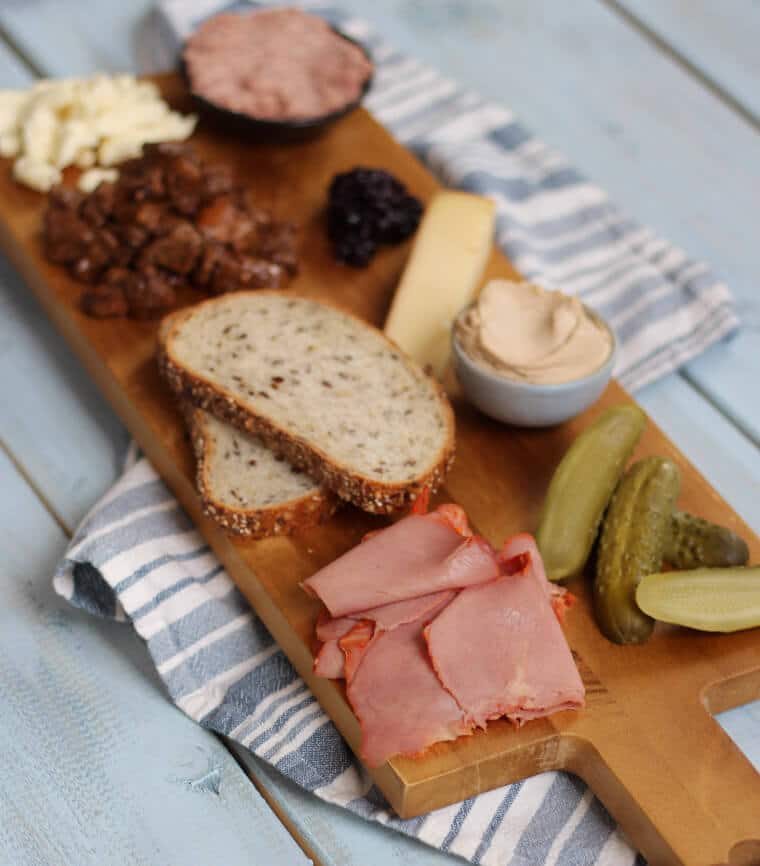
A wooden serving platter with charcuterie on it, such as cheese, meats, bread slices, pickles, and nuts.

Smoked Meat : Smoke Meat was developed by Jewish immigrants in the 1930s who fled Europe and settled in Montreal.

Cretons : A Quebecois signature dish that is a cold meat spread traditionally made with ground pork and cinnamon, savory and cloves.

Beef Tassot: Montreal has a growing Haitian population and Tassot is a classic Haitian dish of fried beef, goat or lamb with citrus and spices.

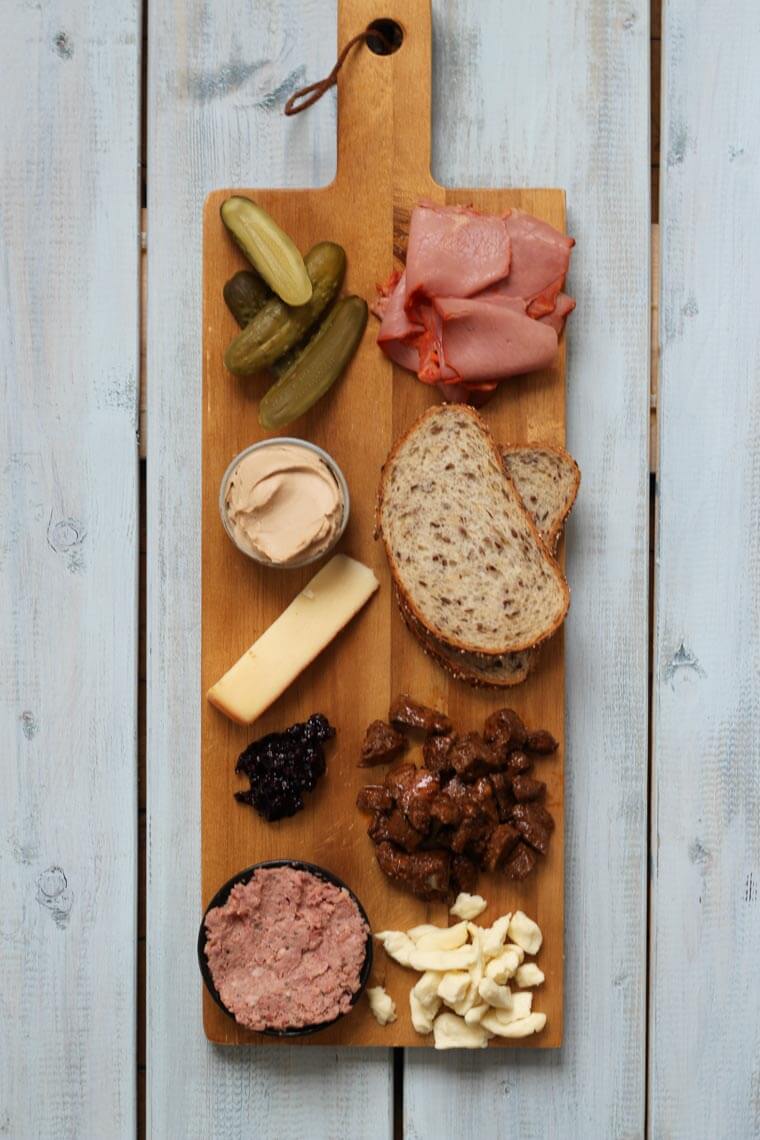
A wooden serving platter with charcuterie on it, such as cheese, meats, bread slices, pickles, and nuts.

Cheese curds: Quebec has always been named the cheese-making leader in North America since the colonialism age. In the 1950s, there was a surplus of milk in Quebec, which meant an increase in cheese production and leftover curds were discovered. Hello, poutine!

Foie Gras terrine: Foie Gras is the fattened liver of a duck or goose that has been overfed. Quebec has the largest foie gras industry in Canada and tends to use duck instead of goose.

Oka Cheese : Named after a small village of Oka located northwest of Montreal made by Trappist monks from the Roman Catholic religious order to provide income for the monastery. The cheese has a nutty and fruity flavour.

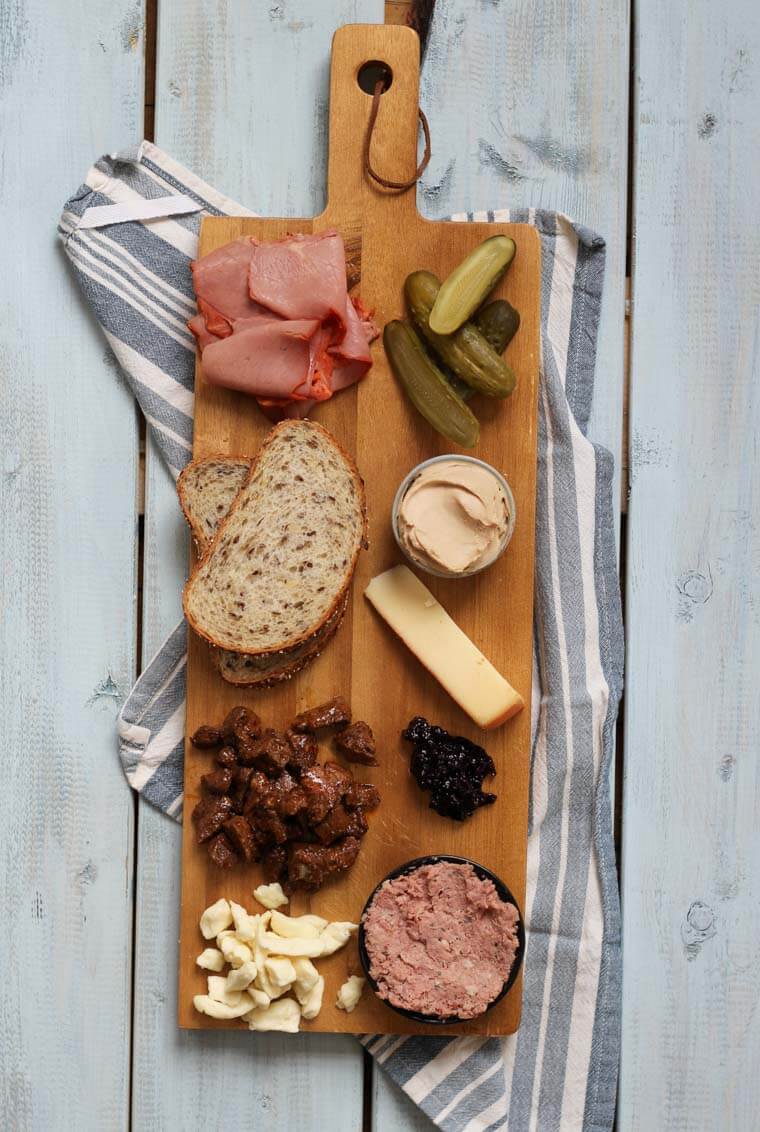
A wooden serving platter with charcuterie on it, such as cheese, meats, bread slices, pickles, and nuts.

Wild Blueberry Jam: Canada is world’s largest producer and exporter of wild blueberries that are mostly grown in Atlantic provinces and Quebec.

Pickles: In 1892, pickles were first brought to Quebec, and to this day, is still the largest pickle producer in Canada.

Rye bread: Rye bread is a traditional bread served at delicatessens to accompany smoked meat and mustard, a common meal introduced by the Jewish community in Montreal.

PRAIRIES

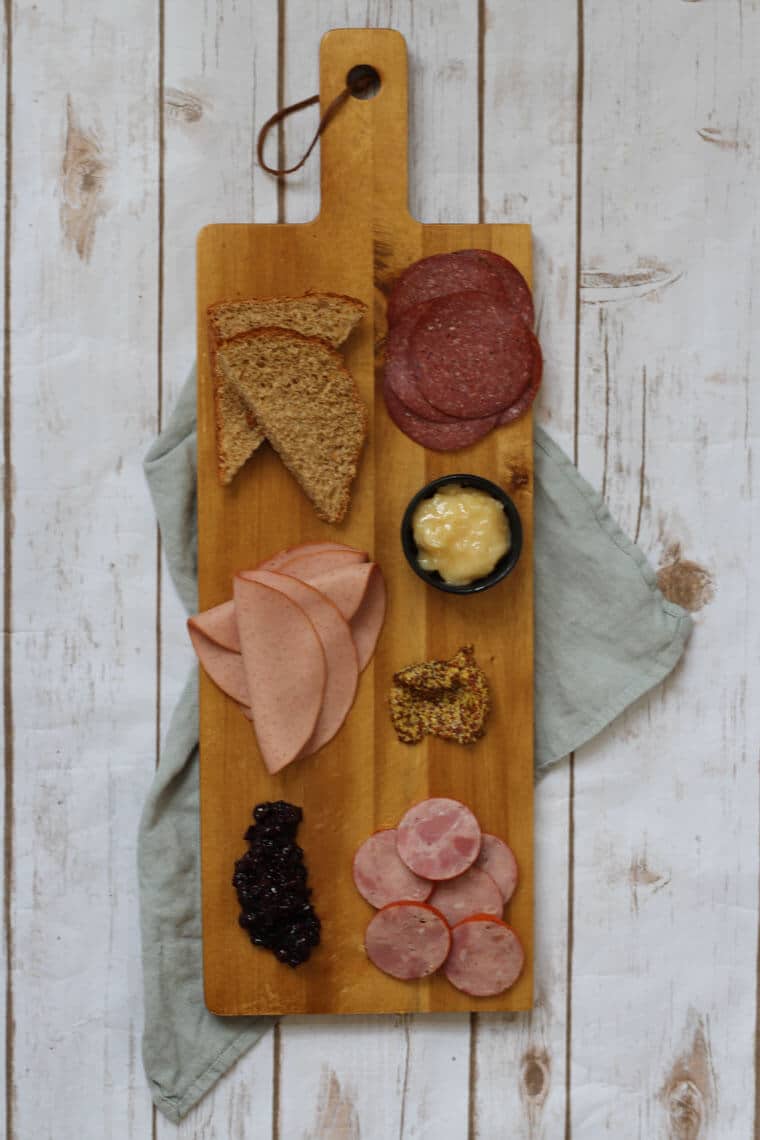
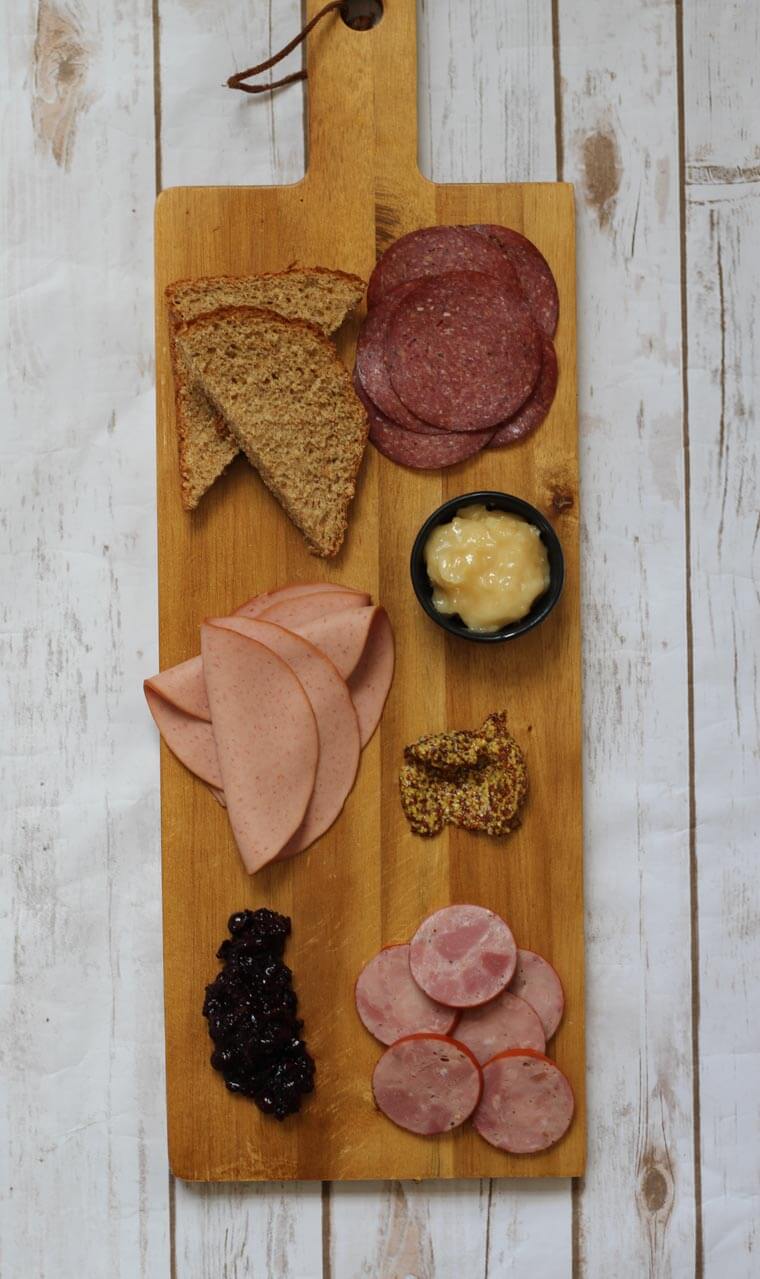
A wooden serving platter with charcuterie on it, such as cheese, sliced meats, bread slices, and nuts.

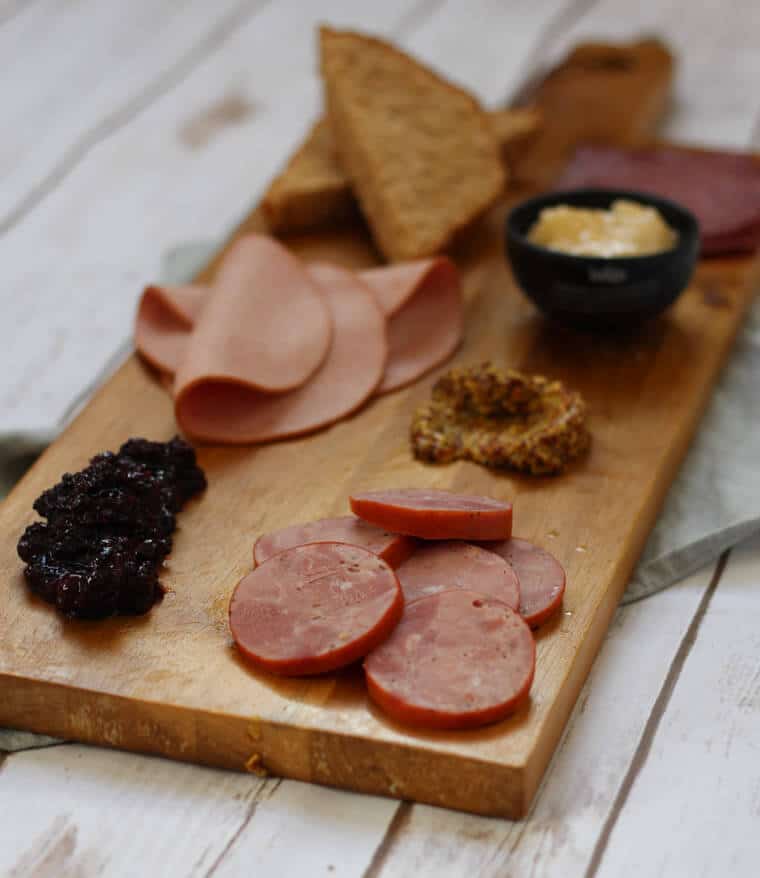
Beef Salami: The cattle industry is a central piece of economic life in Alberta.

Old Country Bologna: A cured beef or pork cold-cut that is a staple in Manitoba.

Kielbasa: Kielbasa is Polish for sausage and is a common sausage from Central Europe. This sausage became popular in the prairies once Ukrainians settled in the prairies.

A wooden serving platter with charcuterie on it, such as cheese, sliced meats, bread slices, and nuts.

Saskatoon Berry Jam: Historically, the Saskatoon berries were popular among indigenous groups in the prairies for sustenance and also to treat diarrhea and stomach aches. The whole bush would be used not only for eating, but also used the leaves to make teas, soups and stews and the branches used for arrows and tools.

Honey: Canada is the world’s sixth largest producers of honey and ¾ of that honey is produced in the prairies.

Mustard: Canada is the largest exporter and second largest producer of mustard seed in the world. Mustard production began in Western Canada in the 1936 and Alberta is responsible for a significant portion of these exports, second to Saskatchewan.

An angled image of a wooden serving platter with charcuterie on it, such as cheese, sliced meats, bread slices, and nuts.

Whole wheat bread: The prairies is a lucrative environment for wheat production and almost half of all Canadian wheat is grown in Saskatchewan, followed by Alberta and Manitoba.

ATLANTIC

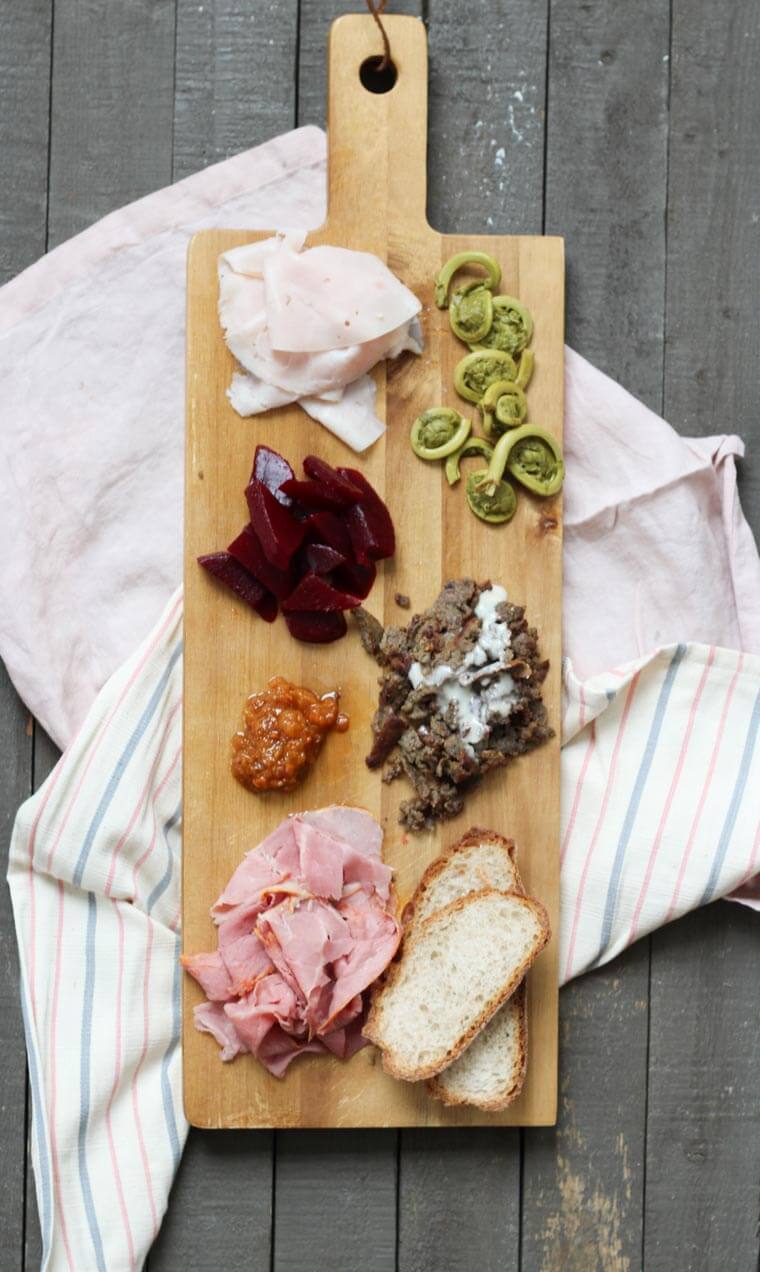
A wooden serving platter with charcuterie on it, such as cheese, sliced meats, bread slices, cut beets, and fiddleheads.

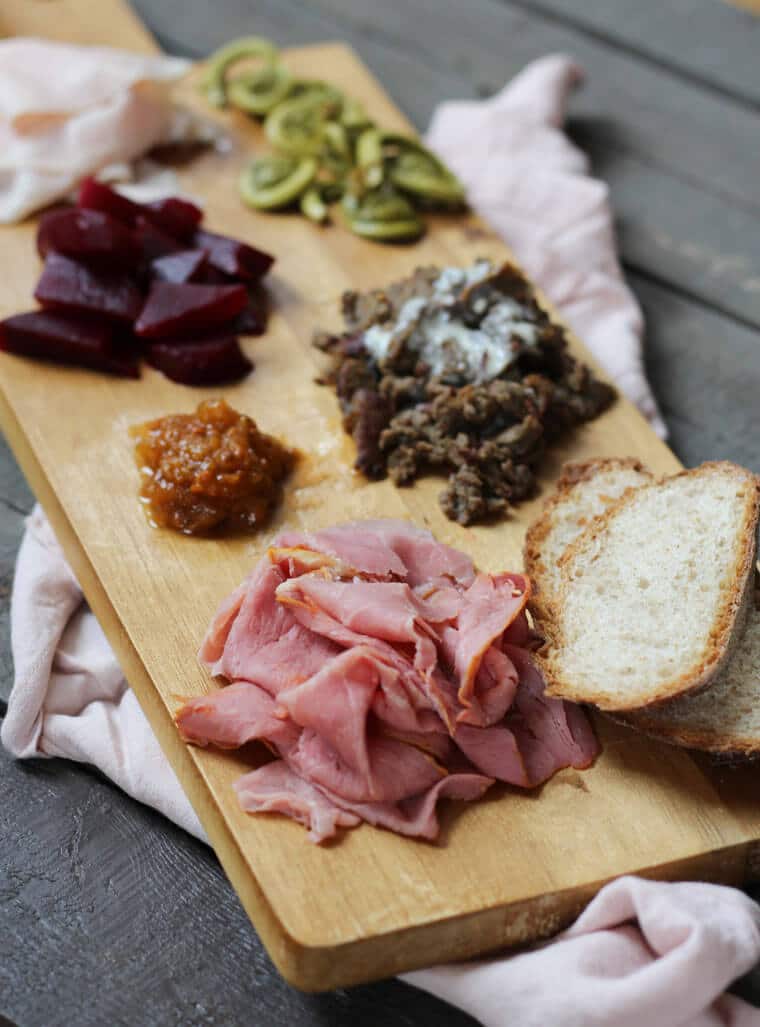
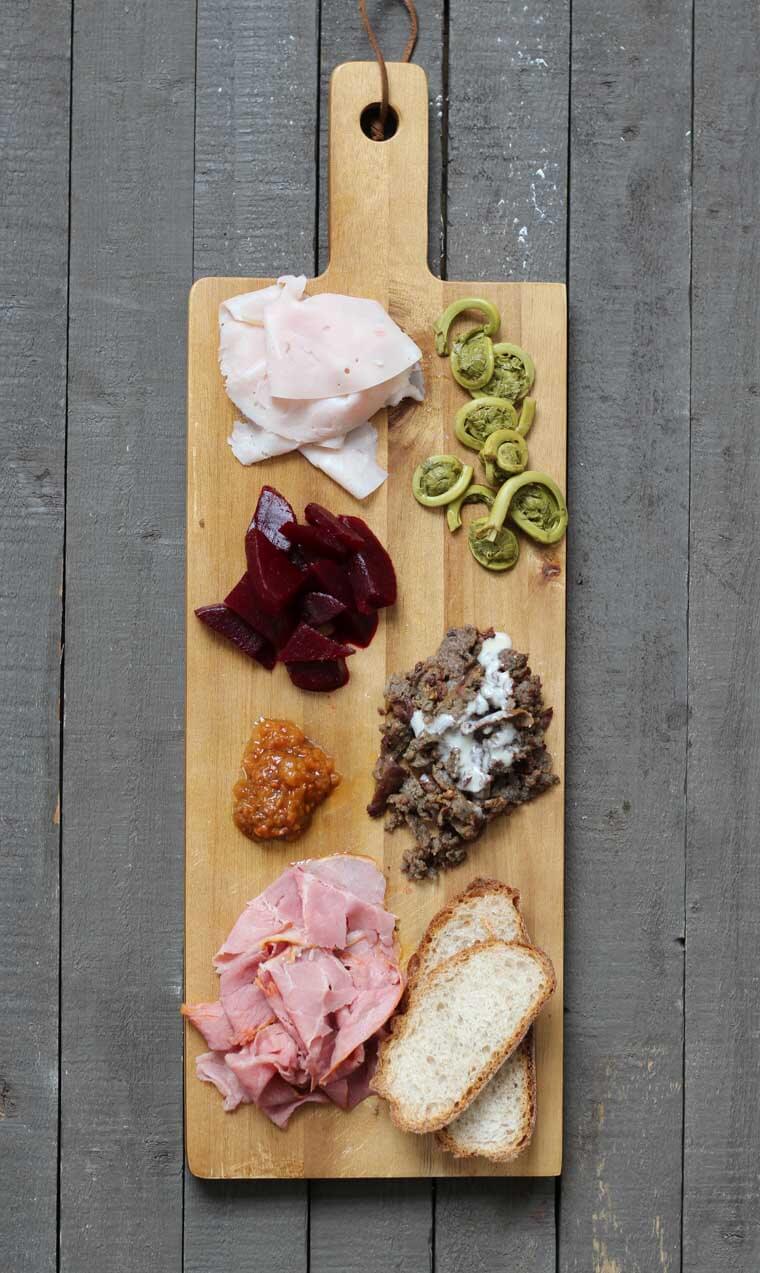
Corned Beef: Grounded in a history of Irish settlement in Canada’s east coast, it’s very common to see corned beef on maritime menus. In fact, a Newfoundland special is something called a Jiggs dinner, a Sunday night staple of Corned beef and cabbage.

Donair Meat with Donair Sauce: A Halifax staple made of cooked ground beef, with a sauce made of evaporated milk sugar and garlic powder.

Cured Chicken: Chosen to symbolize the traditional Acadian dish, Rappie pie, made of roasted whole chickens, potatoes and salted pork. The curing process gives the chicken the salty flavour like the salted pork alternatively would.

A wooden serving platter with charcuterie on it, such as cheese, sliced meats, bread slices, cut beets, and fiddleheads.

Cloudberry Jam: Cloudberries are small berries also known as bakeapple in Newfoundland and Labrador where it makes a popular choice for jam and pie.

Irish Soda Bread: Irish soda bread is a traditional bread made with soft cake or pastry flour and baking soda instead of yeast that was made popular on the East Coast thanks to the large population of Irish immigrants.

Pickled Beets : A common dish prepared by the Acadians and Metis, who are descendants of the French colonists who settled in the 17th & 18th centuries in Atlantic Canada.

A wooden serving platter with charcuterie on it, such as cheese, sliced meats, bread slices, cut beets, and fiddleheads.

Pickled Fiddleheads: Fiddleheads are a cross between asparagus and green beans and have been consumed for centuries in the Atlantic region.

BRITISH COLUMBIA

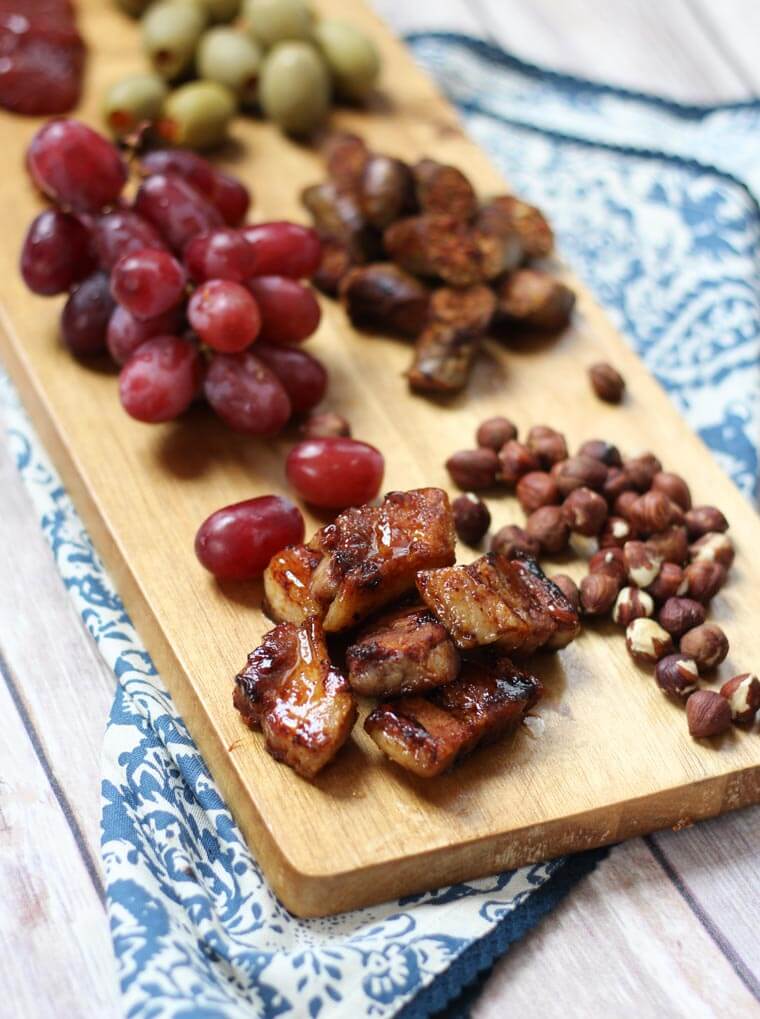
A serving platter with charcuterie on it, such as grapes, meats, and nuts.

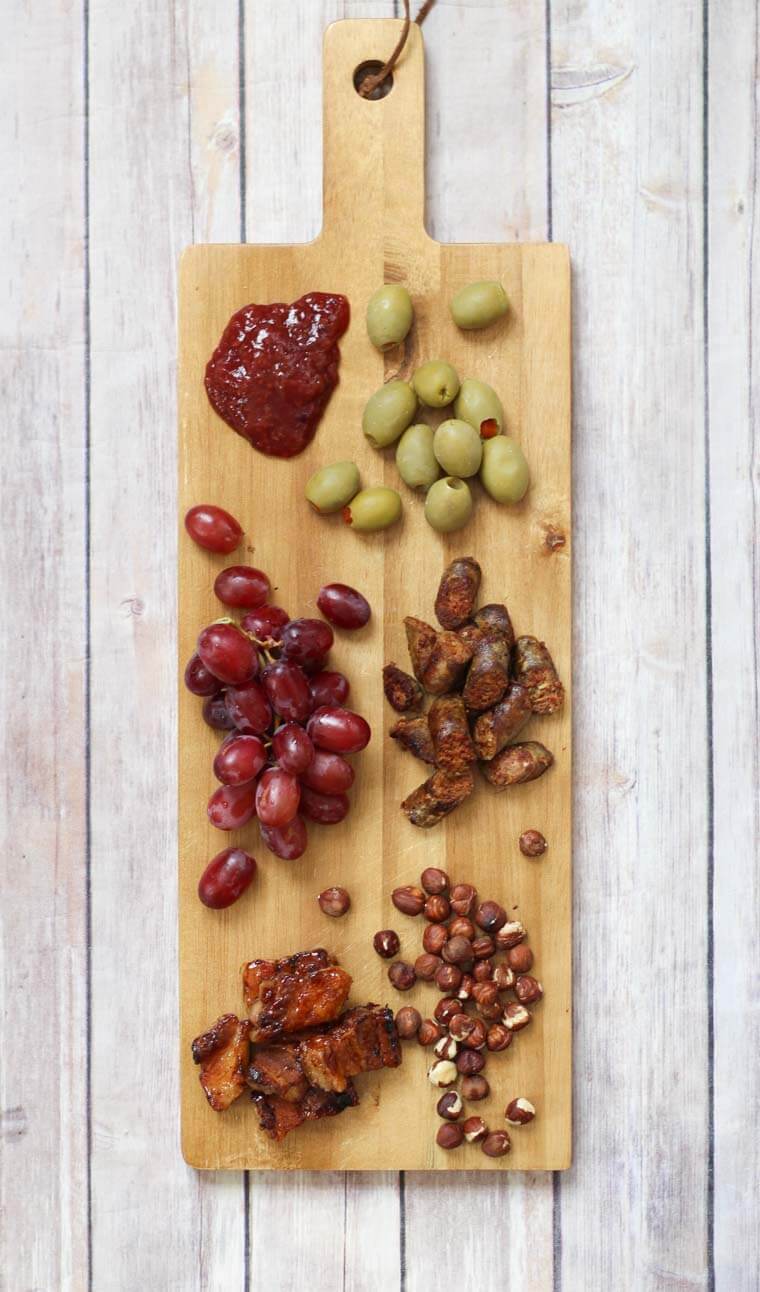
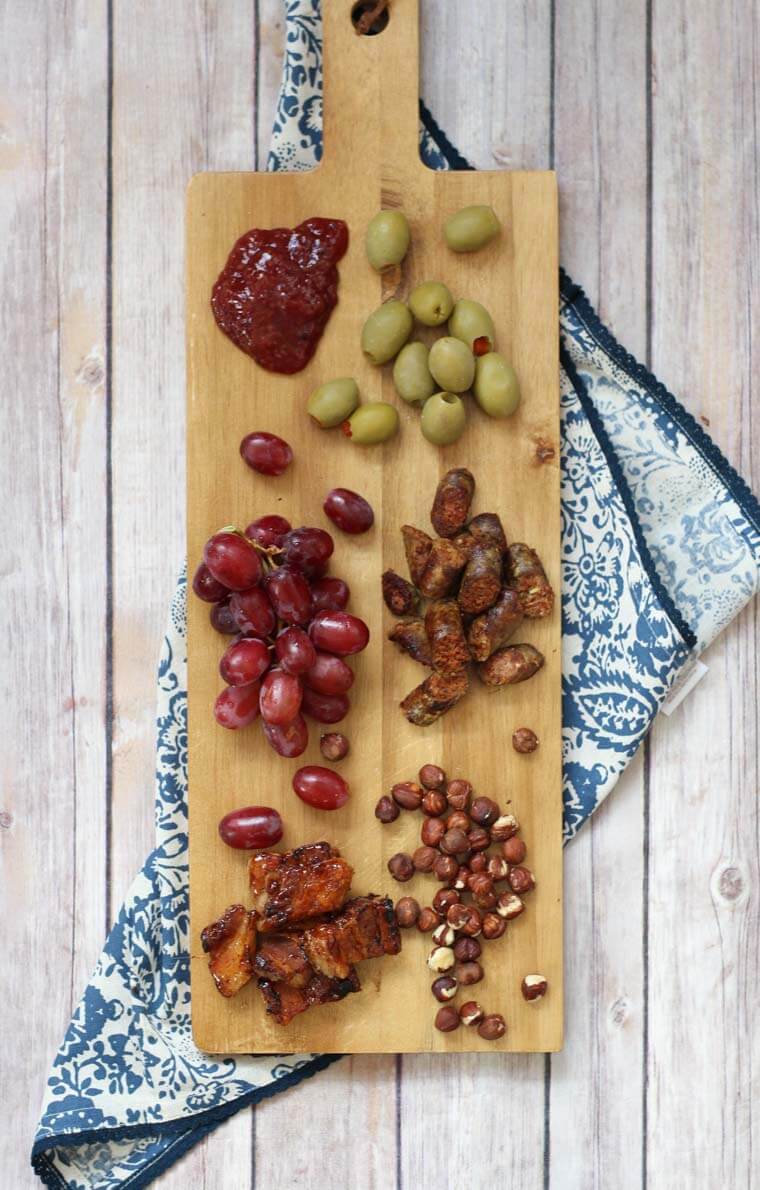
Pork Belly Cured Bacon : Based on stats Canada, the rate of those with Asian roots in metro Vancouver is growing at a faster rate than those without Asian roots- 43% of metro Vancouver residents come from a familial Asian background. This pork belly cured bacon, also known as lap yuk in Cantonese, is a traditional Chinese bacon, and is a knod to the large Asian population in Vancouver and the incredibly vibrant Asian food culture in the city.

Lamb Sausage: BC is quickly becoming a celebrated region for exceptional lamb, especially with the popularity of the beautiful Salt Spring Island destination which is known for its lamb.

Olives: Due to the climate it is difficult to grow olives, however all places, BC would be the place. Most of the growers are located in the lower mainland and southern Vancouver Island.

A wooden serving board with jam, olives, grapes, meat,  and nuts.

Grapes: The warm climate in BC means they are one of the biggest producers of fruit. Specifically, in the Okanagan Valley, its dry climate allows for the cultivation of beautiful plump grapes.

Red Raspberries Preserve: BC is one of the world’s premier production regions for red raspberries because of its fertile regions.

Hazelnuts: Hazelnuts make up an important part of BC food history because of BC’s well suited environment for growth.

A wooden serving board with jam, olives, grapes, meat,  and nuts.

I certainly learned so much researching for this project and I love that I now have the tools to build 5 amazing Canada themed charcuterie boards for many Canada Day celebrations to come.

Now, I want to know, based on where you live, what would you describe as a quintessential charcuterie board ingredient to represent your home?

Leave me a comment below with your thoughts!

We create a map of Canadian Culinary History in Meat with 5 amazing Charcuterie boards for the Canadian provinces in this visual display of culture.

Research Support by Sofia Tsalamlal, RD

Abbey Sharp

Abbey Sharp is a Registered Dietitian (RD), regulated by the Ontario College of Dietitians. She is a mom, YouTuber, Blogger, award winning cookbook author, media coach specializing in food and nutrition influencers, and a frequent contributor to national publications like Healthline and on national broadcast TV shows.
www.abbeyskitchen.com/about-abbey/

Last Updated January 11, 2018. Published May 3, 2017 By Abbey Sharp 36 Comments

Peach Melba Crumble Overnight Oats 101 | Wholesome, Easy, On the Go Breakfast Option for Busy Mornings!

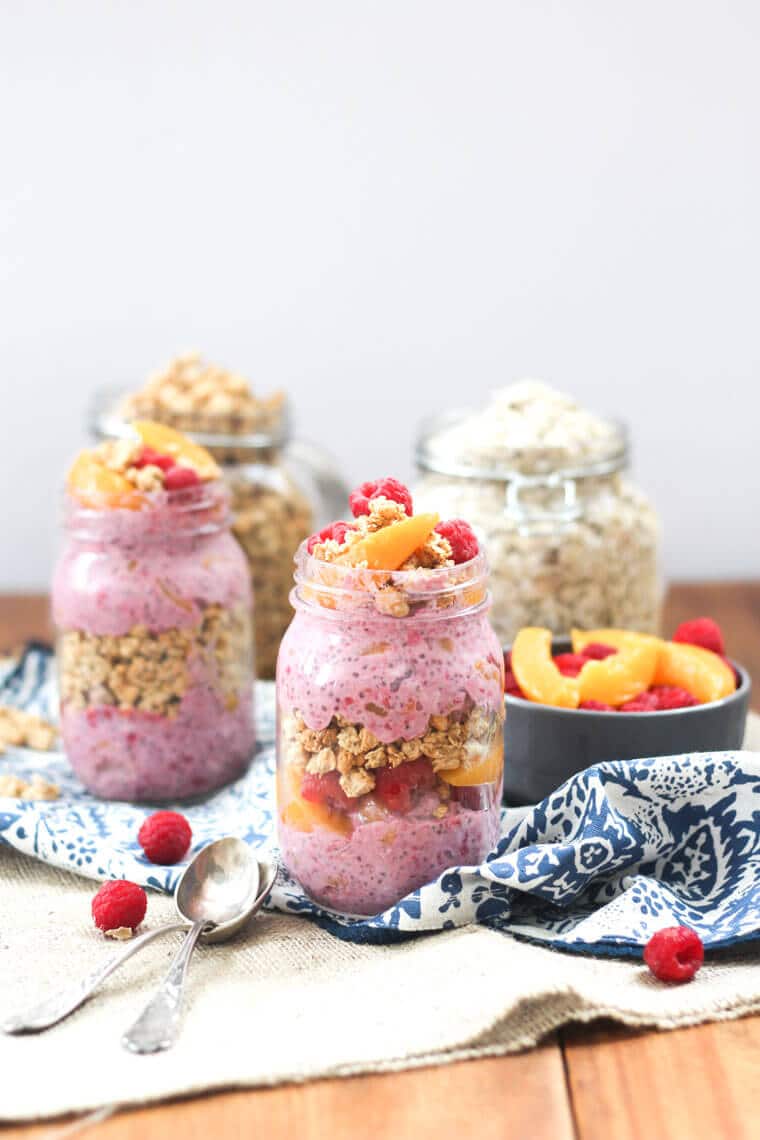
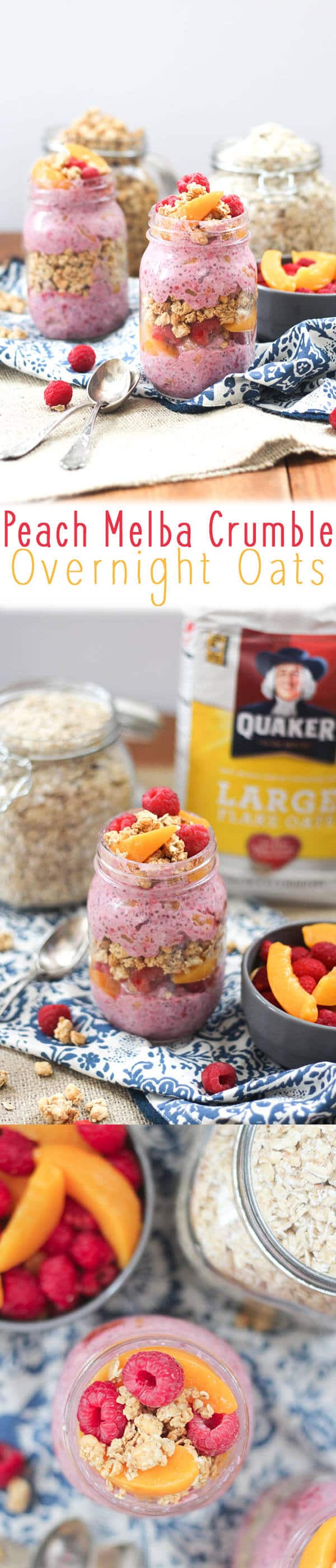
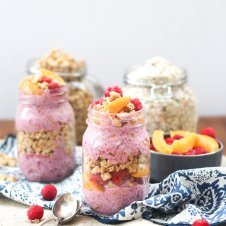
Two mason jars containing peach melba crumble overnight oats with a jar of oats and bowl of peaches in the background.

DISCLAIMER: This post was developed in sponsored partnership with Quaker Oats, however, as always, all opinions are genuine.

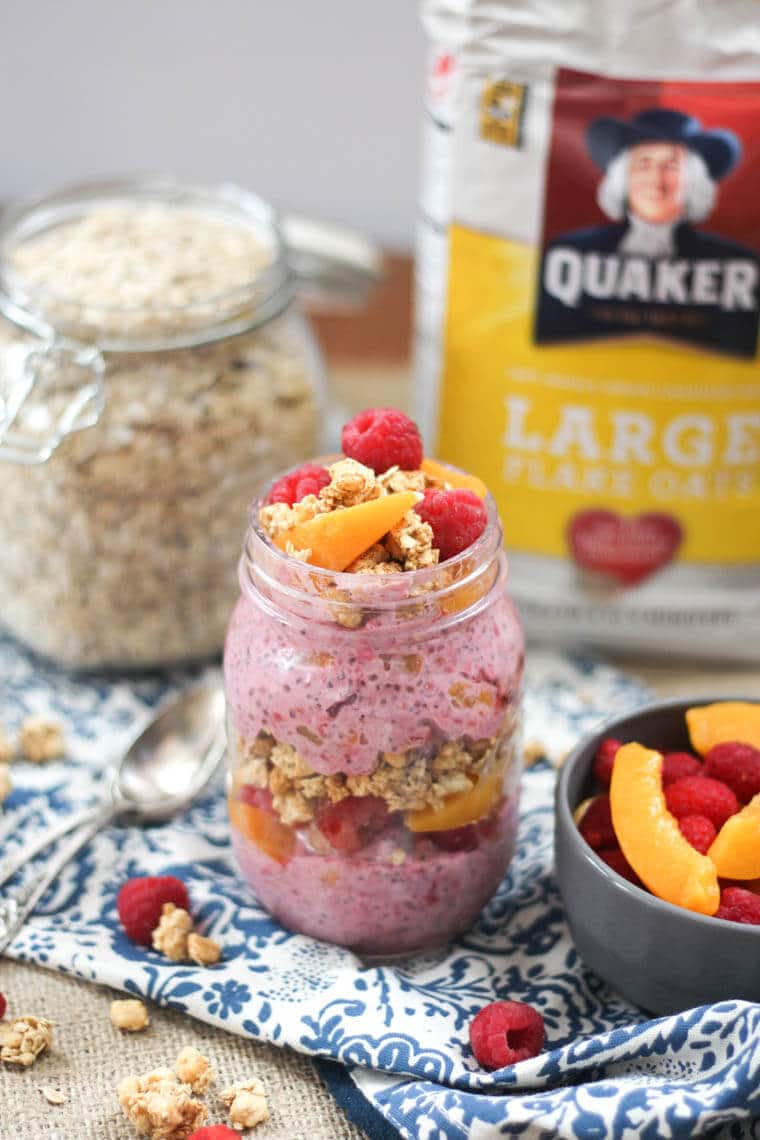
My favourite Peach Melba Crumble Overnight Oats recipe is one of my favourite wholesome, easy, on the go breakfast option for the morning!

 Two mason jars containing peach melba crumble overnight oats with a jar of oats and bowl of peaches in the background.

A lot of people think that working as an entrepreneur means that I have a lackadaisical schedule. As if I just get to sit around sipping fancy latte’s all morning scrolling through my colourful Instagram feed. Yeah… Not so much.

Being a TV expert and entrepreneur means I get up EARLY (like, sometimes 4 AM early) and rarely have time to sit down to a leisurely morning meal. I need to be super organized the night before or else I’m usually found running on caffeine until noon. That’s why overnight oats are my perfect morning solution and my Peach Melba Crumble Overnight Oats are my new BFFs.

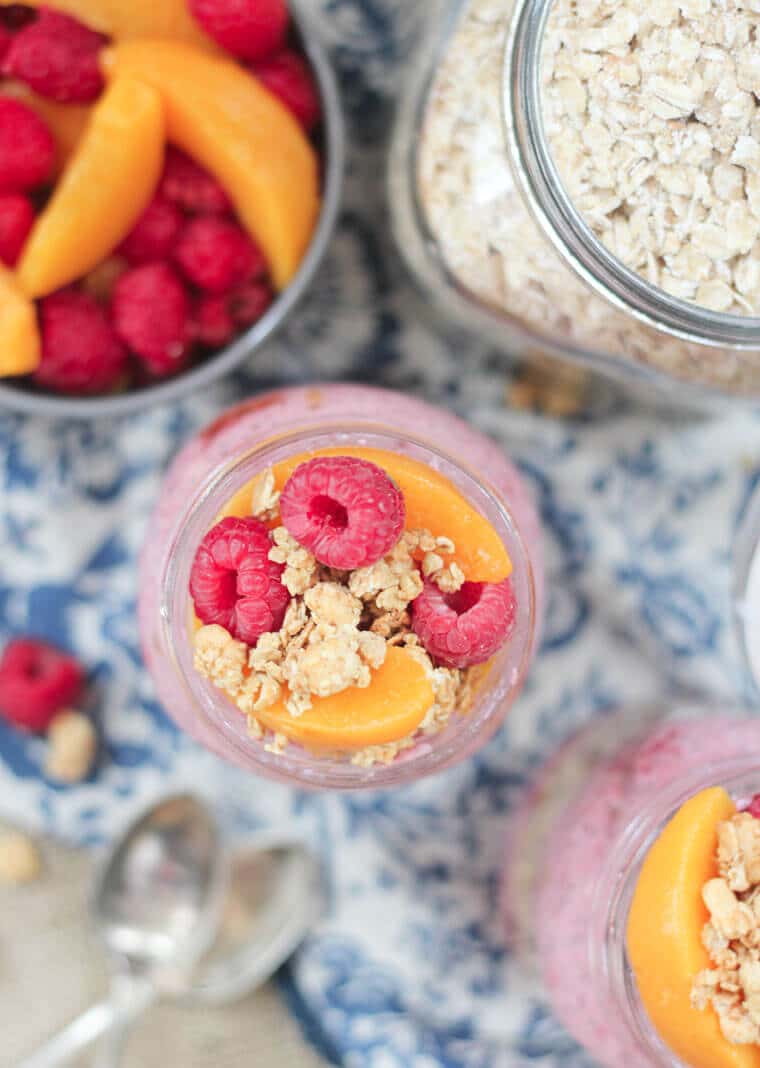
An overhead photo of a jar of overnight oats topped with raspberries and peaches.

Busy Friends… You Need Overnight Oats in Your Life


You know I’ve got a bunch of overnight oats recipes on my blog (like these babies), and honestly, it’s for good reason. Overnight oats are a portable, grab and go choice for hectic mornings that guarantee #OvernightSuccess. They’re also super customizable so it’s easy to add in whatever bits of fruit, nuts, seeds, or dried fruit I’ve got hanging out around the house to add lots of contrasting flavours and textures.

I always make my overnight oats with Quaker Rolled Oats which hold up nicely overnight, making them perfect for make ahead meals.

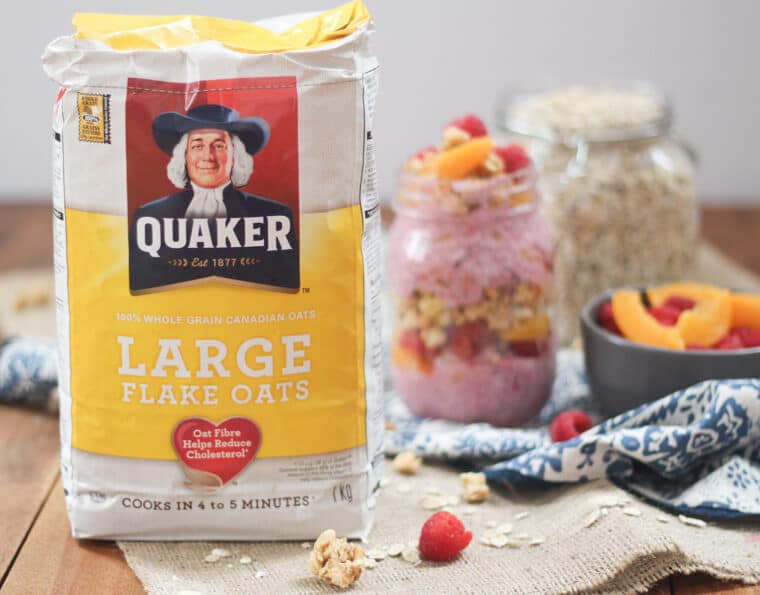
A bag of Quaker large flake oats with a jar of overnight oats in the background.

Why Peach Melba Crumble Overnight Oats?


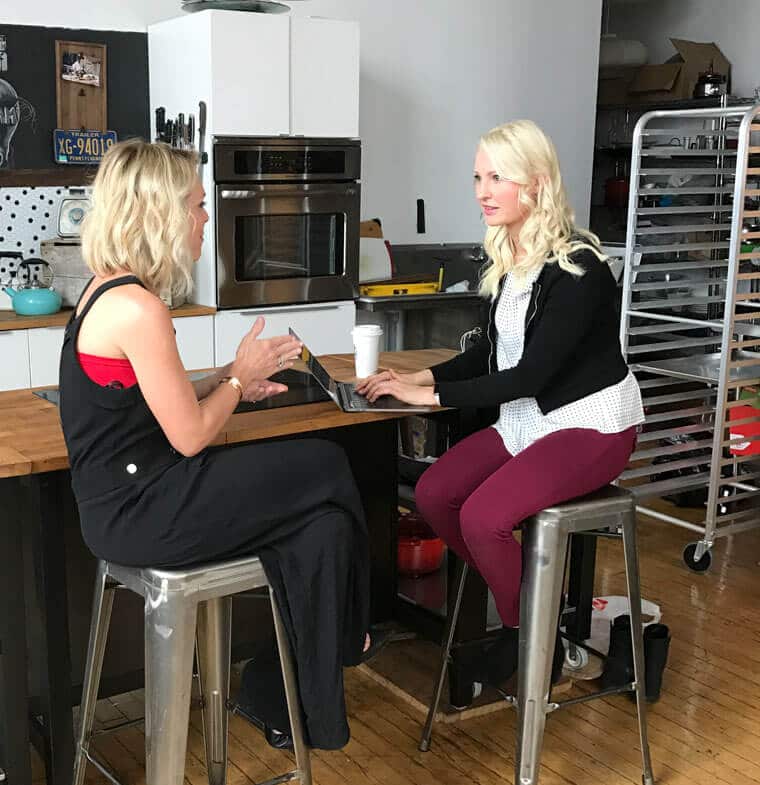
While Overnight Oats are super versatile, these Peach Melba Crumble Overnight Oats are currently my go-to combination. They were inspired by my chat with Kortney Wilson, the Canadian co-star of Masters of Flip on HGTV. With such a busy schedule flipping homes, making music, shooting her hit TV series with her hubby, and of course, being a mom, it’s no wonder Kortney is always looking for fast breakfast solutions.

Abbey Sharp sitting at a bar stool typing on a laptop interviewing a woman.

I caught up with this busy mom of three where she filled me in on how important versatile and quick morning meals like Overnight Oats is to her family. With three children, all with different palates and preferences, she likes to set out a variety of nourishing ingredients and let her kids choose their favourite toppings and add-ins. This gives the kids some autonomy and control over what they’re eating so they’re far more likely to actually eat it, but it still keeps her in control of the quality of the ingredients she uses (like Quaker oats, yogurt, nuts and fruit). The end result? Regardless of what the kids choose, they’ll be getting a wholesome meal that they actually want to eat.

A mason jars containing peach melba crumble overnight oats topped with peaches and raspberries.


As for those preferences, her oldest son is a big fan of berries and maple, her middle son loves raisins, and the youngest adores the combination of peaches and raspberries. Having lived in the South for quite some time, Kortney agreed that she adores a good Southern peach, especially with fresh raspberries. She also said she’s a huge fan of crisps, crumbles and other oat-topped pies, so my mind immediately went to these Peach Melba Crumble Overnight Oats. I think we were both pretty happy with the result.

Abbey Sharp standing in a kitchen with another woman holding two mason jars of overnight oats.

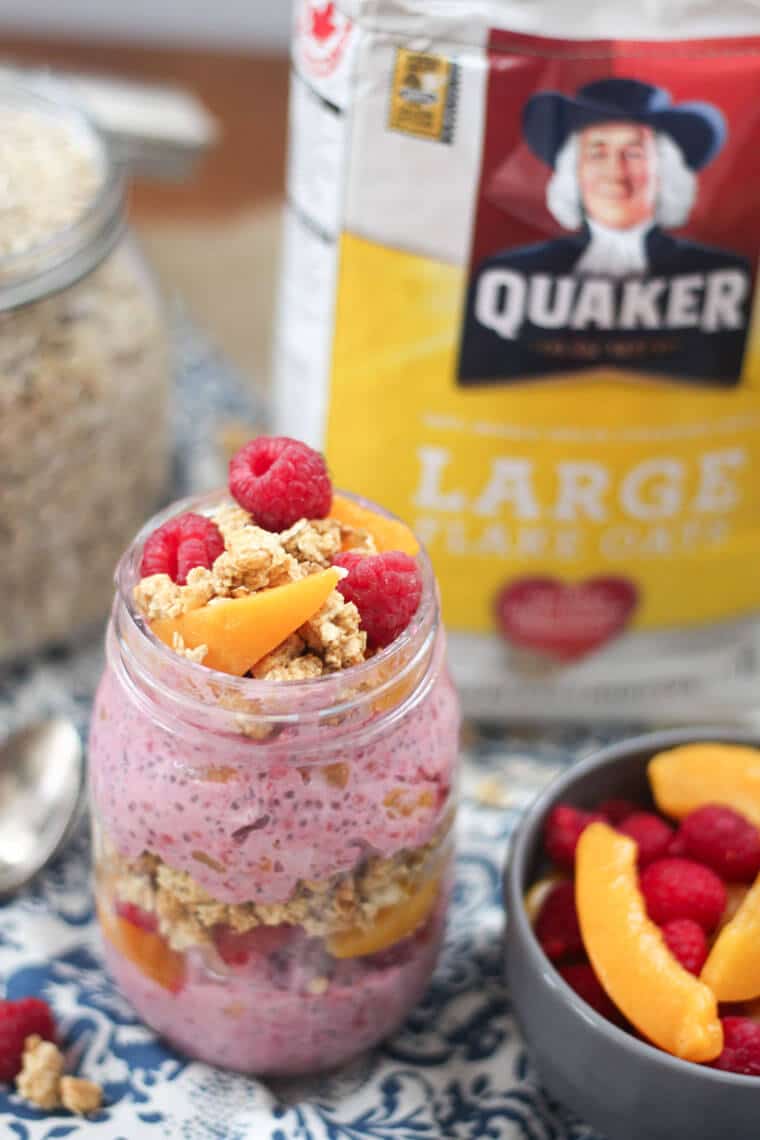
The sweet and tangy combination of bright raspberries and juicy peaches, with a creamy Quaker oat base and a crunchy Quaker granola topping, instantly became a favourite part of breakfast in my home too.

A mason jars containing peach melba crumble overnight oats with a bag of Quaker large flake oats in the background.

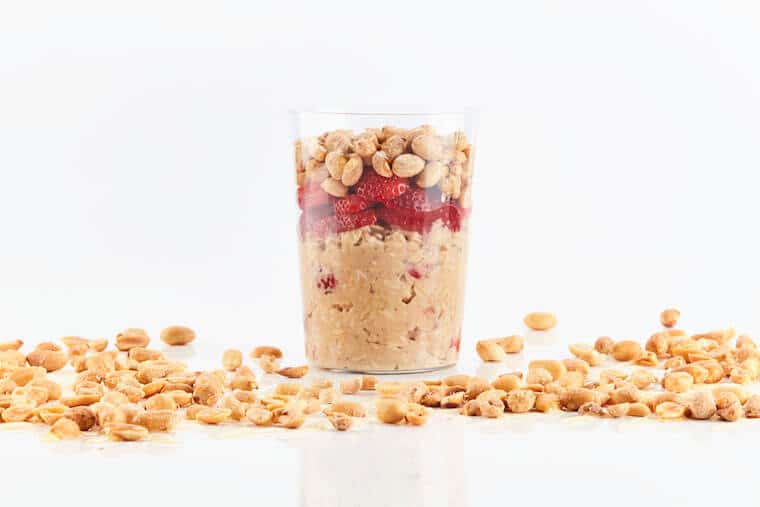
If you want to switch things up from my Peach Melba Crumble Overnight Oats and get some more Overnight Oats inspiration, head on over to OvernightOats.ca for a bunch of amazing Quaker recipes and tips for making overnight oats approachable. My favourites are the PB & Jam Overnight Oats, the Blueberry Honey Overnight Oats, and the Oatmeal Raisin and Date Overnight Oats.

A jar of peanut butter and jam overnight oats.

What are your favourite Overnight Oats flavours?

Have you tried my Peach Melba Crumble Overnight Oats?

Leave me a comment below with some of your family’s go-to flavour combinations!


A mason jars containing peach melba crumble overnight oats with a bag of Quaker large flake oats in the background.

Disclaimer: This post was developed in paid partnership with Quaker, however, all opinions are genuine.


Two mason jars containing peach melba crumble overnight oats with a jar of oats and bowl of peaches in the background.
Print Recipe
5 from 3 votes

Peach Melba Crumble Overnight Oats

My favourite Peach Melba Crumble Overnight Oats recipe is one of my favourite wholesome, easy, on the go breakfast option for the morning!
Prep Time5 minutes mins
Total Time5 minutes mins
Course: Breakfast
Cuisine: American
Servings: 1
Calories: 330kcal
Author: Abbey Sharp

Ingredients

Overnight Oats:

  • 1/3 cup plain cottage cheese
  • 1/3 cup Quaker® Oats
  • 1 tbsp chia seeds
  • 1/8 tsp cinnamon
  • Pinch sea salt
  • ½ tsp vanilla extract
  • 1/3 cup unsweetened vanilla almond milk
  • ½ cup raspberries , gently muddled
  • ½ cup peaches , finely diced
  • Honey , to taste

Garnish:

  • 6 raspberries
  • ¼ cup peaches , finely diced
  • ¼ cup Quaker Harvest Crunch Light & Crisp Honey Nut

Instructions

  • In a food processor, puree the cottage cheese until it reaches a very smooth creamy consistency.
  • Stir the overnight oats ingredients together in a mason jar and refrigerate overnight.
  • When you’re ready to eat, layer half of the overnight oats into a mason jar and add in a layer of raspberries, peaches and Quaker Harvest Crunch. Finish with another layer of oats, raspberries, peaches and Quaker Harvest Crunch.

Nutrition

Calories: 330kcal | Carbohydrates: 46g | Protein: 16g | Fat: 10g | Saturated Fat: 2g | Cholesterol: 12mg | Sodium: 368mg | Potassium: 529mg | Fiber: 13g | Sugar: 15g | Vitamin A: 475IU | Vitamin C: 26.5mg | Calcium: 263mg | Iron: 2.7mg


Abbey Sharp

Abbey Sharp is a Registered Dietitian (RD), regulated by the Ontario College of Dietitians. She is a mom, YouTuber, Blogger, award winning cookbook author, media coach specializing in food and nutrition influencers, and a frequent contributor to national publications like Healthline and on national broadcast TV shows.
www.abbeyskitchen.com/about-abbey/

Last Updated May 8, 2017. Published May 1, 2017 By Abbey Sharp 41 Comments

Gluten Free Chocolate Cherry Almond Muffins with Chocolate Glaze for Mother’s Day

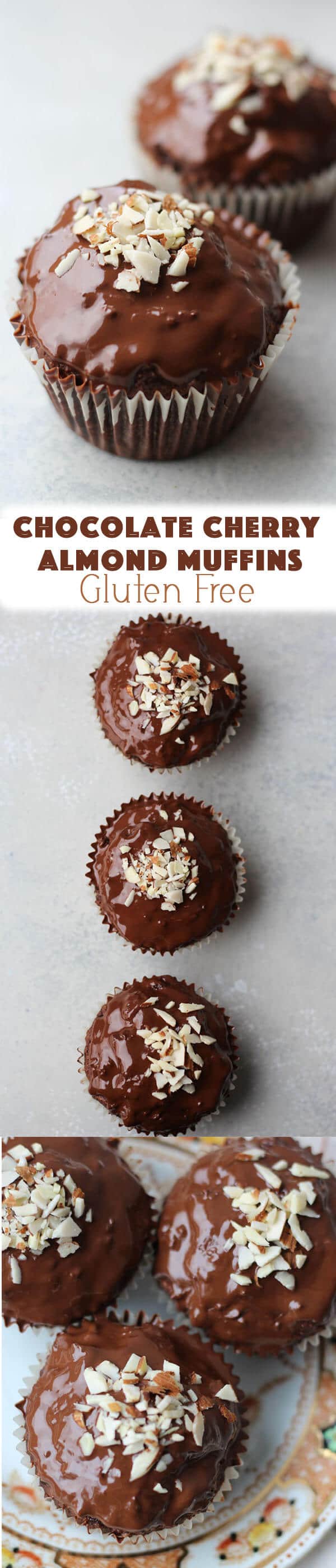
These Gluten Free Chocolate Cherry Almond Muffins with Chocolate Glaze are the perfect healthy treat for Mom on Mother’s Day!

These Gluten Free Chocolate Cherry Almond Muffins with Chocolate Glaze are the perfect healthy treat for Mom on Mother’s Day!

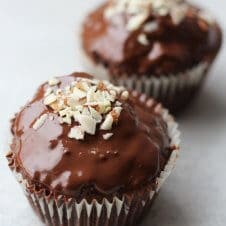
A close up of a chocolate cupcake.My mom was never a superstar cook, but still, some of my best memories are of mom and grandma baking with us as kids. Moms sweet specialties were: baked apples, rice pudding, apple crisp and lemon meringue pie (with store-bought crust and boxed filling, obviously) – all of which are now some of my favourite sweets. For some reason, we never had a lot of chocolate growing up, but now that I’m an adult and can make my own decisions, that’s definitely changed.

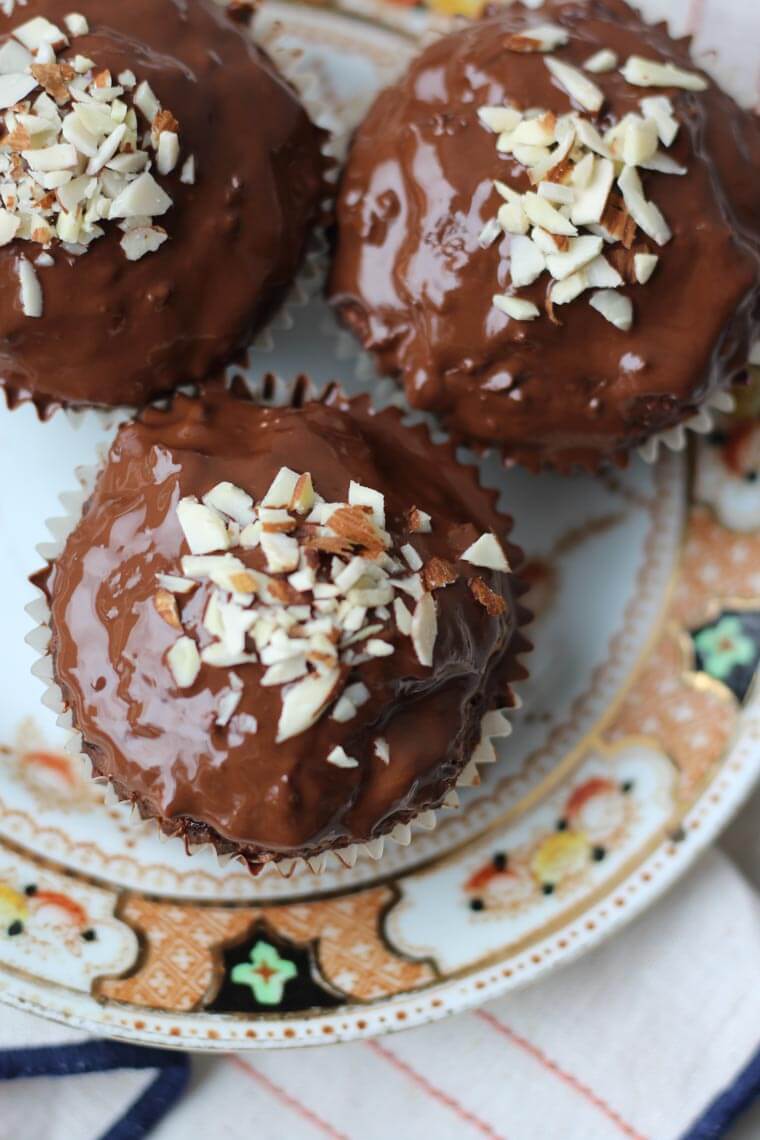
An overhead close up photo of chocolate cherry almond muffins with a chocolate glaze with almonds on top.

These Gluten Free Chocolate Cherry Almond Muffins with Chocolate Glaze are legit my favourite thing about celebrating Mother’s Day for all of the yummy mummy’s in my life! When you bake delicious treats for others, you often get to sneak a little sweetness yourself and I have NO shame about that.

How to Make These Gluten Free Chocolate Cherry Almond Muffins

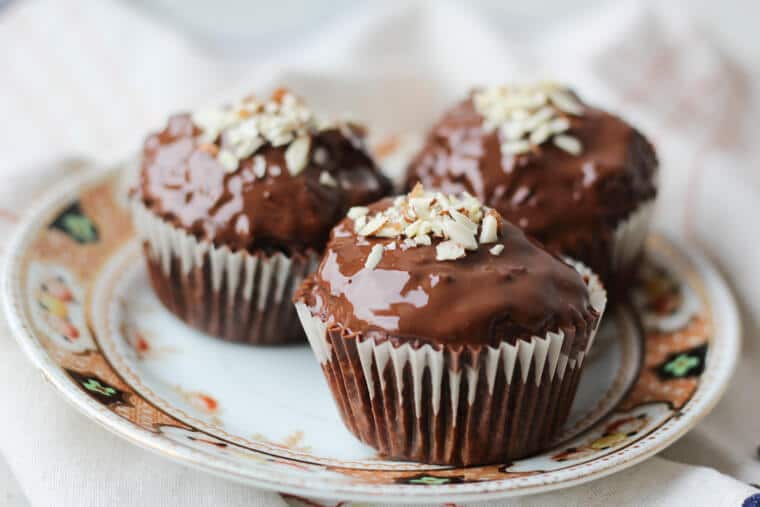
A plate of three chocolate cherry almond muffins with a chocolate glaze with almonds on top.

Okay, so these bad boys are kinda straddling the borderline between muffin and cupcake, but they’re surprisingly healthy and if you do without the glaze, they’re for SURE in muffin territory. I use a combination of almond flour (which is rich in fibre and protein), and oat flour, plus an extra hit of flax for a nutritious kick. They’re surprisingly low in added sugar since we have much sweetness coming in from the chewy dried cherries and the rich chocolately hit of dark chocolate chips.

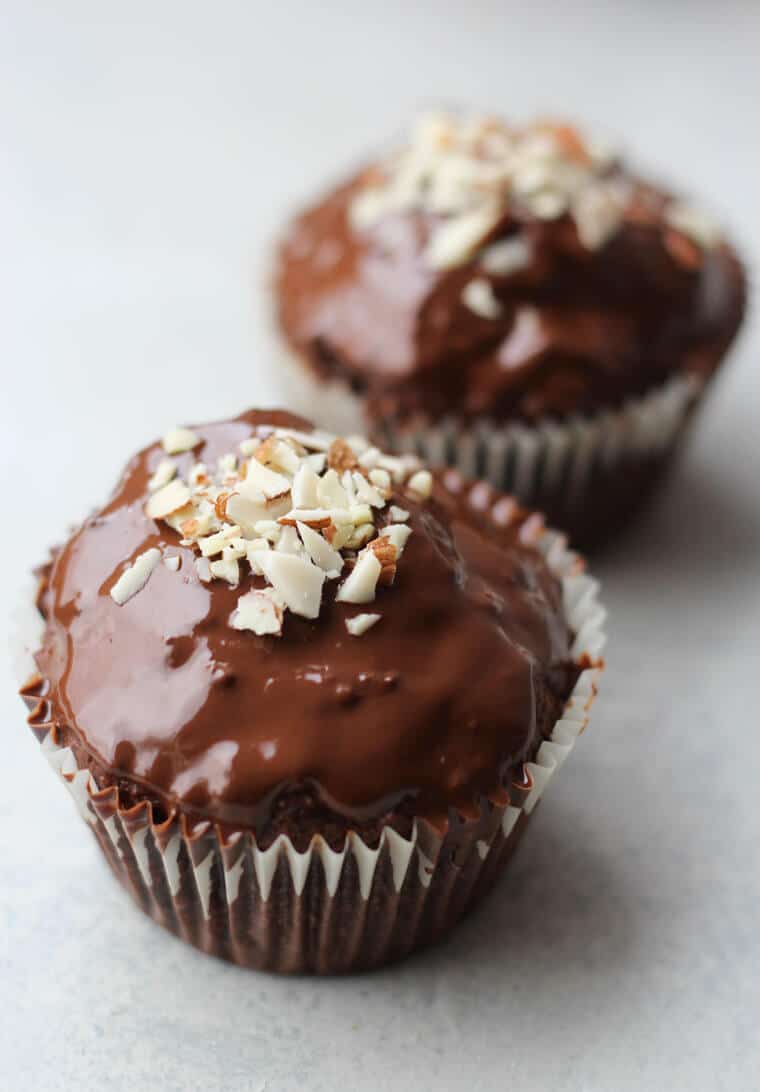
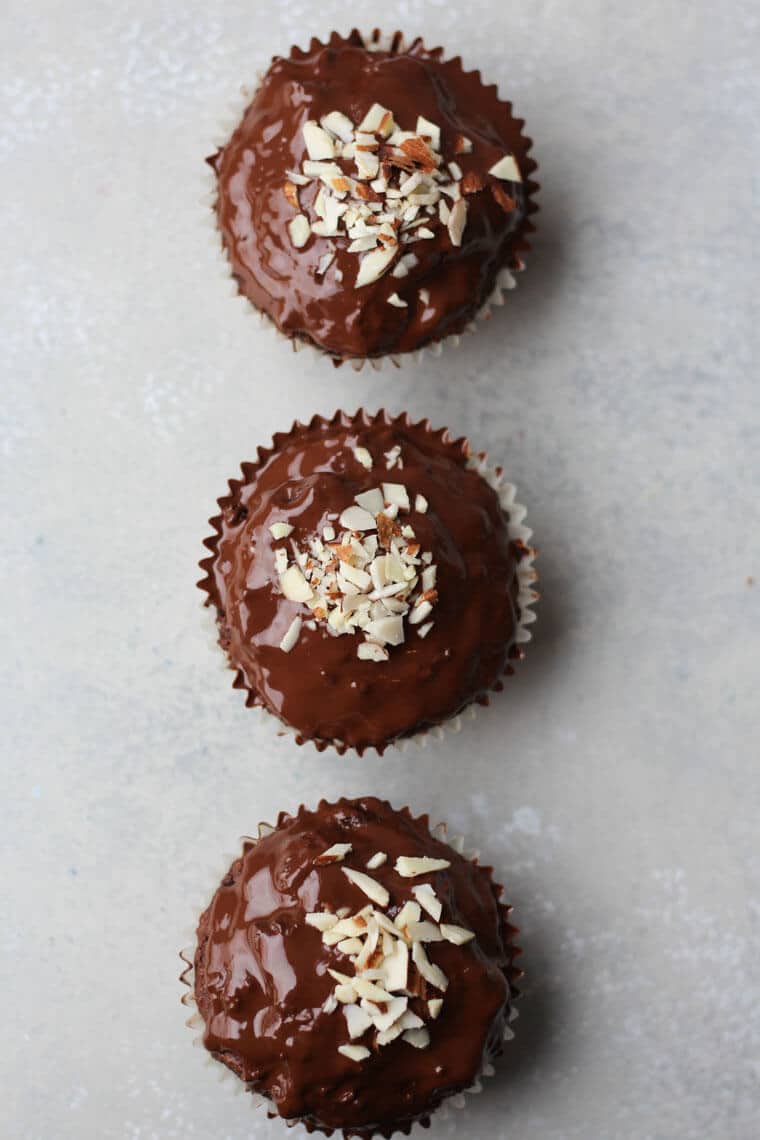
An overhead photo of a chocolate muffin with chocolate glaze with crushed almonds on top.

Let’s be real- I may have made these Gluten Free Chocolate Cherry Almond Muffins with Chocolate Glaze for mom on Mother’s Day, but recipe testing them was admittedly just an excuse to make myself a tasty treat mid-week. You know you do this too.

Now, I want to know:

What are you planning to make mumsy for Mother’s Day?

Have you tried my Gluten Free Chocolate Cherry Almond Muffins with Chocolate Glaze?

Did you and your mom bake together when you were growing up?

Share your food memories with me by leaving a comment below!

An overhead photo of two chocolate muffins with chocolate glaze with crushed almonds on top.

A close up of a chocolate cupcake.
Print Recipe
5 from 8 votes

Gluten Free Chocolate Cherry Almond Muffins with Chocolate Glaze

These Gluten Free Chocolate Cherry Almond Muffins with Chocolate Glaze are the perfect healthy treat for Mom on Mother’s Day!
Prep Time10 minutes mins
Cook Time25 minutes mins
Total Time35 minutes mins
Course: Dessert
Cuisine: American
Servings: 12 muffins
Calories: 357kcal
Author: Abbey Sharp

Ingredients

  • 3 eggs , beaten
  • 1 tbsp apple cider vinegar
  • 1 ½ cups ripe bananas (about 3), mashed
  • ¼ cup melted coconut oil
  • ¼ cup maple syrup
  • 2 tsp vanilla extract
  • 1 tsp almond extract
  • 1 1/2 cups almond flour
  • 2 tbsp ground flaxseed
  • 1 cup oat flour (gluten free, if needed)
  • 2 tbsp cocoa powder
  • 1 tsp cinnamon
  • 1 tsp baking soda
  • ½ tsp nutmeg
  • ½ tsp salt
  • ¾ cup dried cherries , chopped
  • 1/3 dark chocolate chips (dairy free, if needed)

Glaze:

  • ¾ cup dark chocolate chips (dairy free, if needed)
  • 3 tbsp coconut oil
  • 1/4 tsp almond extract
  • 1/3 cup sliced almonds , minced

Instructions

  • Preheat oven to 350 F and prepare 12 muffin tins with paper liners.
  • In a medium bowl, mix together the eggs, vinegar, bananas, oil, maple, vanilla, and almond extract.
  • In another bowl, mix together the almond flour, flax, oat flour, cocoa powder, cinnamon, baking soda, nutmeg, and salt.
  • Mix the wet into the dry, then fold in the dried cherries and chocolate chips. Transfer to the lined muffin tins and bake for 20-23 minutes or until a toothpick inserted into the centre comes out clean.
  • Meanwhile, in a double boiler, melt the chocolate chips and coconut oil until smooth. Stir in the almond extract.
  • Once the cupcakes have cooled to room temperature, pour the chocolate glaze on top. Sprinkle with almonds and enjoy.

Nutrition

Calories: 357kcal | Carbohydrates: 32g | Protein: 9g | Fat: 23g | Saturated Fat: 11g | Cholesterol: 41mg | Sodium: 235mg | Potassium: 253mg | Fiber: 5g | Sugar: 15g | Vitamin A: 340IU | Vitamin C: 1.7mg | Calcium: 105mg | Iron: 1.8mg


Abbey Sharp

Abbey Sharp is a Registered Dietitian (RD), regulated by the Ontario College of Dietitians. She is a mom, YouTuber, Blogger, award winning cookbook author, media coach specializing in food and nutrition influencers, and a frequent contributor to national publications like Healthline and on national broadcast TV shows.
www.abbeyskitchen.com/about-abbey/

Last Updated May 8, 2017. Published April 26, 2017 By Abbey Sharp 24 Comments

Berry Buckwheat Crepes with Avocado Chocolate Mousse | Vegan Gluten Free Mother’s Day Brunch

This Berry Buckwheat Crepes with Avocado Chocolate Mousse is a perfect Vegan Gluten Free Mother’s Day dessert or brunch idea that mom is going to love!

This Berry Buckwheat Crepes with Avocado Chocolate Mousse is a perfect Vegan Gluten Free Mother’s Day dessert or brunch idea that mom is going to love!

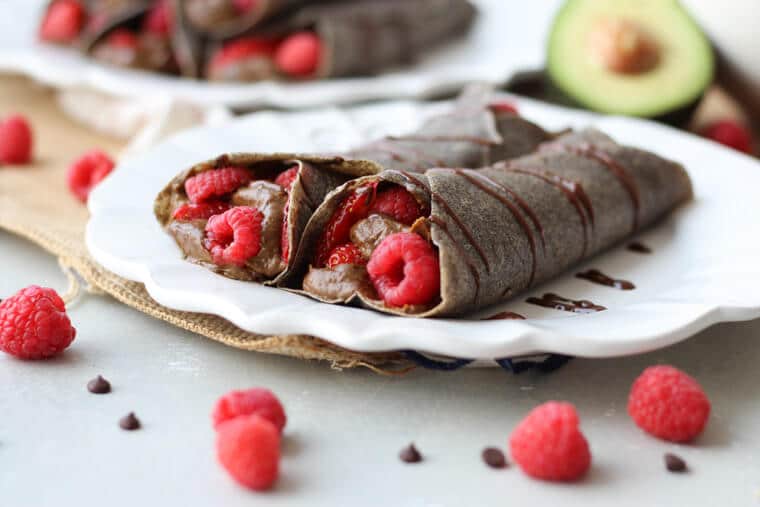
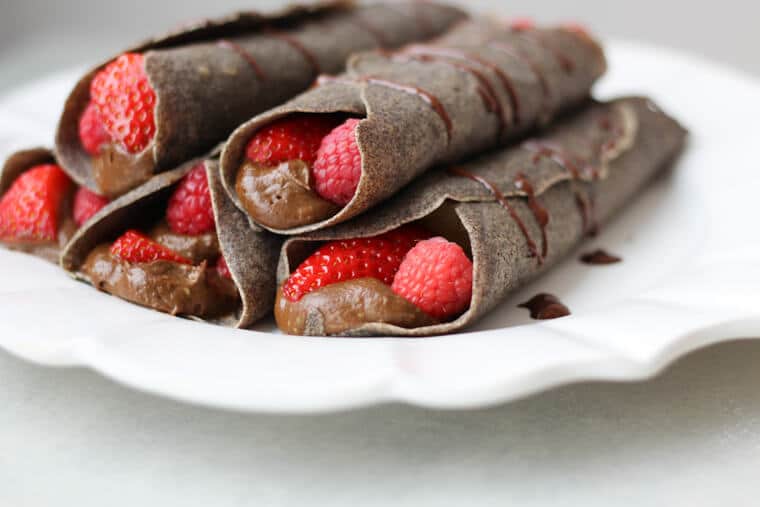
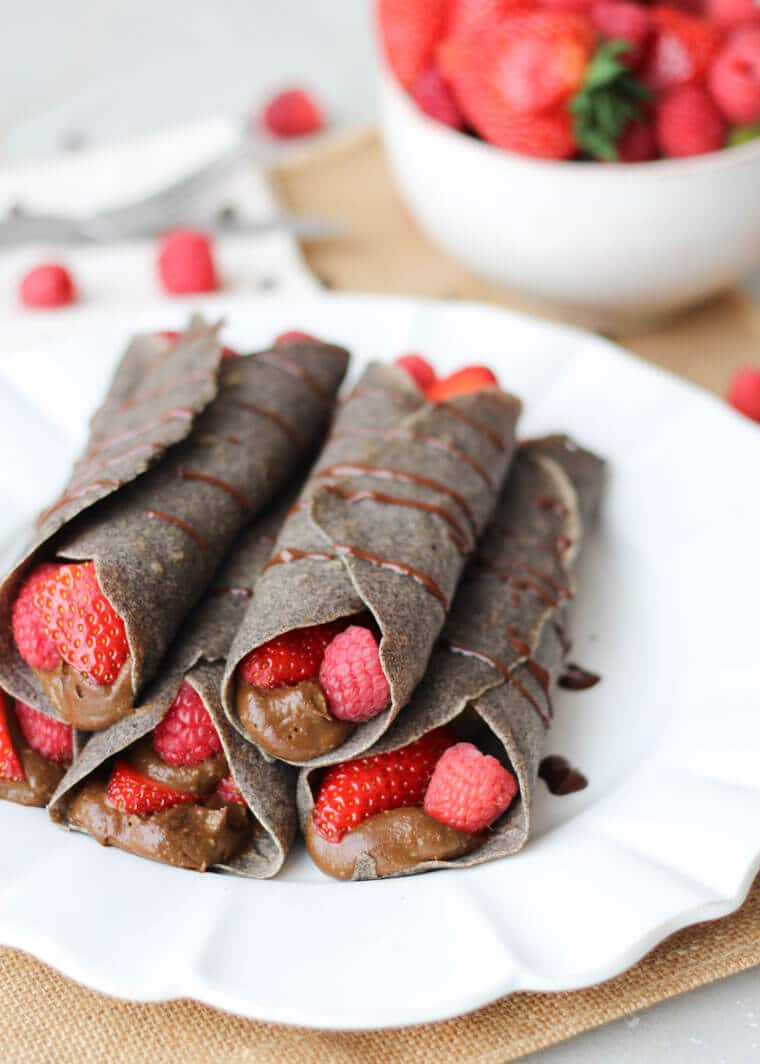
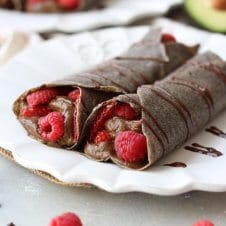
 A white plate with two chocolate buckwheat crepes with raspberries inside and scattered around.

Let’s be real- every day should be mother’s day. I have nothing but total love for all the hard working, under recognized mommas out there right now. So while these Vegan & Gluten Free Berry Buckwheat Crepes with Avocado Chocolate Mousse would be delicious (and tots appropriate) any time of year, they’re specifically amazing for celebrating Mother’s Day.

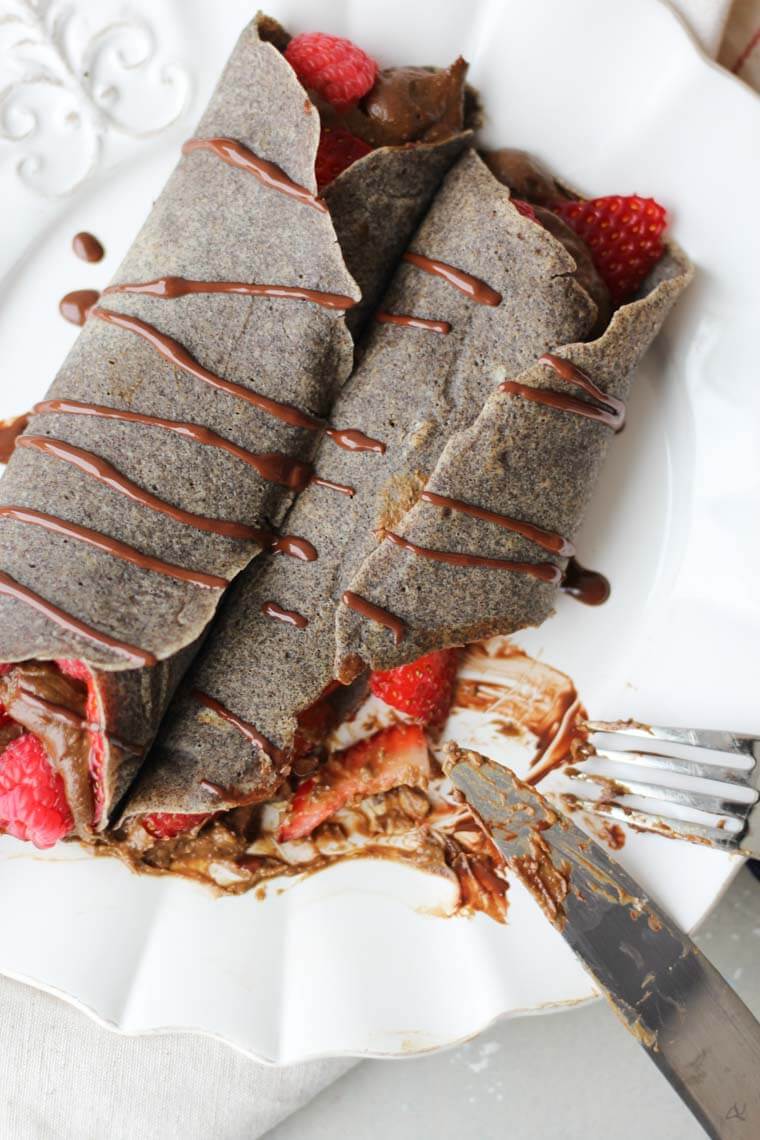
A chocolate buckwheat crepe being cut with a knife and fork.

How to make Berry Buckwheat Crepes with Avocado Chocolate Mousse

So these Berry Buckwheat Crepes with Avocado Chocolate Mousse starts with naturally gluten free buckwheat flour. Buckwheat is a naturally gluten free grain rich in antioxidants and fibre with a delicious nutty flavour.  Word to the wise- seek out LIGHT buckwheat flour which differs from DARK buckwheat flour in that it isn’t a total pain in the ass to work with. While dark buckwheat flour is higher in fibre, it’s definitely a pain. The extra fibre can test your patience with flipping and cooking so I definitely urge you to take the stress out of Mother’s Day and look for the light variety.

A white plate of a stack of chocolate buckwheat crepes with raspberries.

The Avocado Chocolate mousse is super simple, and starts with super ripe, rich avocados, mixed with luscious dark chocolate. It’s honestly so delicious all on its own, but takes these elegant crepes to the next level. Stuffed to the brim with ripe berries, these Berry Buckwheat Crepes are a perfect way to show mom you care (and also eat something you also love).

A white plate with a stack of multiple chocolate buckwheat crepes with raspberries.

If you’re looking for more tasty Mother’s Day ideas, check out these amazing pancakes here!

Become an Abbey’s Kitchen Subscriber

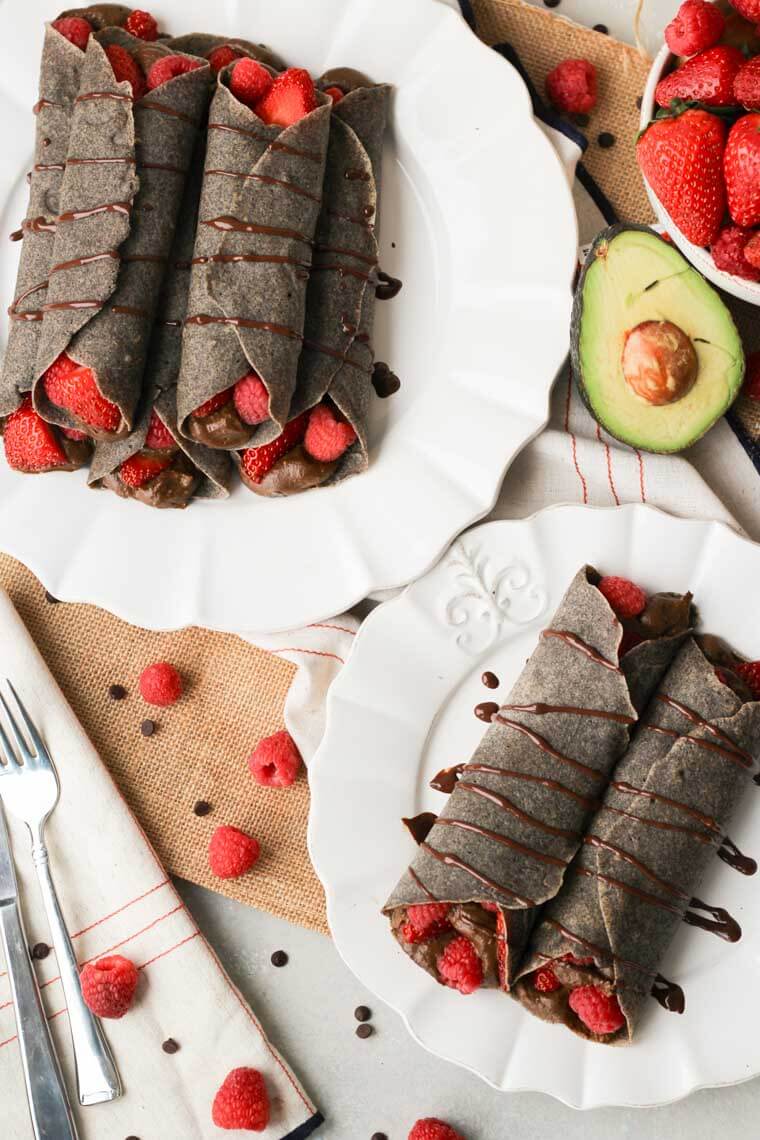
An overhead photo of two white plates with multiple crepes made with buckwheat and chocolate on each.

What do you plan to make your mom for Mother’s Day brunch?

Have you tried these Berry Buckwheat Crepes with Avocado Chocolate Mousse?

Leave me a comment below with your thoughts!

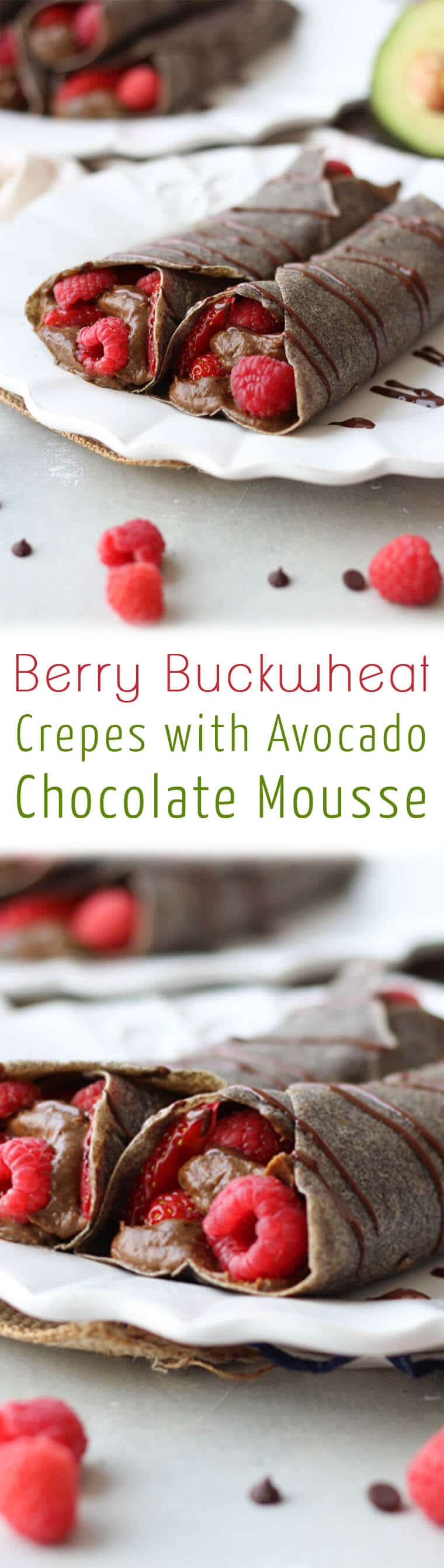
A pinterest image of buckwheat crepes with the overlay text \"Berry Buckwheat Crepes with Avocado Chocolate Mousse.\"


This Berry Buckwheat Crepes with Avocado Chocolate Mousse is a perfect Vegan Gluten Free Mother’s Day dessert or brunch idea that mom is going to love!
Print Recipe
5 from 2 votes

Berry Buckwheat Crepes with Avocado Chocolate Mousse

This Berry Buckwheat Crepes with Avocado Chocolate Mousse is a perfect Vegan Gluten Free Mother’s Day dessert or brunch idea that mom is going to love!
Prep Time1 hour hr 10 minutes mins
Cook Time20 minutes mins
Total Time30 minutes mins
Course: Dessert
Cuisine: French
Servings: 8 people
Calories: 470kcal
Author: Abbey Sharp

Ingredients

Crepes:

  • 1 cup unsweetened vanilla almond milk
  • ¼ cup filtered water
  • 1 cup light buckwheat flour
  • 2 tablespoon pure maple syrup
  • 2 flax eggs*
  • ½ teaspoon table salt
  • 3 tablespoon melted coconut oil plus more for cooking
  • 1 teaspoon pure vanilla extract

Avocado Mousse:

  • Flesh of 4 ripe avocados
  • 1 cup dark chocolate chips (dairy free, if desired), melted
  • 2 tsp vanilla extract
  • ¼ tsp sea salt
  • ¼ cup maple syrup or to taste

Garnish/Filling:

  • 2 cups raspberries
  • 2 cups strawberries sliced
  • 1/4 cup dark chocolate chips (dairy free, if desired), melted
  • Maple syrup if desired

Instructions

Crepes:

  • In a food processor or blender, puree the milk, water, buckwheat, maple, eggs, salt, butter and vanilla until smooth. Refrigerate covered for at least one hour or up to overnight.
  • Heat an 8-inch nonstick skillet over medium heat and brush the pan lightly with melted coconut oil. Pour a scant ¼ cup of the batter into the pan and swirl to form an even layer that coats the whole bottom of the pan. Cook until the bottom looks dry, lightly golden and easily lifts from the pan- about 1 to 2 minutes. Using a flipper, very carefully lift up the crepe and flip it over to cook on the other side- about another minute or so until it easily lifts off of the pan. Carefully slide the crepe off of the pan onto a plate and continue with the remaining batter.

Avocado Mousse:

  • In a food processor or blender, puree the avocados until smooth, then add in the melted dark chocolate, vanilla, salt and maple syrup. Puree until smooth and whipped. Transfer to a piping bag.

Assembly:

  • To assemble, pipe a strip of mousse down the centre of each crepe. Add in a bunch of berries and roll up. Serve with a drizzle of dark chocolate and maple syrup, if desired.

Notes

*Note: To make one flax egg, combine 1 tablespoon ground flaxseed with 2 1/2 tablespoons water and refrigerate for 30 minutes.

Nutrition

Calories: 470kcal


Abbey Sharp

Abbey Sharp is a Registered Dietitian (RD), regulated by the Ontario College of Dietitians. She is a mom, YouTuber, Blogger, award winning cookbook author, media coach specializing in food and nutrition influencers, and a frequent contributor to national publications like Healthline and on national broadcast TV shows.
www.abbeyskitchen.com/about-abbey/

Last Updated June 22, 2020. Published April 25, 2017 By Abbey Sharp 49 Comments

Strawberry Cheesecake Protein Pancakes | Gluten Free & Low Fat!

These decadent strawberry cheesecake stuffed layered protein pancakes are totally gluten free, low in fat and packed with high quality fermented dairy protein.

DISCLAIMER: This post was developed in sponsored partnership with Genuine Health, however, as always, all opinions are genuine.

These decadent strawberry cheesecake stuffed layered protein pancakes are totally gluten free, low in fat and packed with high quality fermented dairy protein.

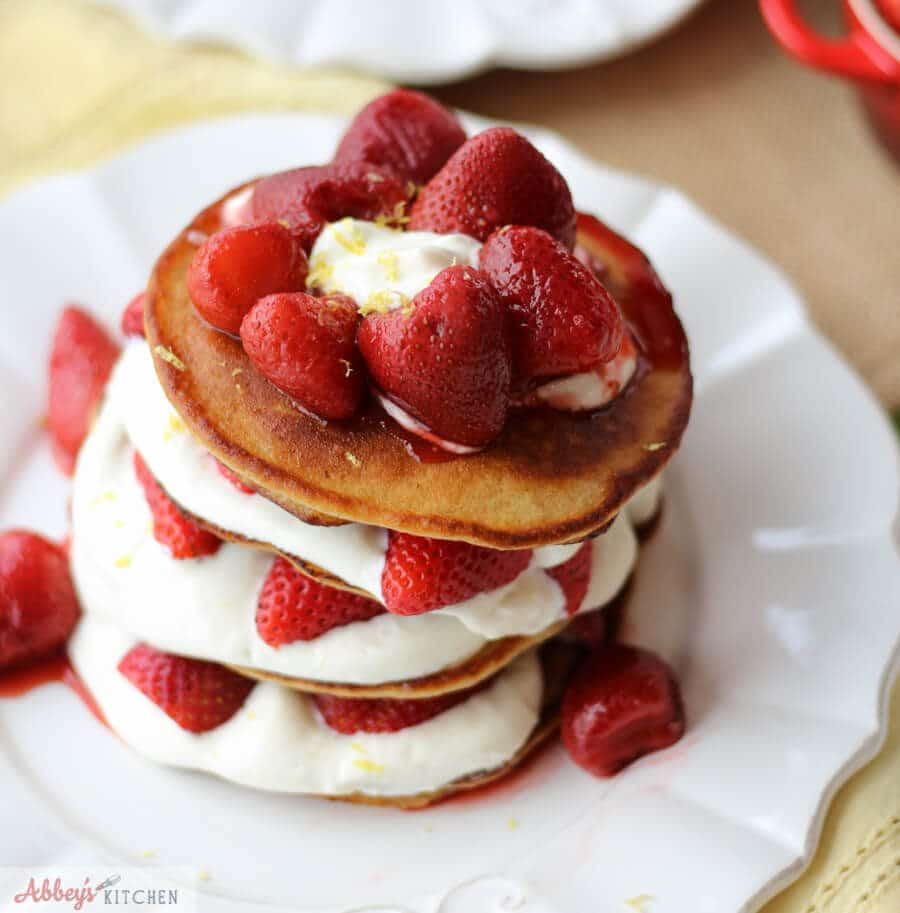
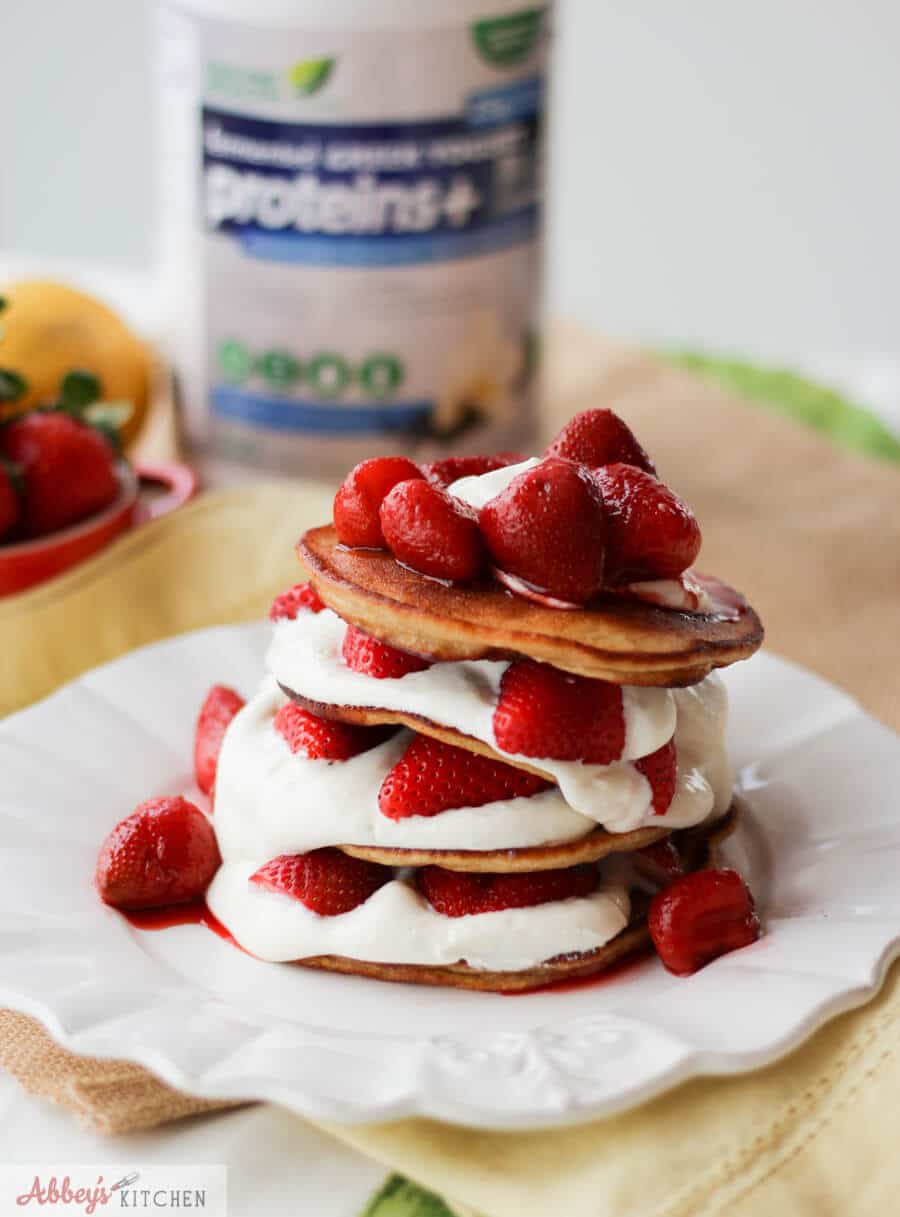
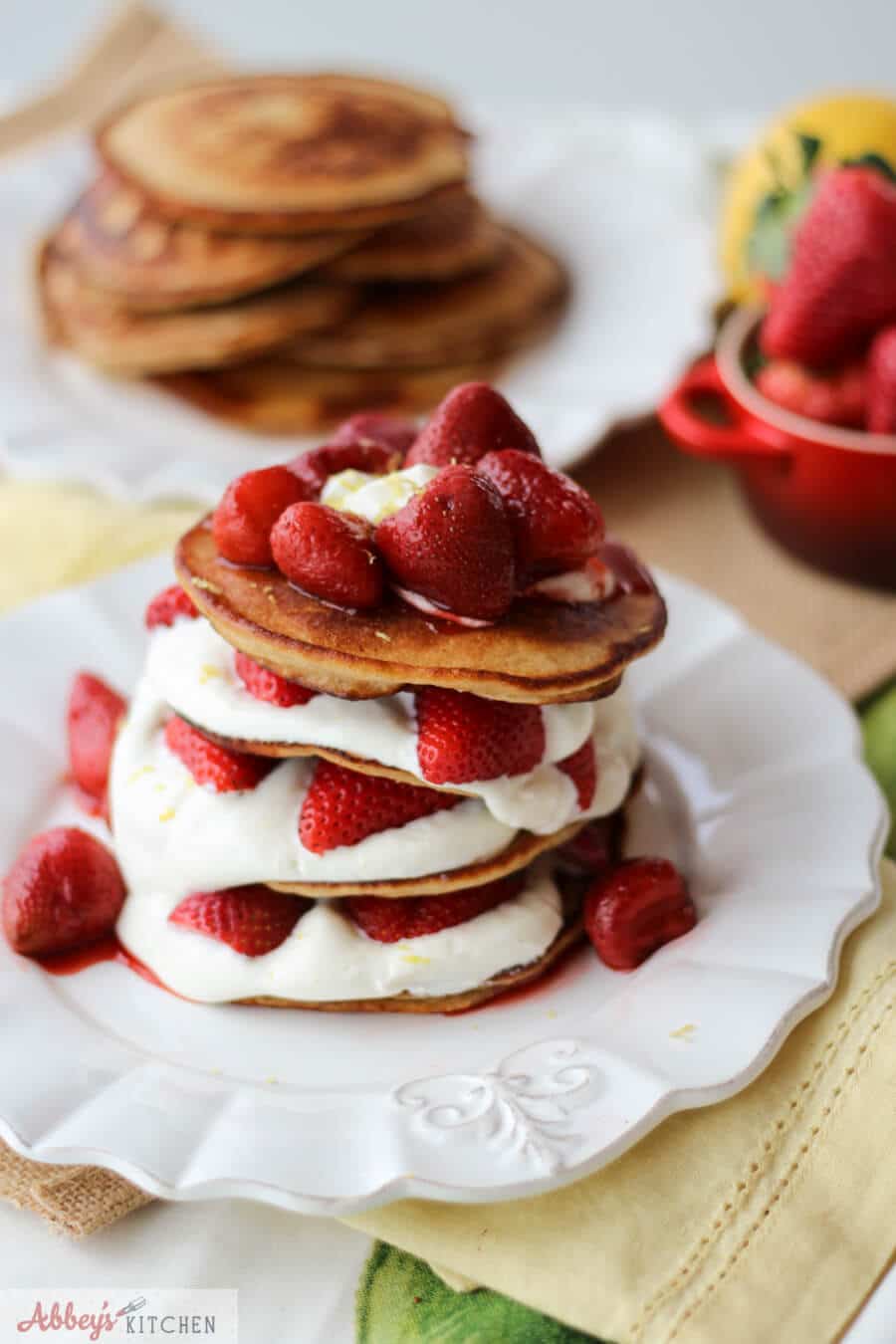
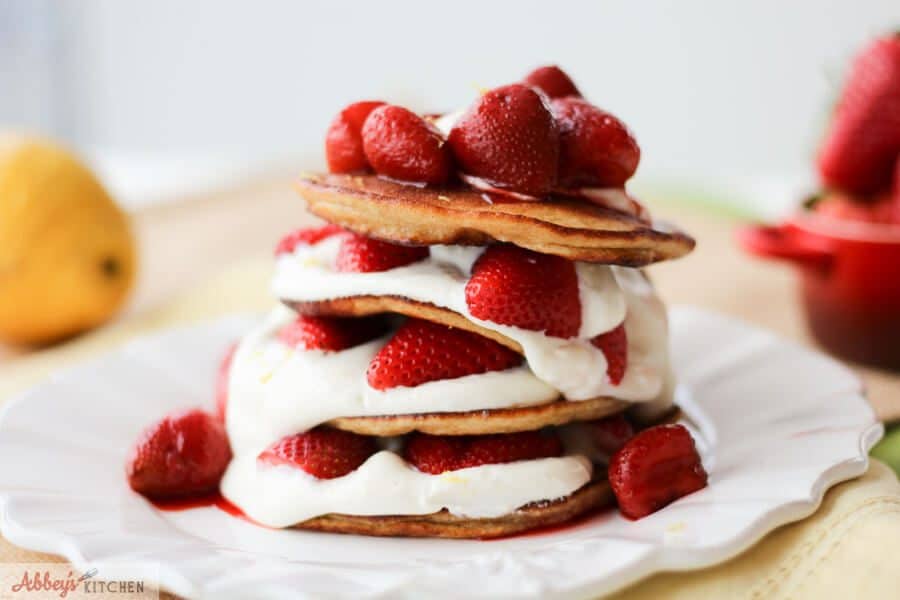
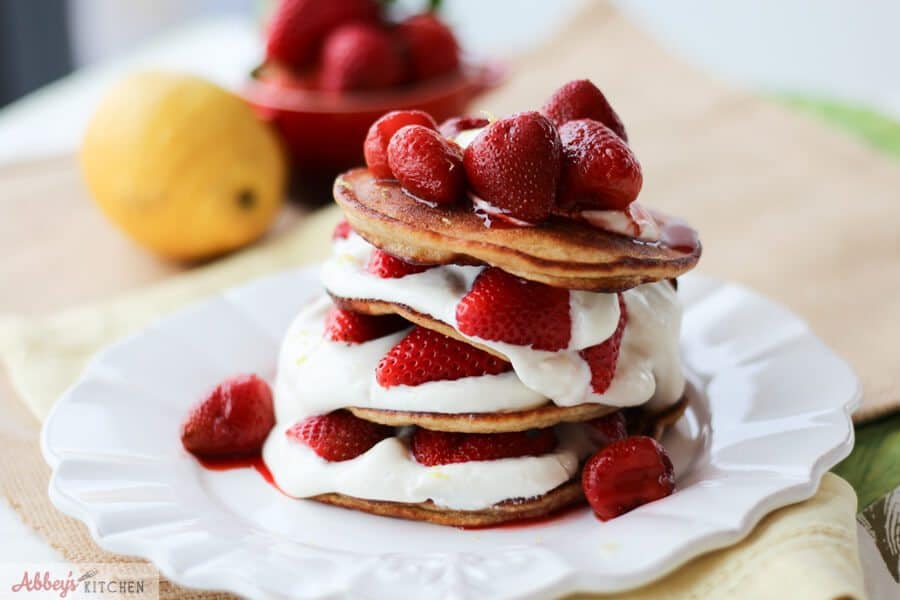
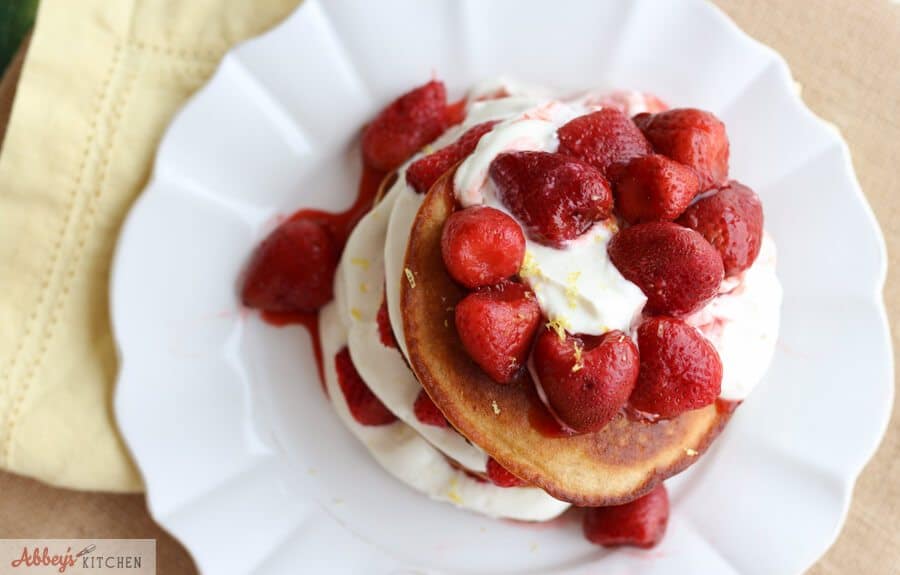
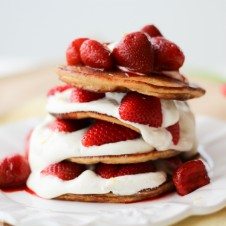
An overhead photo of a stack of strawberry cheesecake protein pancakes with berries on top.I’m a sweet brunch kinda girl. If you take me for brunch, my eyes will simply be drawn to the pancakes, waffles, crepes, donuts and parfaits. I eat eggs every day for protein at home so brunch is like an excuse to have dessert at 10 AM.

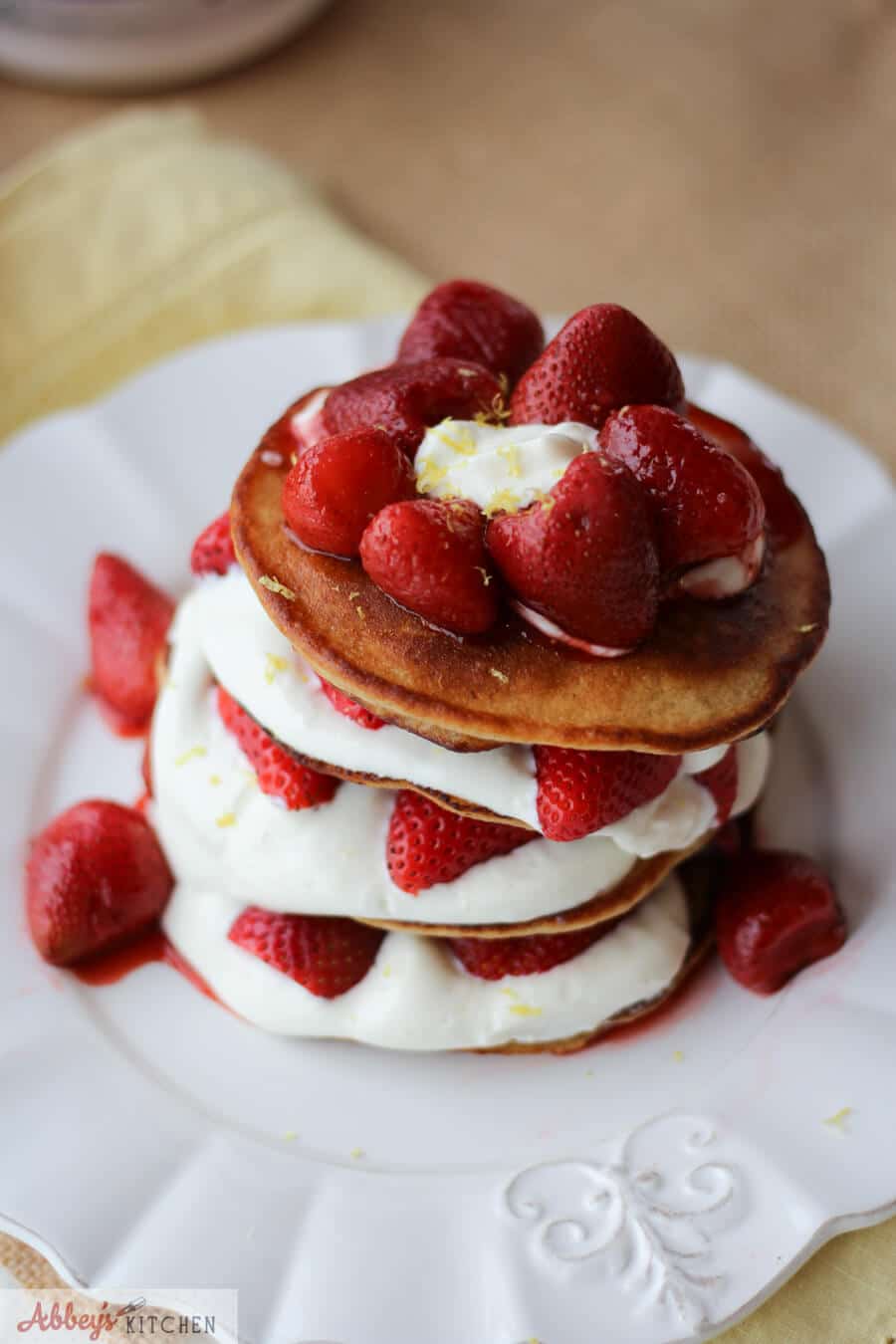
An overhead photo of a stack of cheesecake protein pancakes with strawberries on top.But since I started training hard to get summer ready, I have been on the protein kick. That was the inspiration for these amazing gluten free protein pancakes.

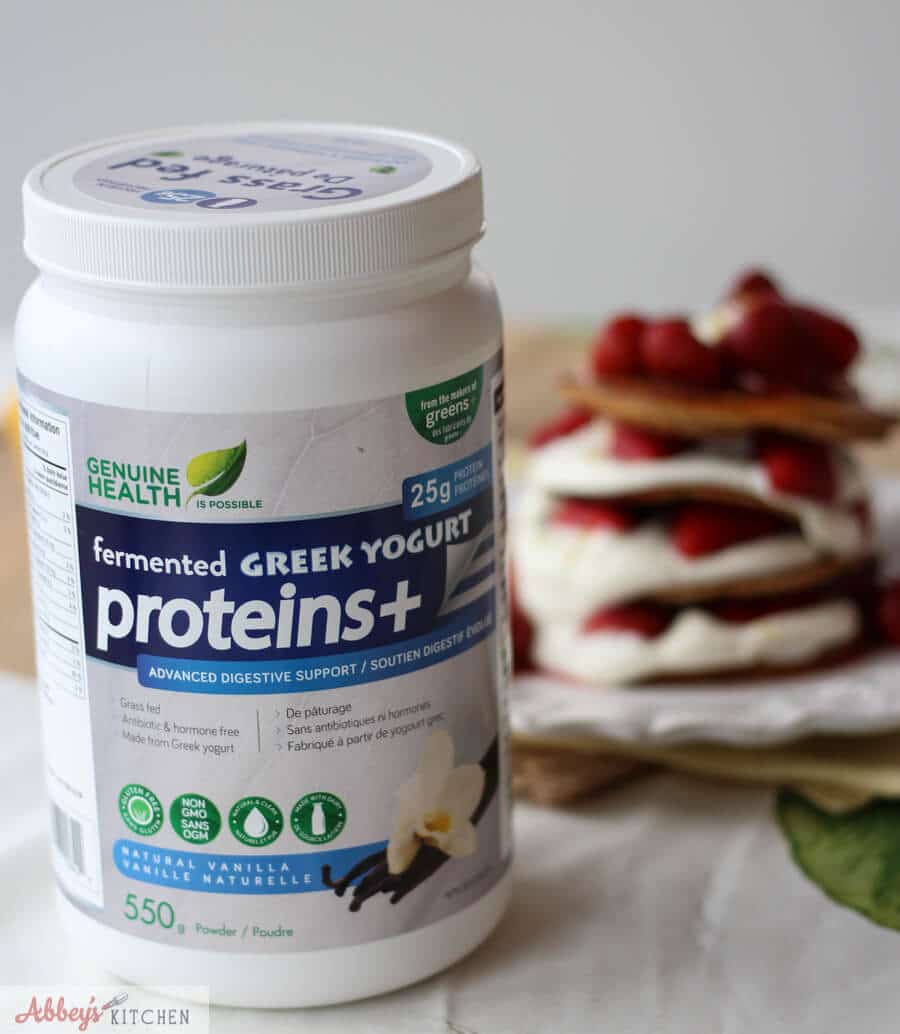
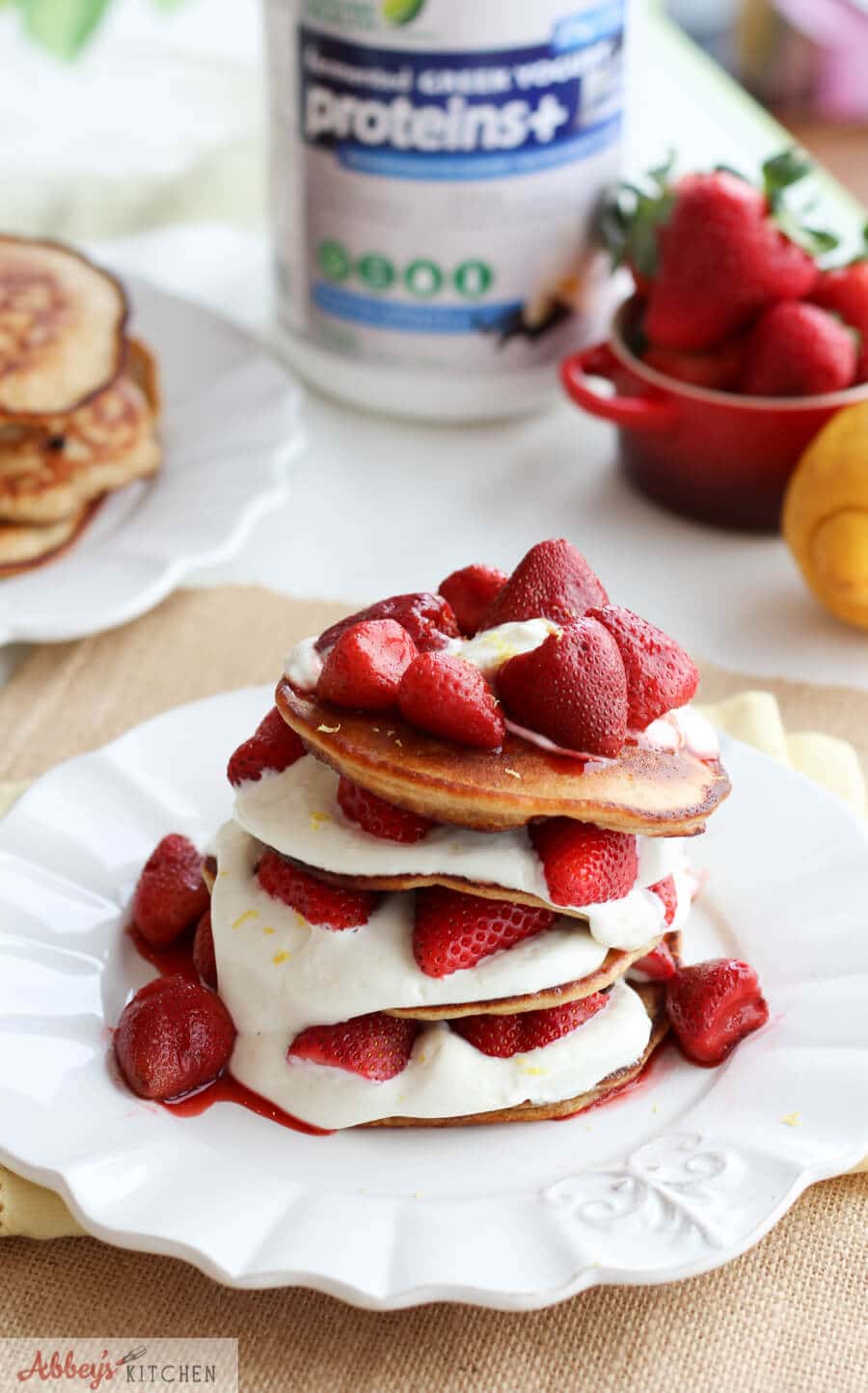
A photo of a stack of strawberry cheesecake protein pancakes with berries on top with a bottle of protein powder in the back.What started as pure desperation to find new non-savoury sources of protein became an obsession with making protein pancakes. The key, of course, is to start with a good quality protein, and it’s generally well accepted that dairy protein (like whey) is king. Animal-based protein like whey is better absorbed than vegan sources, but they are sometimes not well tolerated by some.

A stack of cheesecake pancakes with strawberries on top on a white plate.So when I heard that Genuine Health was launching a fermented Greek yogurt proteins+ protein powder, I suddenly had a whole new reason to whip up these protein pancakes. I’ve written about fermented foods and their gut-protective benefits here before, put simply, the probiotics that are formed from the fermentation process can essentially counteract the digestion issues some people experience with whey.

A stack of cheesecake pancakes with strawberries on top on a white plate.Genuine Health’s protein powder is also free of gluten, wheat, artificial colours, or sweeteners, is non-GMO, and packs a whopping 25 grams of protein per 130 calories.

A bottle of Genuine Health protein powder.

Protein Pancakes Meet Dessert


A stack of cheesecake pancakes with strawberries on top and around the pancakes on a white plate.

When I was deciding what flavours I wanted to come up with in my protein pancakes, my mind automatically went to cheesecake. I’m kind of a cheesecake fiend. I recently made another amazing cheesecake inspired breakfast, so if you’re also a fan, you’ve got to check that out too.


A stack of cheesecake pancakes with strawberries on top on a white plate.

What are your favourite healthy yet decadent breakfasts? Have you ever tried making protein pancakes? Leave me a comment below with some of your go-tos!

A stack of cheesecake pancakes with strawberries on top on a white plate with a bottle of protein powder in the back.These decadent strawberry cheesecake-stuffed layered protein pancakes are totally gluten free, low in fat and packed with high-quality whey protein.

A pinterest photo of stacks of pancakes with the overlay text \"Strawberry Cheesecake Protein Pancakes Gluten Free & Low Fat.\"

A stack of cheesecake pancakes with strawberries on top on a white plate.
Print Recipe
4.88 from 8 votes

Strawberry Cheesecake Protein Pancakes | Gluten Free & Low Fat!

These decadent strawberry cheesecake stuffed layered protein pancakes are totally gluten free, low in fat and packed with high quality fermented dairy protein.
Prep Time10 minutes mins
Cook Time10 minutes mins
Total Time20 minutes mins
Course: Breakfast
Cuisine: Amercian
Servings: 4 people
Calories: 360kcal
Author: Abbey Sharp

Ingredients

Pancakes:

  • 1 1/4 cup gluten free oats
  • 1 tsp cinnamon
  • 1/4 cup Vanilla Genuine Health Fermented Greek Yogurt Proteins+ Powder
  • 1 tsp pure vanilla extract
  • 1 cup plain 0% Greek yogurt
  • 1/3 cup skim milk
  • 3 tbsp honey
  • 1 tsp lemon zest
  • 1 egg
  • 1/2 tsp baking powder
  • Pinch salt
  • Nonstick spray oil or butter for cooking

Filling:

  • 1 1/2 cups Plain 0% Greek Yogurt
  • 1/3 cup cream cheese softened
  • 1 tsp lemon zest
  • 1 1/2 tbsp honey

Sauce:

  • 2 cups frozen strawberries
  • 1/4 cup water
  • Honey if desired, to taste

Instructions

  • Add the oats to a food processor or blender and pulse until they turn into a powder. Mix the cinnamon and protein powder together in the food processor.
  • In another bowl, mix together the remaining pancake ingredients. Gently mix the dry ingredients into the wet and allow the batter to rest for 10 minutes.
  • Heat a large nonstick skillet over medium heat and grease with nonstick cooking spray, oil or butter. Pour the 1/4 cup circles of batter into the pan. Once you see bubbles form around the edges, flip and continue to cook until golden brown on both sides. Keep pancakes warm on a plate tented with foil.
  • Meanwhile, in a food processor or blender, puree the cream cheese, yogurt, lemon zest and honey together. Set aside.
  • In a small saucepan, heat the frozen strawberries with the water and any additional honey, if desired. Cook until bubbly, saucy and warmed through.
  • To assemble, dollop a few spoonfuls of cheesecake filling between the protein pancakes and garnish with the strawberry sauce.

Nutrition

Calories: 360kcal


Abbey Sharp

Abbey Sharp is a Registered Dietitian (RD), regulated by the Ontario College of Dietitians. She is a mom, YouTuber, Blogger, award winning cookbook author, media coach specializing in food and nutrition influencers, and a frequent contributor to national publications like Healthline and on national broadcast TV shows.
www.abbeyskitchen.com/about-abbey/

Last Updated May 12, 2020. Published April 24, 2017 By Abbey Sharp 36 Comments

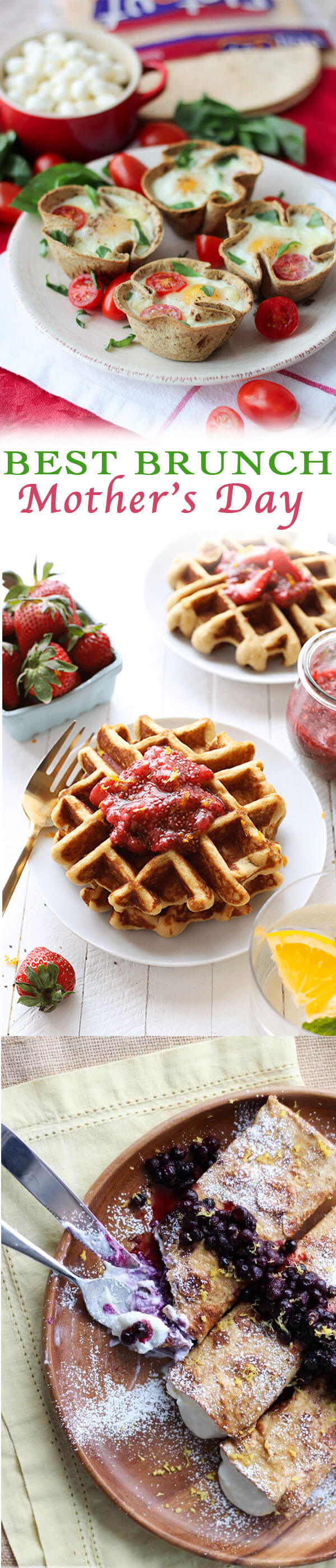
Best Brunch Recipes for Mother’s Day from Healthy Bloggers I Vegan, Gluten Free, Paleo & More

Best Brunch Recipes for Mother's Day from Healthy Bloggers I Vegan, Gluten Free, Paleo & More

I’m sharing the most scrumptious, unique brunch meals made for mom to delight her this Mother’s Day from top bloggers around the web. 

It can be hard to find juuuust the right meal to show your dedication and appreciation for Mom. So, I’ve rounded up the most delectable items and potions for the perfect Mother’s Day brunch. From vegan french toast, to almond flour waffles, and rhubarb ginger spritzers, you’ll have the prized ‘Child of the Year’ award in no time!

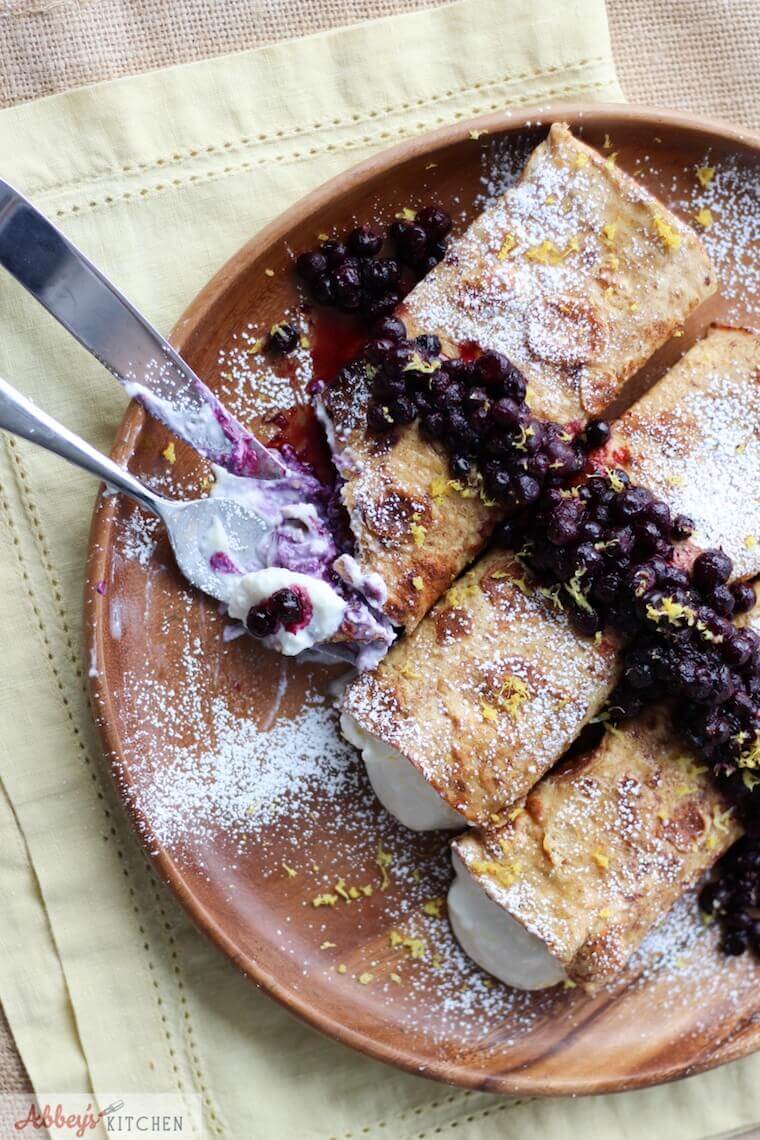
Abbey’s Kitchen – Healthy Cheesecake Stuffed French Toast Crepes

A plate with cheesecake stuffed french toast crepes being cut with a knife and fork.

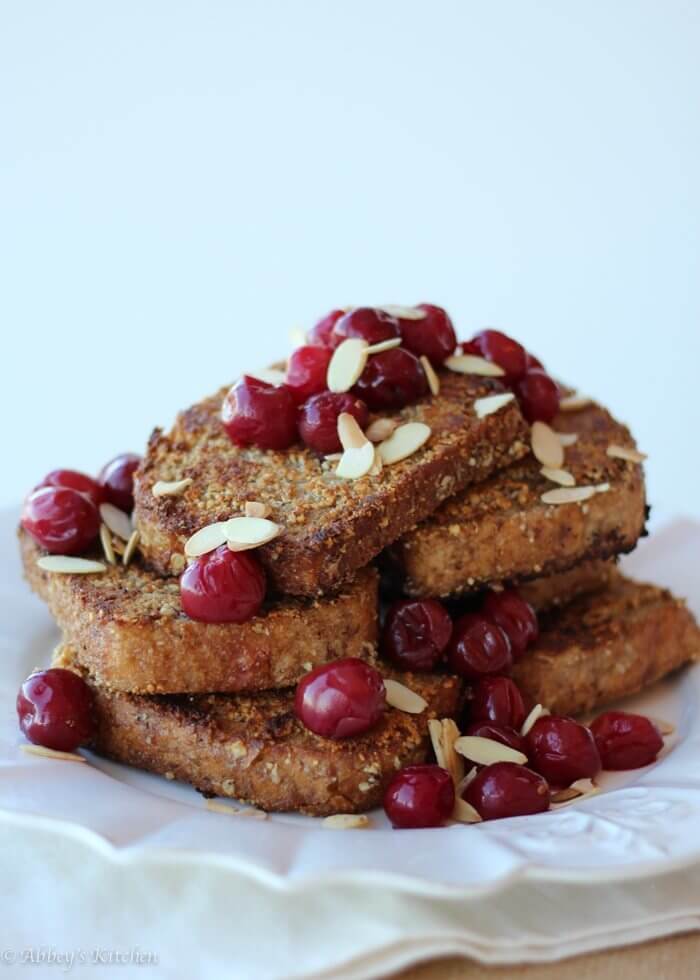
Abbey’s Kitchen – Almond Crusted Vegan French Toast with Sour Cherries

ALMOND CRUSTED VEGAN FRENCH TOAST WITH SOUR CHERRIES

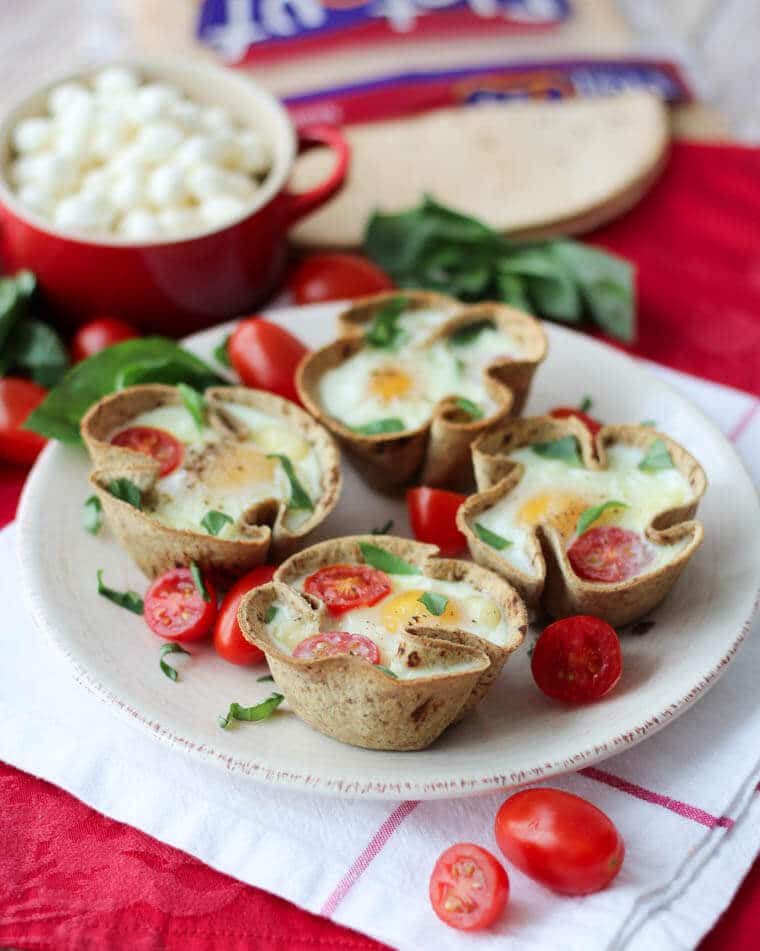
Abbey’s Kitchen – Caprese Egg Salad

caprese egg cups for mother's day

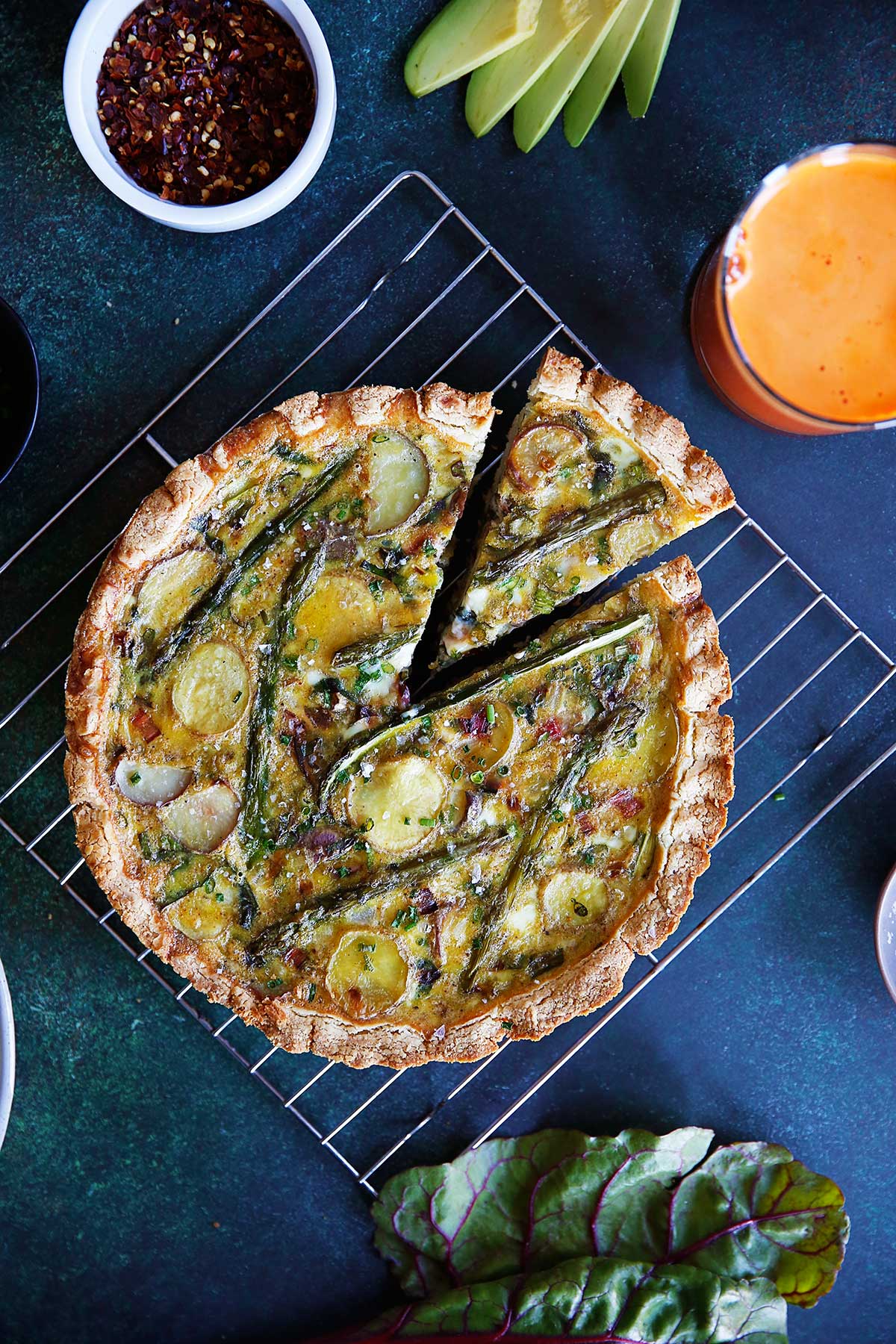
Lexi’s Clean Kitchen – Spring Vegetable Quiche

Paleo Spring Vegetable MOther's Day Bruch Lexi's Kitchen

Lexi’s Clean Kitchen – Cinnamon Crunch Pancakes

cinnamon crunch pancakes lexi's clean kitchen

Lexi’s Clean Kitchen –Paleo Lemon Blueberry Muffins

lemon blueberry muffin lexi's clean kitchen

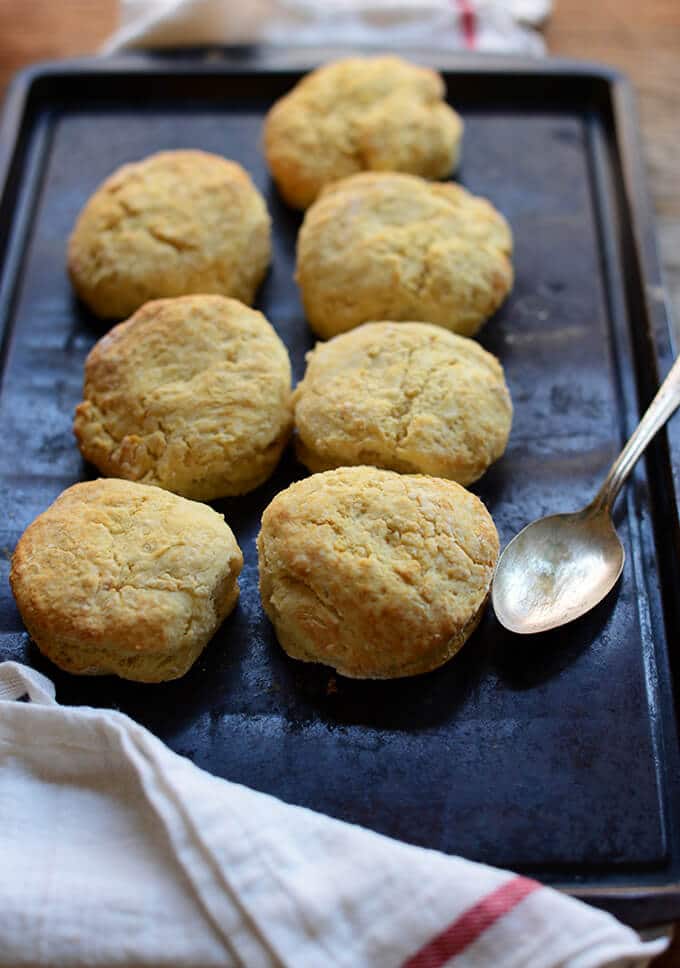
The Minimalist Baker – Vegan Biscuits 

mother's day healthy brunch

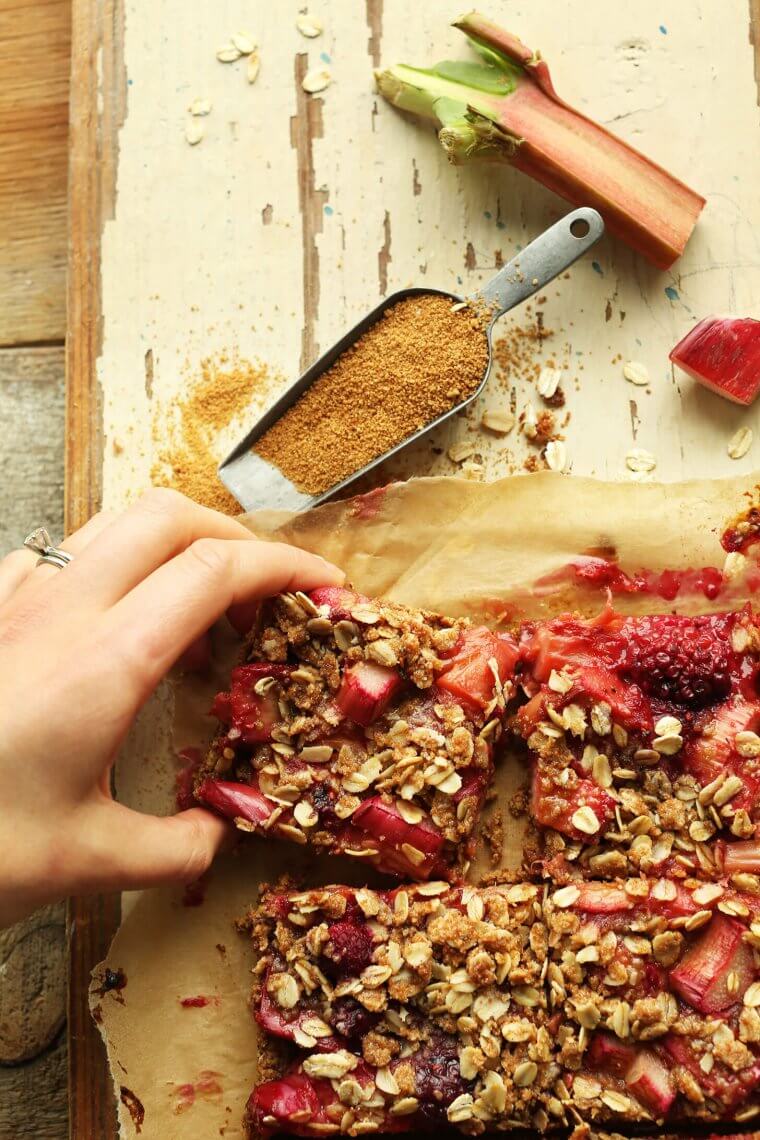
Minimalist Baker – Strawberry Rhubarb Crumble Pie

A hand grabbing a bar of strawberry rhubarb crumble bars.

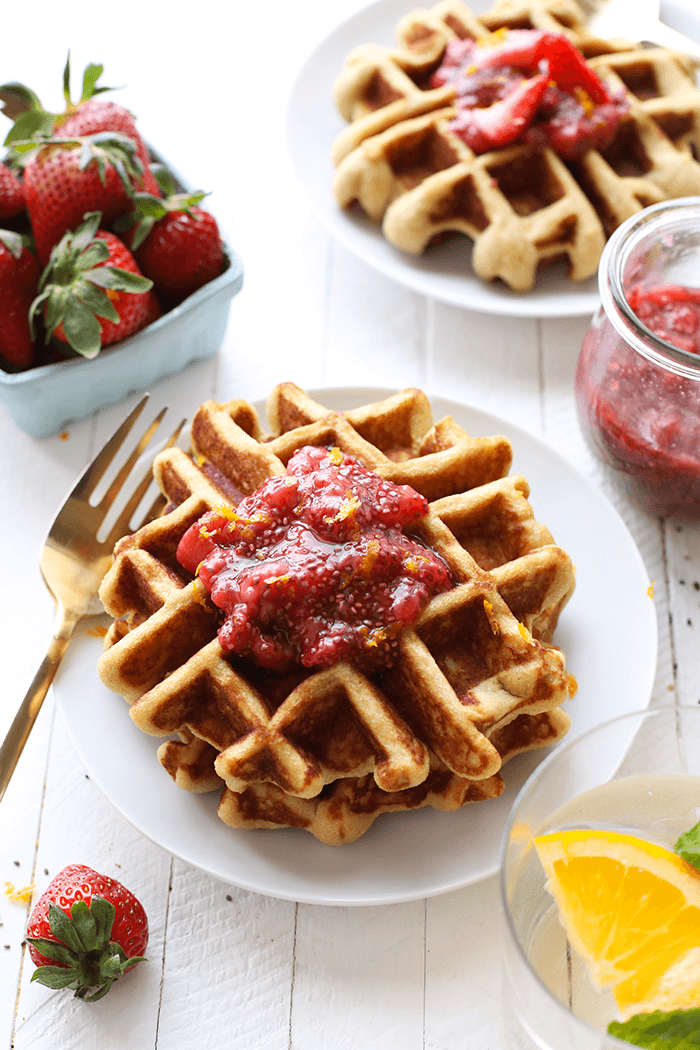
Fit Foodie Finds – Almond Flour Waffles

mother's day brunch recipes

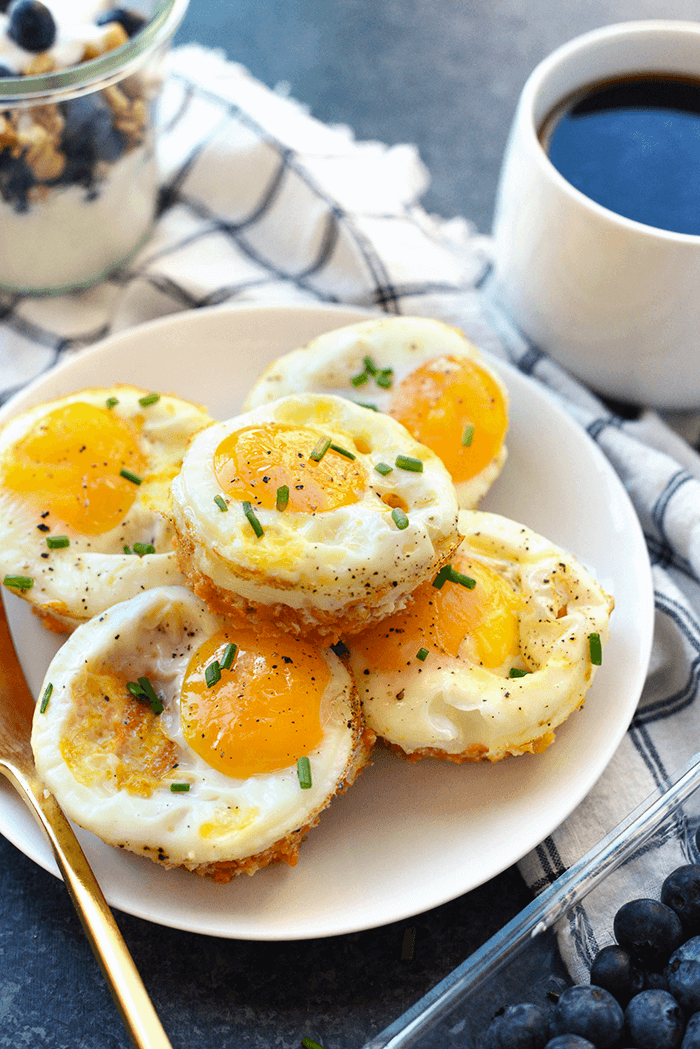
Fit Foodie Finds – Sweet Potato Hash Eggs

mother's day baked eggs

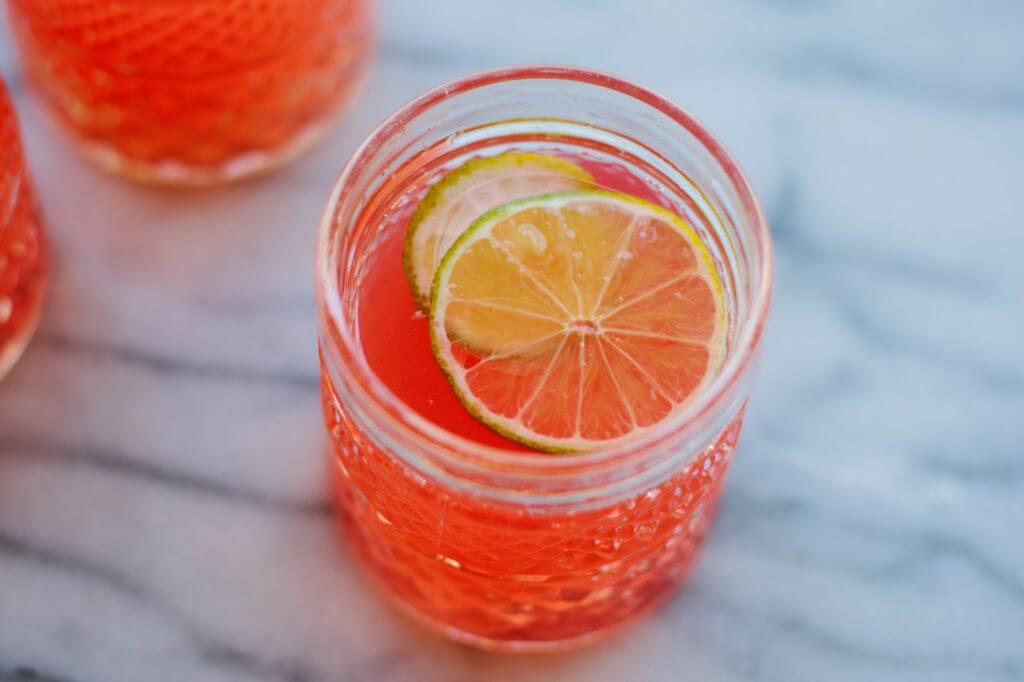
My Darling Lemon Thyme – Rhubarb Ginger Fizz

Rhubarb ginger fizz mother's day recipe

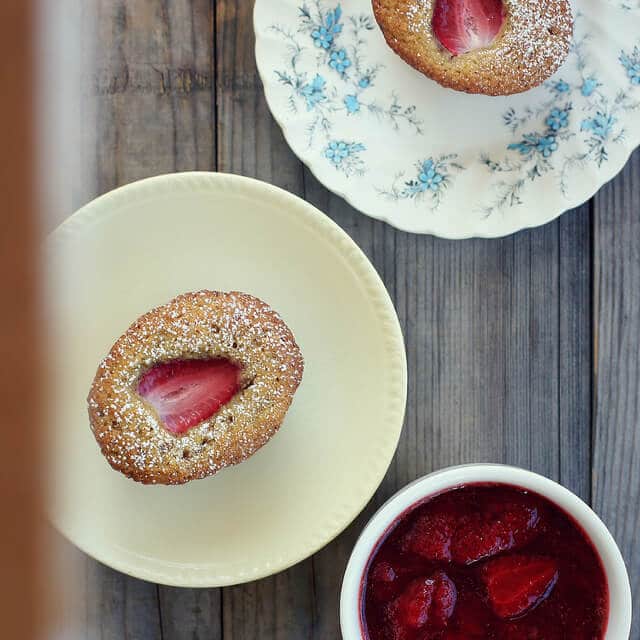
My Darling Lemon Thyme – Strawberry Almond Cake

mother's day brunch recipe

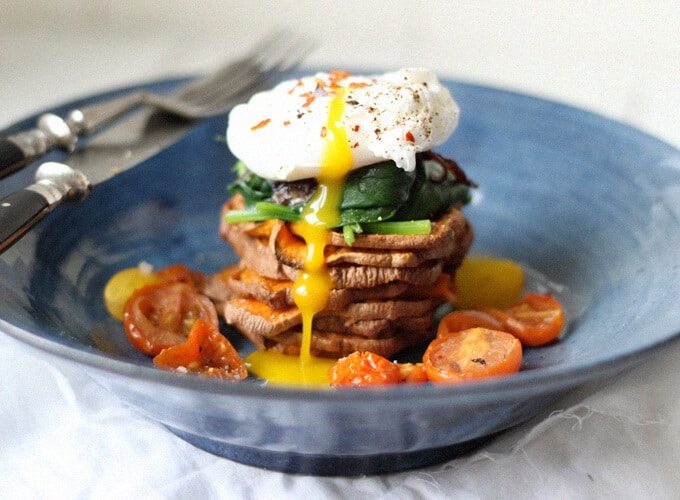
My New Roots – Veggie and Egg Power of Tower

the best mother's day brunch recipes

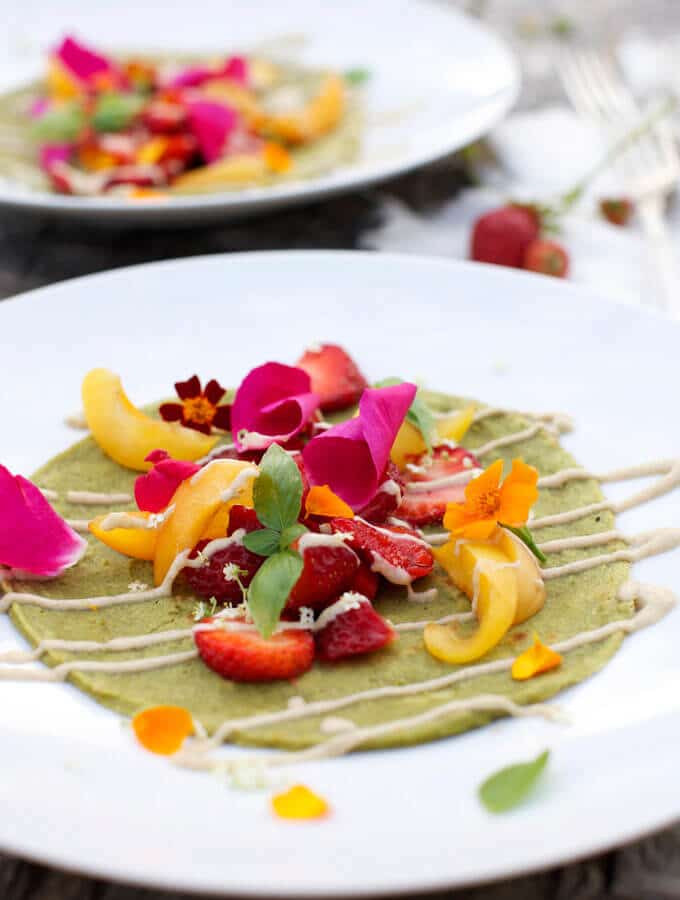
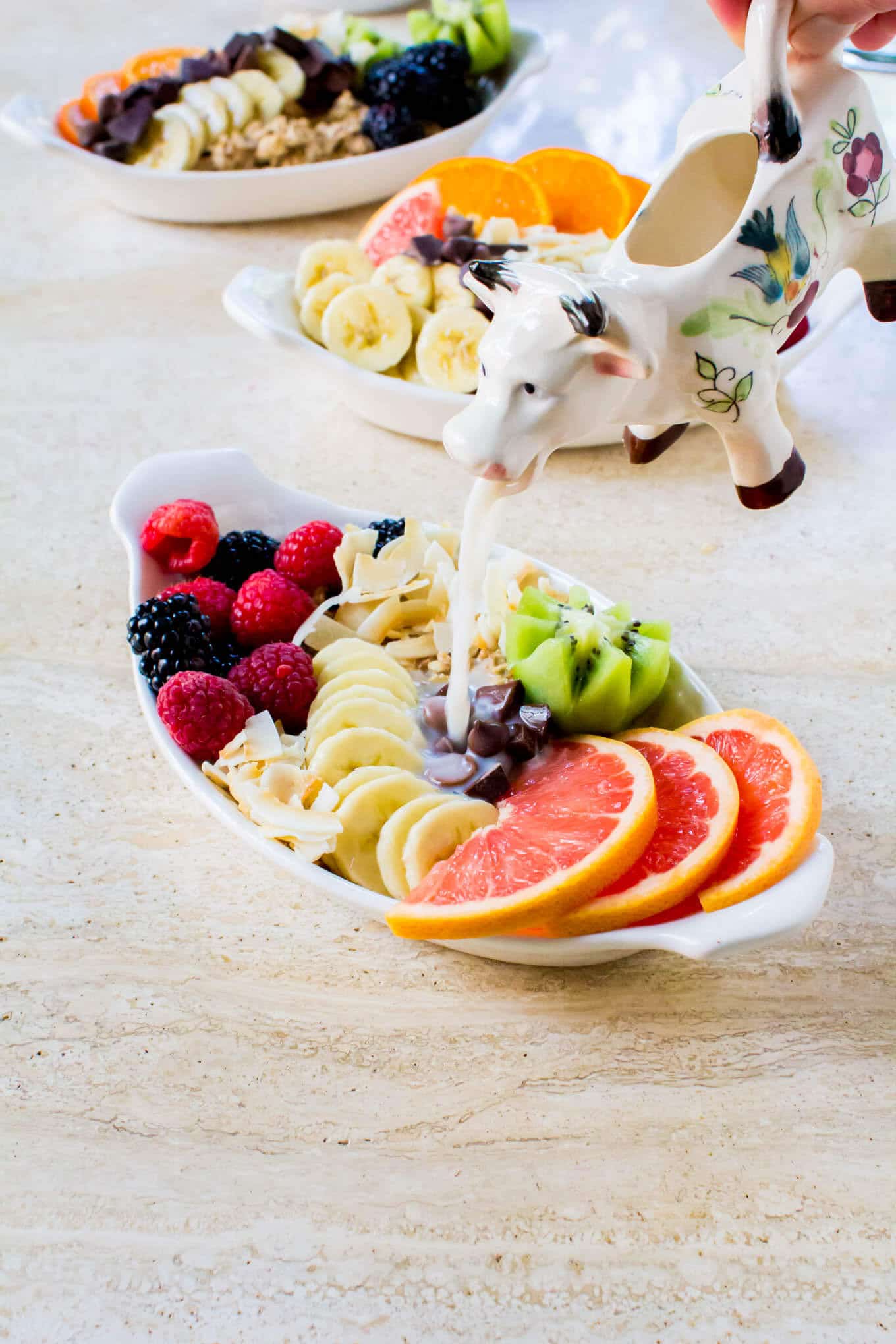
My New Roots – Miraculous Summer Crepes

the best mother's day brunch recipes

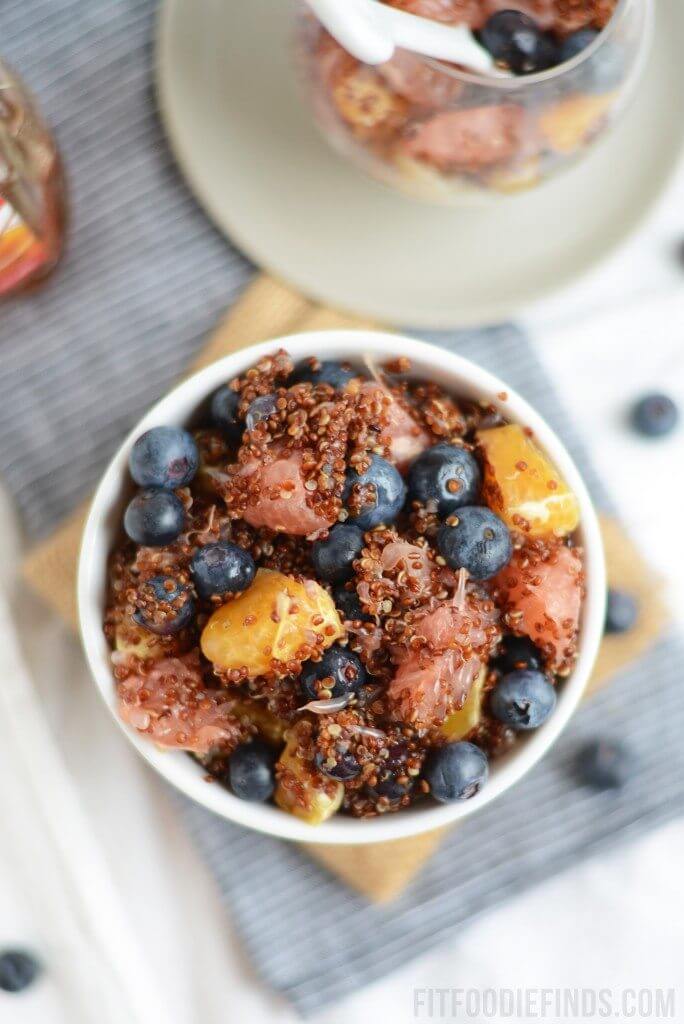
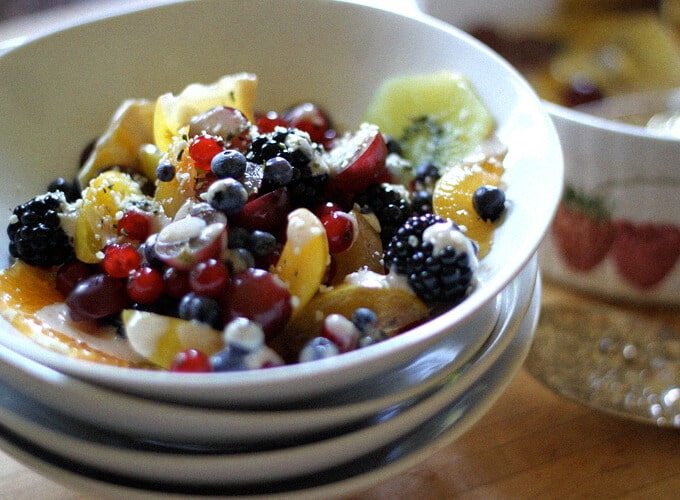
My New Roots – Chakra Fruit Salad

the best mother's day brunch recipes

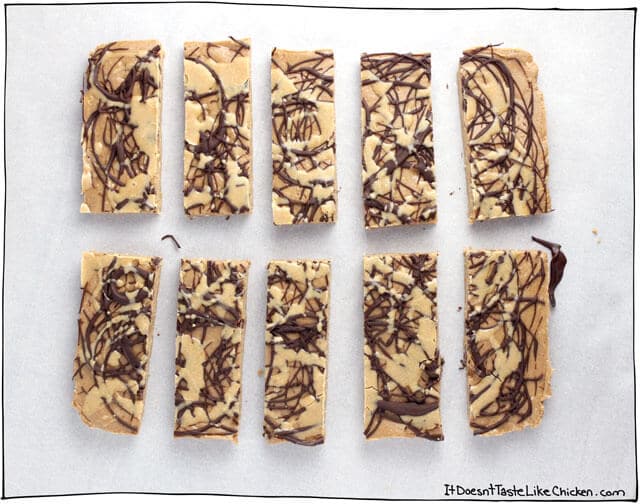
It Doesn’t Taste Like Chicken – Peanut Butter and Oatmeal Chocolate Bars

best mother's day brunch recipes

Oatmeal Dough – Imma eat that

best mother's day brunch recipes

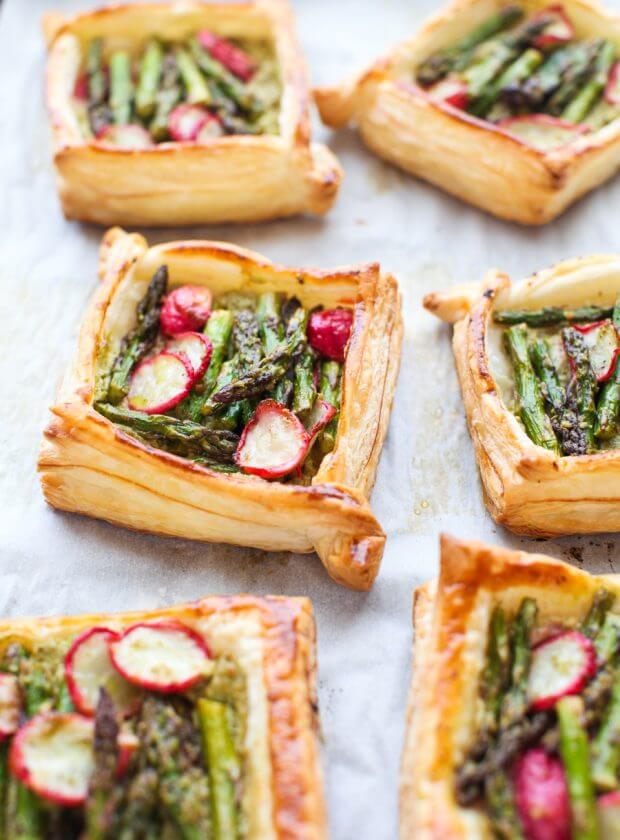
Simple Bites – Pesto and Ricotta Filled Asparagus and Radish Tarts

best mother's day brunch

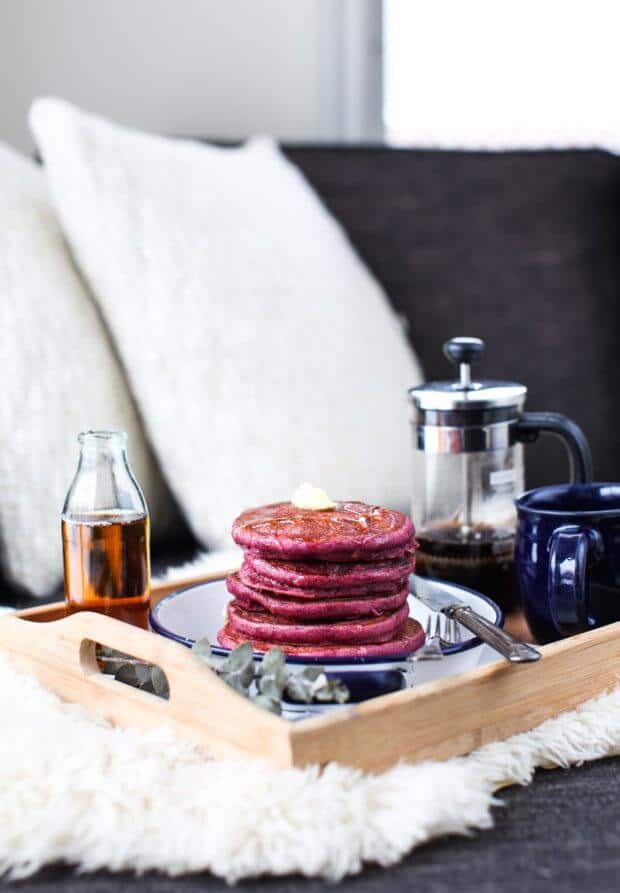
Simple Bites – Beet Buckwheat Pancakes

best mother's day brunch recipes

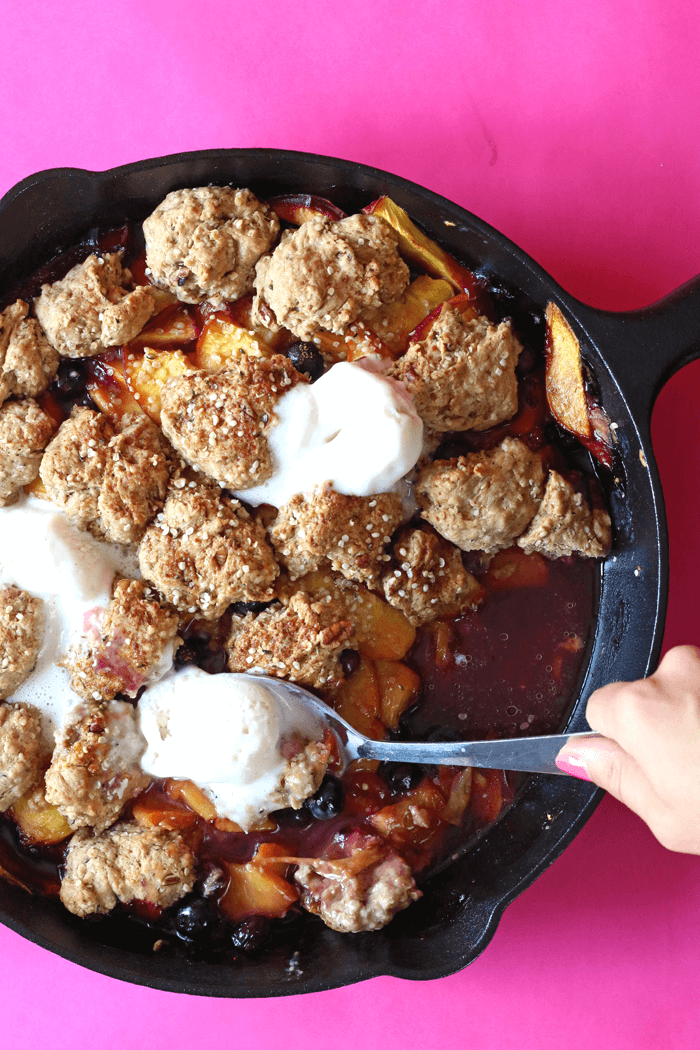
HealthNut Nutrition – Blueberry Peach Cobbler

best mother's day brunch recipies

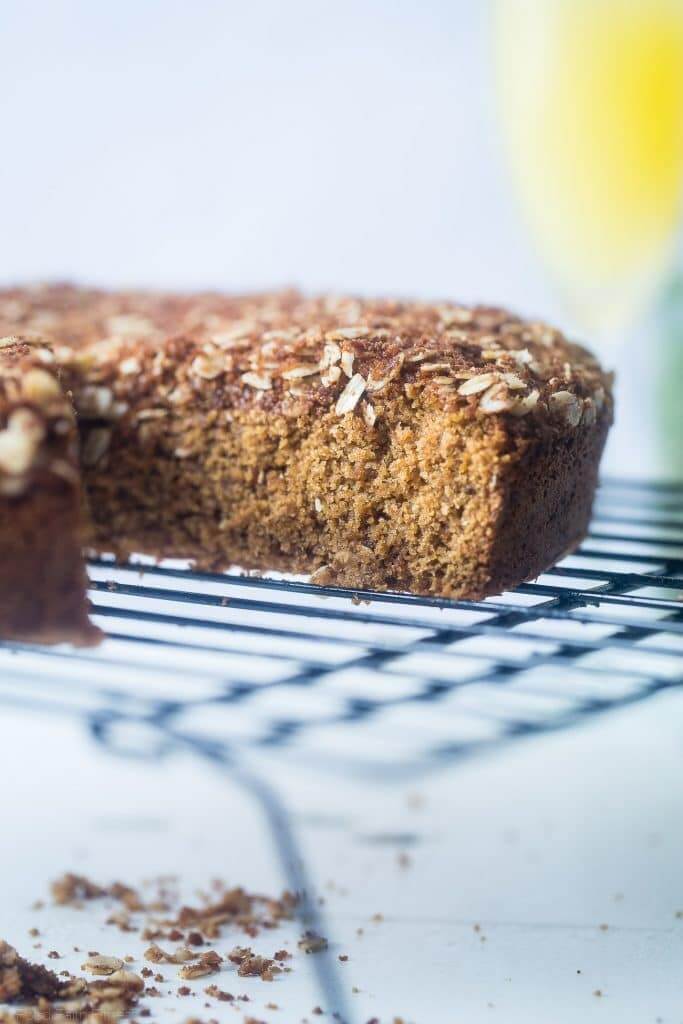
Food Faith Fitness – Mimosa Gluten Free Coffee Cake 

mother's day brunch recipes


What are some of your favourite meals to cook for mom?

Which one of these brunch dishes will you be trying first?

Leave me a comment below with your thoughts!

A white plate with two waffles on top with jam.

Abbey Sharp

Abbey Sharp is a Registered Dietitian (RD), regulated by the Ontario College of Dietitians. She is a mom, YouTuber, Blogger, award winning cookbook author, media coach specializing in food and nutrition influencers, and a frequent contributor to national publications like Healthline and on national broadcast TV shows.
www.abbeyskitchen.com/about-abbey/

Last Updated October 4, 2021. Published April 21, 2017 By Abbey Sharp 36 Comments

Spring Vegetarian Breakfast Pizza with Asparagus, Tomatoes and Runny Eggs | Low Carb Pizza

This Spring Vegetarian Breakfast Pizza with Asparagus, Tomatoes and Runny Eggs is a healthy, high protein, low carb alternative to bacon and eggs or pancakes to switch up your morning routine.

DISCLAIMER: This post was developed in sponsored partnership with Flatout Flatbread, however, as always, all opinions are genuine.

This Spring Vegetarian Breakfast Pizza with Asparagus, Tomatoes and Runny Eggs is a healthy, high protein, low carb alternative to bacon and eggs or pancakes to switch up your morning routine.

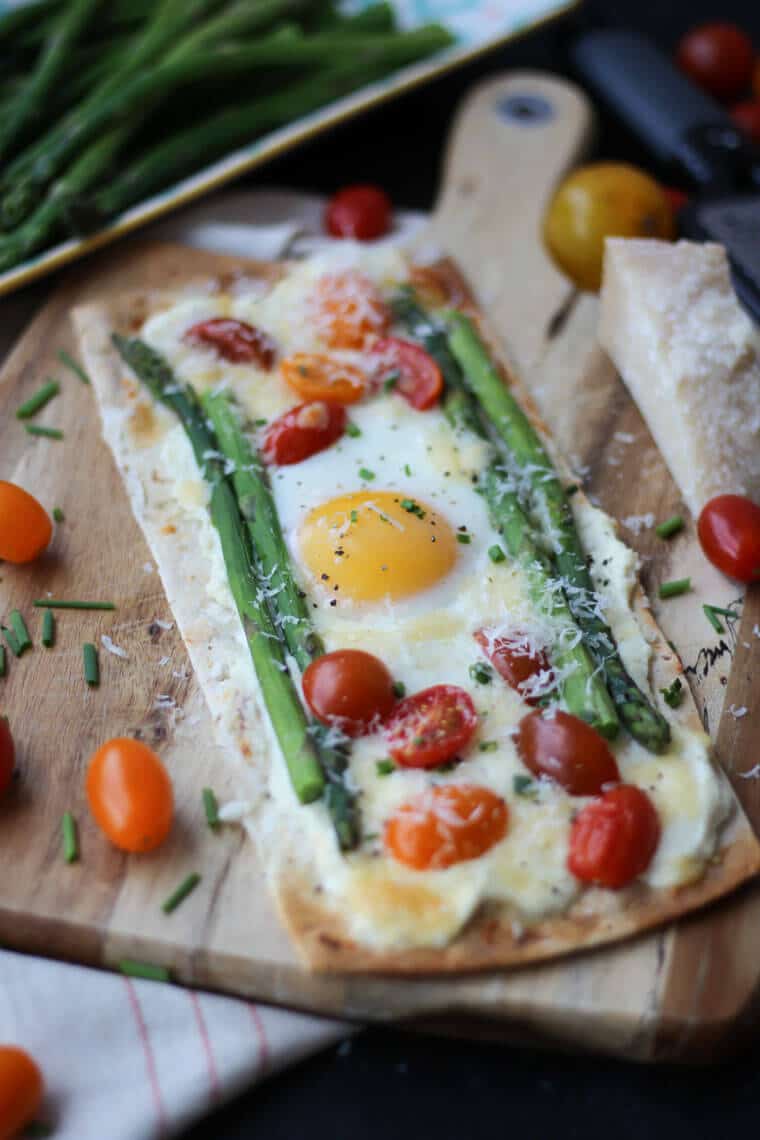
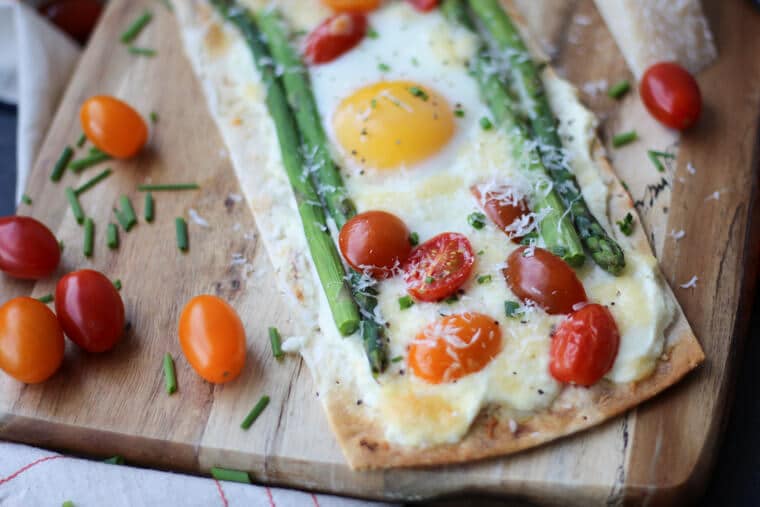
A breakfast pizza with egg, tomatoes, and asparagus.

I’m a breakfast person. I could happily eat eggs for dinner and pancakes all day, but there’s also something really lovely about starting off your day on a delicious note. This Spring Vegetarian Breakfast Pizza with Asparagus, Tomatoes and Runny Eggs is my new favourite fix.

How to make Spring Vegetarian Breakfast Pizza

If you’ve never had a breakfast pizza, get ready for potentially one of the most glorious things you can possibly wake up to (aside from, of course, coffee).

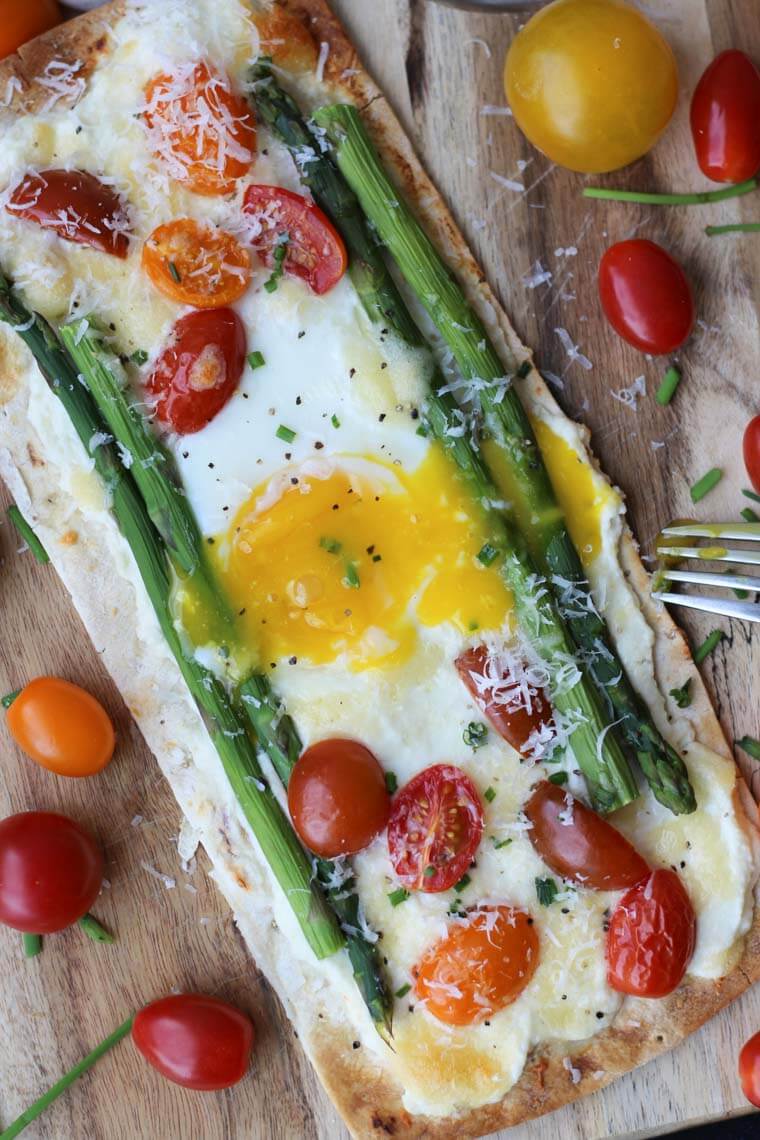
A breakfast pizza with egg, tomatoes, and asparagus with a fork beside it.

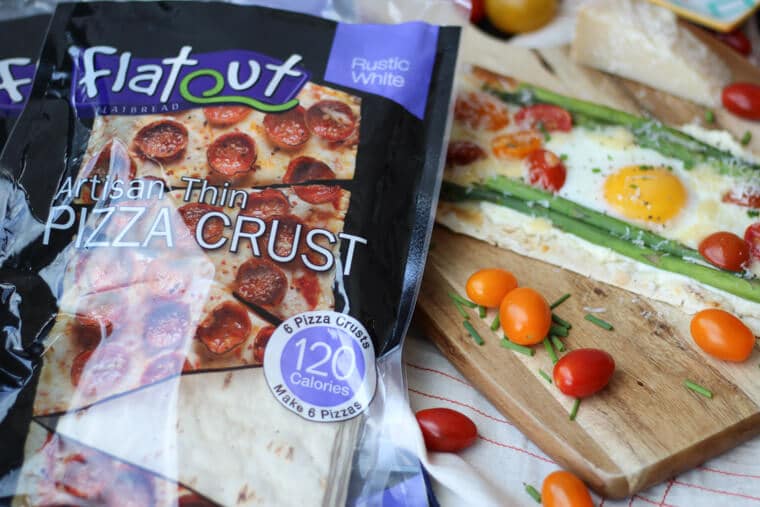
It starts with the crust, but I don’t know anyone who has the energy to make a pizza crust from scratch first thing in the morning (obviously, not this girl). Morning meals need to be fast and furious if they’re going to happen at all. I love using Flatout Artisan Thin Pizza Crust for busy breakfasts – one 6 inch pizza crust has only 120 calories, but an amazing 5 grams of protein and 2 grams of fibre. It’s an easy way to get pizza on the table and in your mouth before 9 AM. I’ve made pizza with the original Flatout’s before (check out this sausage stunner here), so I was so excited to find their product made specifically for pizza!

A breakfast pizza with a bag of flatout pizza crust.

I top my Spring Vegetarian Breakfast Pizza starts with beautiful fresh asparagus and bright tomatoes circling a gorgeous runny egg. Topped off with creamy gruyere cheese and a little fresh chive action, and you’ve got a breakfast pretty enough for company, but simple enough for a solo Tuesday.

[clickToTweet tweet=”This low carb Spring Vegetarian Breakfast Pizza is a tasty way to start your day!” quote=”This low carb Spring Vegetarian Breakfast Pizza is a tasty way to start your day!”]

A breakfast pizza with egg, tomatoes, and asparagus on a wooden serving board.

Feel free to experiment with the toppings on your Spring Vegetarian Breakfast Pizza. Figs and arugula are absolutely delicious, as is a little pesto and tomato action. The egg is amazing but if you’re squeamish about runny eggs, you can also scramble an egg and add it on top if you prefer.

Now, I want to know what are your favourite breakfast pizza toppings?

Have you tried making my Spring Vegetarian Breakfast Pizza?

What are your thoughts?

Leave me a comment and don’t forget to review this recipe!

A breakfast pizza with egg, tomatoes, and asparagus with a fork beside it.
Print Recipe
5 from 3 votes

Spring Vegetarian Breakfast Pizza with Asparagus, Tomatoes and Runny Eggs

This Spring Vegetarian Breakfast Pizza with Asparagus, Tomatoes and Runny Eggs is a healthy, high protein alternative to bacon and eggs or pancakes to switch up your morning routine.
Prep Time10 minutes mins
Cook Time12 minutes mins
Total Time22 minutes mins
Course: Breakfast
Cuisine: French
Servings: 2 people
Calories: 420kcal
Author: Abbey Sharp

Ingredients

  • Flatout Thin Pizza Crust Flatbread
  • 2/3 cup ricotta cheese
  • 1 ½ oz gruyere cheese shredded
  • 8 spears of asparagus trimmed and blanched
  • ½ cup colourful cherry tomatoes halved if needed
  • 2 eggs
  • ½ oz parmigiano reggiano cheese finely grated
  • Chives for garnish

Instructions

  • Preheat oven to 400 F. Lightly grease a large baking sheet and place the Flatout flatbreads on the baking sheet and bake for 2 minutes.
  • Top the pizza with ricotta cheese, gruyere, asparagus, tomatoes, leaving space in the middle for the eggs to get “trapped” in the centre. Bake for 10 minutes until the whites are set and the yolks are still runny.
  • Garnish with parmesan cheese and chives.

Nutrition

Calories: 420kcal

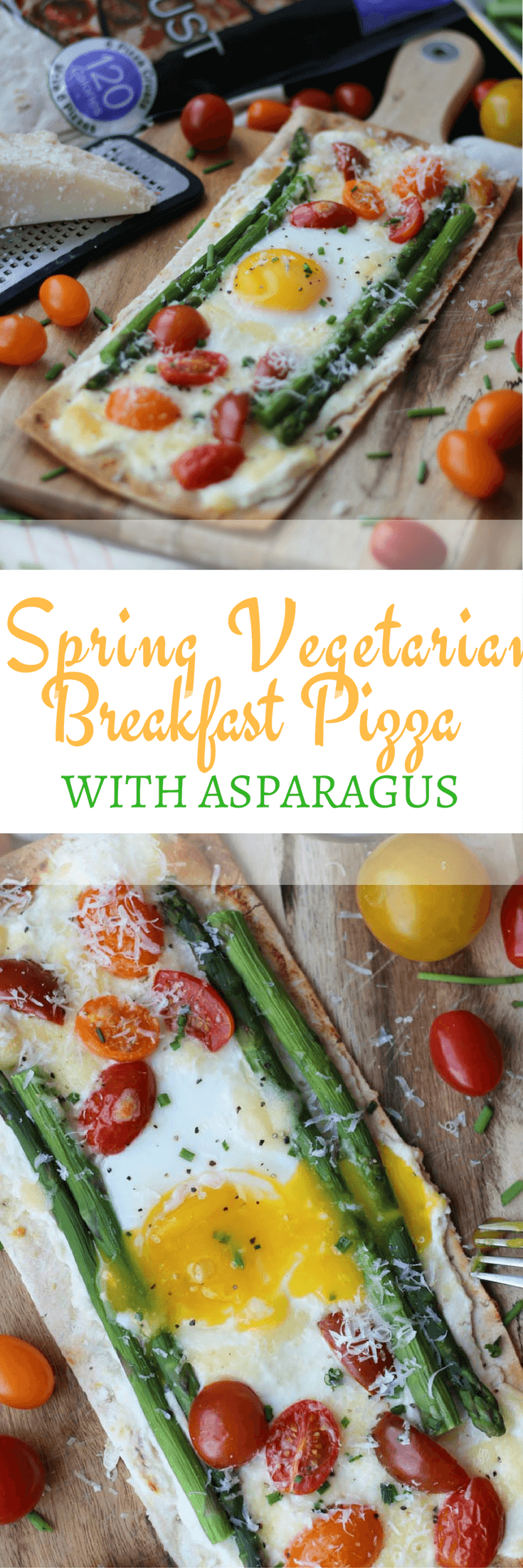
A breakfast pizza with egg, tomatoes, and asparagus with the overlay text \"Spring Vegetarian Breakfast Pizza with Asparagus.\"

Disclaimer: This post was developed in paid partnership with Flatout Flatbread, however, all opinions are genuine.


Abbey Sharp

Abbey Sharp is a Registered Dietitian (RD), regulated by the Ontario College of Dietitians. She is a mom, YouTuber, Blogger, award winning cookbook author, media coach specializing in food and nutrition influencers, and a frequent contributor to national publications like Healthline and on national broadcast TV shows.
www.abbeyskitchen.com/about-abbey/

Last Updated September 1, 2022. Published April 19, 2017 By Abbey Sharp 31 Comments

Vitamin D and Bone Health | Are the Vitamin D Recommendations a Lie?!

A pinterest image of fruits and pills with the text overlay "Vitamin D & Bone Health Are the Recos a Lie?"

How Much Vitamin D do We Need? In this post, we share the current research on Vitamin D and bone health including info on where the controversial vitamin D recommendations come from.

 At one time or another, you might have asked a health professional about vitamin D. Why do we need it, am I deficient and should I supplement? These can be tough questions for a health professional because vitamin D has become an elusive character in the research community. Experts have been battling out the appropriate recommendation and optimal blood levels and we seem to still be in the dark. In this post, I hope to shed some light on the issue with recent studies and by the end of it, hopefully some of your questions will be answered.

Legs on a bed with light shining on it.

 Commonly referred to as the sunshine vitamin, vitamin D is a fat-soluble nutrient and hormone which our body produces when exposed to the sun. Even though certain foods contain vitamin D, the majority of our vitamin D intake comes from the sun. This can be problematic for individuals living in geographical areas that lack constant sunlight, like us winter-loving, parka-wearing Canadians. The amount of vitamin D you produce depends on the time of day, the season, where you live, your sun exposure and your age (sadly, you synthesize less vitamin D as you age).

Vitamin D Deficiency

History lesson here folks! Back in the 1930s, vitamin D deficiency was an all too common thing among children. The lack of vitamin D led to a condition known as rickets which is the weakening and softening of the bones which caused permanent skeletal deformities. This epidemic triggered governments to fortify milk and infant formulas with vitamin D to reduce the incidence, and it did dramatically. To this day, a variety of foods are fortified with vitamin D (yoghurt, milk, orange juice) to prevent that problem from ever returning. It is also recommended to give breastfed babies a daily liquid drop of a vitamin D supplement since they don’t get enough from their diet.

Since the synthesis of vitamin D reduces as we age, there is a high prevalence of vitamin D deficiency among the elderly which puts them at risk for poor bone health conditions like osteomalacia (softening of bones), osteopenia and osteoporosis and fractures. Much of the research around the benefits of vitamin D have centered around bone health. Vitamin D aids in the absorption of calcium and phosphorus which build healthy bones and teeth, thus the more vitamin D we have, the stronger our bones and teeth.

Vitamin D Recommendations

With the wide range of research we have on vitamin D and bone health like here, here and here, what are the current recommendations, you ask? The most reputable and credible worldly organization shelling out recommendations is known as the National Academy of Medicine (NAM). Before I provide the recommendations I would like briefly explain the units of measurement and how vitamin D status is measured so you know the lingo.

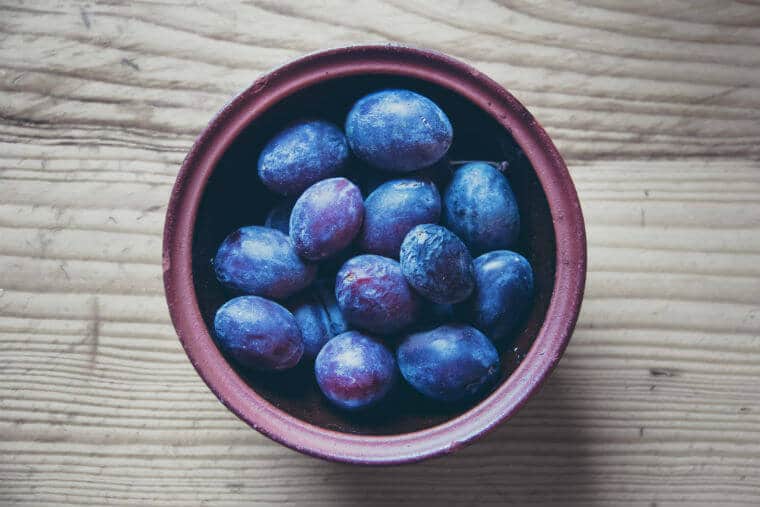
A bowl of fruit.

The best indication of vitamin D status is done by measuring levels in the blood. These blood samples are measuring vitamin D in the form known as 25-hydroxyvitamin D (25OHD). The concentration of vitamin D are in the form of nanomoles per litre (nmol/L) which reflects the number of molecules of vitamin D per one litre of blood. The recommendations are based on the amount of vitamin D is required every day to achieve optimal levels of vitamin D in our blood to maintain healthy bones.


Drumroll please… Here are the recommendations.

Back in 1997, the NAM came out with guidelines that many believed were conservative numbers and far too low to promote any benefits in bone health and overall health. These guidelines were revisited and in 2011, and NAM came out with a 1,000 page report on vitamin D and calcium. Here’s what they came out with:

Glasses of fruit juice.

Blood levels containing 50 nmol/L of vitamin D is adequate for achieving adequate bone health in most individuals (the previous blood level was just 30 nmol/L).

How much vitamin D should we be having to reach 50 nmol/L per day?

If you’re under the age of 70: 600 IU/day (previously was 200 IU/day)

If you’re above the age of 70: 800 IU/day (previously was 600 IU/day)

Even given this bump, experts believe the new guidelines are still too low and many organizations have created their own recommendations.

The US Endocrine Society recommends that vitamin D blood levels should be greater than 75 nmol/L to reap the benefit. This means individuals should aim for between 1500 – 2000 IU/day of vitamin D to maintain an optimal level of vitamin D in the blood.

Health Canada and Dietitians of Canada cite the NAM and provide those recommendations to Canadians.

Was there a Statistical Error in Reporting our Vitamin D Needs?

A pill.

Now get ready for the plot to thicken. Back in 2014, the University of Alberta released an interesting study. Researchers at the School of Public Health believe that the NAM miscalculated the RDA for vitamin D intake and the actual results are drastically different.

Image of a bottle with small pills.

You may be first asking what the heck is an RDA.  RDA (Recommended Dietary Allowance) is described as the amount of a nutrient considered to be sufficient to meet the requirements of 97.5% of healthy individuals.

Okay, back to the juicy story. These researchers decided to re-review the studies that were included in the 2011 NAM report and they came to a very different conclusion. Without getting too statistical on you, the study estimated how much vitamin D is needed for 97.5% of individuals to achieve a blood level of 50 nmol/L or more. The final number according to the researchers in Alberta : 8895 IU/d of vitamin D. That’s quite a large number and even surpasses the 4000 IU daily limit that’s advised since a dose that high has never been studied in humans. The researchers decided to also assess whether the 600 IU recommendations would achieve a blood level of 50 nmol/L and were rather disappointed when they came up with a value of 26.8 nmol/L.

Let’s break this down for a second and do a little review.

The NAM report stated that a dose of 600 IU/day of vitamin D would be enough to achieve blood levels of 50 nmol/L, however, researchers reviewing this found that this would only achieve blood levels of 26.8 nmol/L.

Confused yet? I sure am.One thing to keep in mind is that the NAM report only based these new recommendations on the bone health benefits of vitamin D and not on any new benefits that are starting to emerge

One thing to keep in mind is that the NAM report only based these new recommendations on the bone health benefits of vitamin D and not on any new benefits that are starting to emerge since the 2011 report. At the time, the NAM report stated there was insufficient evidence to support the notion that vitamin D carried additional benefits beyond bone health. New research and highly controlled clinical studies have surfaced and may influence the future recommendations by the NAM. Let’s review these and see whether the current vitamin D recommendations are adequate.

What’s the Link Between Vitamin D and Bone Health?


A close up of a slice of orange.

As I mentioned already, the role of vitamin D in bone health is a no-brainer and has been touted by many experts, however it is still argued by many on how much vitamin D is required to have a significant impact on our health. One study showed that despite a supplementation of 400 IU/day and eating foods high in vitamin D (came out to a total of about 632 IU/day), there was still 10% of participants had blood levels of less than 50 nmol/L. Another study reported that 15% of participants had blood values less than 50 nmol/L despite reporting supplementation with vitamin D. Is it possible 600 IU/day is still not enough to achieve the recommended blood level?

A  2016 meta-analysis found that vitamin D plus calcium supplementation produced a 15% reduced risk of total fractures and a 30% reduction risk in hip fractures. So how much vitamin D was supplemented to these subjects? Majority of the studies provided subjects with 800 or 700 IU of vitamin D per day.

Finally, a super recent 2017 systematic literature review found that after reviewing countless meta-analyses and double-blind randomized controlled trials (RCTs) the fracture-protecting effects of vitamin D depend on the dose and that the higher levels of vitamin D in our blood, the greater reduction in fracture risk. The review concluded that optimal blood levels should be between 60 nmol/L – 95 nmol/L to achieve optimal bone health.

Interestingly, a recent New Zealand and Australian position paper provided recommendations that are tailored to the specific seasons. They concluded that vitamin D blood levels should be around 50 nmol/L or greater at the end of winter and 60-70 nmol/L at the end of summer for adequate skeletal health.

While we argue about the appropriate amount of vitamin D to be supplemented, what about whether vitamin D supplementation even improves bone health?

One meta-analysis found that vitamin D supplementation with our without calcium did not have much of an impact on hip fractures and found the reduction to be no more than 15%.

On top of that, another systematic review and meta-analysis looked at whether vitamin D supplementation affects bone mineral density. Subjects were given vitamin D supplements and their bone mineral density was measured. The results? The study found that vitamin D did not have any significant impact on bone health which definitely makes us question the common practice of using vitamin D for osteoporosis prevention. Researchers from the study argued that past studies were poorly done and cite statistical error and inappropriate doses.

So at this point, you can see there’s quite a lot of information with regards to vitamin D and bone health that goes into crafting the current Vitamin D recommendations. A lot of this makes for pretty muddy waters when trying to determine how much we need.

In part 2, I will be covering some of the new research on some of the other benefits of Vitamin D and give you my recommendations on how much you need.

 let me know your thoughts on Vitamin D.

How much do you take?

How much do you think you should take?

Any other burning Vitamin D questions?

Leave me a comment below and we’ll try to address them in Part 2.

A pinterest image of fruits and pills with the text overlay \"Vitamin D & Bone Health Are the Recos a Lie?\"


Contribution by Sofia Tsalamlal

Abbey Sharp

Abbey Sharp is a Registered Dietitian (RD), regulated by the Ontario College of Dietitians. She is a mom, YouTuber, Blogger, award winning cookbook author, media coach specializing in food and nutrition influencers, and a frequent contributor to national publications like Healthline and on national broadcast TV shows.
www.abbeyskitchen.com/about-abbey/

Last Updated October 23, 2020. Published April 18, 2017 By Abbey Sharp 43 Comments

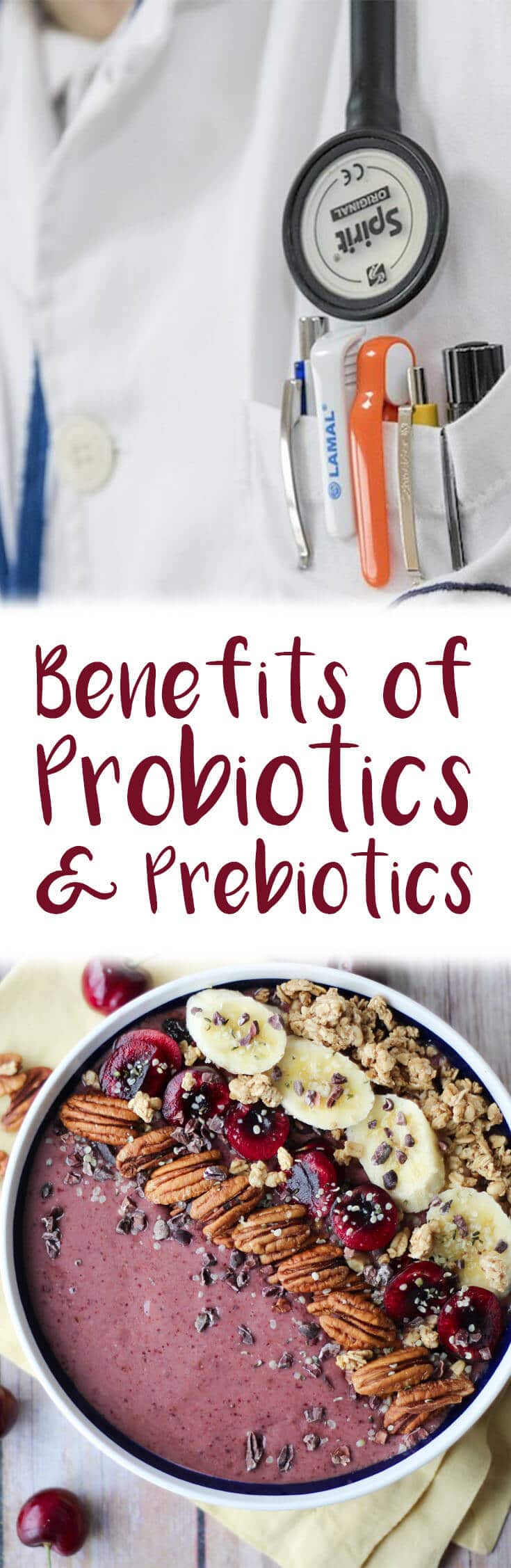
Exciting NEW Health Benefits on Probiotics and Prebiotics | What Does New Science Say About Gut Health?

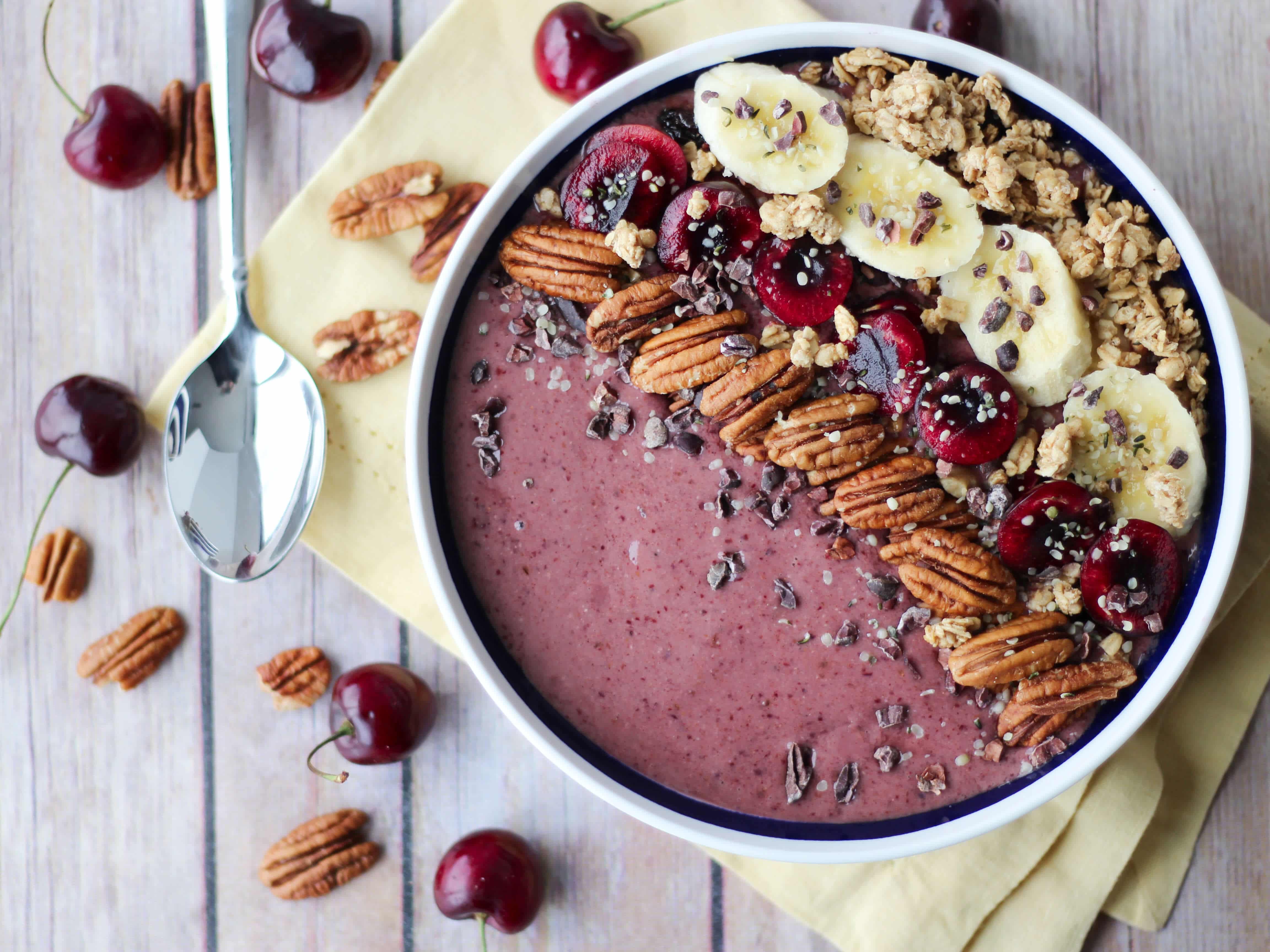
A white bowl containing a cherry smoothie with pecans, chia seeds, bananas, and cherries on top.

I discuss new research on the health benefits on probiotics and prebiotics and discuss how healthy gut bacteria is important for digestive health.

We have talked about some tasty fermented foods before, but today I wanted to just simply things and clear up any confusion about the difference between probiotics and prebiotics and discuss in more detail about the health benefits of probiotics and prebiotics.

Become an Abbey’s Kitchen Subscriber

What are Probiotics?

First a refresher on probiotics. Our gut houses the largest number of bacteria in our body, and a large proportion of that is known as “good” bacteria. Probiotics are the “good” bacteria that we need to promote good balanced health. Here are some of the known benefits of probiotics.

PROBIOTICS and lactose intolerance

Good news for dairy lovers, probiotics may improve lactose intolerance! Back in 2010, an SLR (systematic literature review) was conducted to review effective management strategies for lactose intolerance. They looked at 7 RCTs that evaluated the use of probiotics in yoghurt and milk at improving symptoms of lactose intolerance. Overall, there was insufficient evidence to conclude symptoms improved after probiotic use, however, there were a few limitations. First of all the trials were small – only included 9 to 28 people. Second of all, the study assessed lactose malabsorption through a hydrogen breath test. In all the studies except one, hydrogen breath tests were included and no reports of symptoms improvement were included which limits the effectiveness of probiotics.

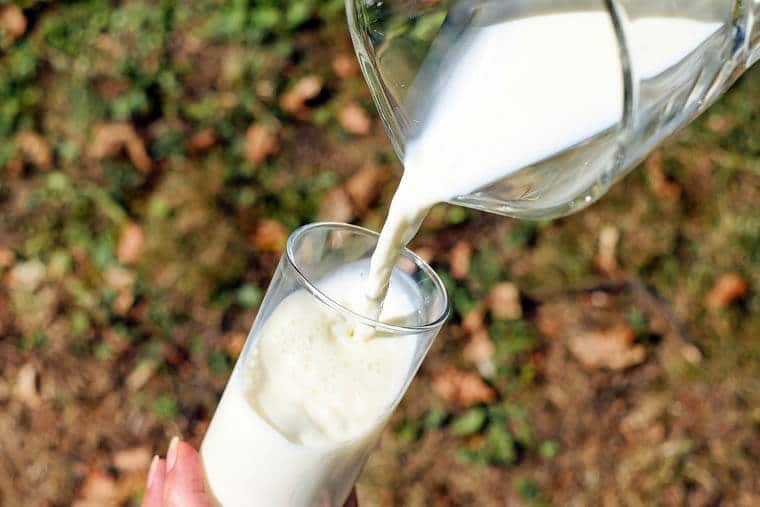
Milk being poured into a glass.

Since 2010, there have not been any SLRs evaluating the effectiveness of probiotics on symptoms of lactose intolerance. However, in 2016, a 12-week RCT (randomized control trial) studied the consumption of a specific probiotic strain (lactobacillus acidophilus) by individuals experiencing lactose intolerance. Within four weeks, the group receiving the placebo experienced worsened symptoms compared to the group receiving the strain of probiotics. Evidence has found that some individuals who are lactose intolerant can tolerate yoghurt due to the presence of lactase which is produced by probiotic bacteria. In another clinical trial, they studied the effect of lactase on lactose absorption and found that individuals who ate yoghurt absorbed more lactose compared to individuals who drank milk. It seems the bacterial lactase can withstand the acidity of the stomach better since it is encased in bacterial cells. The RCT found that the specific strain of probiotics was able to improve GI symptoms of lactose intolerance including diarrhea, abdominal cramping and vomiting. However, future RCTs and an SLR are needed to confirm the use of this strain on improving symptoms of lactose intolerance.

PROBIOTICS and Heart Health

A 2016 meta-analysis pooled together 14 RCTs to assess the effect of probiotics on individuals with normal, borderline and high cholesterol levels who were not on cholesterol-lowering drugs. This meta-analysis witnessed a significant reduction in total cholesterol levels among individuals who consumed probiotics compared to the control group. Of these studies, 6 trials showed a statistically significant decrease in total cholesterol levels and four of the trials saw that reduction in LDL-cholesterol. HDL-cholesterol and triglyceride levels were not changed by probiotic consumption. One limitation to note is individuals were given high dosages of probiotics which would be too high to be used on a regular daily basis, so future studies must test the use of probiotics in small amounts over a longer period of time. The researchers did mention that the effect of probiotics on cholesterol is certainly not as strong as cholesterol-lowering medications, but for individuals who experience severe side effects from meds, and prefer a non-drug treatment, probiotics may be an option to significantly lower cholesterol levels and reduce their risk of developing CVD.

Close up of a doctor\'s lab coat with pens in the pocket and a stethoscope around their neck.

A recent systematic review gathered nine RCTs to assess the role of probiotics at reducing blood pressure. Overall, the study results revealed that probiotics consumption may help reduce your systolic blood pressure by 3.56 mmHg and your diastolic blood pressure by 2.38 mm Hg. In terms of the type of probiotics, fermented dairy products were the most effective at reducing blood pressure compared to other sources of probiotics (capsules or rose-hip drink). That may be because there were not enough trials using alternate forms of probiotics, so future studies are needed to make a case for the best source of probiotics at reducing blood pressure. Another interesting note from this review is that trials using a variety of species of probiotics were more effective at reducing blood pressure than trials using only one type of probiotic.

So what’s the mechanism behind this? Many believe probiotics may aid in the production of angiotensin-converting enzyme, which is essential in regulating our blood pressure through a process known as the renin-angiotensin system.

PROBIOTICS and Immunity

A lot of the research in the area of immunity and probiotics comes from animal studies at this point, but is still worth bringing up. A recent 2017 study administered probiotics in 15 piglets and found that their weight increased, and their diarrhea decreased compared to the control group. The study also found that certain proteins and an antibody involved in immune responses increased significantly compared to the control group.

Well, what about human studies?

In one study, researchers found that the gut of individuals who consumed probiotics induced different gene expressions in their intestinal lining compared to the control group. In another study, they provided probiotics to individuals suffering from esophagitis and found that the probiotic promoted the expression of a variety of genes involved in our immune responses and inflammation. This research is premature, and there must be more research done on humans (healthy and those with chronic diseases) to understand the mechanism and its effectiveness on treating or preventing disease.

Because of the potential association between probiotics and our immune system, there has been some early research on the use of probiotics to reduce allergy symptoms. Most of the research has been on animals, and the research on humans is very limited. Only a few studies saw improvements in allergy symptoms, however, we do not yet know the long term effects or if providing probiotics to pregnant women might prevent the onset of allergies.

PROBIOTICS and Inflammation

A study conducted on mouse with colitis, found that lactobacillus (probiotic strain) supplementation increased the promotion of an antioxidant enzyme which reduced the oxidative stress (which causes the inflammation) in their intestinal wall and reduced colitis symptoms. Granted, this was only done on mice, this may be a possible route for more study on individuals suffering from IBD which may help in reducing the oxidative stress and thus reduce IBD symptoms.

In humans, two small anecdotal trials and larger randomized controlled clinical trials have shown some use for IBD like Ulcerative Colitis with certain probiotic strains. Escherichia coli Nissle may help maintain remission for at least 1 year in patients who have colitis. More recently, trials were published that tested a probiotic product called VSL#3 (VSL Pharmaceuticals, Inc.), which is a combination of 8 probiotics. This one also has shown some efficacy for inducing remission in Ulcerative Colitis. Still, we need many more trials to identify which strains induce long term remission and exactly how much would be needed to see those results.

PROBIOTICS and BONES

Most of the studies on probiotics and bone health have come from the poultry industry. One study on broiler chickens found that when given probiotics, they experienced increased nutrient availability and an increase in the lateral and medial walls of their tibia bone. Other research has looked at the role of probiotics in treating or preventing bone loss caused by periodontitis (inflammatory disease that affects tissue surrounding teeth). One study revealed that the use of probiotic therapy reduced bone loss in rats experiencing periodontitis and protected their intestines from the inflammation. An interesting discovery from this was that stress may interfere with the effectiveness of probiotics.

A close up of a skeleton model.

Probiotic treatment was also studied on elderly patients in a 2016 study. This RCT included 417 elderly patients with acute distal radius fracture where half of them received regular milk and the other half got milk with added probiotics. The study found that individuals who received probiotics exhibited significantly faster rate of improvement compared to those who received the placebo. Future research must look at the role of probiotics in healthy individuals and its long term use at promoting bone strength and/or preventing bone loss.

PROBIOTICS and regularity

Evidence has shown that these fermented foods can alleviate constipation to get things going like clockwork. A 2016 RCT studied the use of probiotics with 60 constipated pregnant women. Half of these women received yoghurt enriched with 300g of two strains of probiotics and the other half received non-enriched yoghurt (control group). After four weeks, the probiotic group experienced a significant increase in defecation compared to the control group.

The use of probiotics is often prescribed for managing IBS symptoms because of its impact on the gastrointestinal system. A systematic review and meta-analysis found that probiotics are an effective treatment for IBS, however it is still unclear on the type and number of strains of probiotics that are beneficial at being the most effective. Another systematic review confirmed these findings, but also stated that future research on specific probiotic strains, doses and duration of its use are needed to appropriately compare their effects on human health.

PROBIOTICS and WEIGHT loss

Can probiotics and the gut dictate our body weight and shape? Let’s find out. A famous animal study comparing lean and obese rat twins revealed there exists difference in the types and number of bacteria in the gut. In individuals considered “obese”, they had less diversity in their gut bacteria. Remember, this was only done on rats.

A scale with measuring tape on top.

So what about human studies? A systematic review included a variety of RCTs on humans, and they concluded that probiotics did not have a significant effect on body weight and BMI. Our diet is having a huge influence on out gut function and the type and amount of bacteria present, however for the time being, that might be the only association. Sticking to a balanced healthy diets, is the best way to cultivate that good bacteria in our gut and not just relying on probiotics to do that for us.

PROBIOTICS AND GLYCEMIC CONTROL

New evidence suggests probiotics may help with glycemic control to decrease the risk of metabolic diseases such as obesity, diabetes, and cardiovascular disease. A 2015 systematic review assessed 17 RCTs that studied the effect of probiotics on fasting blood sugars, fasting insulin and insulin resistance. To summarize the review, probiotics significantly reduced fasting blood sugars, insulin and insulin resistance. This research is preliminary, but since we know that insulin plays a huge role in weight, diabetes and other chronic diseases, probiotics may be a useful tool in maintaining normal blood sugars. Early research on rats with diabetes found that probiotics supplementation improved glucose metabolism, lipid levels and delayed hyperglycemia. Down the road, probiotics may be recommended to manage symptoms in individuals with diabetes. Until then, more research is needed to confirm the type, dosage and length of supplementation of probiotics for the best results.

PROBIOTICS AND ANXIETY

Emerging evidence has shown that probiotic supplementation may reduce anxiety and depression symptoms. Rodent-based studies have seen interactions between the central nervous and the gut through something called the gut-brain axis. Research in this area explains the mechanism behind this as a potential signalling pathway from our gut to brain through our endocrine system. Evidence has suggested that the cells in our gut can interact with neurons on our brain which can regulate our mood and stress-related behaviours. Kinda geeking out here, guys.

Aside from the evidence from rats and pigs (which is not great), a recent systematic review tested this hypothesis on healthy adults as well as individuals suffering from a variety of psychological disorders. In healthy adults, a few studies reported reductions in depressive or anxiety symptoms among the probiotic treated group versus the placebo control group. Another study reported a significant reduction in symptoms in a group of subjects after four weeks of probiotic supplementation. However, other studies may have seen slight reductions but were not statistically significant enough to make a strong case. In individuals suffering from major depressive disorder, one study found that probiotic supplementation improved symptoms, while another found no difference. Ultimately, there are a number of limitations from this review like small sample sizes and the fact that a consistent probiotic strain, concentration and dose wasn’t used.

PROBIOTICS AND MIGRAINES

Aside from psychological disorders, a recent literature review assessed the gut-brain relationship by revealing a higher prevalence of headaches in patients with gastrointestinal disorders. Researchers believe there is a potential link between the use of probiotics at reducing the frequency and severity of migraine headaches. This is early research, since no RCTs have yet to be done, however will most likely start be done to evaluate its clinical efficacy.

WOAH. That was a lot. Clearly, we’re really just scratching the surface understanding all of the roles probiotics play in health, so I’m always trying to stay on top of the latest research.

So where do we find Probiotics?

Look for fermented foods! Fermentation is a beautiful process where we convert sugars to acids, gases and alcohol to preserve food. In the process, you get a wide range of beneficial enzymes and probiotics. Examples of fermented foods like yoghurt, sauerkraut, tofu, pickles, beer, wine and the trendiest of drinks: kombucha. You can find lots of yummy ideas for fermented foods here!

So What are Prebiotics Then…?

What the what? Prebiotics set the stage for gut health. They are parts of certain foods that we cannot digest, and they “feed” the good bacteria in our gut. You can get your prebiotic fix by eating foods like bananas, onions, garlic, leeks, asparagus, artichokes, sunchokes, chicory root, soybeans and whole wheat foods which contain small amounts of these indigestible bacteria chow.

When you think about probiotics and prebiotics, you have to think of them as a team. Prebiotics are the trusty sidekick to probiotics that makes them even more bad ass. Variety in our diet is key, so instead of chugging back kombucha all day, throw some bananas on your yoghurt and you’ll get a super- duper-gut-protecting-health-promoting-hero.

A white bowl containing a cherry smoothie with pecans, chia seeds, bananas, and cherries on top. The diet industry has taken hold of these gut promoting miracles by featuring them in dietary supplements and cleanses, but remember you can reap the same benefits simply by eating good food. That way, the only thing going down the toilet is your s**t and not your money. Sorry to be so crass.

Now, I want to know:

What are some of your burning toilet question?

Do you try to get more prebiotics and probiotics?

Leave me a comment below!


I discuss new research on the health benefits on probiotics and prebiotics and discuss how healthy gut bacteria is important for digestive health

Collaboration with Sofia Tsalamlal, RD

Abbey Sharp

Abbey Sharp is a Registered Dietitian (RD), regulated by the Ontario College of Dietitians. She is a mom, YouTuber, Blogger, award winning cookbook author, media coach specializing in food and nutrition influencers, and a frequent contributor to national publications like Healthline and on national broadcast TV shows.
www.abbeyskitchen.com/about-abbey/
  • Previous Page
  • Go to page 1
  • Interim pages omitted …
  • Go to page 70
  • Go to page 71
  • Go to page 72
  • Go to page 73
  • Go to page 74
  • Interim pages omitted …
  • Go to page 89
  • Next Page

Get started with

Eight Free Recipe Books

From the co-founder of Neue Theory and creator of the Hunger Crushing Combo

Sign me up!
Abbey smiling at table
Abbey Sharp

“Foods may never be nutritionally equal. But we can make them morally equal by recognizing that our worth is never determined by what's on our plate.”

— Abbey Sharp, RD About Abbey ◥

Books

  • HCC™
  • Mindful Glow
  • Free E-Books

Blog

  • Nutrition
  • Recipes
  • Motherhood
  • Life

Explore

  • Neue Theory™
  • Bite Back
  • YouTube

Abbey

  • About
  • Coaching
YouTube TikTok Instagram Facebook X Pinterest
Abbey Sharp - The No BS Dietitian From Abbeys Kitchen

© Abbey's Kitchen 2026  All Rights Reserved •  ACCESSIBILITY STATEMENT •  Privacy Policy

This site uses cookies. By continuing to browse the site, you are agreeing to the use of cookies Accept Privacy Policy
Privacy & Cookies Policy

Privacy Overview

This website uses cookies to improve your experience while you navigate through the website. Out of these, the cookies that are categorized as necessary are stored on your browser as they are essential for the working of basic functionalities of the website. We also use third-party cookies that help us analyze and understand how you use this website. These cookies will be stored in your browser only with your consent. You also have the option to opt-out of these cookies. But opting out of some of these cookies may affect your browsing experience.
Necessary
Always Enabled
Necessary cookies are absolutely essential for the website to function properly. This category only includes cookies that ensures basic functionalities and security features of the website. These cookies do not store any personal information.
Non-necessary
Any cookies that may not be particularly necessary for the website to function and is used specifically to collect user personal data via analytics, ads, other embedded contents are termed as non-necessary cookies. It is mandatory to procure user consent prior to running these cookies on your website.
SAVE & ACCEPT

Rate This Recipe

Your vote:


A rating is required
A name is required
An email is required