• Skip to main content

Abbey's Kitchen

Healthy Recipes, Nutrition Myth Busting, Healthy Eating Tips

  • Books
    • HCC™
    • The Mindful Glow Cookbook
    • Recipe eBooks
      • Family
      • Hypothyroidism
      • BLW
      • Vegan Week 1
      • Vegan Week 2
      • Vegan Week 3
      • Keto
      • Gluten Free Week 1
      • Gluten Free Week 2
      • Fitness
      • Paleo
  • Blog
    • Nutrition
    • Recipes
    • Motherhood
    • Life
  • Explore
    • Neue Theory™
    • Bite Back With Abbey Sharp
      • Apple Music
      • Spotify
      • Amazon Music
    • YouTube
  • Abbey
    • About
    • Coaching
    • Contact

Abbey Sharp

Last Updated October 23, 2020. Published November 17, 2016 By Abbey Sharp 13 Comments

Gluten Free Poached Apples with Turkey Stuffing and Pomegranate

Gluten Free Turkey Stuffing

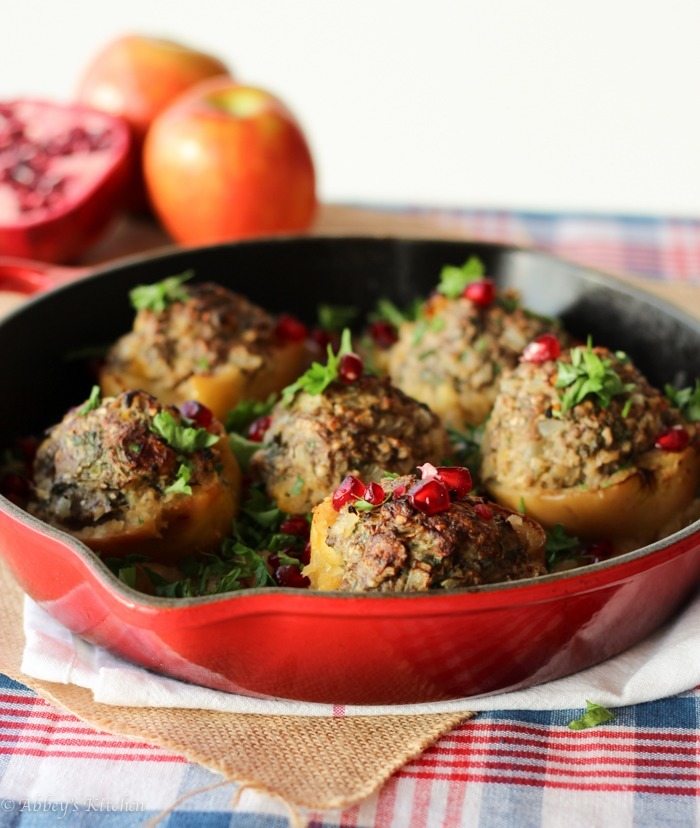
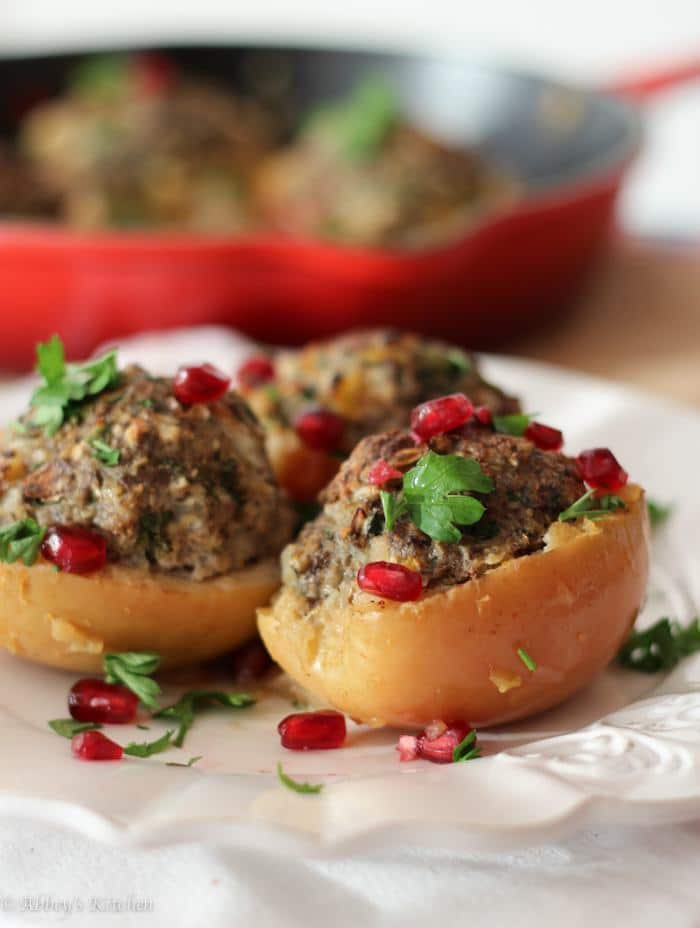
This gluten free poached apples with turkey stuffing and pomegranate will become an instant holiday tradition!

A lot of people are asking me for healthy winter recipes to enjoy between their indulgent holiday meals. You’ve been asking for more gluten free recipes, easy healthy dinner recipes, and even some weeknight takes on holiday flavours (hence this turkey stuffing idea).
gluten_free_turkey_stuffed_apples_1_of_7.jpg

So when this months #TheRecipeRedux asked us to open our favourite cookbooks and put our spin on a great looking recipe, I knew what I was looking for. I hadn’t seen a specific apple turkey stuffing recipe but I knew I could put a spin on a fruit based lamb or beef stuffing concept.
gluten_free_turkey_stuffed_apples_7_of_7.jpg

The key was finding a recipe like that in my massive stack of cookbooks. Since the Recipe Redux has been around for a whopping 54 months, we were instructed to open our books to the 54th or 154th page and get in to work in our kitchens.
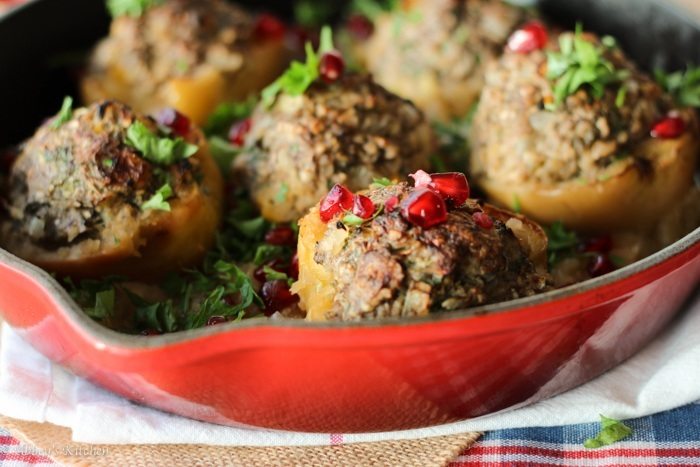
gluten_free_turkey_stuffed_apples_3_of_7.jpg

I remembered Yotam Ottolenghi’s book Jerusalem, probably one of my favourites, featured a stuffing style recipe – Lamb-Stuffed Quince with Pomegranate and Coriander and I honestly could not resist. So, no, not turkey stuffing, but definitely something I could gather some inspiration from.
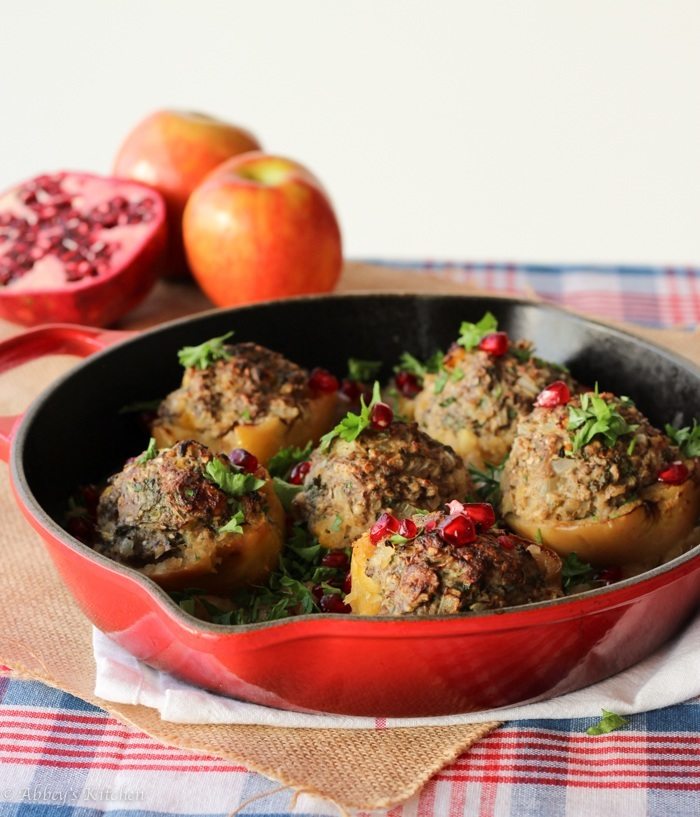
gluten_free_turkey_stuffed_apples_2_of_7.jpg

So How Did Lamb Become Turkey Stuffing?

So yah, I changed pretty much everything about the recipe. The lamb got substituted for extra lean ground turkey stuffing and minced mushrooms to cut fat (and also make a turkey stuffing for a holiday feel). The quince made way for apples, which are cheaper and more readily available. The breadcrumbs got swapped out for gluten free oats to make it an easy gluten free dinner recipe. I also changed amounts as I went (I thought it was way too much onion), altered spices and herbs, added dried fruit, and cut fat. I even changed the method to include a trip under the broiler so the ground meat didn’t look so pale and sad having been virtually poached in a apple-steam bath.
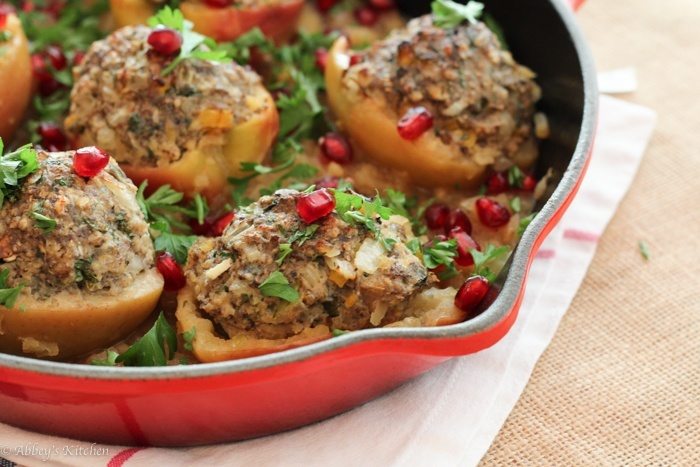
gluten_free_turkey_stuffed_apples_4_of_7.jpg

In the end, I was really, really happy with it. My fiancé and I gobbled it up and I ate the turkey stuffing leftovers for breakfast. Yes, I ate it for breakfast BECAUSE THE FLAVOURS WERE LEGIT BREAKFAST-Y. Don’t judge, guys.
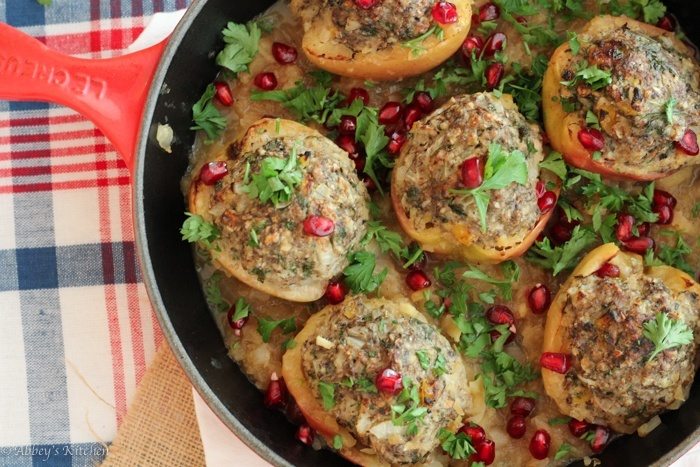
gluten_free_turkey_stuffed_apples_5_of_7.jpg

Love this idea for a gluten free turkey stuffing? Leave me a comment below with some of your favourite turkey recipes!
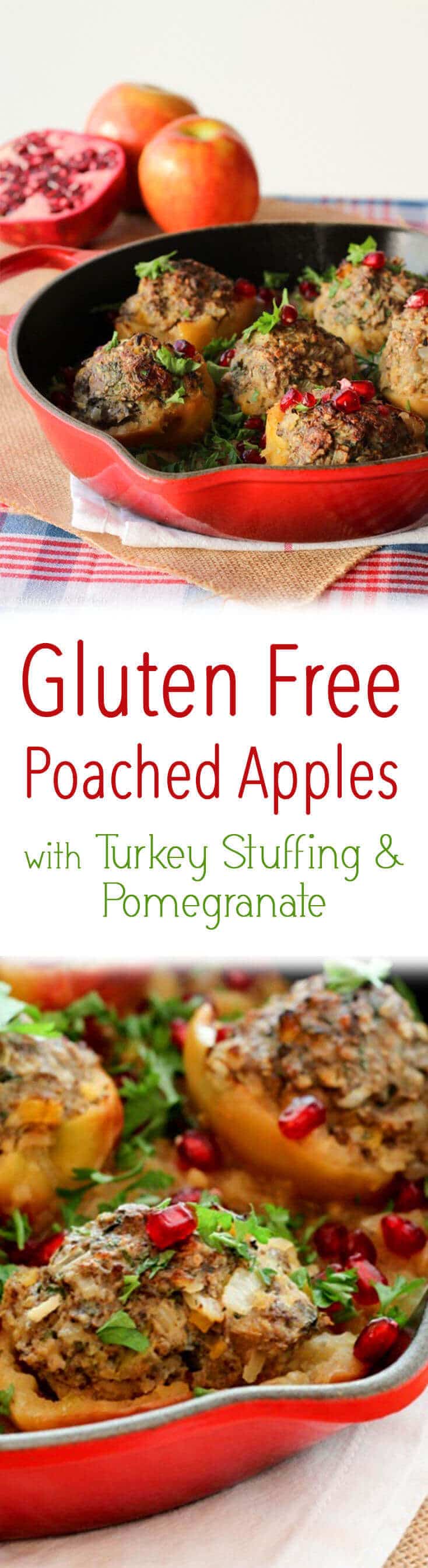
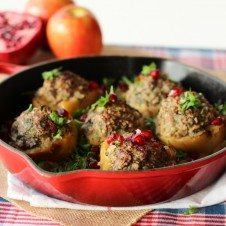
These Poached Apple with Turkey Stuffing are a great gluten free holiday recipe!

Gluten Free Turkey Stuffing
Print Recipe
5 from 1 vote

Gluten Free Poached Apples with Turkey Stuffing and Pomegranate

This gluten free poached apples with turkey stuffing and pomegranate will become an instant holiday tradition!
Prep Time20 minutes mins
Cook Time33 minutes mins
Total Time53 minutes mins
Course: Main Dish
Servings: 6 people
Calories: 420kcal
Author: Abbey Sharp

Ingredients

Meat Filling

  • 250 g cremini mushrooms stems removed and roughly chopped
  • 1 clove garlic finely minced
  • 1 tbsp finely grated ginger
  • 1/4 cup gluten free oats
  • 1/3 cup parsley chopped
  • 1/4 tsp all spice
  • 1/4 tsp cinnamon
  • 3 tbsp dried apricots minced
  • 1/2 medium onion finely chopped
  • 1 egg
  • 250 g extra lean ground turkey
  • 1/2 tsp salt
  • 1/4 tsp pepper
  • 3 apples cut in half lengthwise

Sauce

  • 1 tsp extra virgin olive oil
  • 1/2 medium onion finely chopped
  • 1 tbsp Reserved apple scraps
  • 1 tbsp finely grated ginger
  • 1 1/2 cups reduced sodium chicken stock
  • 3 tsp pomegranate molasses
  • 1 tsp coconut sugar
  • 1 lemon juice only
  • Salt and pepper to taste
  • Parsley finely chopped
  • 1/4 cup pomegranate seeds

Instructions

Meat Filling

  • Add the mushrooms to a food processor and pulse until they reach a “ground meat” like consistency. Add to a bowl.
  • Add the garlic, ginger, oats and parsley to the food processor and pulse until the oats break up and reach a rough powder like consistency. Add this to the bowl.
  • Add in the all spice, cinnamon, apricots, onion, egg, turkey, salt and pepper and mix until well distributed.
  • Using a melon baller, remove the core and the stem and discard. Then hollow out the apple, reserving this apple filling and leaving at least 1/4 inch of apple around the edges.
  • Fill the hollowed out apple halves with the meat mixture and set aside.

Sauce

  • Meanwhile, add the olive oil to an oven-safe skillet or pan over medium heat. Add in the onion, apple scraps and ginger and cook on medium heat for about 8 minutes, until soft.
  • Add in the chicken stock, molasses, coconut sugar, and lemon juice and add in the apple halves with the meat facing up. Cover with a lid and simmer on low heat for 25 minutes, or until a thermometer reaches 165 F.
  • Preheat the broiler and transfer the skillet to the oven to broil the tops of the meat and apples until browned.
  • Season the sauce with salt and pepper, scatter with pomegranate seeds and parsley.

Nutrition
Calories: 420kcal
Abbey Sharp

Abbey Sharp is a Registered Dietitian (RD), regulated by the Ontario College of Dietitians. She is a mom, YouTuber, Blogger, award winning cookbook author, media coach specializing in food and nutrition influencers, and a frequent contributor to national publications like Healthline and on national broadcast TV shows.
www.abbeyskitchen.com/about-abbey/

Last Updated November 16, 2016. Published November 16, 2016 By Abbey Sharp 17 Comments

Best New Healthy Snacks – Bars, Shakes, Nut Mixes

Two RXBARs.

I share my favourite best new healthy snacks that I sampled at the American Nutrition Expo in Boston including bars, shakes and snack mixes.

Every year, dietitians from the US (and a handful of us die hard Canadians) gather for an annual conference and expo called FNCE (Food & Nutrition Conference & Expo). Last year was my first year attending and I sampled and brought home a bunch of the best new healthy snacks I’ve ever had. This year I was determined to do an even more deep dive into the healthy snack offerings and do a little bit of a recap for you all!

By the end of the expo I had accumulated a massive arsenal of some of the best new healthy snacks I think any health nut has ever seen. I had a massive sack (it was like adult trick or treating) and there was no way it was even going to fit into my luggage. So I shipped it express back home and voila! Now I have some of the best new healthy snacks in my pantry to last me until next year’s conference (okay, so I expect I’ll only make it to December but it’s a start).

Of all the snacks I tasted, I thought I would share some of my favourites here! Check out some of the best new healthy snacks available in stores now!

Best New Healthy Snacks

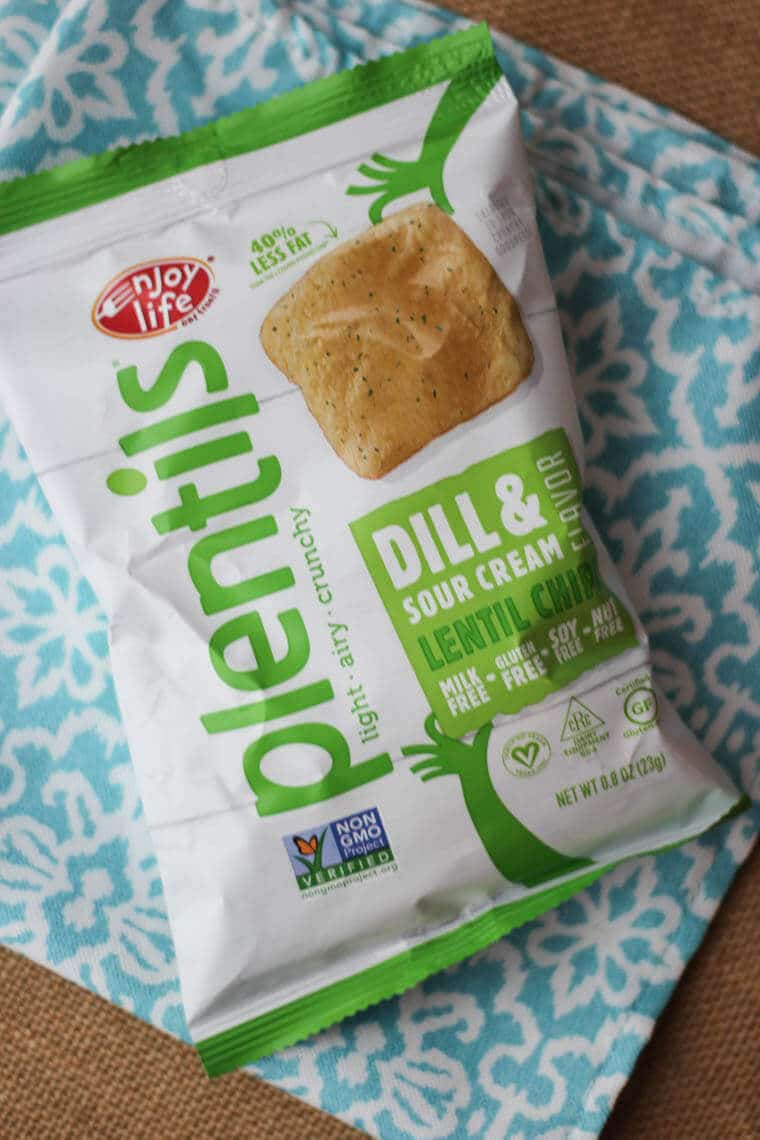
Plentils by Enjoy Life

These are light, crunchy, gluten free, and an awesome way to get your chip fix for only 100 kcal!

A bag of plentils chips.

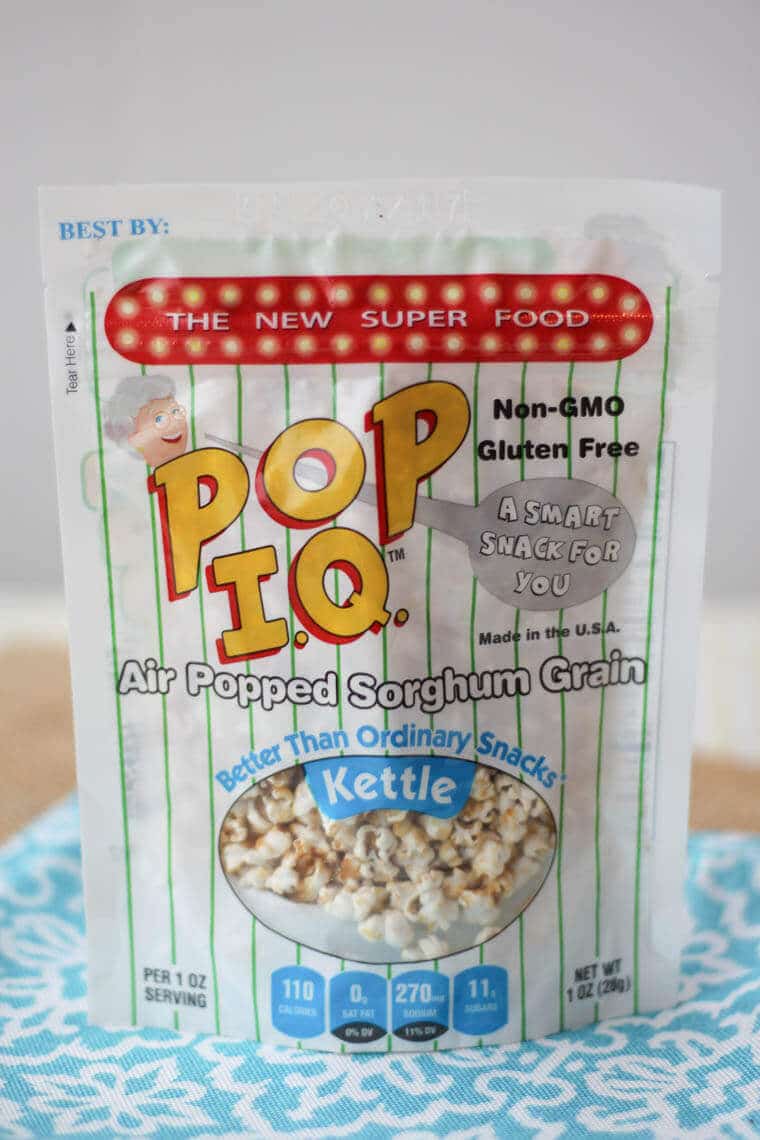
Pop IQ Sorghum Grain

I’m obsessed with sorghum as a gluten free whole grain and this popped version has just 110 calories per ounce plus 2 grams each of protein and fibre. Just look how cute this is- it’s like popcorn for ants!

A bag of POP IQ popped sorghum grain.

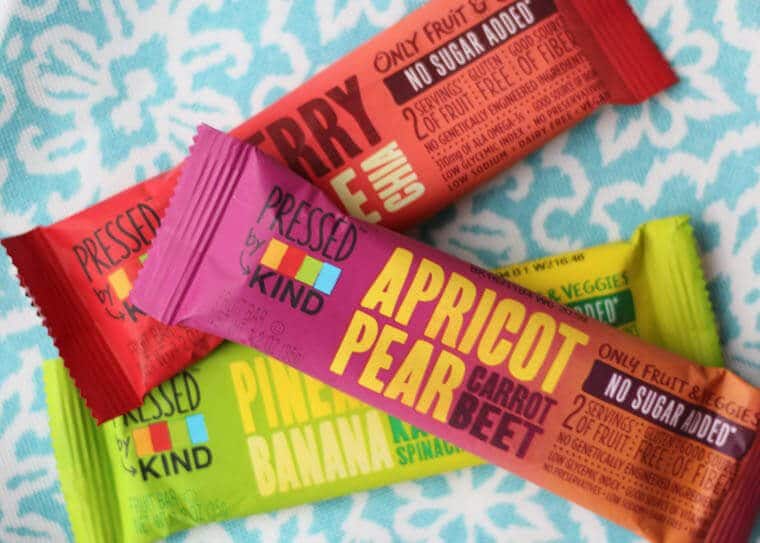
Pressed by KIND

For those days you just think you’re not going to get in your veg, I’m loving these all fruit and veggie bars by KIND. They have no sugar added, with 2 servings of fruit, 4 grams of fibre for just over 100 calories. And the ingredients? In this flavour, it’s just pear, apple, carrot, apricot and beets.

KIND bars.

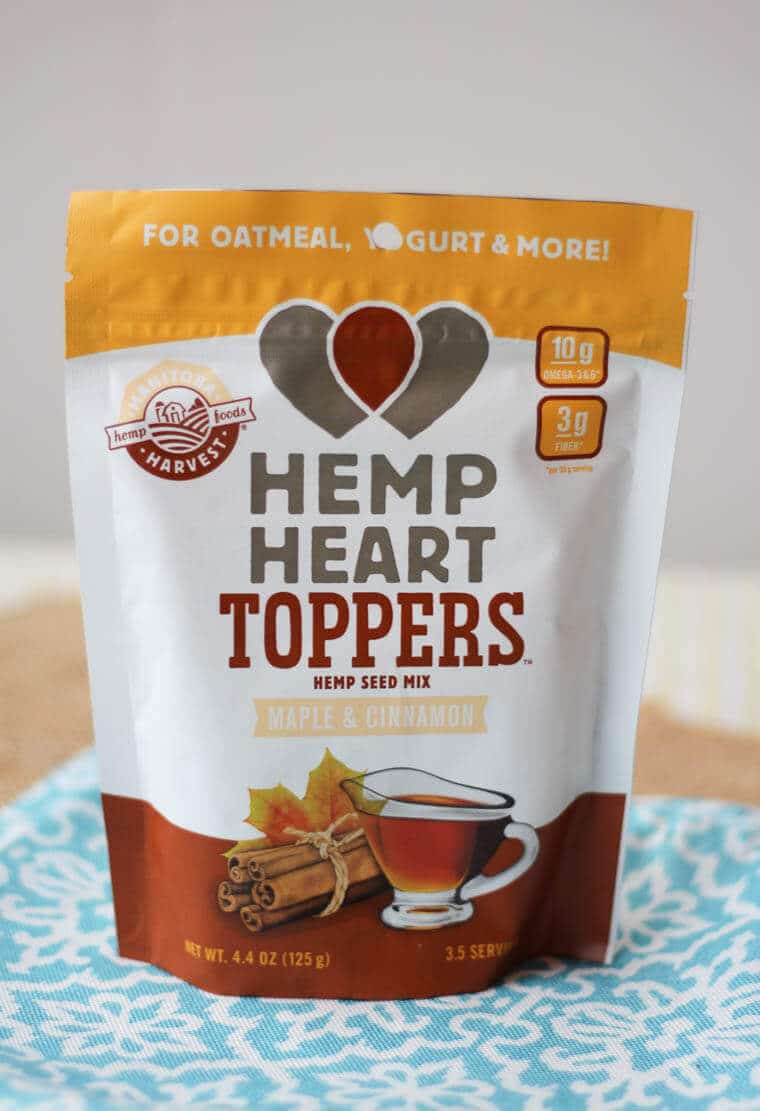
Hemp Heart Toppers

I’ve always been a fan of hemp hearts, but I’m obsessed with these flavoured toppers for throwing on cereal, oatmeal or yogurt. In a ¼ cup you get 10 g protein, 3 g fibre, plus heart healthy omega 3s so yes, I’ve been topping everything.

A bag of hemp heart toppers.

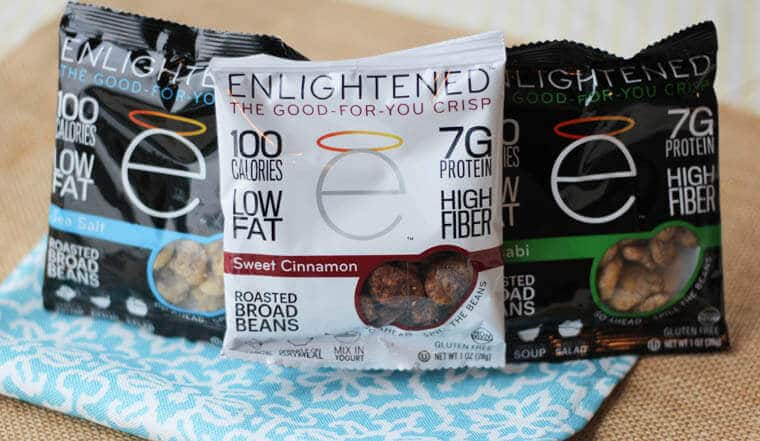
Enlightened broad beans

Okay so I’ve been munching on these like crazy since I got home. Each little pack is 100 calories, with 7 g protein, and 6 g fibre plus they come in savoury and sweet varieties. PS: the chocolate is AMAZING.

A bag of Enlightened crisps.

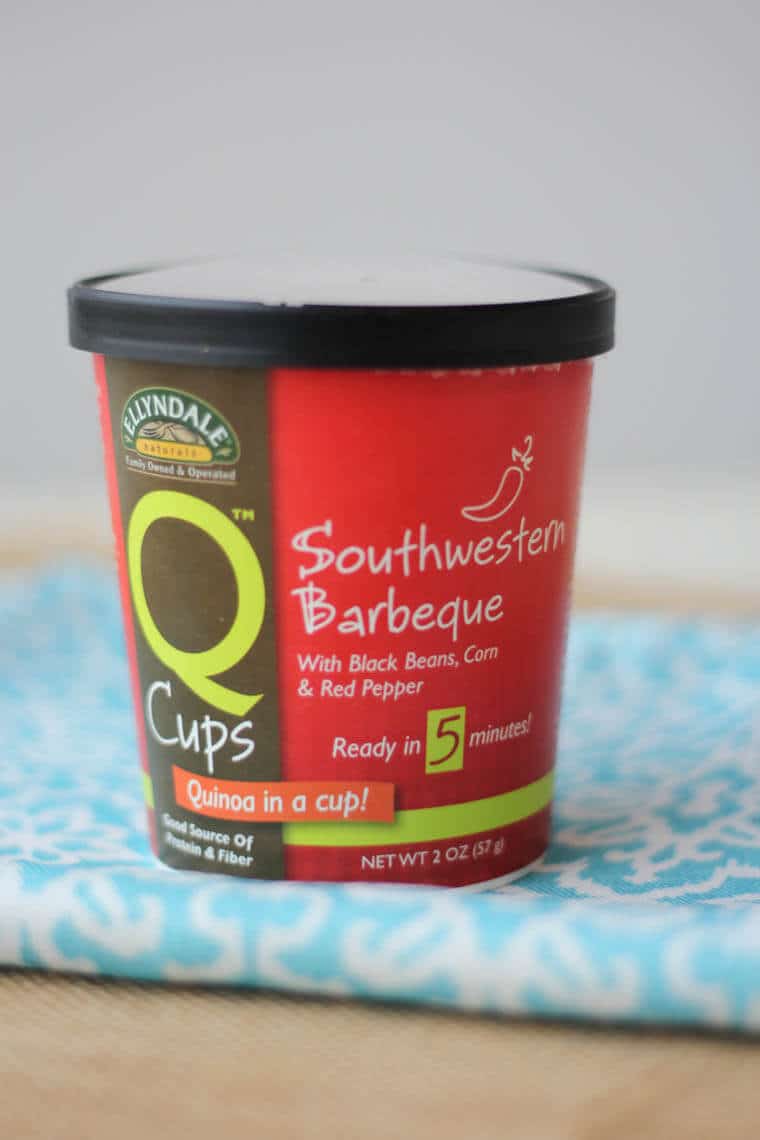
Ellyndale Quinoa in a Cup

I love the idea of making healthy food convenient, and this quinoa in a cup totally fits the bill. You get 7 g of fibre and 7 g protein in each 220 calorie cup and I’m totally in love with the southwestern BBQ flavour.

A container of Q Cups.

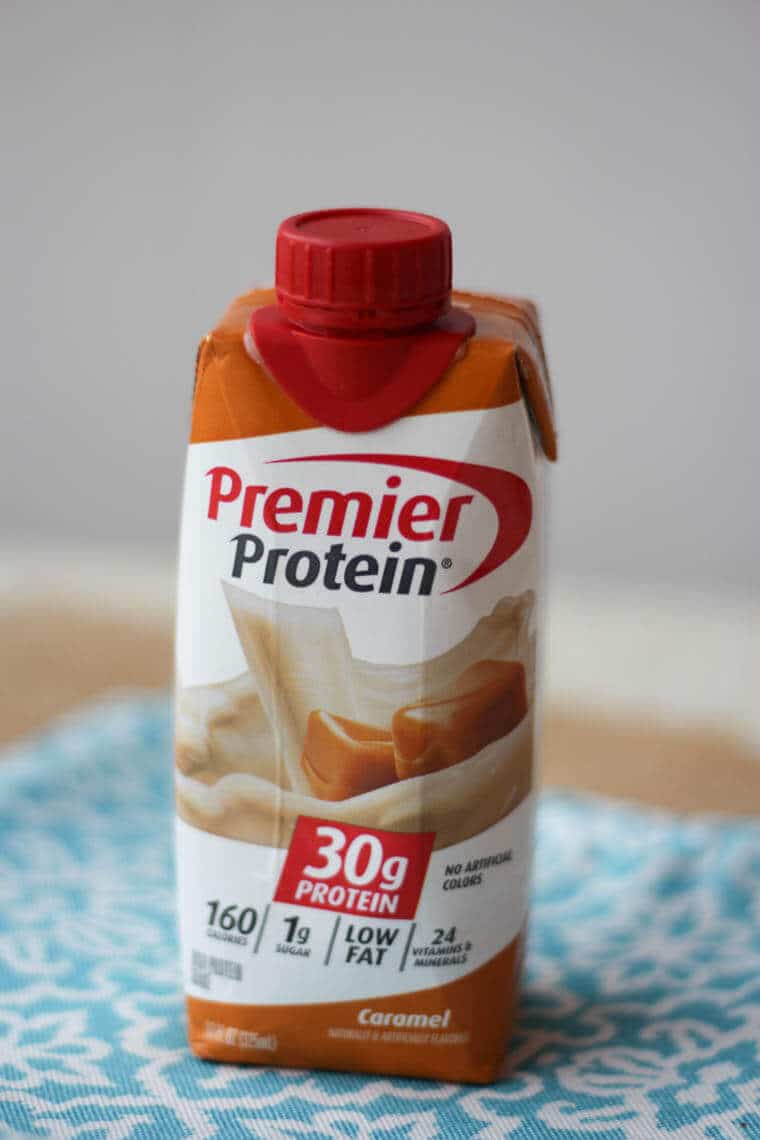
Premier Protein Caramel Shake

Anyone who knows me knows I’m obsessed with caramel anything so this protein shake really is my style. You get 30 grams of protein, 160 calories, only 5 g carb in each shake and OMG they’re really good.

A bottle of premier protein.

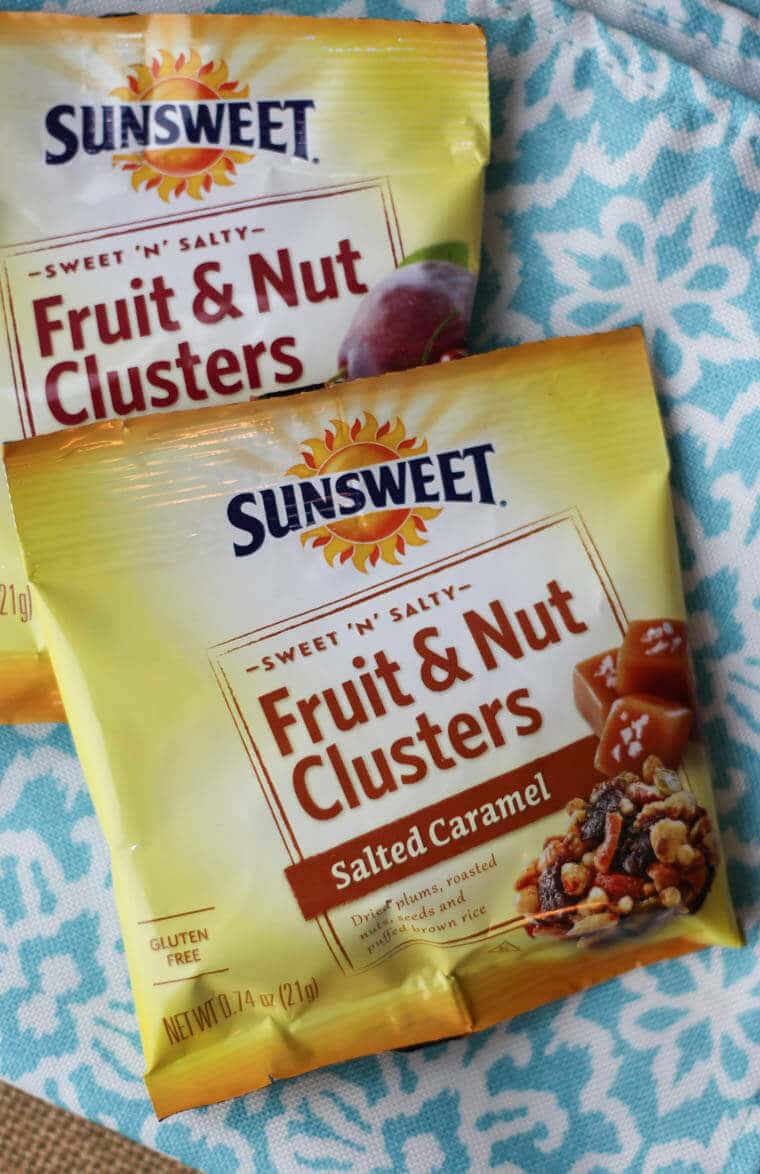
Sunsweet Sweet n’ Salty Salted Caramel Clusters

Again. Caramel. But this time with the goodness of sweet prunes. Each little package packs 100 calories with 2 g each of fibre and protein and OMG they taste amazing.

A bag of Sunsweet fruit and nut clusters.

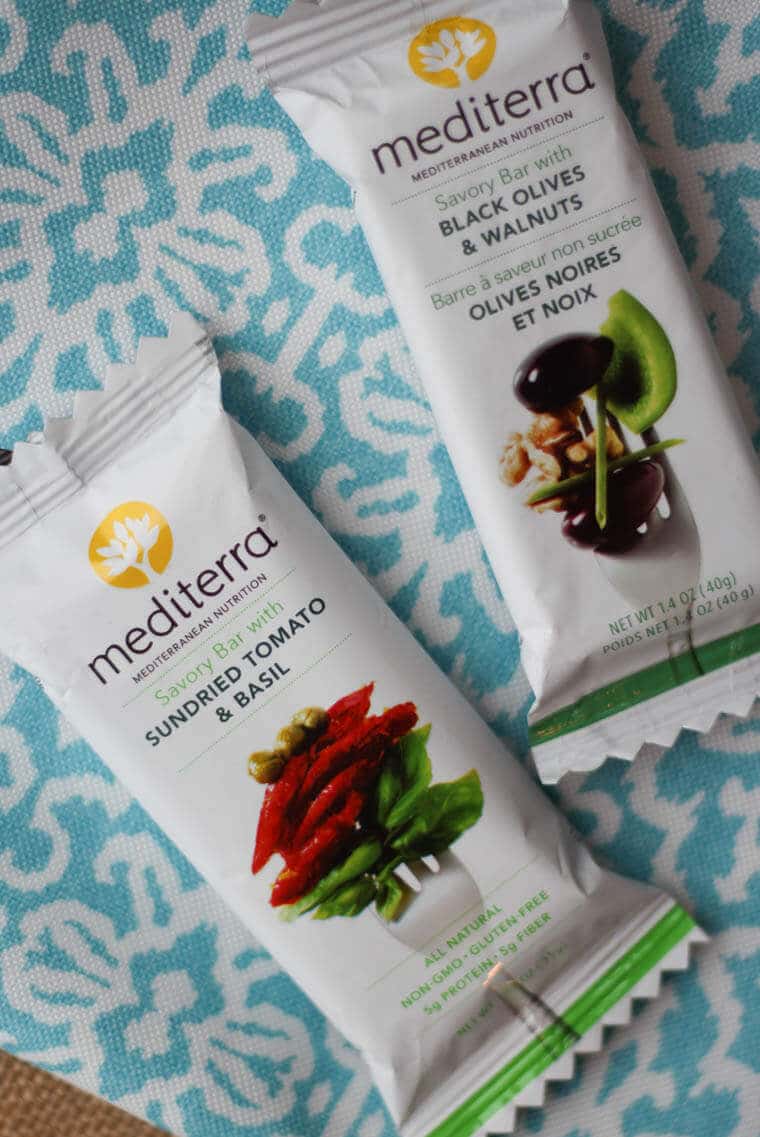
Mediterra Savory Bar

Made with pea protein, nuts, veggies and herbs, these bars are a refreshing change from the typical sweet granola bar. The tomato and basil version has just 140 calories, plus 5 g each of fibre and protein.

Mediterra bars.

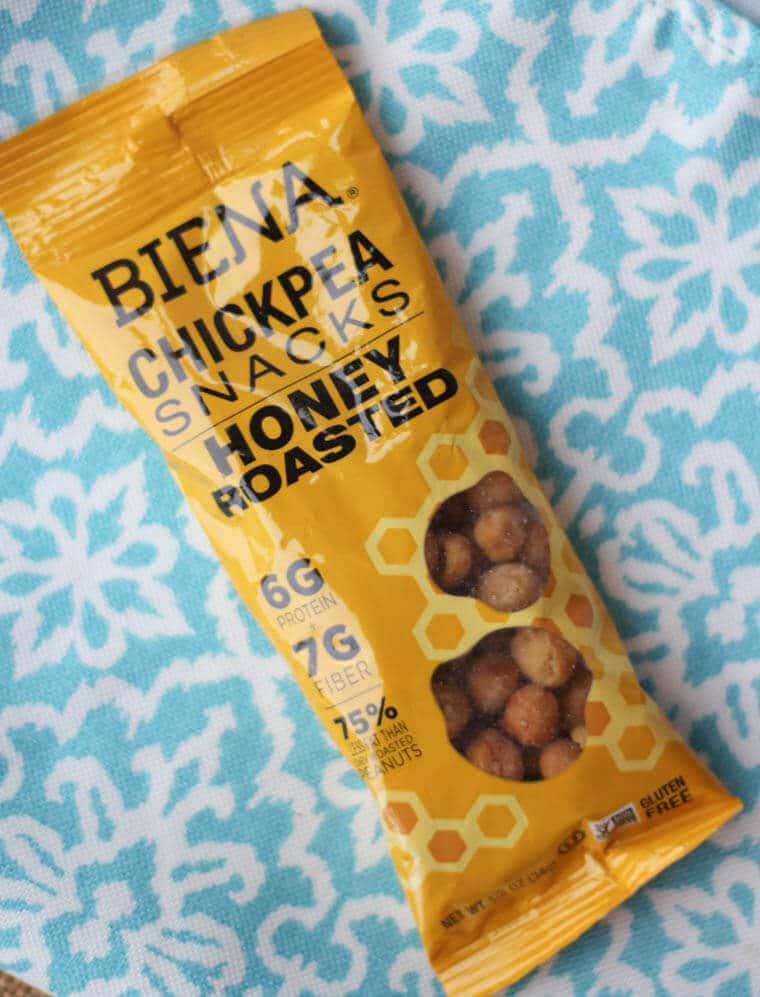
Biena Chickpea Snacks

OK so I’m obsessed with these. I’ve tried a lot of roasted chickpeas but these are by far the best b/c they’re so deliciously crisp without tasting dry. You also get about 150 calories per package with 7 g fibre and 6 g protein so I’ve been putting them on everything.

A pack of Biena chickpea snacks.

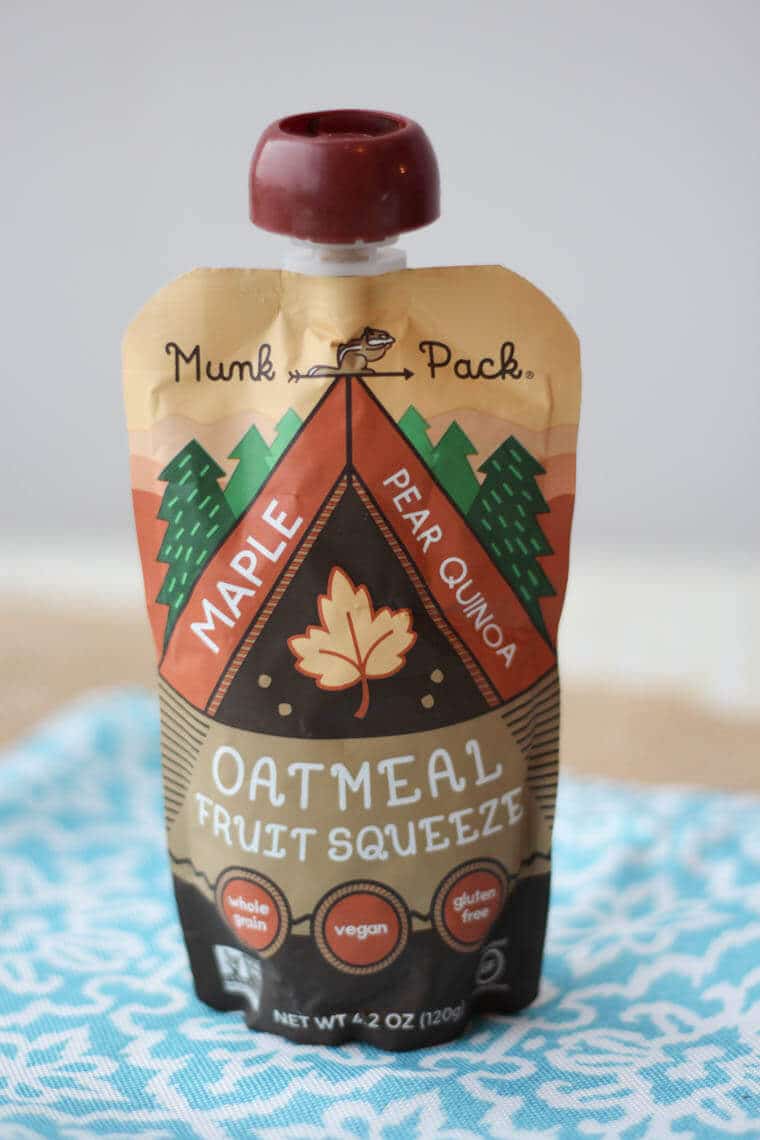
Munk Pack Oatmeal Fruit Squeeze

This is actually oatmeal in a squeeze tube with 90 calories, 3 g fibre and 2 g protein plus heart healthy omega 3s. This is awesome for the days your on the go, camping or travelling and need a wholesome breakfast sans stove.

A pack of oatmeal fruit squeeze.

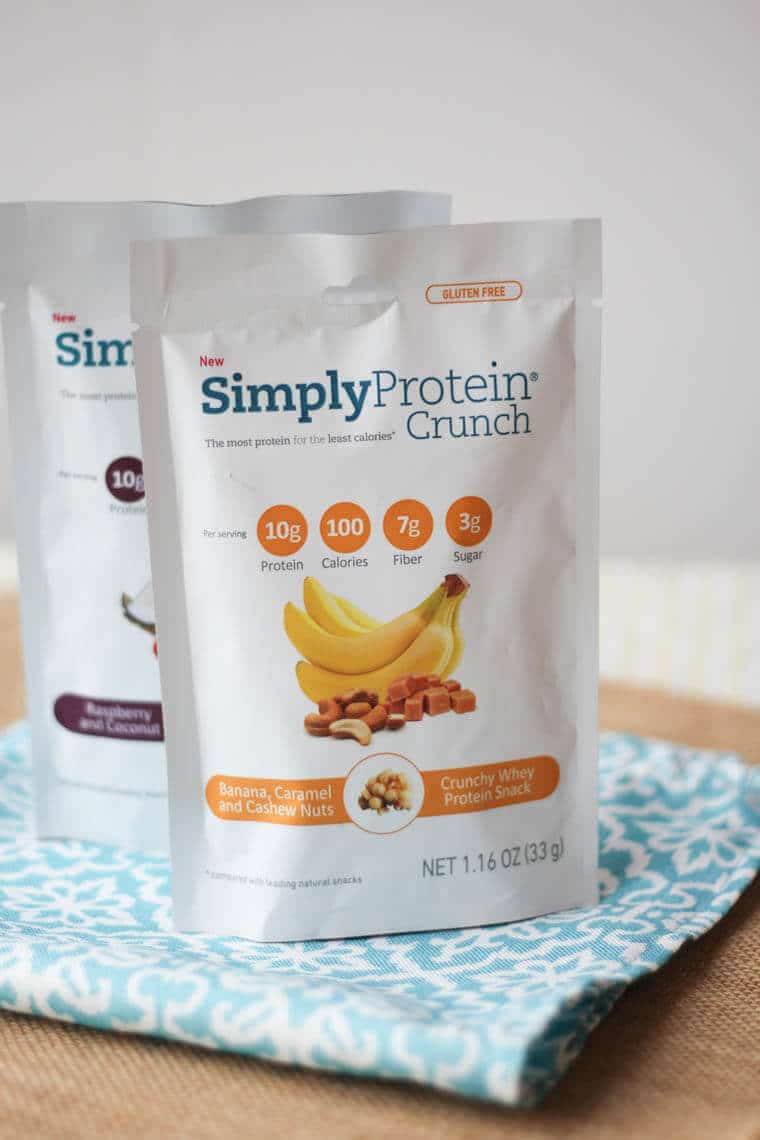
Simply Protein Crunch

Simply protein is known for packing in the most protein for the least calories so these crunchy little morsels offer 100 calories, 10 g protein and 7 g of fibre per bag. PLUS they come in Banana Caramel Cashew flavour so I’m a happy girl.

A bag of Simply Protein Crunch.

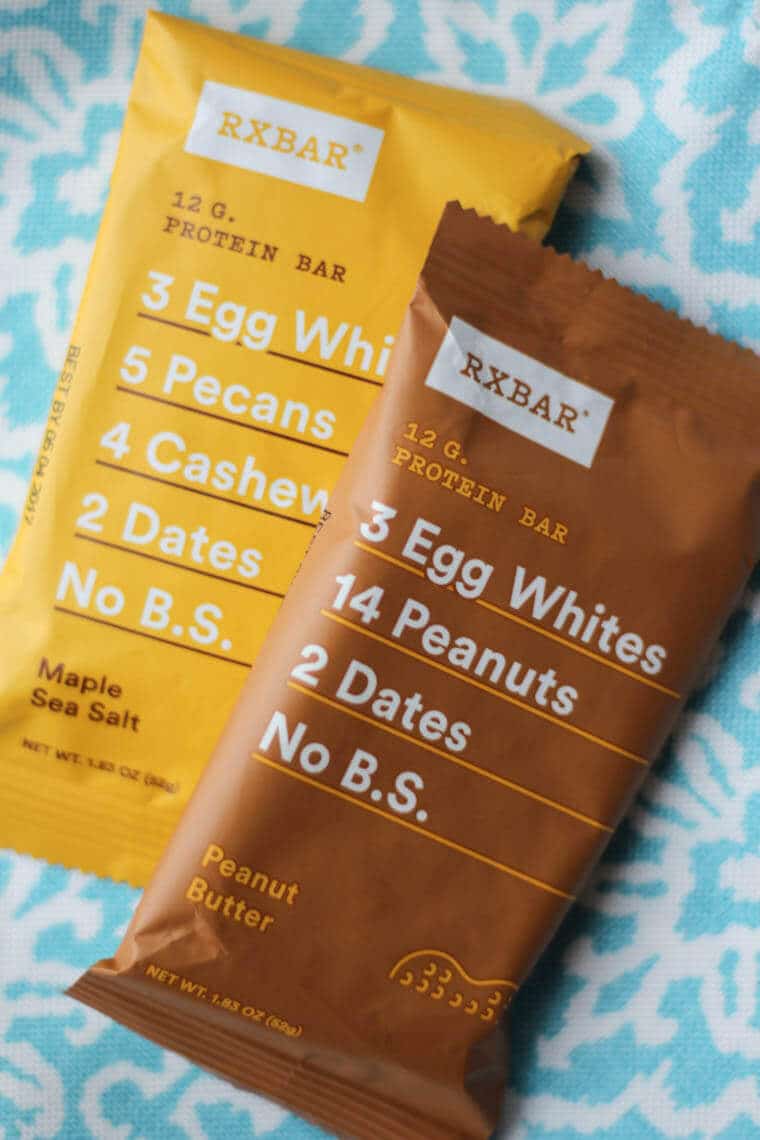
RX Bar

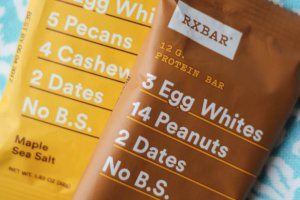
Most protein bars have about 100 ingredients, but RX bars are made with just egg whites, nuts, and dates. Pretty damn awesome. I’m kinda obsessed with the maple sea salt flavour which has 3 g fibre and 12 g protein per 210 calorie bar.

Two RXBARs.

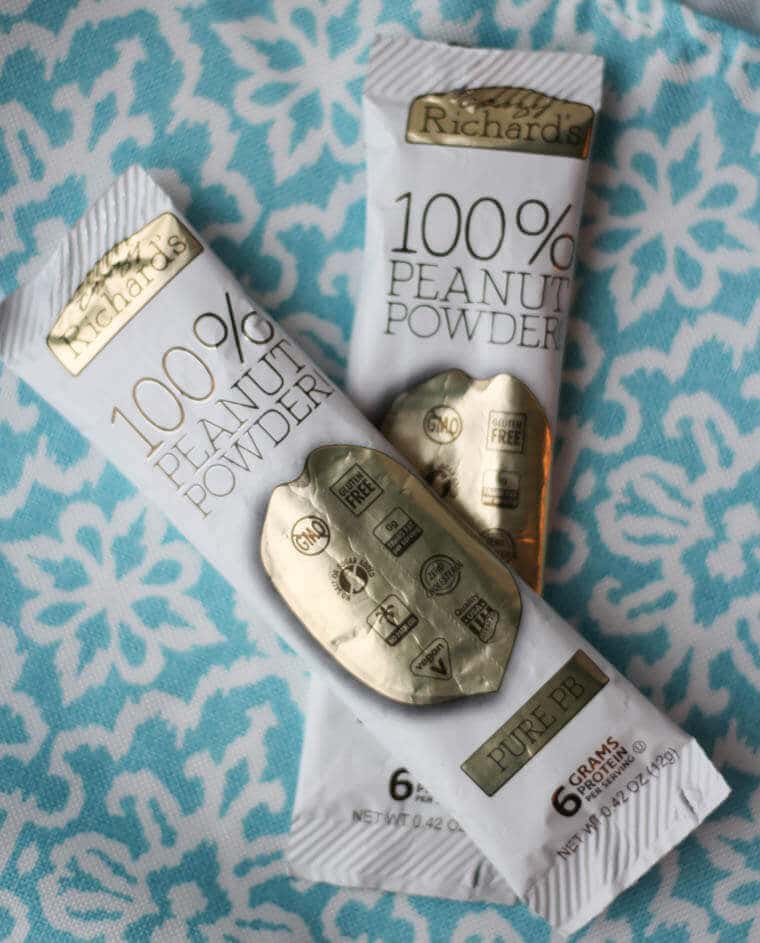
Crazy Richards 100 % Peanut Powder

So you guys know I’m crazy about PB, and this powdered peanut butter has just 50 calories, 2 g fibre, 6 g protein per package. YES! I throw it into smoothies, oatmeal and yogurt and do a happy dance.

Two packs of peanut powder.

What are some of the best new healthy snacks you’ve tried? Leave me a comment below with some of your favourite bars, shakes and other snackable treats! I would love to hear what you’re digging these days!

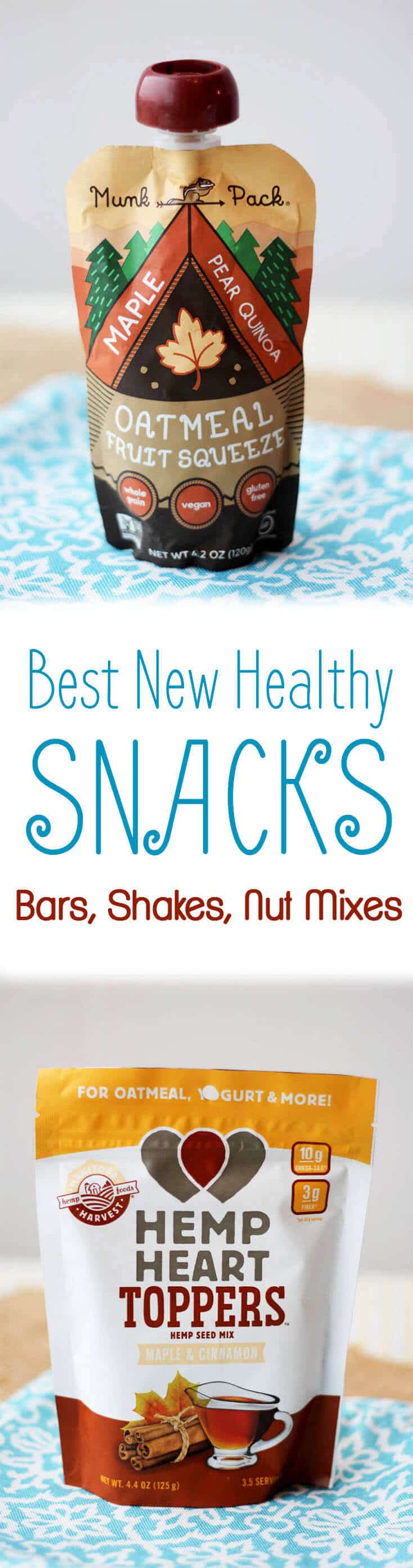
A pinterest image of snacks with the text overlay \"Best New Healthy Snacks Bars, Shakes, Nut Mixes.\"

Disclaimer: All of the products were given to me as samples at the conference (anyone at the conference was allowed to take samples). I was also given a free media pass to attend FNCE.

Abbey Sharp

Abbey Sharp is a Registered Dietitian (RD), regulated by the Ontario College of Dietitians. She is a mom, YouTuber, Blogger, award winning cookbook author, media coach specializing in food and nutrition influencers, and a frequent contributor to national publications like Healthline and on national broadcast TV shows.
www.abbeyskitchen.com/about-abbey/

Last Updated October 23, 2020. Published November 14, 2016 By Abbey Sharp 45 Comments

Gluten Free Tuna Noodle Casserole | Healthy, Low Carb Casserole

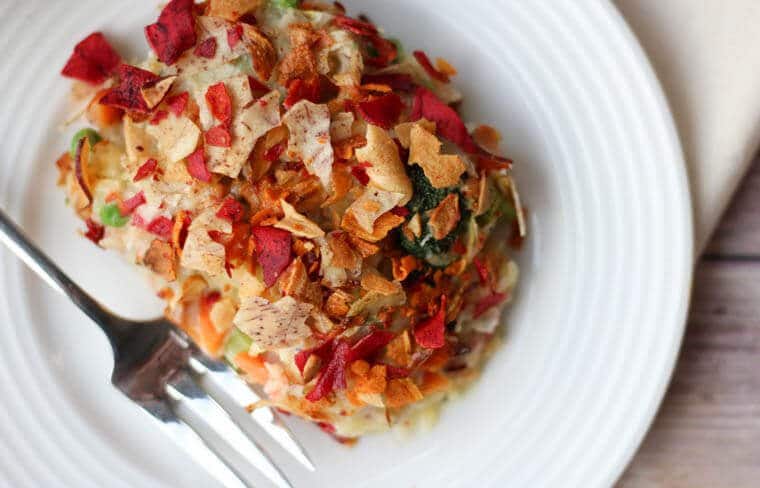
A serving of tune casserole on a plate.

DISCLAIMER: This post was developed in sponsored partnership with Terra Chips, however, as always, all opinions are genuine.

This healthy gluten free tuna noodle casserole is a lightened up, low carb version of the classic comfort food dish.

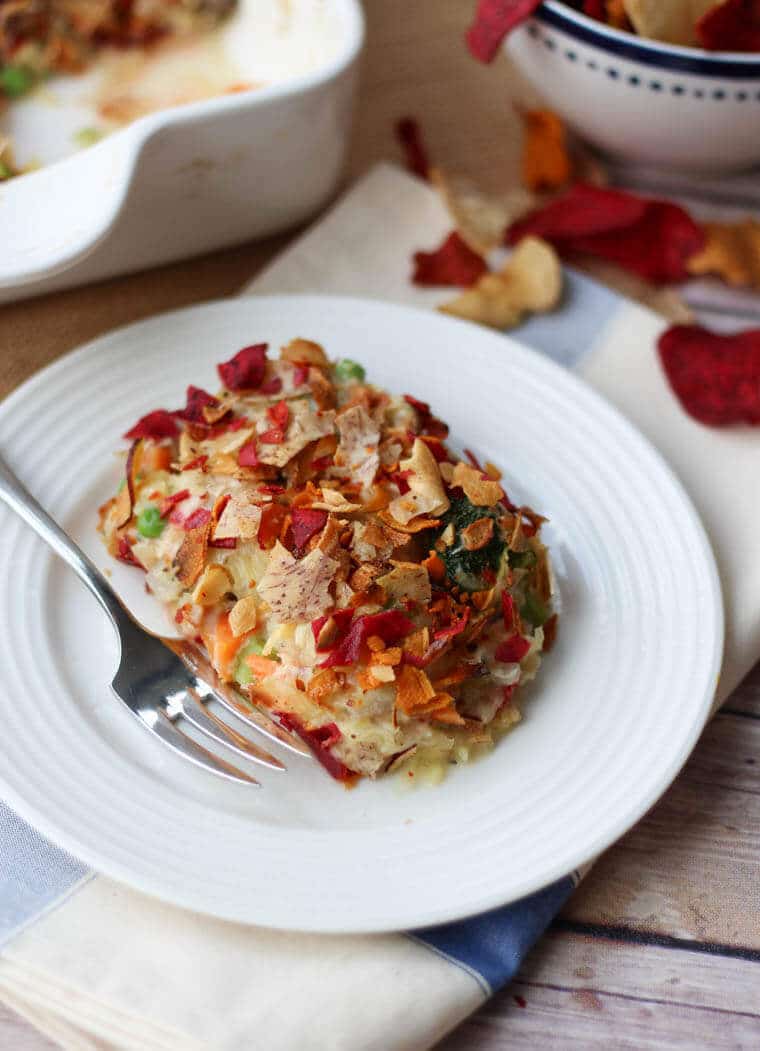
A white plate with a serving of tuna noodle casserole.

My mother wasn’t always enthusiastic about cooking dinner. It was no fault of hers- I was admittedly a picky polly and only ate chicken nuggets and fries, so I can only imagine how thrilled she would be to pass that job off to the pros (aka. Swiss Chalet). One dish I do remember my mom making us was Tuna Noodle Casserole topped with a bag full of salty potato chips.

A serving of tune casserole on a plate.

As the weather gets cooler, I tend to start reminiscing about my childhood eats and I was inspired to make a healthy gluten free tuna noodle casserole to pay homage to my gluten free sister. I’m not gluten free myself, but I do like to eat light and sometimes a ton of carby pasta weighs me down. Not here! This casserole is made with spaghetti squash giving it a delicate sweetness that I really love.

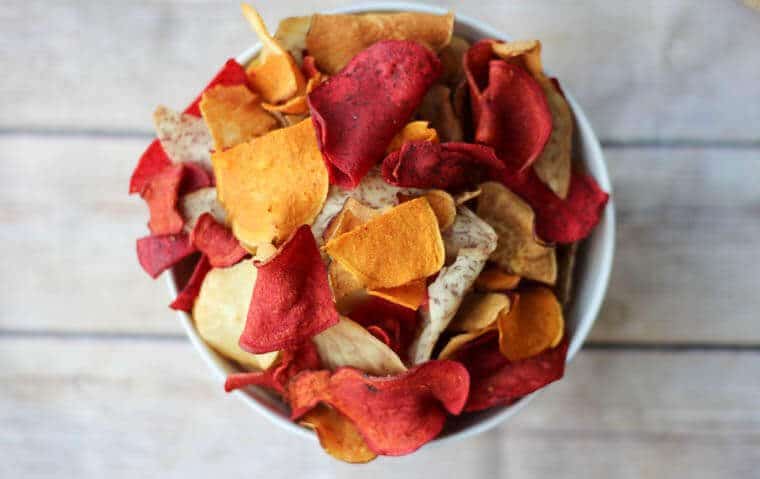
A bowl of vegetable chips.

How to Make Healthy Gluten Free Tuna Noodle Casserole

It starts with the spaghetti squash as my noodles. I usually bake mine off until they’re easily scraped into “noodles” but you can also just pop it into the microwave as well.

Then comes the sauce of my healthy Gluten Free Tuna Noodle Casserole. Instead of a ton of cream or a super fatty roux, I make min with rice flour, milk and stock plus a good amount of fresh herbs. And if you haven’t gotten your veggie fix from the squash, try adding in some mushrooms, broccoli and peas.

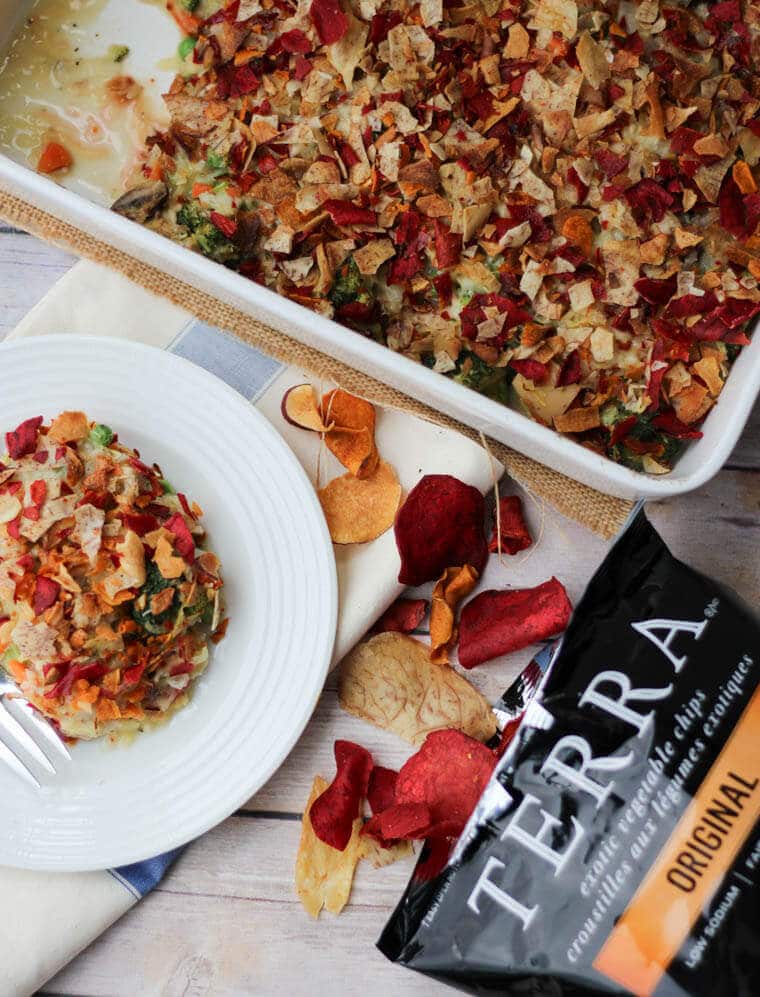
A casserole dish containing a tuna casserole with a plate on the side and Terra chips poured out beside it.

You can’t forget the tuna of course! I actually love recipes that use canned tuna because it’s an easy and light way to get your protein fix.

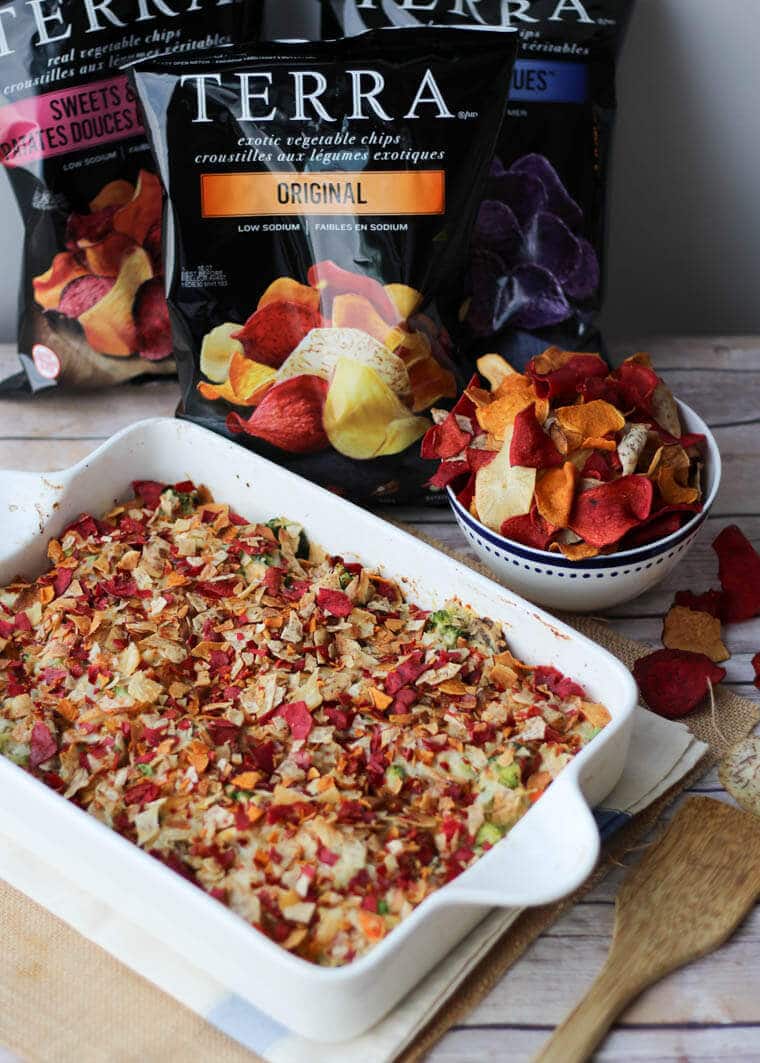
But now let’s talk about what really matters in this healthy Gluten Free Tuna Noodle Casserole. The crown. The cherry on top. The chips! And not just any chips, I used my go-to TERRA chips. They’re made from a delicious blend of exotic vegetable and potato chips that are high in fibre, low in sodium but super BIG on flavour. In this recipe I used the Original variety (with taro, sweet potatoes, batata, parsnips, yucca and beets), but they also come in Sweets & Beets and Blue chips! Talk about a tasty way to get in a serving of veg!

A white casserole dish with a bowl of vegetable chips beside it.

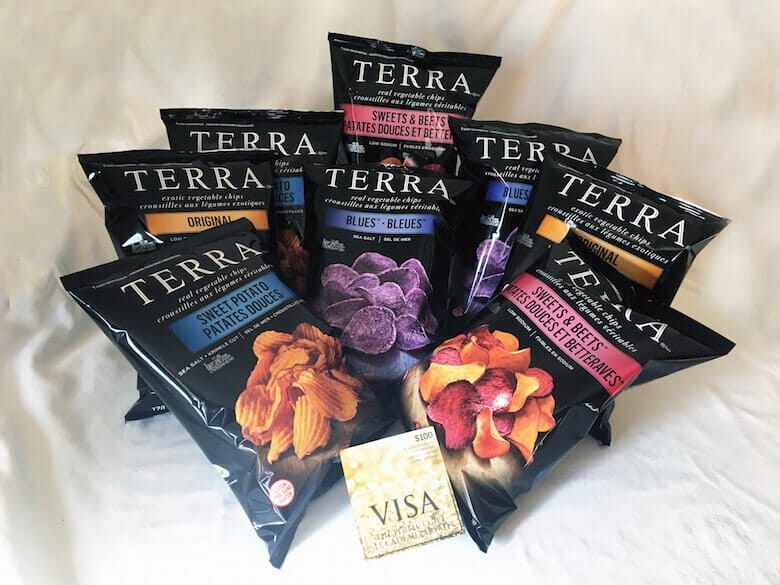
To help you have fun with TERRA Chips and create your own delicious dishes, I’m giving away a Terra Prize Pack + $100 VISA card to one lucky reader! To enter you can do any of the following (the more you do, the better chance you have to win!)

  • Follow me on Twitter @AbbeysKitchen
  • Join my subscriber list by adding your name above!
  • Leave a blog post comment on this post about what dish you would create using Terra chips!
  • Subscribe on Youtube (click here!)
  • Follow me on Instagram @AbbeysKitchen
  • Like me on Facebook (here!)
  • Follow me on Pinterest (here)
  • Tweet about the contest

Multiple bags of Terra chips.

a Rafflecopter giveaway

Have you tried making this healthy Gluten Free Tuna Noodle Casserole? What other delicious recipes can you come up with using TERRA chips? Leave me a comment below with your favourite goodies and check out their facebook page for more crunchy fun!

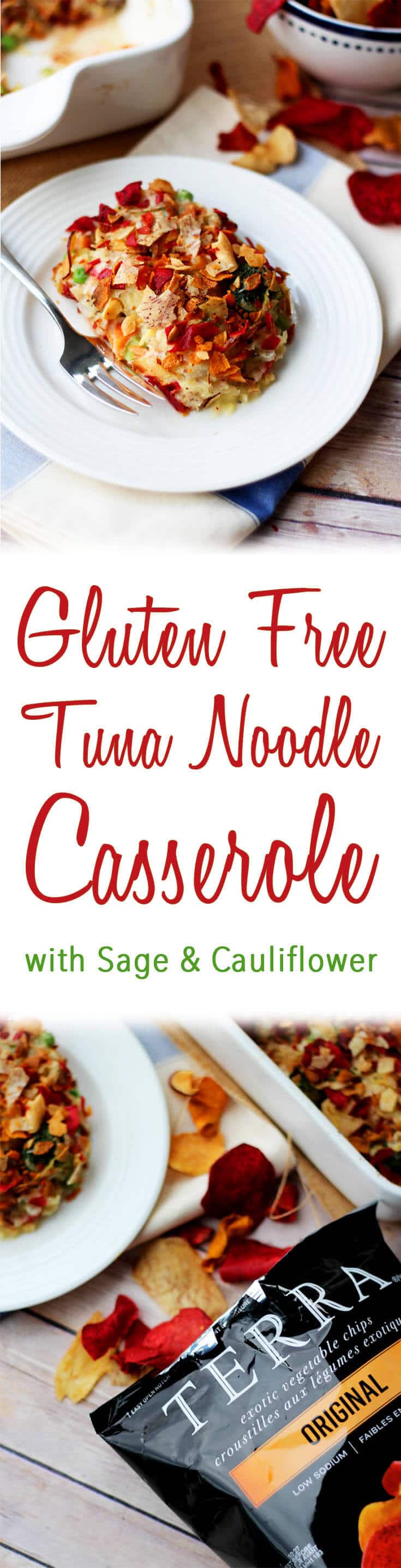
A pinterest image of a plate with a serving of casserole with the overlay text \"Gluten Free Tuna Noodle Casserole with Sage & Cauliflower.\"

Print Recipe
4.86 from 7 votes

Gluten Free Tuna Noodle Casserole | Healthy, Low Carb Casserole

This healthy gluten free tuna noodle casserole is a lightened up, low carb version of the classic comfort food dish.
Prep Time15 minutes mins
Cook Time20 minutes mins
Total Time35 minutes mins
Course: Main Dish
Servings: 8 people
Calories: 270kcal
Author: Abbey Sharp

Ingredients

  • 1 medium spaghetti squash
  • 1 tbsp olive oil
  • 1/2 onion finely minced
  • 1 stalk celery diced
  • 1 carrot finely diced
  • 1/4 cup rice flour
  • 1 1/2 cups reduced sodium vegetable stock
  • 1 1/2 cup 1 or 2% milk
  • 1 Tbsp fresh thyme leaves minced
  • 2 tbsp fresh parsley leaves chopped
  • 1 cup cremini mushrooms thinly sliced
  • 1 cup broccoli cut into small florets
  • 1 cup frozen peas
  • 2 cans albacore tuna packed in water drained well
  • 1 cup sharp cheddar cheese finely shredded
  • 1 cup Original Terra chips crushed

Instructions

  • Preheat your oven to 400 F. Lightly grease a 9x13” casserole dish and line a baking sheet with aluminum foil.
  • Cut your squash in half, place cut side down onto the baking sheet and bake for 45 minutes- 1 hour, or until the squash flesh shreds easily with a fork. Allow to cool and reduce the heat to 375 F.
  • Meanwhile, heat the olive oil in a large nonstick skillet over medium heat. Add the onion, celery and carrot and sauté until the onion becomes translucent and the carrot softens, about 7 minutes.
  • Stir in the flour and cook on medium heat for 2-3 minutes until it fully coats the vegetables.
  • Whisk in the stock and milk, and bring the mixture to a simmer. Cook for 5 minutes until the mixture begins to thicken, then add in the thyme, parsley, mushrooms, broccoli, peas, tuna and squash. Stir until fully mixed then transfer to the casserole dish.
  • Top with the cheese and bake for 10 minutes. Remove the casserole and top with the chips and bake for an additional 10 minutes or until the casserole has thickened. Enjoy!

Nutrition

Calories: 270kcal


Abbey Sharp

Abbey Sharp is a Registered Dietitian (RD), regulated by the Ontario College of Dietitians. She is a mom, YouTuber, Blogger, award winning cookbook author, media coach specializing in food and nutrition influencers, and a frequent contributor to national publications like Healthline and on national broadcast TV shows.
www.abbeyskitchen.com/about-abbey/

Last Updated October 23, 2020. Published November 9, 2016 By Abbey Sharp 5 Comments

Slow Cooker Pomegranate Poached Pears | Vegan, Gluten Free & Refined Sugar Free!

This slow cooker pomegranate poached pears is a vegan and gluten free treat that is refined sugar free! Perfect for healthy entertaining this holiday season!

This slow cooker pomegranate poached pears is a vegan and gluten free treat that is refined sugar free! Perfect for healthy entertaining this holiday season!

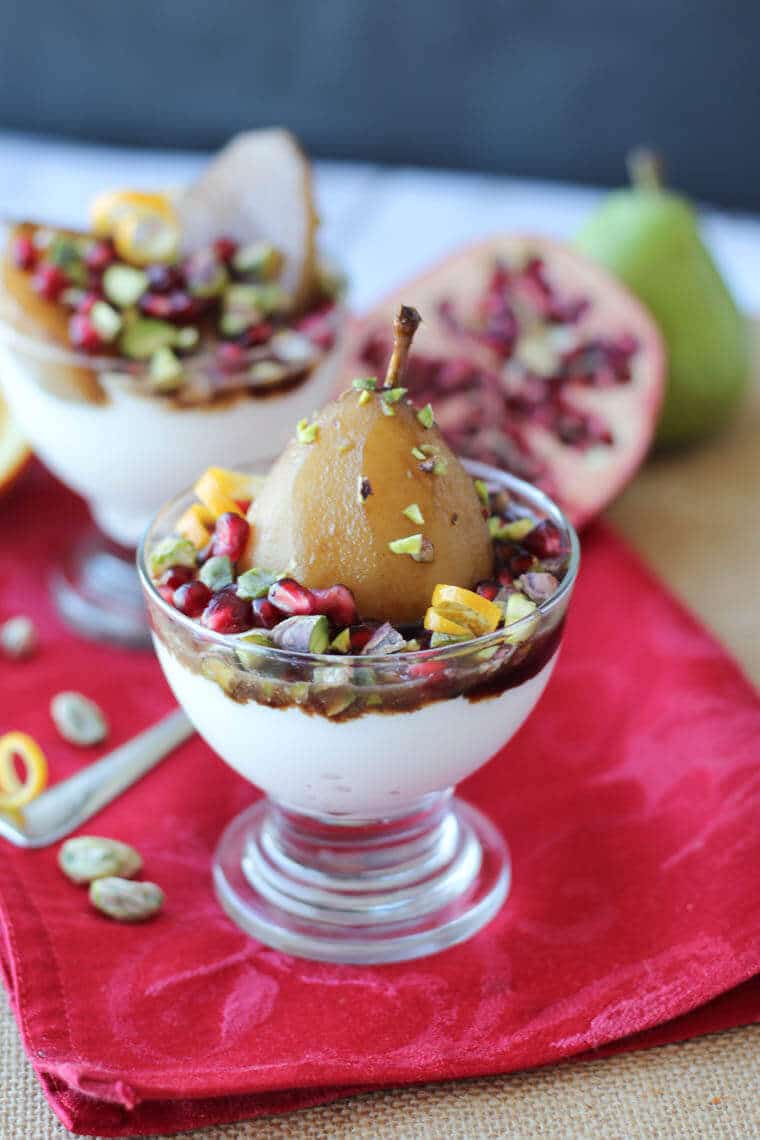
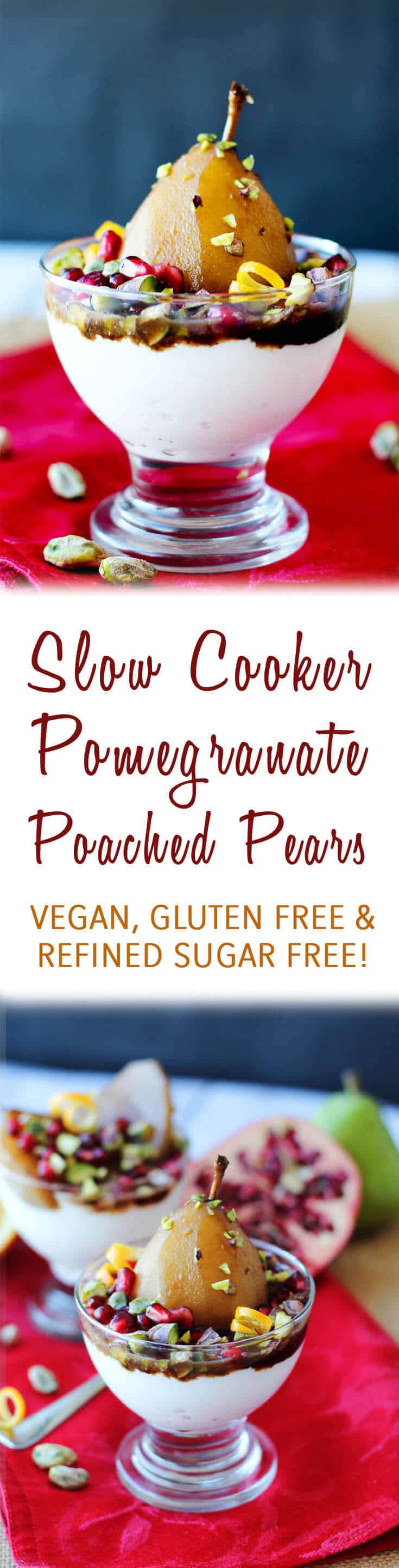
An angled photo of two cups of poached pear with one in focus.

The holidays are coming and I know I’m always looking for healthy dessert recipes that will satisfy a wide range of palates and dietary restrictions. These Slow Cooker Pomegranate Poached Pears are one of my favourites for the winter months because they’re vegan, gluten free, refined sugar free and always impress. There is nothing more exciting then coming home to the smell of fragrant baking spices in the house- especially knowing that I’ll get to tuck into something sweet after supper.

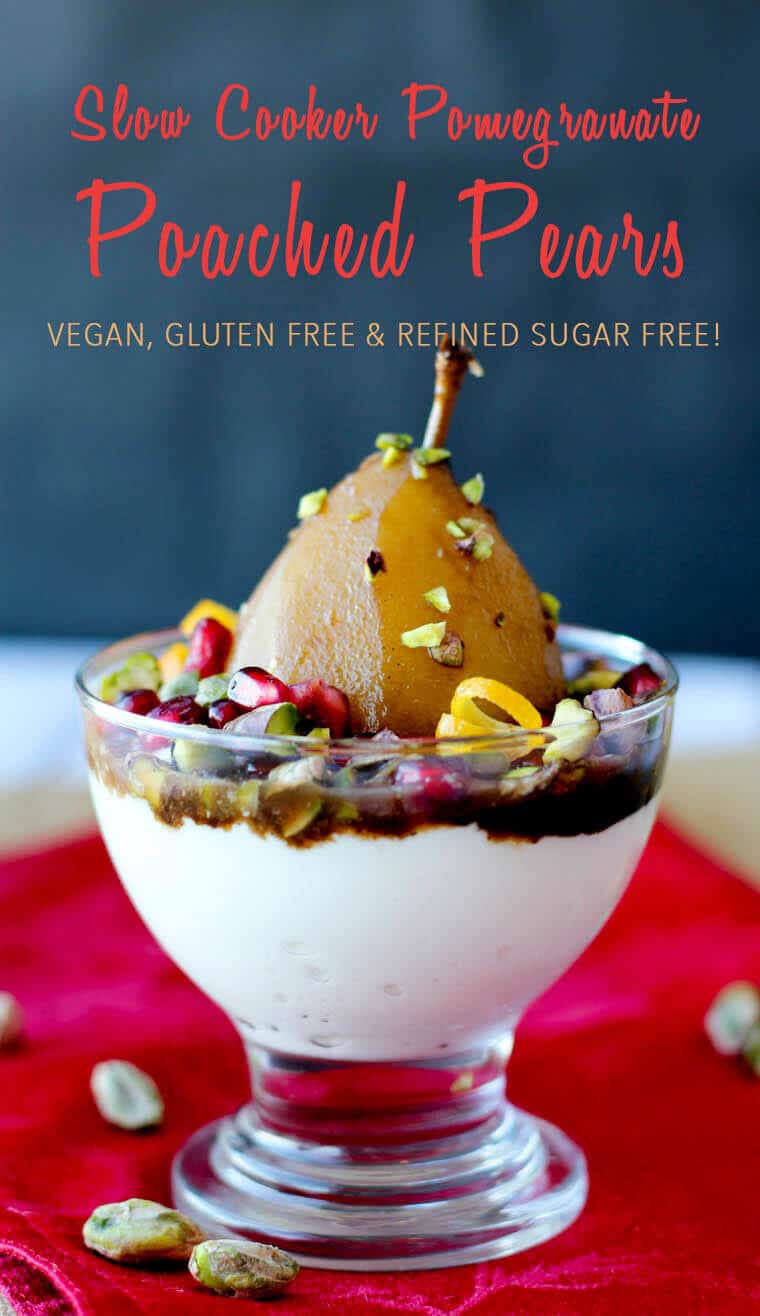
A pinterest image of a slow cooker poached pear with the overlay text \"Slow Cooker Pomegranate Poached Pears. Vegan, Gluten Free & Refined Sugar Free!\"
This recipe for slow cooker pomegranate poached pears takes the holiday flavours of pomegranate, citrus, cinnamon, ginger, and vanilla, and pumps them into the slow cooker. That means by the time you get home, it smells better than a Glade commercial film set, and you have an elegant dessert worthy of company.
 

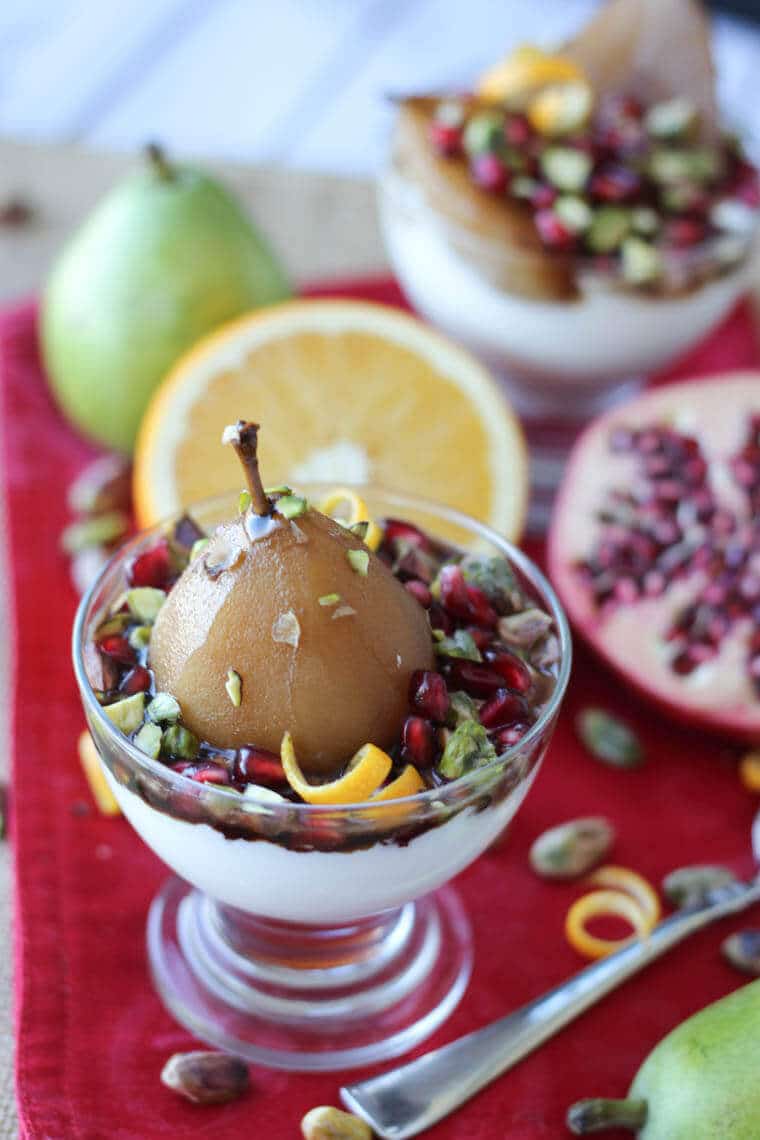
A serving of poached pear with citrus and pomegranate in the background.

How to Make Slow Cooker Pomegranate Poached Pears

Now, as you look at the ingredients in my slow cooker pomegranate poached pears, you’ll notice I don’t use any white or brown sugar here- my sweetener of choice is the super trendy ingredient- pomegranate molasses. Oh yes, yum. This stuff is literally just pomegranate juice boiled down to a satisfying syrup that’s sticky, sweet, tangy and really fruity. If you go to Israel or anywhere in the Middle East, you’ll see it used everywhere in both sweet and savoury preparations. Honestly, I’m obsessed with the stuff and have been busting it out all over town. Usually you can find it in the “International” section of your grocery store, but if not, just substitute honey or brown sugar.


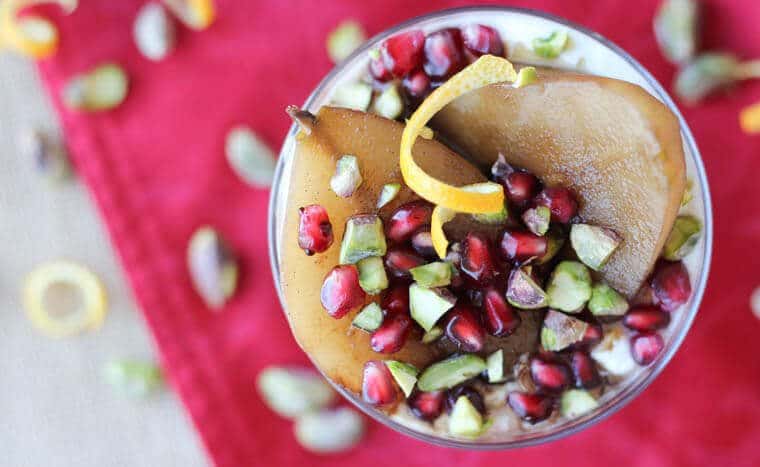
An overhead photo of poached pear overtop yogurt with pomegranate perils and pistachios sprinkled over top.I also like using petite forelle pears in this slow cooker pomegranate poached pears recipe because they look super elegant in a little dessert dish for a dinner party and are a much more manageable size for most folks after dinner.  The result is a low sugar, nutrient dense dessert that let us enjoy the holidays without the sugar-fueled bloat.

Tell me friends:

What’s your go-to healthy recipe to stay on track this holiday season?

Have you tried making delicious slow cooker pomegranate poached pears?

Let me know your thoughts!

A pinterest photo of a poached pear in yogurt with the overlay text \"Slow Cooker Pomegranate Poached Pears. Vegan, Gluten Free & Refined Sugar Free!\"

Print Recipe
5 from 2 votes

Slow Cooker Pomegranate Poached Pears

This slow cooker pomegranate poached pears is a vegan and gluten free treat that is refined sugar free! Perfect for healthy entertaining this holiday season!
Prep Time15 minutes mins
Cook Time3 hours hrs
Total Time3 hours hrs 15 minutes mins
Course: Dessert
Servings: 8 people
Calories: 210kcal
Author: Abbey Sharp

Ingredients

Poached Pears

  • 8 forelle pears
  • 2 1/2 cups pomegranate juice
  • 1 1/2 cups late harvest Riesling
  • 2 tbsp pomegranate molasses
  • 1 cinnamon stick
  • Rind from half an orange
  • 1 inch piece of ginger peeled and sliced
  • Vanilla bean split (seeds and pod)

Garnish

  • 1 cup pomegranate arils
  • 1/2 cup pistachios
  • 4 cups Coconut Yogurt for serving
  • Orange twists for garnish

Instructions

  • Peel pears and remove the core with a melon baller. Transfer to the slowcooker with the juice, wine, molasses, cinnamon stick, orange, ginger, and vanilla bean. Cook on low for 3-4 hours.
  • Before serving, reduce the poaching liquid over high heat on the stove until thick and syrupy, about 8- 10 minutes.
  • Serve on a bed of yogurt with a drizzle of sauce, almonds and pomegranate seeds.

Nutrition

Calories: 210kcal
Abbey Sharp

Abbey Sharp is a Registered Dietitian (RD), regulated by the Ontario College of Dietitians. She is a mom, YouTuber, Blogger, award winning cookbook author, media coach specializing in food and nutrition influencers, and a frequent contributor to national publications like Healthline and on national broadcast TV shows.
www.abbeyskitchen.com/about-abbey/

Last Updated October 4, 2021. Published November 8, 2016 By Abbey Sharp 31 Comments

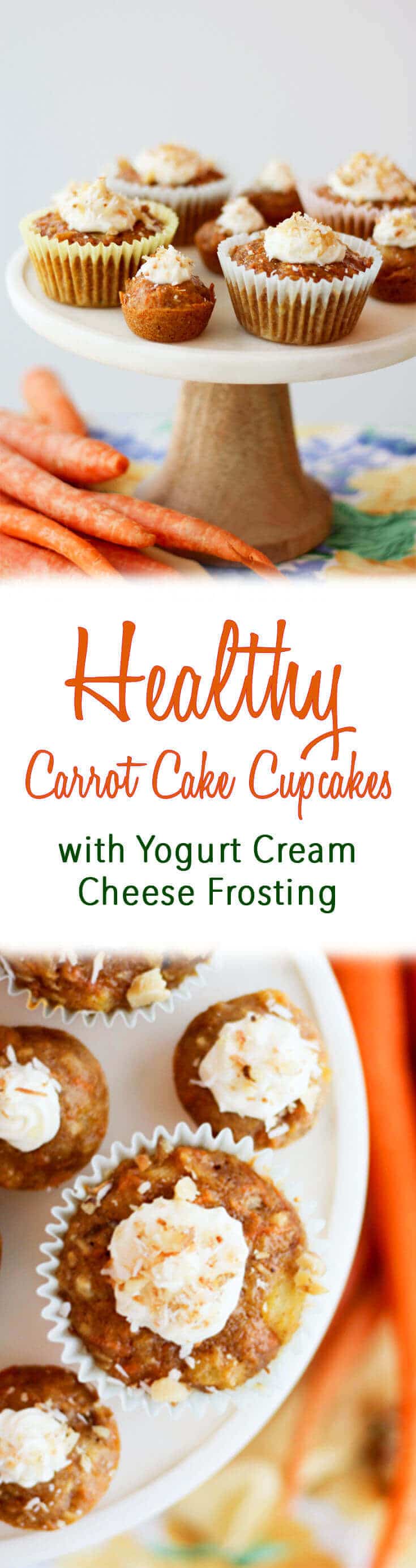
Healthy Carrot Cake Cupcakes with Yogurt Cream Cheese Frosting

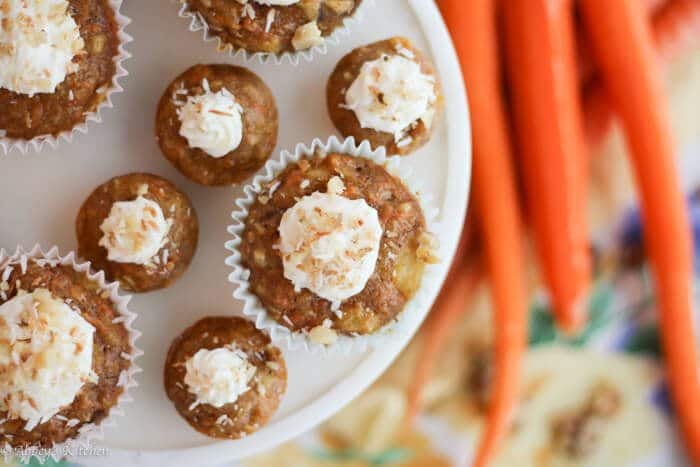
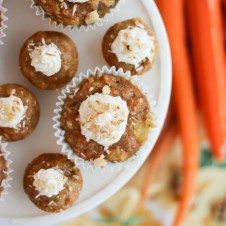
An overhead photo of multiple carrot cake cupcakes on a serving platter.

These healthy carrot cake cupcakes with yogurt cream cheese frosting are a delicious snack or treat for satisfying that sweet tooth!

Aside from banana muffins (I make a wicked version of these too), carrot cake cupcakes are my all-time favourite vegetable-based treat. They’re sweet, they’re chewy, and they’re packed with yummy bits of pineapple, nuts and carrot. And best of all – they come topped with a decadent cream cheese frosting.

An overhead photo of multiple carrot cake cupcakes on a serving platter.

But how do you make Healthier Carrot Cake Cupcakes?

Well, carrot cake cupcakes, like any kind of baked good, are pretty particular when it comes to modifications. You can’t just remove all the fat or all the sugar and expect it to work out.  Sorry guys, I have done the hard work and can honestly tell you that it won’t. It’s important to remember that carrot cake cupcakes – even though they have veggies in them – are still a treat. But we can still make some significant changes to the recipe to lighten them up, cut back on fat, and also reduce the sugar.

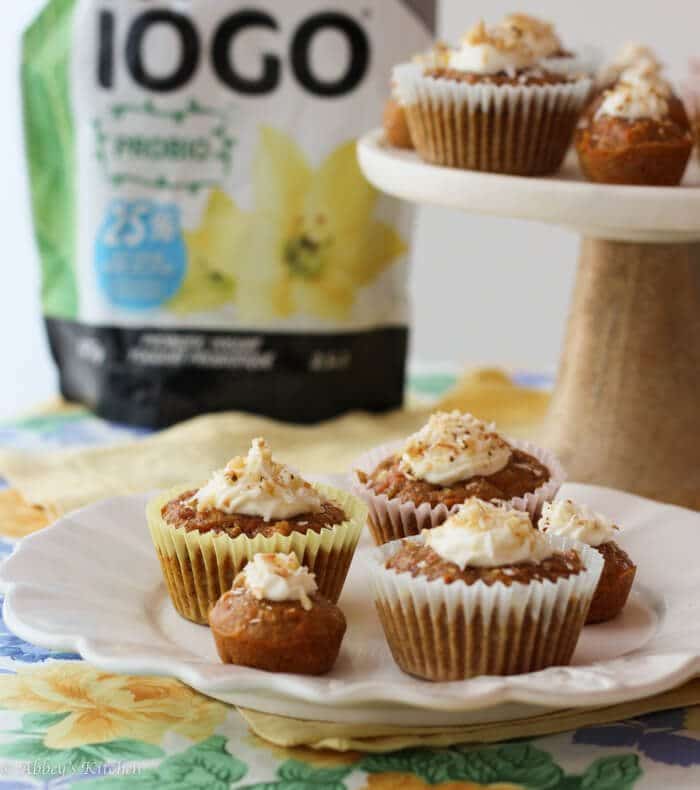
A plate with carrot cake cupcakes on a plate with a cake stand with more cupcakes on it behind it alongside a bag of yogurt.

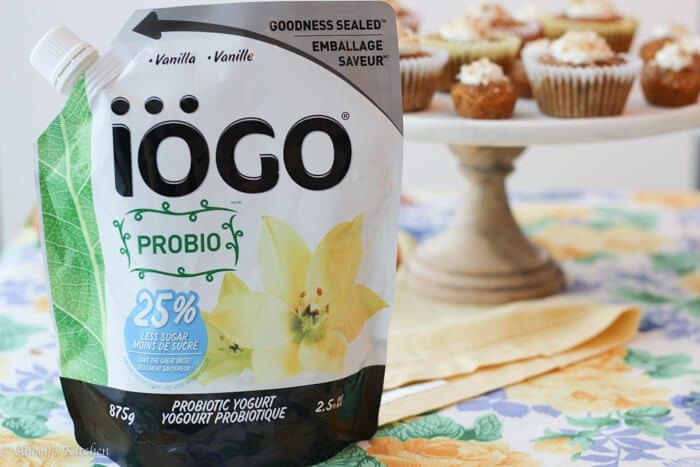
One of my secrets to cutting down on fat, boosting protein, and still getting really moist carrot cake cupcakes is to use yogurt. I’m using my go-to yogurt, IÖGO Probio Vanilla yogurt which now has 25% less sugar than before and only 80 calories per serving. It also packs over 1 billion probiotics per 100 gram serving so it’s great for promoting gut health.  Not only does it add amazing texture and vanilla flavour, but the yogurt keeps my carrot cake cupcakes so moist, I only need to add 1/4 cup of coconut oil and can cut back drastically on the sugar.

A photo of IOGO yogurt.

Recently I discovered IÖGO’s new packaging with a resealable cap in their Original, Probio and Greek flavours. The new cap not only locks in the freshness, but it makes pouring my yogurt into my recipe a million times easier and takes up way less space in my fridge. When you’re done whipping up a batch of these bad boys, you can just screw the lid on, pop it back in the fridge, and it’s ready to be poured into a parfait glass for breakfast the next day. Or maybe right into your mouth. Either way, no spoons and no mess required!

Healthy Carrot Cake

But what are we going to do about the obligatory cream cheese frosting? You cannot have carrot cake cupcakes without a decadent cream cheese frosting – AM-I-RIGHT? Don’t worry, folks. I got your back. If you were getting ready to head to the gym to help you justify topping these healthy carrot cake cupcakes with a super sugar bomb frosting, get ready for something a little lighter. I love this yogurt cream cheese frosting because it is significantly lower in fat and calories and light as a feather, but you still get that classic cream cheese sweet-tangy flavour. OMG. This on a spoon? YEP.

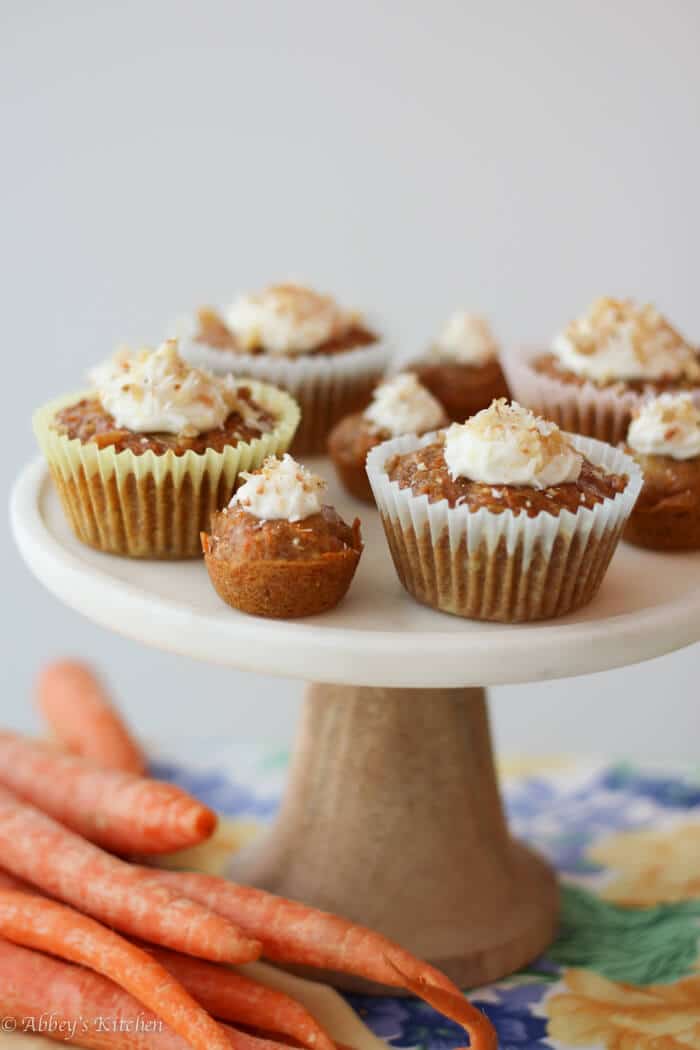
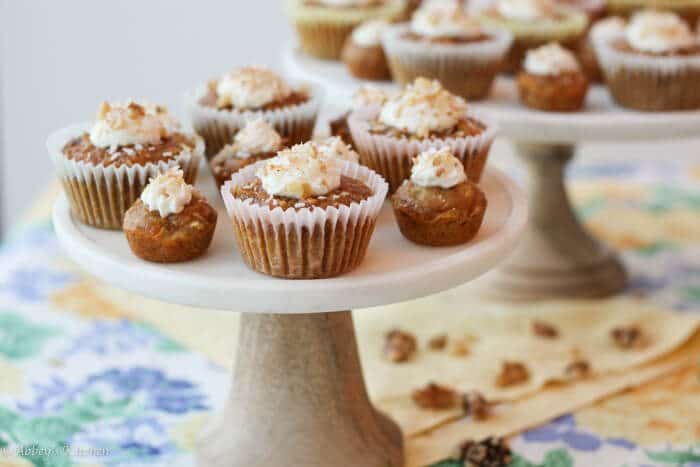
A cake stand with multiple regular sized carrot cake cupcakes with a few mini ones.

Do you love carrot cake cupcakes with cream cheese frosting but have been looking for a lightened up version? What are some of your favourite baked goods that need a recipe makeover? Leave me a comment below with your go-to treats!

Healthy Carrot Cake

These Carrot Cake Muffins are one of my favourite healthy treats. They're moist, chewy, and topped with a decadent cream cheese frosting.

Disclaimer: This recipe was developed in paid partnership with IÖGO, however, as always, all opinions are genuine.

An overhead photo of multiple carrot cake cupcakes on a serving platter.
Print Recipe
4.80 from 5 votes

Healthy Carrot Cake Cupcakes with Yogurt Cream Cheese Frosting

These deliciously moist carrot cake cupcakes are lightened up with yogurt, less oil and less sugar and you still get an amazing low yogurt cream cheese frosting! Yay- winning!
Prep Time30 minutes mins
Cook Time25 minutes mins
Total Time55 minutes mins
Course: Dessert
Servings: 18 regular and 48 mini
Calories: 90kcal
Author: Abbey Sharp

Ingredients

Cupcakes

  • 1/2 cup crushed pineapple drained
  • 1 1/2 cups finely grated carrots
  • 1/4 cup golden raisins
  • 1/4 cup finely chopped walnuts
  • 1/4 cup unsweetened coconut
  • 2/3 cup whole wheat flour
  • 2/3 cup all purpose flour
  • 1/2 tsp baking soda
  • 1 tsp baking powder
  • 1/2 tsp nutmeg
  • 1/4 tsp ginger
  • 2 tsp cinnamon
  • 1/2 tsp salt
  • 3/4 cup plus 2 tbsp brown sugar packed
  • 1/2 cup IOGO’s Vanilla Probio yogurt
  • 1/4 cup coconut oil
  • 2 eggs
  • 1 tsp vanilla extract

Frosting

  • 1/2 cup cream cheese very soft
  • 2 tbsp coconut oil melted
  • 3 tbsp powdered sugar
  • 2/3 cup IOGO’s Vanilla Probio yogurt
  • 1/4 tsp vanilla extract
  • Toasted unsweetened coconut for garnish
  • Toasted walnuts finely chopped, for garnish

Instructions

  • Preheat oven to 350ºF. Prepare 18 muffin tins with muffin liners or spray 48 mini muffin tins with non-stick cooking spray (or do a combination of both!)
  • Press the excess juice out of pineapple in a fine sieve. Place the pineapple in a small bowl and stir in carrots, raisins, nuts and coconut.
  • In another large bowl, whisk together flours, baking soda, baking powder, nutmeg, ginger, cinnamon, and salt. Add in the brown sugar, yogurt, coconut oil, eggs and vanilla and beat on low speed in an electric mixer until well combined.
  • Add the carrot-raisin mixture to the flour mixture, and fold until well combined.
  • Fill the muffin tins no more than 2/3 of the way full. Bake the large cupcakes for 20-25 minutes, and the mini cupcakes for about 8-12 minutes, or until a skewer comes out clean. Let cool in the pan for 10 minutes, then remove and transfer to the fridge to completely chill before icing.
  • While the cupcakes cool completely, put the cream cheese and coconut oil in a medium size bowl and beat until very soft. Add in the sugar and continue to beat until well incorporated and smooth. Add the yogurt and vanilla extract and beat until fluffy and light.
  • To decorate, transfer the icing to a piping bag if desired and pipe little florets onto each cupcake. Top with toasted coconut and walnuts, if desired. Store in the fridge until consumed.

Nutrition

Calories: 90kcal


Abbey Sharp

Abbey Sharp is a Registered Dietitian (RD), regulated by the Ontario College of Dietitians. She is a mom, YouTuber, Blogger, award winning cookbook author, media coach specializing in food and nutrition influencers, and a frequent contributor to national publications like Healthline and on national broadcast TV shows.
www.abbeyskitchen.com/about-abbey/

Last Updated November 19, 2016. Published November 2, 2016 By Abbey Sharp 44 Comments

The Best Weight Loss Diet for You- a Dietitian’s Pros, Cons & Comparisons

What is the best weight loss diet for you? I weigh out the pros, cons and comparisons as a dietitian!

Whether you’re looking to lose weight, maintain it, or just improve your energy and performance, choosing the right plan for you can be tricky. You can’t pick up a magazine without reading about the latest “hot diet” to try. It can get confusing even for a dietitian like me! To help you wade through the choices and choose the best plan for you, I have compiled a variety of diets, as well as some of their possible pros and cons. This will hopefully help you decide on the best weight loss diet for you.

Since the word “diet” simply just means a way of eating, my suggestion to you is to choose a weight loss diet that you feel you can live with for the rest of your life. And maybe you’ll even find that it’s not about weight loss at all. Love bread? You probably shouldn’t go paleo. On a tight budget? You may want to avoid the commercial diet product programs. Have a family to feed and please? They may hate you if you only eat raw. Whatever you choose to try, I urge you to consider it a lifestyle shift that you and your family can live with happily. This is why I personally practice Mindfulness and a general Heart Healthy diet. I try to listen and honour my body’s unique needs and cravings, while sticking to a general eating pattern that includes a variety of fibre-rich vegetables, fruits and whole grains, lean proteins, and low fat dairy. I feel happy and healthy, so that’s how I know it’s “working” – not necessarily by the number on the scale or size of my clothes. That’s my nutrition “truth” – it’s up to you to find yours and through that, your best weight loss diet.

What’s the Best Weight Loss Diet for You?

Read on, share with your friends, and keep this weight loss diet infographic on hand the next time you find yourself struggling with food. A big thank you to my fantastic nutrition student Katie Brunke for compiling the literature and creating this snazzy infographic!

Popular_Weight_Loss_Diets_Conflict_Copy.png
What weight loss diet has worked well for you? Have you tried any of these fads or had success with something more long term? Leave me a comment below about your successes and challenges!
Abbey Sharp

Abbey Sharp is a Registered Dietitian (RD), regulated by the Ontario College of Dietitians. She is a mom, YouTuber, Blogger, award winning cookbook author, media coach specializing in food and nutrition influencers, and a frequent contributor to national publications like Healthline and on national broadcast TV shows.
www.abbeyskitchen.com/about-abbey/

Last Updated November 22, 2019. Published November 1, 2016 By Abbey Sharp 19 Comments

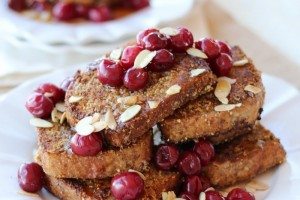
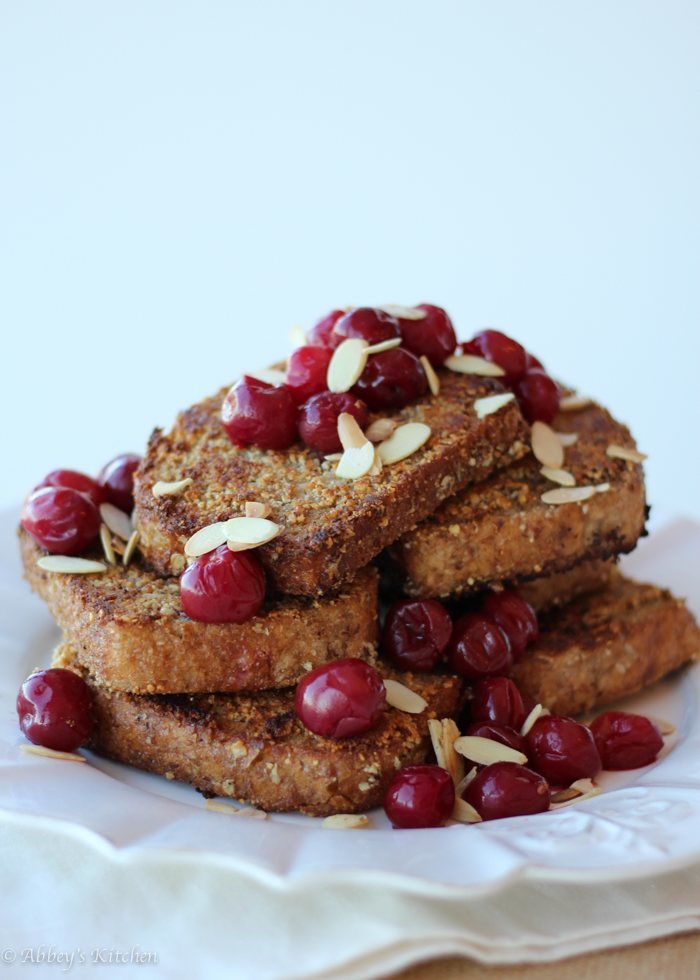
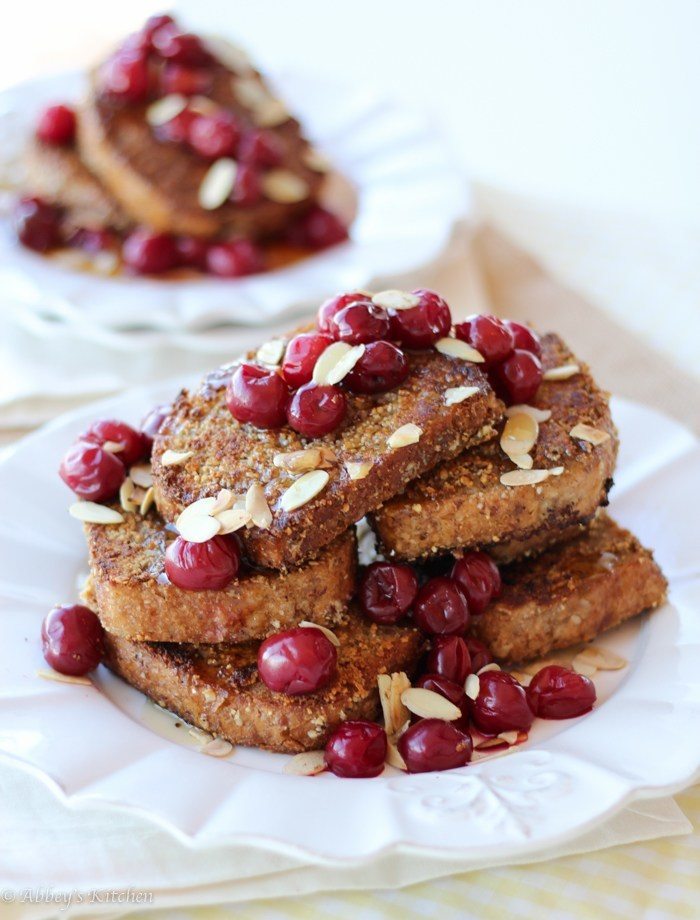
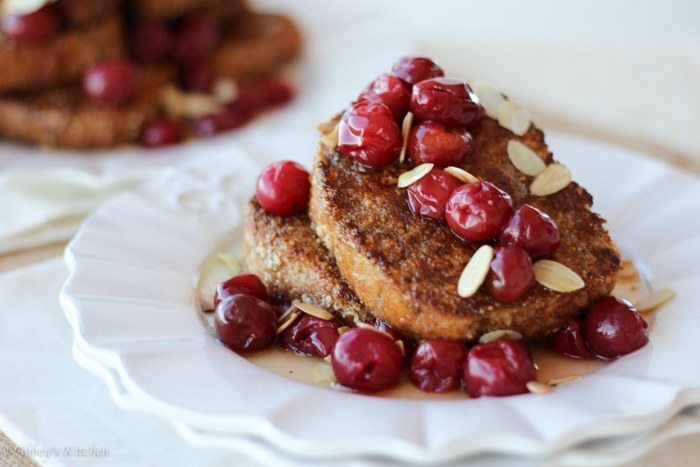
Almond Crusted Vegan French Toast with Sour Cherries

vegan french toast

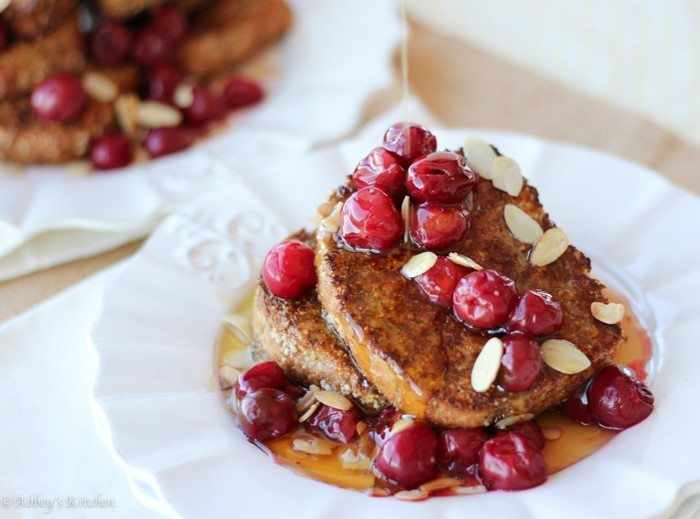
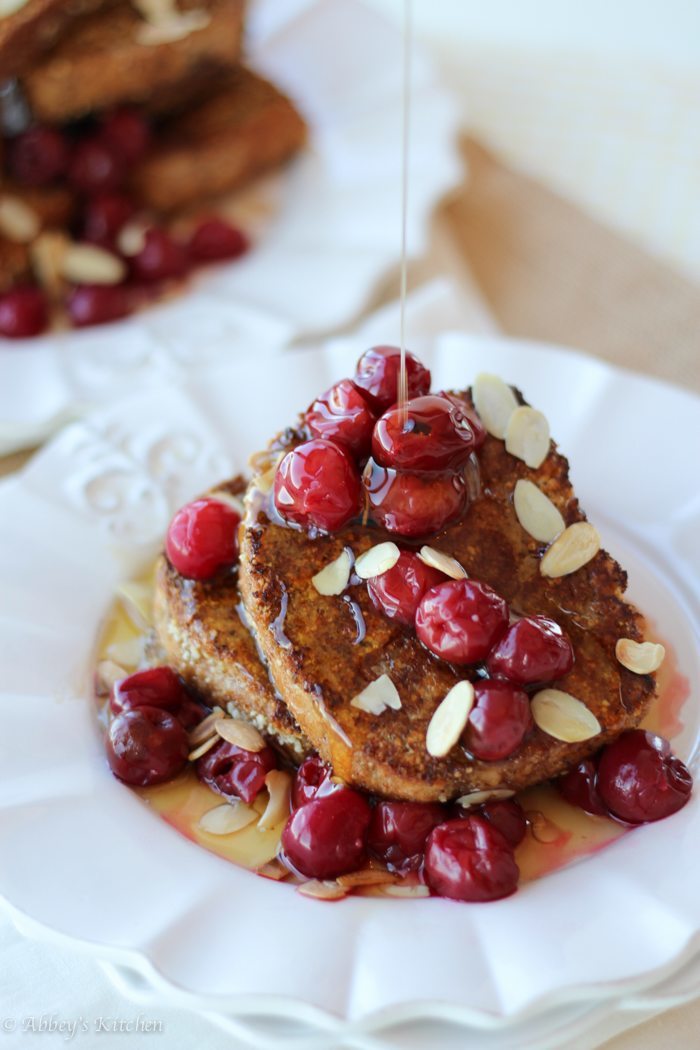
This almond crusted vegan french toast with sour cherries will quickly become your reason to get up in the morning!

Anyone that hangs out around me in the mornings knows I’m the last person to order a vegan breakfast, nevermind want to try a vegan French toast recipe.

vegan_french_toast_3_of_7.jpg

I plow through a large container of Greek yogurt every few days, love a good breakfast banger, and a gorgeous runny egg is totally my thing. So when I had a thought to experiment with flax eggs and whip up a totally dairy and egg free – yep, a vegan French toast – I was nervous to say the least.

vegan_french_toast_6_of_7.jpg

Vegan French Toast? What About the Egg?

With a bit of experimenting, this French toast recipe quickly became one of our actual favourite recipes for brunch. The key to making vegan French toast is a flax egg. If that sounds a wee bit hippy-dippy-flower-child to you. Don’t worry, I was there too. But it’s actually super easy to do. By mixing flax with some kind of liquid, the flax seeds create a bit of a binding sticky consistency similar to an egg that makes it a solid vegan replacement for eggs in an egg-dependent recipe like French toast.

vegan_french_toast_5_of_7.jpg

To give it a bit more texture (since it was missing out on the fat from milk and egg yolks), I added a super crispy layer of almond meal as a crust. OMG. It’s really good. I would recommend adding an almond meal crust to literally any and every French toast recipe- not just your vegan French toast!

vegan_french_toast_4_of_7.jpg

To finish, because every good French toast dish needs a finisher, I topped it with some tangy sour cherries and toasted sliced almonds for crunch factor. Almonds and cherries are a natural pairing and are so tasty together, there’s really no need for syrup. Unless you have it… then maybe throw in a little for good measure. Hey, brunch should be a wee bit decadent.

vegan_french_toast_7_of_7.jpg

What’s your favourite French toast recipe? Would you be down for trying a vegan breakfast? Have you ever tried making vegan French toast? Leave me a comment below – I would love to hear your successes and not-so-successes.

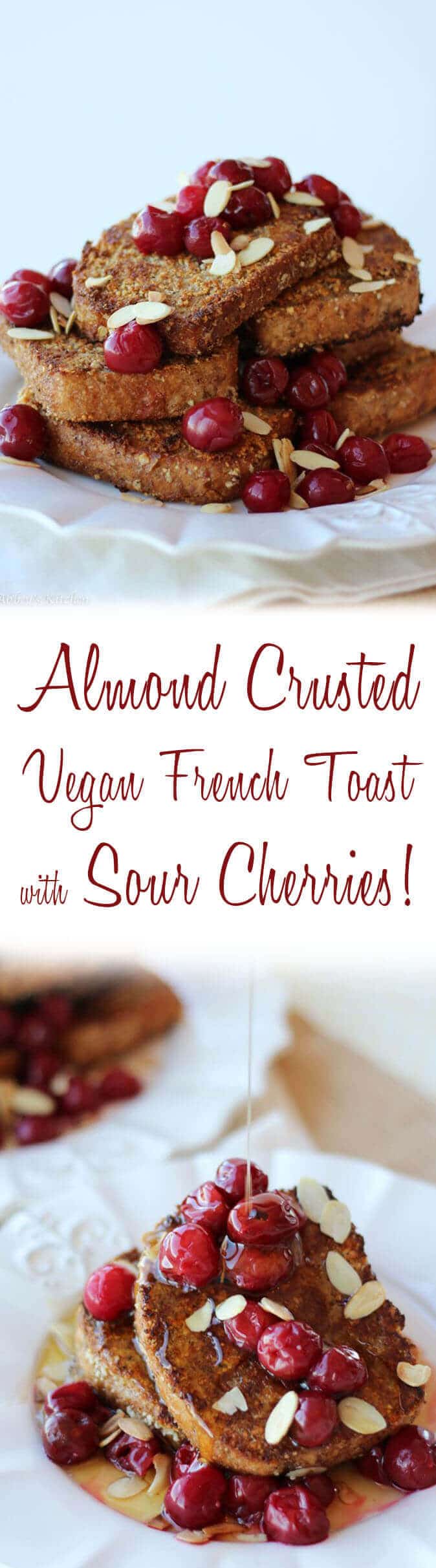
A pinterest image of plates of French toast with the overlay text \"Almond Crusted Vegan French Toast with Sour Cherries!\"

vegan french toast
Print Recipe
5 from 3 votes

Almond Crusted Vegan French Toast with Sour Cherries

This almond crusted vegan french toast with sour cherries will quickly become your reason to get up in the morning!
Prep Time20 minutes mins
Cook Time20 minutes mins
Total Time40 minutes mins
Course: Breakfast
Cuisine: American
Servings: 4 -8 people
Calories: 214kcal
Author: Abbey Sharp

Ingredients

  • 1 cup unsweetened vanilla almond milk
  • 1/4 cup ground flax seeds
  • 1 1/2 tsp vanilla
  • 1/2 tsp cinnamon
  • 1/4 tsp nutmeg
  • 1 Pinch salt
  • 1 Tbsp maple syrup
  • 8 slices whole grain bread thickly sliced
  • 1/4 cup almond meal
  • Coconut oil for cooking
  • 1/4 cup sliced almonds toasted
  • 1 cup frozen sour cherries warmed through

Instructions

  • Combine the almond milk with the flax seeds and whisk until well combined. Refrigerate for 20 minutes until thickened slightly. Then add in the vanilla, cinnamon, nutmeg, salt, and maple syrup.
  • Preheat a large griddle or non-stick skillet over medium heat and grease with a light coating of coconut oil.
  • Dip the bread into the almond flax mixture, soaking it for a few seconds on each side. Then sprinkle liberally with almond meal and pan fry until golden brown on each side. Continue with remaining slices, keeping the finished toast in a 200 F oven to stay warm.
  • To serve, garnish with the almonds and cherries and enjoy.

Nutrition

Calories: 214kcal | Carbohydrates: 24g | Protein: 6g | Fat: 12g | Saturated Fat: 1g | Sodium: 111mg | Potassium: 197mg | Fiber: 5g | Sugar: 4g | Vitamin A: 455IU | Vitamin C: 1.7mg | Calcium: 146mg | Iron: 2mg
Abbey Sharp

Abbey Sharp is a Registered Dietitian (RD), regulated by the Ontario College of Dietitians. She is a mom, YouTuber, Blogger, award winning cookbook author, media coach specializing in food and nutrition influencers, and a frequent contributor to national publications like Healthline and on national broadcast TV shows.
www.abbeyskitchen.com/about-abbey/

Last Updated January 2, 2019. Published October 31, 2016 By Abbey Sharp 34 Comments

Skim Milk vs Whole Milk for Weight Loss | Dairy Myths Part 2

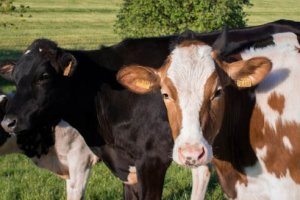
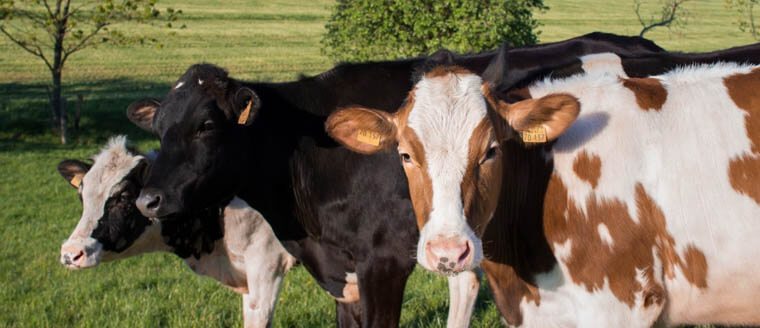
A group of cows.

In Part 2 of Diary Myths we cover the skim milk vs whole milk for weight loss debate and whether or not you should consume dairy for weight loss.

Last week, we introduced our topic in this multi-part series on milk and dairy and your health. Milk has garnered a really bad reputation over the past few years, and I wanted to look at the research to find out why and if it had any merit.

A group of cows.

In Part 1 we discussed milk and bone health, and here we are moving on to discuss bones and weight management.

Milk for Weight Loss

Still living by the old adage that “fat will make you fat”? Maybe it’s time to change your thinking.

It’s true that fat adds calories (9 calories per gram!), but what does that look like in milk?

Let’s look at the difference in 1 cup of milk at different fat percentages:

Skim: 88kcal, 316mg Ca, Total fat 0.21g

1%: 108kcal, 322mg Ca, Total Fat 2.5g

2%:129 kcal, 309mg Ca, Total fat 5.1g

3.25% (Whole): 157kcal, 291mg Ca, Total fat 8.38g

You may have noticed that whole milk has almost twice the calories of skim milk, but is this necessarily a bad thing?

In a review by the European Journal of Nutrition, the authors stated that dairy fat is typically not associated with weight gain, cardiovascular disease or type 2 diabetes. That’s promising, but let’s dive deeper into the recent studies that have discovered some very important findings about the skim milk vs whole milk for weight loss debate.

In Part 2 of Diary Myths we cover the skim milk vs whole milk for weight loss debate and whether or not you should consume dairy for weight loss.

One study (Korean National Health and Nutrition Examination Survey) conducted on the Korean adult population discovered a link between calcium-intake and dairy products (e.g milk and yogurt), and obesity. The findings of this study found a correlation showing that the more frequent the intake of dairy products (particularly milk), the lower the prevalence of obesity (BMI≥25 kg/m2). Similarly, the higher the calcium intake from dairy product consumption and total dietary calcium intake, the lower the prevalence of obesity. The strength of these relationships were much stronger in women compared to men (yay!), although an inverse relationship in men was still suggested.

Calcium’s potential protective mechanism in combating weight gain may be due to its ability to regulate adipocyte (fat cell) metabolism by inhibiting lipogenesis (the generation of fat) and stimulating lipolysis (the break-down of fat). Additionally, calcium has also been found to increase excretion of fecal fat, rather than it being stored within our bodies.

Interestingly, when researchers analyzed the effects of non-dairy sources of calcium on obesity levels, there was no significant link found in both men and women. It has therefore been suggested that calcium may not have been the only contributor to the reduction in obesity rates, but also the other nutritional components in dairy such as branched chain amino acids (BCAAs), conjugated linoleic acid (CLA), vitamin D, medium-chain fatty acids, and various proteins (bioactive casein peptides, and whey protein).

Other correlational research has echoed these associations. One study in children and adolescents found that those with higher dairy intakes had reduced body fat percentages and lower risks of being overweight or obese. Another study found that adolescents who consumed a lot of high-fat dairy were more likely to have lower body weights and body fat percentages. However, in individuals with risk factors for metabolic syndrome (ie. Diabetes, obesity, high blood pressure etc.), the opposite was true. This suggests that the relationship is not as straight forward as we would like it to be, but rather, there are clearly other contributors at play.

Let’s look at cohort studies. Cohort studies performed on adults found that higher intakes of dairy was associated with lower risks of abdominal obesity and risk of becoming overweight, compared to lower intakes. Yogurt in was particularly related to reduced risks of obesity and weight gain.

Overall, the results of the aforementioned studies suggest that high fat milk (ie. whole milk) is inversely associated with obesity, which may potentially put an end to avoidance of high-fat dairy in fear of weight gain. Ahhh… but that would be too simple. Read on for the full-fat story.

Dairy fat is known to be a good source of fat-soluble vitamins (A,D,E and K), and unsaturated fats (e.g omega-3s). However, they are also predominantly made of saturated fats which dietary guidelines usually recommend to reduce in our diet. This recommendation is now being challenged by evolving research looking at the effect of saturated fats on our health. There are actually different types of saturated fats out there such as conjugated linoleic acids, butyric acid, palmitoleic acid, and phytanic acid– all of which are conveniently found in dairy. Contrary to what you’ve heard and probably believed over the years (especially regarding heart health), saturated fats may not be as bad as you had once thought. As we will discuss below, whole milk and high-fat dairy has been shown to be inversely related with weight gain in various situations.

But wait. Doesn’t whole milk contain a whole whoppin’ lot more fat and calories than skim?!

Now let’s compare this study to a recent literature review which examined various studies to determine the relationship between the consumption of high-fat dairy and obesity, metabolic syndrome and cardiovascular disease. The findings suggested that some minor types of fatty acids found in dairy have an effect on cardiometabolic risk factors and weight gain, along with some evidence indicating that pasture-raised cows and their feed play a great role in enhancing the quality of dairy fat.

What many of the studies found was a negative relationship between high-fat dairy or whole milk intake and obesity. They observed that those who initially had a higher intake of dairy fat (whole milk) were leaner or had less weight gain compared to those who increased their intake of dairy fat over time (and therefore gained more weight). However, this change in weight with dairy may have been associated with other diet and lifestyle changes so it’s really hard to say. When observing the link between high-fat dairy and metabolic health, studies were pretty inconsistent, either finding an inverse or no relationship at all, but overall, did suggest that high dairy fat may have some protective properties against weight gain. Generally, the studies did not support the claims against dairy being “obesogenic” (causing obesity), but found some evidence suggesting that it can be protective against weight gain. Also, the research was not able to support an idea that low fat dairy or skim milk helped avoid weight gain. Not convinced? Read on.

More Evidence in the Skim Milk vs Whole Milk for Weight Loss Debate

Similar to the cohort study conducted on men, in the Women’s Health study, a moderate inverse association was observed for consumption of high-fat dairy but not for total dairy intake or low-fat dairy intake in initially normal-weight middle-aged and elderly women.

Taken together, the conclusions were not in support of dairy fat increasing the risk of obesity, cardiovascular or metabolic disease (e.g type 2 diabetes), but that consuming high fat dairy (whole milk) with certain dietary patterns may help reduce the risk of obesity! Now we still need more research to confirm these findings, but this analysis sheds some light on the effect of the bioactive properties found in dairy fat for human health.

The Components of Whole Milk for Weight Loss

Now let’s look at the various components (particularly some unique fatty acids) in milk that may be beneficial for weight management.

  1. Conjugated linoleic acids (CLA)

The main type of CLA found in dairy fat is cis-9, trans 11 (a.k.a rumenic acid), followed by trans 10, cis-12. You may be familiar with CLA if you’ve visited a recent health supplement store recently, namely due to its potential effects on weight and fat loss. Some of the other health benefits that have contributed to its hype is its effect on blood lipid levels, insulin sensitivity, glucose tolerance, inflammation and liver triglyceride levels. However, total CLA concentrations are highly varied between dairy products. Existing studies have mostly been conducted using isolated or mixed CLA supplements (1-5 grams per day), with some results showing reduction in body fat. However, CLA was taken at high concentrations for a long period of time and the primary form of CLA in dairy fat (cis-9, trans 11) was not able to decrease fat levels as much compared to other types. Also, it’s important to mention that although CLA has shown to be beneficial for reduction of fat, other studies have found adverse effects on lipid profile and metabolism of glucose associated with CLA consumption. Overall, based on the available research, CLA’s potential health benefits on humans are not as evident compared to rodents, and more so, it is way too early to make recommendations for ingesting CLA, especially from dairy fat, because there is little to no scientific proof for its effect on body weight, insulin sensitivity, fat levels, blood lipid levels, inflammation or glucose tolerance.

  1. Butyric acid

Butyric acid makes dairy fat quite unique since it is a short-chain fatty acid found in only a few dietary sources. When produced in the gut or taken orally, butyrate has an important impact on gut health by providing energy to enterocytes and inhibiting pro- inflammatory pathways. In an older clinical study, patients who consumed 4 grams of butyrate daily for the duration of 8 weeks displayed reduced levels of pro-inflammatory cytokine expression in the GI and improved symptoms of Crohn’s disease, with some experiencing complete remission! From the research, it’s thought that butyrate in dairy fat (approximately 4%) may have great effects on maintenance of healthy body weight and metabolism because of its inhibitory effects on inflammation and effects on regulating energy expenditure, but research is still incredibly limited and we need more current evidence to show the potential benefits of this fatty acid in humans.

3.  Palmitoleic acid

Rodent and in vitro experiments have showed phytanic acid to lower triglyceride (fat) levels and regulate blood sugar metabolism. However, there is no solid evidence of phytanic acid’s effect on humans, so this area definitely requires further investigation!

Taken together, while there has been much interest in CLA as a potential beneficial fatty acid in dairy fat, the existing evidence suggests that the amounts of CLA present in dairy fat is unlikely to have a significant effect on chronic diseases, liver fat, adiposity, energy expenditure, inflammation, insulin sensitivity, and glucose tolerance. For the other fatty acids in dairy fat, the research is still inconclusive.

Bottom Line on Skim Milk vs Whole Milk for Weight Loss

Milk and dairy products (both low and high-fat) can be included as part of a healthy, well-balanced diet, but the type of dairy you choose depends on your current health status in order to best suit your health needs. From the overall research, the evidence shows us that dairy, despite versions with higher fat content, will not hinder, but may actually help you achieve your weight-loss goals so feel free to enjoy it in moderation.

Don’t forget to check out Part 1 of this debate to get some background information on this skim milk vs whole milk for weight loss conversation! Check out Part 3, 4, and 5 where we cover milk and diseases as well as milk controversy, safety and alternatives!

What are your thoughts on the skim milk vs whole milk for weight loss debate?
What do you drink at home?
Do you avoid dairy?
Leave me a comment below- I would love to hear your thoughts!

A pinterest image with a glass of milk and cows with the text overlay \"Skim Milk vs Whole Milk for Weight Loss Milk Myths Part Two.\"

Contribution By:

RD2B Rachel Shim

Abbey Sharp

Abbey Sharp is a Registered Dietitian (RD), regulated by the Ontario College of Dietitians. She is a mom, YouTuber, Blogger, award winning cookbook author, media coach specializing in food and nutrition influencers, and a frequent contributor to national publications like Healthline and on national broadcast TV shows.
www.abbeyskitchen.com/about-abbey/

Last Updated September 1, 2022. Published October 26, 2016 By Abbey Sharp 29 Comments

Aspartame & Artificial Sweeteners vs Sugar – Pros, Cons & Controversy

I discuss aspartame & artificial sweeteners vs sugar debate as it pertains to the pros, cons and controversy around health and nutrition.

When it comes to the question of what to sweeten your coffee with each day, there is a lot of confusion and noise. Is sugar the root cause of all human disease? Are artificial sweeteners toxic? Should I reach for something more trendy like Stevia or Agave? WHY DO I NEED TO MAKE THESE DECISIONS BEFORE I’VE HAD COFFEE!?

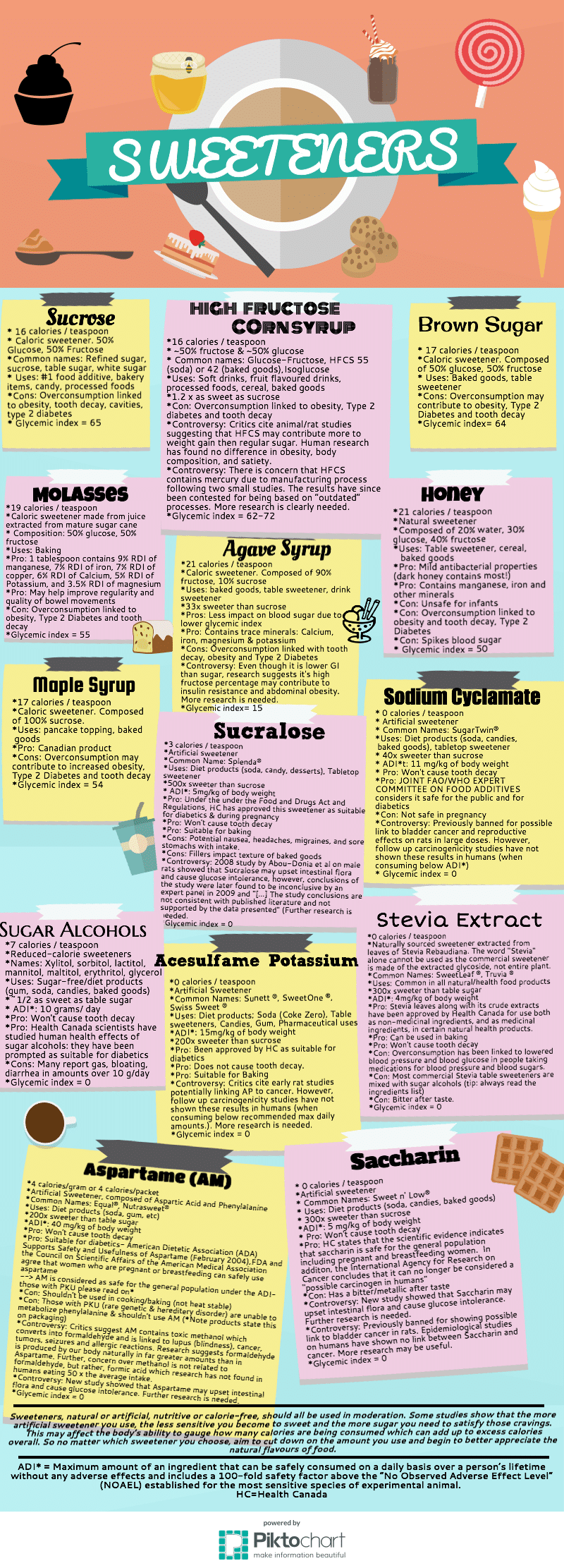
Well, the following infographic will hopefully become something you will bookmark as your one-stop-shop for everything about sugars and artificial sweeteners like aspartame and splenda. Led by two of my fantastic Ryerson Nutrition student volunteers, Olivia Maida and Alexis Silver- we’ve compiled all of the information you may be curious about into one place. All of the following sugars and artificial sweeteners are approved by Health Canada as safe (at least below the recommended intake levels) but they each present their own unique set of pros, cons and controversy.

Sugars vs Artificial Sweeteners – the Facts

SWEETENERS_NEW.png

Is Aspartame Really Poison?

So I would say that is using some super strong language but it’s not something I consume a lot of thanks to the impact on gut microflora which I think we will start to see is the KEY to a lot of chronic disease.

So then which sugars or artificial sweeteners do I think are best?

Honestly, it’s a tough call. Originally, I wanted to rank them for you but after going through the literature myself, I quickly realized it would be an arbitrary order. The recommendation I can stand behind is this: whatever sweetener you choose, whether they be caloric sugars or artificial sweeteners, just try to choose less of it. I’m not saying you should never have a Diet Coke again and should start drinking your coffee black. I’m just saying that it’s in all of our best interests to try to ease ourselves off our dependence on “sweet”. With less added sweet in our lives, we will actually start to appreciate the natural sweetness inherent in fruits, grains, and even vegetables. Yep, Brussels sprouts can actually start to taste sweet when you cut down on the amount of Splenda you throw in your tea.

Give it a read, share the image on social media and please tell me- What’s Your Go-To sweetener? Do you think artificial sweeteners are good or bad? Do you think sugar, honey or agave are better? Do you use aspartame and how much?
Abbey Sharp

Abbey Sharp is a Registered Dietitian (RD), regulated by the Ontario College of Dietitians. She is a mom, YouTuber, Blogger, award winning cookbook author, media coach specializing in food and nutrition influencers, and a frequent contributor to national publications like Healthline and on national broadcast TV shows.
www.abbeyskitchen.com/about-abbey/

Last Updated April 30, 2020. Published October 24, 2016 By Abbey Sharp 20 Comments

Healthy Halloween Dessert Dip | Edible Graveyard | Vegan Reduced Sugar Dessert!

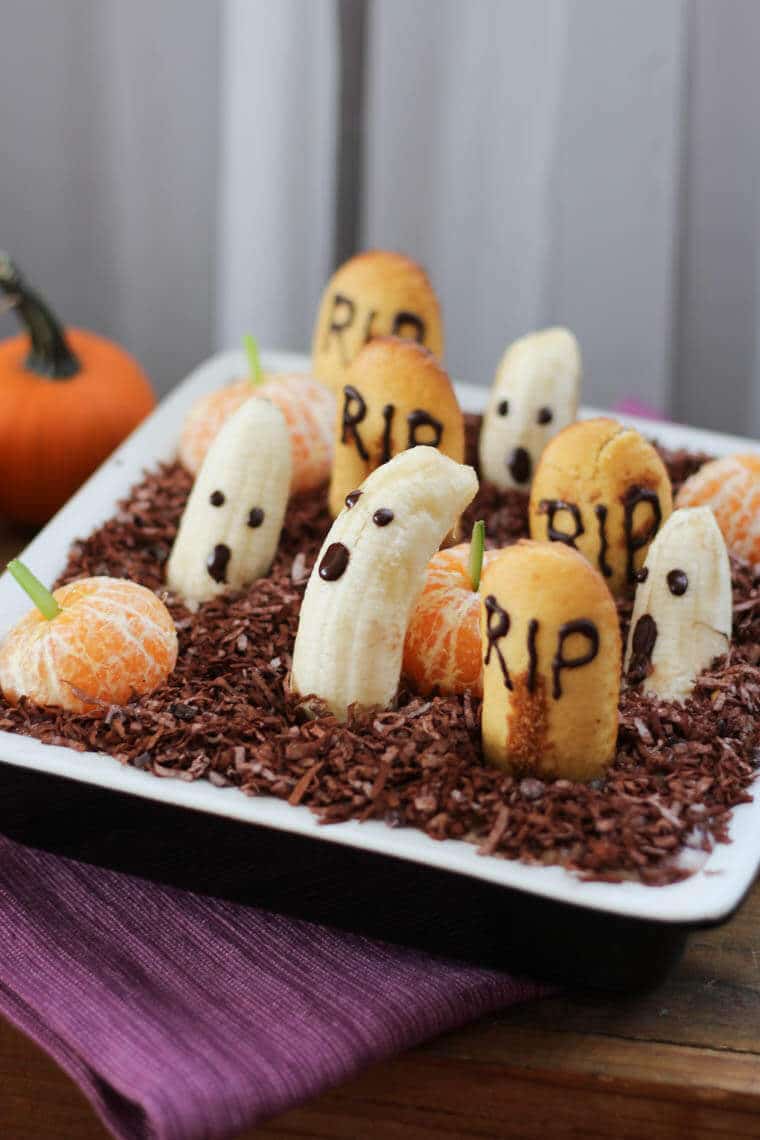
An edible graveyard made with bananas with ghost faces.

This healthy Halloween dessert dip looks like an edible graveyard and is a healthy vegan dessert for Halloween parties!

An edible graveyard made with bananas with ghost faces.

When you’re a kid, Halloween feels scary and spooky because there are weird men roaming the streets with psycho serial killer masks on. When you’re my age, it feels scary because you’re somehow expected to get yourself into the skimpiest costume of life while starring down a pot of candy that you’re tethered to at the front door. Like forget stranger danger, overdosing on candy is a serious issue.

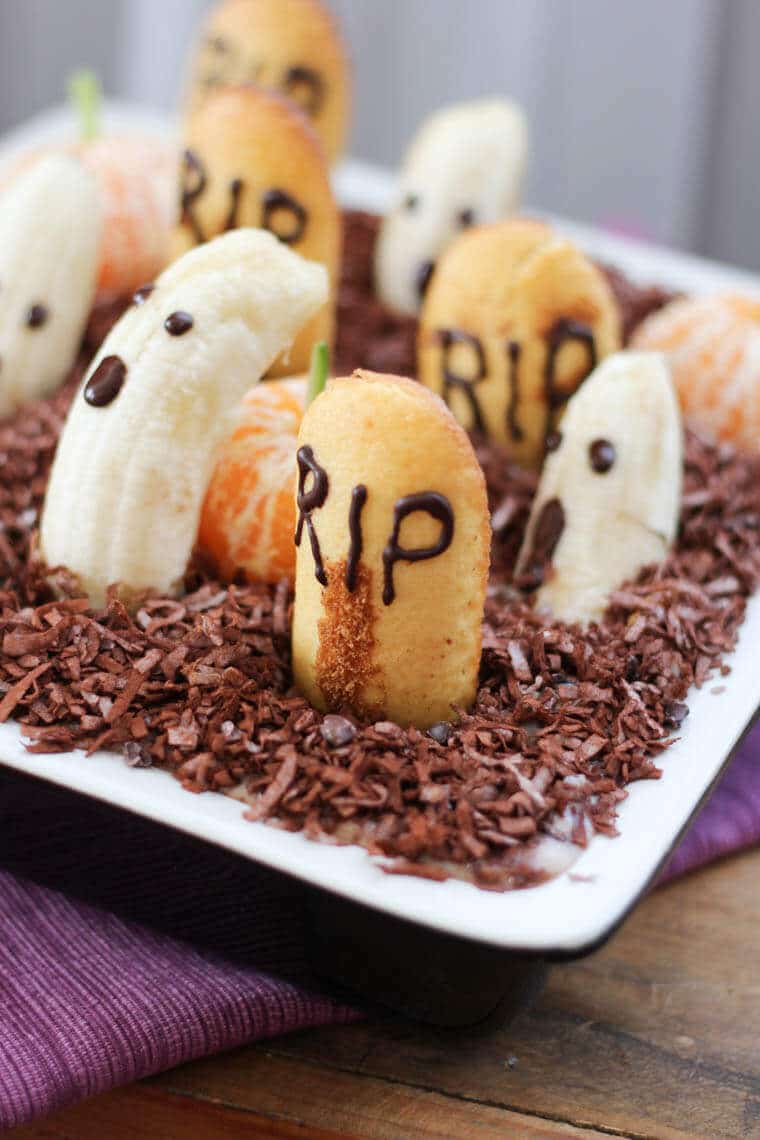
An edible graveyard with lady fingers with RIP on it and ghost faces on bananas.

I am all for a sweet treat, but have too many of those those mini fun bars, and you’re probably not going to be having so much fun. Introducing a Healthy Halloween Dessert Dip that your kids (and let’s be honest you) will love. It looks like a spooky graveyard but its actually a vegan reduced sugar dessert that everyone at the holiday party will love.

How to Make a Healthy Halloween Dessert Dip Look Like an Edible Graveyard

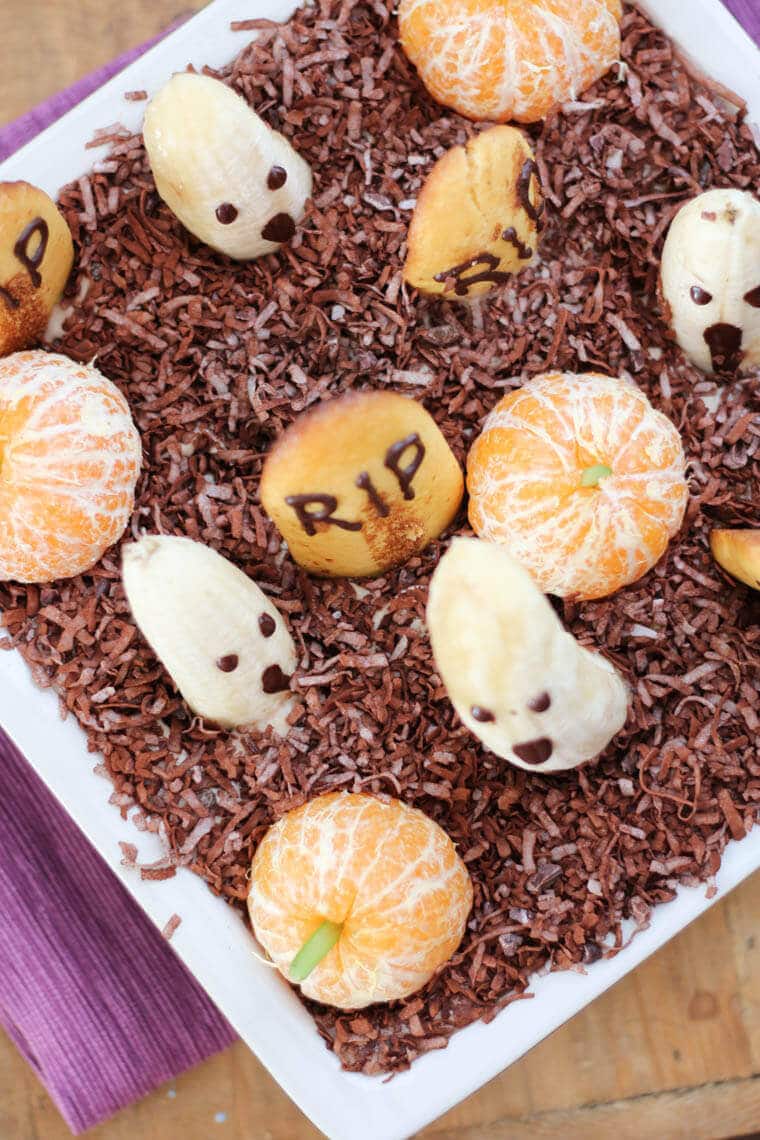
Halloween is a kitchy holiday so I’m all for making somewhat kitchy themed food. If I’m expected to dress up, then I better dress up my food as well. This Healthy Halloween Dessert Dip starts with a vegan protein pudding, topped with a chocolately coconut “soil” and some fun graveyard editions like pumpkins, ghosts and tombstones.

An overhead shot of an edible graveyard made with bananas with ghost faces, lady fingers graves, and clementine pumpkins.

If you’re not already sold on this Healthy Halloween Dessert Dip, check out my Youtube video here to see it in its full glory.

What are some of your favourite Halloween recipes? Have you tried making an edible graveyard like this healthy Halloween dessert dip? Leave me a comment below with your plans for all hallows eve!

A pinterest image of an edible grave with the text overlay \"Healthy Halloween Dessert Dip Edible Graveyard.\"

An edible graveyard made with bananas with ghost faces.
Print Recipe
5 from 2 votes

Healthy Halloween Dessert Dip | Edible Graveyard | Vegan Reduced Sugar Dessert!

This Halloween dessert dip looks like an edible graveyard and is a healthy vegan dessert for Halloween parties!
Prep Time20 minutes mins
Total Time20 minutes mins
Course: Dessert
Servings: 12 people
Calories: 250kcal
Author: Abbey Sharp

Ingredients

Soil:

  • 1/3 cup unsweetened flaked coconut
  • 1 tbsp unsweetened cocoa powder
  • 2 tbsp cacoa nibs

Dip:

  • 2 2/3 cups silken firm tofu drained
  • 4 cups very ripe banana mashed
  • 1 cup natural peanut butter
  • 4 tsp vanilla
  • 4 tsp maple syrup
  • 1 tsp cinnamon

Ghosts:

  • 3 Bananas sliced in half in the middle
  • 1 oz vegan Dark chocolate melted and put into a small piping bag

Pumpkins:

  • 4 clementines peeled
  • 4 pieces tiny of celery

Graves:

  • 4-6 Lady fingers
  • 1 oz vegan Dark chocolate melted and put into a small piping bag

Instructions

  • In a bowl mix together the coconut, cocoa, and cacao nibs. Set aside.
  • In a food processor, puree together the tofu, banana, peanut butter, vanilla, maple, and cinnamon. Layer the dip into a 8 or 9” square dish. Top with the coconut mixture and refrigerate to set while you work on the decorations.
  • To make the ghosts, draw little mouths and eyes with the chocolate on the tops of each banana half (the uncut top).
  • To make the pumpkins, insert the celery piece into the top of the clementines.
  • To make the graves, write RIP using the melted chocolate.
  • Stick the ghosts, pumpkins and graves into the graveyard and serve!

Video

Nutrition

Calories: 250kcal
Abbey Sharp

Abbey Sharp is a Registered Dietitian (RD), regulated by the Ontario College of Dietitians. She is a mom, YouTuber, Blogger, award winning cookbook author, media coach specializing in food and nutrition influencers, and a frequent contributor to national publications like Healthline and on national broadcast TV shows.
www.abbeyskitchen.com/about-abbey/
  • Previous Page
  • Go to page 1
  • Interim pages omitted …
  • Go to page 75
  • Go to page 76
  • Go to page 77
  • Go to page 78
  • Go to page 79
  • Interim pages omitted …
  • Go to page 89
  • Next Page

Get started with

Eight Free Recipe Books

From the co-founder of Neue Theory and creator of the Hunger Crushing Combo

Sign me up!
Abbey smiling at table
Abbey Sharp

“Foods may never be nutritionally equal. But we can make them morally equal by recognizing that our worth is never determined by what's on our plate.”

— Abbey Sharp, RD About Abbey ◥

Books

  • HCC™
  • Mindful Glow
  • Free E-Books

Blog

  • Nutrition
  • Recipes
  • Motherhood
  • Life

Explore

  • Neue Theory™
  • Bite Back
  • YouTube

Abbey

  • About
  • Coaching
YouTube TikTok Instagram Facebook X Pinterest
Abbey Sharp - The No BS Dietitian From Abbeys Kitchen

© Abbey's Kitchen 2026  All Rights Reserved •  ACCESSIBILITY STATEMENT •  Privacy Policy

This site uses cookies. By continuing to browse the site, you are agreeing to the use of cookies Accept Privacy Policy
Privacy & Cookies Policy

Privacy Overview

This website uses cookies to improve your experience while you navigate through the website. Out of these, the cookies that are categorized as necessary are stored on your browser as they are essential for the working of basic functionalities of the website. We also use third-party cookies that help us analyze and understand how you use this website. These cookies will be stored in your browser only with your consent. You also have the option to opt-out of these cookies. But opting out of some of these cookies may affect your browsing experience.
Necessary
Always Enabled
Necessary cookies are absolutely essential for the website to function properly. This category only includes cookies that ensures basic functionalities and security features of the website. These cookies do not store any personal information.
Non-necessary
Any cookies that may not be particularly necessary for the website to function and is used specifically to collect user personal data via analytics, ads, other embedded contents are termed as non-necessary cookies. It is mandatory to procure user consent prior to running these cookies on your website.
SAVE & ACCEPT

Rate This Recipe

Your vote:


A rating is required
A name is required
An email is required