I share my top tips for helping you identify bad nutrition advice red flags as you plan your new year’s resolutions and share the worst nutrition websites on the web for nutrition BS.
Well folks, it’s that time of year: New Year’s Resolutions! While I wrestle with the idea of waiting until a certain time of year to make a change, I understand that New Years can be the motivation some people need. While change can be hard, it also can have a wonderful impact on your life. The important thing to remember is that change and developing new habits takes time. If anyone promises a “quick fix”, run the opposite way because it is complete BS! This, along with other red flags, will help you avoid costly diet fads and products that won’t help you achieve your goals in the long run. In this post, I’ll walk you through some bad nutrition advice red flag websites and cautionary words to get you on the right track this New Year!
Bad Nutrition Advice Red Flag Words and Phrases
WARNING: Some of these words and phrases WILL make any Registered Dietitian’s eyes roll. If you’re looking for a more detailed list, check out my article on Nutrition Buzzwords. Here are my top bad nutrition advice words and phrases to look out for:
“Detox”
This is one of my favourites. If you’ve been following me for some time, you will have seen my videos and blog posts on detoxes and how they make absolutely no sense physiologically and are greatly offensive to our amazing bodies! If anyone is promising a food, product, or lifestyle will “detox” your body, run for the hills! Why? Because our bodies have an amazing detoxification system (thanks liver, kidneys, lungs, and other amazing organs). If you’re looking to “clean up” your lifestyle, start by eating fewer refined/pre-packaged foods and get back to eating whole foods cooked from home. Nothing beats home cooking!
“Sugar-free”
It’s obvious that too much sugar isn’t a good thing. And yes, we are definitely consuming too much refined sugar in our diet! My beef with this bad nutrition advice comes down to the strict limitations of a sugar-free diet, especially when ALL sugar is eliminated. Fruit and some vegetables are high sources of a sugar called “fructose”. These sugars are intact in the cells of the fruit and are released at a slower rate than table sugar. Fruit is also a great source of fibre, nutrients, and antioxidants, all of which constitute for a nutritious diet. If you’re interested in cutting down on your refined sugar, such as white flours, candy, soda, etc., then that’s great. Just remember that everything can be consumed in moderation. We need to enjoy our food and remember food is an experience just as much as it is fuel for our bodies.
“___ diet to lose weight”
Have you ever had someone tell you how much weight they lost on a certain diet? Then the next day you hear another person tell you they lost weight on the complete opposite diet? How does that make any sense if there is supposed to be one right diet? Well, the answer is quite simple. Any time you go on a diet (please don’t, they aren’t fun and there are better ways to be healthy), you pay more attention to what you eat and therefore are controlling your intake. So, whether it’s Paleo, Keto, Vegan, high-carb, low-carb, high fat, low fat, whatever, you’re likely to lose some weight simply because you’re making conscious food decisions, eating from home, and monitoring your intake, all of which help with weight loss or maintenance. Any diet that’s touted as THE ONLY diet is bad nutrition advice.
“Toxic-free” or “Clean eating”
Sure, we don’t want to eat poison. But there has been an overwhelming number of claims stating everything we eat has “toxins” in them. The solution? Clean-eating. While the general idea of clean eating is good (i.e., whole food with limited ingredients), it takes a negative turn when we start viewing food as “dirty” and “bad”. As soon as we start labeling foods with positive and negative terms, we are circling the drain of orthorexia. Food should be viewed as a social, cultural, nourishing experience. While some is better for us than others from a nutrition standpoint, we ought to remember that placing judgement on our eating patterns is no healthier than eating a bowl of chips now and then.
“Lose 20 pounds in 2 weeks!” or “Lose weight fast!”
Any time you’re promised to lose weight in a short period of time, you’re likely to have two outcomes: 1) You cannot lose the weight that fast; or 2) You lose the weight and then gain it back, and then some. Not only this, but any time you have a rapid, large change in weight, you’re shifting your metabolism. This means that it can be harder in the future to lose weight because your metabolism has slowed down. Also, any program that you do for a certain timeframe (e.g., 30 days) is not worth it. Some programs may recommend small changes to try in 30 days, which is good, but if it asks you to completely change your eating habits for that period of time that you know you can’t keep up in the long run, just say “no thank you!” In the tortoise and the hare story, be the tortoise: slow and steady wins the race for long-term behaviour change. No, it’s not as glamorous sounding as that bad nutrition advice, but it actually works.
Anything that cuts out an entire food group
Yes, the food guide is changing, and it’s about time. While there are definite flaws, there are still good components of it that help shape the way we eat, such as food groups. Within each food group (Vegetables/Fruit, Grains, Milk & Alternatives, and Meat & Alternatives) are different sources of nutrients our body needs. For example, the Meat & Alternatives food group provides us with solid protein, whether from an animal source or plant-source. The Milk & Alternatives group provides us nutrients such as protein and calcium, such as Greek yogurt or soy milk. If we cut out an entire group, such as grains, we are missing out on important vitamins and minerals such as fibre, B-vitamins, antioxidants, etc. This is just obviously bad nutrition advice and also, SO not fun. This is why I have beef with following diets like Paleo or keto to a T.
“Superfood”
I guarantee there will be at least 3 sexy new superfoods for 2018. It’s just a given nowadays. It’s funny because these foods have existed much longer than the superfood trends. No particular food is going to cure any disease or help you lose weight. All foods come with an individual set of nutrients that can benefit our bodies. Instead of eating the same thing over and over again, you’re better off eating a variety of nutrient-rich foods to ensure your body is getting a diverse number of vitamins, minerals, antioxidants, and more!
“Organic” or “All-natural”
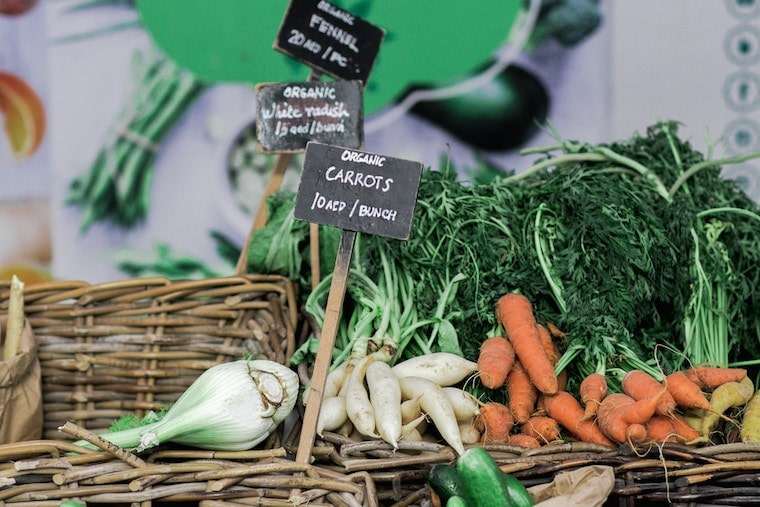
You do you. And you have the right to choose organic products if you want. Organic is a regulated term so yes, there are differences. Nutritional differences? A systematic review and meta-analysis showed only teeny tiny slight increases in certain vitamins, minerals, antioxidants, and phytonutrients due to soil quality, but lower protein quality. However, the evidence is limited as to whether it improves overall health or not, with many experts suggesting it wouldn’t make a large enough difference. The authors did note that more rigorous, standardized research is needed. If you’re concerned about pesticides, Canada has extremely strict laws regarding pesticides and farmers only use them to yield better crops. Organic farming involves rotating crops and using composted plants and manure to enrich the soil and avoiding the use of artificial pesticides (i.e., man-made).
Now the word “natural” becomes tricky because this is not a regulated term, meaning anything can be called natural. Arsenic is natural, but I wouldn’t consider that a good thing! Just remember, the dose is the poison. Meaning, yes, extremely high exposure to a certain pesticide may cause a health problem but it is unlikely that you would eat enough of that food to have any effect on you. At the end of the day, the important thing is to include more vegetables and fruit in your diet, whether organic or not. Just remember to always wash your produce with running water (and use a scrub brush for rougher skins) before eating!
“Healthy”
While this one isn’t inherently bad, it can be used in a misleading way. Obviously, we all want to live healthy lifestyles, that’s a given. What isn’t okay is throwing the word “healthy” in front of something to give off the impression that it is. Just because you say “healthy double cheeseburger” doesn’t mean you should right away trust that it’s okay to eat 10 of them. That’s just bad nutrition advice.
“Free of ___”
Once again, a food “free of” something can be a good thing or a bad thing. Take trans fats, for example. We want to avoid trans fats because of the well-researched evidence out there directing it to heart disease. On the other hand, saying something is “fat free” when it’s licorice (it’s just sugar!) is misleading to the public. Often when something is free of one thing, it’s higher in the other, so look at every food as a whole.
Money $$$

Nutrition shouldn’t be at a high-price. Any time you have to rely on processed products or diets, you’re wasting your money. I’m sure you’ve all had your neighbour or friend try to sign you up for a nutritional supplement program, but really you could be investing those hundreds of dollars into real, nutritious, and delicious food. Trust me, those vitamin fizz drinks aren’t going to help like the synergistic action of food will do with vitamins and minerals.
Personal Stories
Personal stories can help demonstrate how a diet or product works (remember my rant on WTH?). Unfortunately, personal anecdotes are not scientific research. Considering everyone is different, what works for one person may not work for another. In some cases, the stories may also be fabricated to sound more interesting or favour the product and the images are photoshopped (isn’t it annoying when you see an anti-aging commercial and only in the “after” photo are they wearing a full face of makeup??)
Worst Nutrition Websites on the Web for Nutrition BS

Any website hosted by a Registered Dietitian will give you accurate, evidence-informed information. We ARE the experts in nutrition, and we’re regulated by our Colleges to ensure we’re not dishing out bad nutrition advice. We are also well-trained to decipher nutrition research and critically appraise scientific studies. What? All studies aren’t equal? You betcha. Some can be very flawed and you know I talk about that often. While some medical doctors also will give sound nutrition advice, they usually receive one to two nutrition classes in medical school, which is understandable since they are experts in diagnosis and disease. Any time you stumble upon a website that doesn’t have the the credentials RD (Canadian) or RDN (American) listed, you’re going in blind as to whether the information is accurate or not. It may be good stuff and well researched, and it may not be. I often look to see if claims are hyperlinked to research as a good start (though even that doesn’t tell you if that research has been carefully cherry picked or not).
Since I’ve read a LOT of health BS, I wanted to share some of the worst offenders on the internet.
Goop
Oh, Goop, it’s such gobbly goop. If you’re not familiar with the site, you’re better off. Goop is a company founded by Gwyneth Paltrow (yes, the actress). The website talks about a lot of different topics, but let’s focus on their detox section, or else we will be here all week. There are two areas of detoxes according to the site: “Easy Detoxes” and “Advanced Detoxes”. While I’m no fan of any detoxes, the “advanced” ones are concerning. They state: “If you’re plagued by issues like parasites or heavy metals, you might need a bit more than a standard clean eating protocol” and “over time toxic heavy metals can oxidize, causing damage to surrounding tissue and promoting inflammation.” They literally poison our bodies, and can inflict damage on virtually every system and organ, including our brain, liver, digestive system, and other parts of our nervous system. Toxic heavy metals put an immense burden on our immune system, leaving us vulnerable to a variety of illnesses.
Red Flag Reason (among many others): This is a bunch of BS fear-mongering. First of all, if you have parasites, go to the hospital, not to the internet. Second, your body does an amazing job of dealing with any type of heavy metal exposure and sure, it can happen, but for the average person it’s not something to be concerned about since our exposure is limited. If you have high exposure to heavy metals, any food isn’t going to help and you’ll need to seek medical attention. Antioxidants and phytochemicals can definitely help with oxidation, but to completely mislead people and say they are the miracle cure is ridiculous. Making promises to treat severe health problems is, in my opinion, purely unethical. And finally, their disclaimer at the bottom tells you a lot:
The views expressed in this article intend to highlight alternative studies and induce conversation. They are the views of the author and do not necessarily represent the views of goop, and are for informational purposes only, even if and to the extent that this article features the advice of physicians and medical practitioners. This article is not, nor is it intended to be, a substitute for professional medical advice, diagnosis, or treatment, and should never be relied upon for specific medical advice.â€
So, this disclaimer is a safeguard and reminds the reader that this information shouldn’t be used as medical advice since every person will have specific medical needs. Having a disclaimer isn’t the bad part, in fact, it’s good to be transparent. But how many people actually read the disclaimer? Sadly, too few. Most read the title, a few sentences, and call it a day, leading to absurd and potentially dangerous behaviours. This is a site that is primarily opinion-based and goes against most modern medicine. Sorry Gwen, you just give bad nutrition advice.
Natural News
Okay, I can’t talk about this one long or else I may self-implode. Basically, all you need to know about this site is it is notorious for going against majority of modern medicine and is all about “natural” medicine. While I’m not against alternative therapies and believe that they can be used in conjunction to support traditional medicine, I do believe in science first, and that’s one area this site is grossly lacking in. The front page of the website already has about 1000 red flags, but one that stood out was “Is your cardiologist KILLING you?” I mean, come on, as soon as you read a fear-mongering click-bait statement like that, click the back-button immediately.
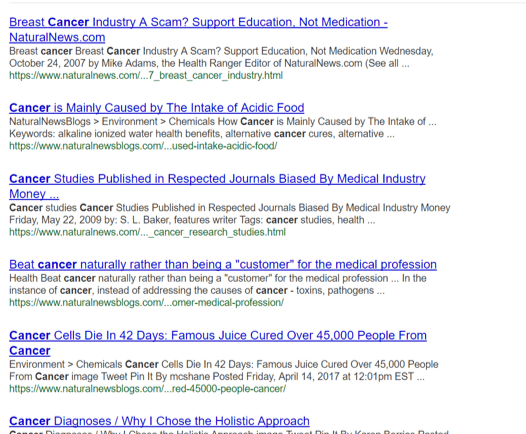
Also, whenever you see bold statements that state “X causes Y”, you know you’ve found spotty research and there are a lot of these claims on this site. The problem with this is that research seldom can prove causation but rather correlation. This means that X can be related to Y, but it’s not certain what causes what. For example, smoking cigarettes is highly correlated with lung cancer, but you’re not guaranteed to ever get it (PSA: NOT a promotion to start smoking!) As well, suggesting that cancer or any other disease can be easily cured naturally is concerning and once again, unethical.
Food Babe
Food Babe is a website by Vani Hari, an advocate for safe and ethical food practices, which yes, is great. The problem here is that she has no formal education in any nutrition or food related area. She also uses fear-mongering tactics (seeing a trend here?) to scare and influence consumers. Many of her statements are limited to her personal opinion, conflation of research and demonstrate a lack of knowledge in the science of food and nutrition. Here is her disclaimer:
“Before starting any new diet and exercise program please check with your doctor and clear any exercise and/or diet changes with them. I am not a doctor or registered dietitian. The information presented herein is not presented with the intention of diagnosing or treating any disease or condition. This information is for educational purposes only. No responsibility is assumed by the author nor anyone connected with this website for the use of this information and no guarantees of any kind are made for the performance or effectiveness of the recommendations provided.”
While once again, this is important to let the consumer know, many people do not reach this point. Another issue is that unless you search around a bit, you don’t know immediately that she studied computer science in university, not nutrition or any related science. So, average consumers may just trust that she has education in this area based on the topic of her site. At least she highlights she’s not a doctor or Registered Dietitian (it would be illegal for her to call herself one anyway!) but most people don’t ever come upon this information. The amount of bad nutrition advice on this site makes me a wee bit nauseous, so I’m going to just bow out now.
Mercola
Dr. Mercola has a history of promoting alternative medicine that benefits himself. For example, he promoted and sold tanning beds stating they decrease risks of cancer. You’d think I’m kidding but I’m unfortunately not! This site also is notorious for promoting scientifically discredited diets and other medical remedies. In fact, the FDA has had to send him warning letters about some of his false claims. Just save yourself the hassle and avoid the bad nutrition advice on this site altogether.
The Science of Behaviour Change in a Snap Shot and Change You Can Stick To
So, the question remains, what works and how do we make our resolutions stick? Researchers have studied behaviour change for quite some time. Why? Because they want to know if, how, and how long people are sticking to their goals. At some point in your life, you’ve failed to stick to at least one of your goals and that’s okay because we’re human after all. What’s important is you’re taking the first steps towards changing your life in a positive way. It’s not a straight road, but rather a winding curve with obstacles on the way. It may be hard, but oh is it worth it when you reach them!
In a 2017 systematic review, researchers found that by setting a goal, such as eating five vegetables and fruit per day, or monitoring behaviour, such as using a food journal or using a fitness tracker, were independently associated with behaviour change. The authors noted that when a person sets a goal and then tracks the change, they are more likely to have long-term behaviour change. They also mention that there are two key components to long-term success: 1) Self-regulation (i.e., skills or the “how to”) and 2) An understanding of the reason for the change (i.e., the “why” to the wanted change). In other words, it can be difficult to make a change in your eating habits if you don’t have the skills (e.g., cooking, meal planning, knowledge of nutrition) and/or you aren’t sure why you want to make the change (i.e., why do you want to lose weight? Why do you want to build muscle?). In this case, talking to a Registered Dietitian or doctor can help you identify reasons for change and provide you with the tools to make the change possible.
Here’s a quick overview of SMART goals:
S = set specific, detailed goals
M = the goal should be measurable
A = attainable or achievable
R = realistic
T = a timeline to achieve the goal
An example of a SMART goal would be: “Using my fitness tracker, I will walk 10,000 steps each day for the next 2 weeks”
This is a SMART goal because it’s specific (walking 10,000 steps), measurable (using the fitness tracker to measure 10,000 steps), attainable (this is individual but should be something you genuinely think you can do), realistic (walking 100,000 steps per day would not be realistic), and timely (the checkpoint would be 2 weeks).
How to Spot Bad Nutrition Advice on the Internet

Start the New Year right with positive changes that are known to improve your health. Although it isn’t sexy, you’re better off making small changes over a long period of time if you’re interested in seeing long-term change. Be aware of fear-mongers, faulty science (i.e., bold claims like “X causes Y”), and anything or anyone that promises a miracle cure. It’s all bad nutrition advice that won’t help you reach your goals. When in doubt, always look for credible websites by regulated health care professionals, such as Registered Dietitians, for your nutrition information. Still struggling with what sites to visit? Here’s a quick check list, if you check any of the boxes, you’re better off to ignore it:
- Does the company or person promise quick results? For example, lose 15-20 pounds in a few weeks?
- Are they using buzz words to promote their product such as “detox”, “all-natural”, “super food”, or “clean”?
- Is there a sign-up fee or are there expensive products you must buy?
- Is the program or product only used for a certain timeframe, such as “30-days to a new you”?
- Do they use scare tactics? For example, “This food is KILLING YOU” or “Eat these foods if you want to avoid getting [insert disease]”?
- Are you required to eliminate entire food groups or large portions of a type of food? For example, eliminating all carbohydrates?
- They are not a Registered Dietitian or an expert with lengthy education in the field of nutrition (e.g., PhD in Nutritional Sciences). Note: A Registered Holistic Nutritionist is not a regulated health professional, the “Registered” part here is part of a trademark.
- Are they asking you to purchase a bunch of supplements? Ones you haven’t even heard of before?
- Are they using bold statements like “X causes Y†or “This will cure cancer”?
- Is it too good to be true? (it usually is)
Now I want to know, what are some of the bad nutrition advice websites out there that make you crazy?
What terms and red flags set you off on nutrition BS?
Leave me a comment below with your thoughts!
Contribution by RD2B Katey Davidson
Updated on October 23rd, 2020
Abbey Sharp is a Registered Dietitian (RD), regulated by the Ontario College of Dietitians. She is a mom, YouTuber, Blogger, award winning cookbook author, media coach specializing in food and nutrition influencers, and a frequent contributor to national publications like Healthline and on national broadcast TV shows.




Amy Gorin says
This is such a great post. There is a ton of poor nutrition advice out there!
Abbey Sharp says
thanks! Totally
Whitney E. RD says
Great list 😉 You can add “Dr.” Axe to that list. He once promoted coffee enemas for cancer patients, a potentially dangerous practice that can result in death.
Abbey Sharp says
Oooh yes I forgot about him. Very scary
Rachael Schirmer says
Yes! All of this! Detox, ugh.
Abbey Sharp says
lol yup
Lisa says
Thank you for some great information.
I recently went through a program that had everyone of those Bad, too good to be true, claims. Promising a customized guaranteed approach.
There was nothing customized, other than the high price.
With absolutely no medical background information and they don’t care what your medical conditions are.
20-25 pills a day. Uneducated staff. Healthy oils poured over everything.
Overpriced Dr Matt’s Custom Weight loss in Rochester N.Y.. is all of the bad things I should have known better not to believe.
You don’t know what to expect until After the check has cleared.
Very much like Mercola. They sell you expensive miracle product. If one doesn’t work, here take another. I was up to 28 pills a day. Plus drops and powered drinks.
Thanks Dr Matts Custom weight loss for suckering me again. Oh, and taking my money.
Abbey Sharp says
Sounds super sketchy. Sorry you went through that but thanks for sharing with us 🙂
Emily @Sinful Nutrition says
LOVE this post! We need to get more real nutrition talk out there like this!
Abbey Sharp says
I hear ya!
Sheryl says
Great article and great advice here! It also gets dangerous when all this misinfo gets spread around and someone takes it seriously.
Abbey Sharp says
For sure! Super dangerous
carmy @ carmyy.com says
“sugar free” diets drives me nuts because hello, fruit has sugar! A lot of things have natural sugars in it!
Abbey Sharp says
haha yup!
Summer @ summer-price.com says
As usual great content. I love all of your red flags. Luckily I haven’t ever really looked at any of the websites you mentioned or if I had it sounds like I would have rolled my eyes and clicked off, never giving them much thought. Great post.
Abbey Sharp says
Hahah yup, you would have
Kalee says
So many things to watch for! It really comes down to a healthy, balanced diet and working out like you preach!
Abbey Sharp says
Definitely! Keep it simple
Deborah Brooks says
I think it’s always important to take a closer look at claims before jumping on a band wagon
Abbey Sharp says
Definitely! Do your research!
Rachel says
I’ve never heard of GOOP but the others, yes. They crush my soul.
Abbey Sharp says
lol i agree
Annmarie says
I need to send this to a friend. She actually texted me the other day and asked what “detox” I recommended. I said “I don’t” and I think she got offended – oooh well.
Abbey Sharp says
Haha love it!
Rebecca says
great post! thanks for sharing! That whole sugar-free claim makes me absolutely crazy! I see lots of recipes and even restaurants that claim items are sugar-free that have fruit or syrup or another type of sweetener. ugh. also GOOP makes my blood boil, Gwyneth has NO idea what they promote on that site. she even said so on Ellen or something
Abbey Sharp says
Lol yes i heard that too! She’s crazy
Nicole @ Fitful Focus says
SO MANY PEOPLE I want to send this post to! Thank you!
Abbey Sharp says
Aw thank you!
Farrah says
I hateeeee the word detox, hahaha. I didn’t get to learn anywhere as much about nutrition as I would’ve liked when I was in medical school, so I like to start people off with the basics and send em’ off to dietitians for more comprehensive information!
Goop pisses me off to no end. 😐 THANK YOU for this post!
Abbey Sharp says
Yes! That sounds like a good plan!