• Skip to main content

Abbey's Kitchen

Healthy Recipes, Nutrition Myth Busting, Healthy Eating Tips

  • Books
    • HCC™
    • The Mindful Glow Cookbook
    • Recipe eBooks
      • Family
      • Hypothyroidism
      • BLW
      • Vegan Week 1
      • Vegan Week 2
      • Vegan Week 3
      • Keto
      • Gluten Free Week 1
      • Gluten Free Week 2
      • Fitness
      • Paleo
  • Blog
    • Nutrition
    • Recipes
    • Motherhood
    • Life
  • Explore
    • Neue Theory™
    • Bite Back With Abbey Sharp
      • Apple Music
      • Spotify
      • Amazon Music
    • YouTube
  • Abbey
    • About
    • Coaching
    • Contact

Abbey Sharp

Last Updated March 8, 2022. Published May 18, 2021 By Abbey Sharp 1 Comment

Intuitive Fasting – Is it Really Intuitive or Just Another Diet?

We review the controversial wellness diet “intuitive fasting” and discuss whether it is possible to combine intermittent fasting and intuitive eating.
An empty plate with cutlery placed overtop to demonstrate how sad and restrictive intuitive fasting is.

When it rains pseudoscience, it pours. Which means I need to SERIOUSLY rant about the highly problematic and controversial book that has been making shockwaves across wellness spaces. Recently, the GOOP queen herself, Gwyneth Paltrow, took to her Instagram to endorse the wellness book “Intuitive Fasting” by Functional Medicine practitioner Dr. Will Cole. She claims that intuitive fasting is a “flexible” meal plan that combines intuitive eating, intermittent fasting, and the “ketotarian” diet. 

Now, despite these seemingly contradictory eating philosophies, according to Gwen and Dr. Cole, intuitive fasting will not punish or “restrict” you but promises to help you find “food freedom” by strengthening your intuition through fasting. CRINGE.

So my friends, get ready to grab your diet culture bingo cards, because this rant is about to be a doozy.

WTF IS INTUITIVE FASTING?

A measuring tape wrapped around a fork.

According to Dr. Cole, intuitive fasting merges intermittent fasting and his questionable version of intuitive eating to achieve “metabolic flexibility” which he claims to be at the “root” of wellness.

What the hell does metabolic flexibility mean anyways? Well according to Cole, this is our body’s ability to adapt to different fuel sources like carbs and fat. By becoming metabolically flexible through his 4-week program, Cole claims that it will balance blood sugar levels, improve gut health, manage stress, balance hormones, reduce inflammation, decrease hunger and sugar cravings, increase weight loss, improve longevity, promote anti-aging… you know, the standard list of ailments that apparently every diet fixes.

He also claims that metabolic flexibility achieved through fasting is the “KEY to intuitive eating”.  I would LOVE to know what the creators of intuitive eating, Evelyn Tribole and Elyse Resche think about that.

And while I don’t want to put words in their mouth, from everything I know about intuitive eating as a eating philosophy, ANY restrictive diet is NOT and will never be an integral part of intuitive eating. Full stop. So, either Dr. Cole is just ignoring the defined intuitive eating principles and making up his own definition to fit his agenda, or he’s co-opting the term because its “trendy” in the hopes that it will sell more copies of his book. OR BOTH. it’s obviously both, but more on that later.

IS METABOLIC FLEXIBILITY LEGIT?

Now, the research does suggest that impaired metabolic flexibility is linked to obesity, diabetes, insulin resistance, and metabolic syndrome,. However, there is no research to suggest that there is any specific diet that would have any measurable impact. In fact, a recent randomize control trial found that putting overweight and obese adults on a healthy diet made up of plant-based foods, fish, and low GI carbs did not improve metabolic flexibility. Based on a TON of population research, we’re pretty confident that this is a very healthy dietary pattern for most people. While the marketing of this diet and its associated health claims might sound super sexy and appealing, because metabolism and flexible are two words wellness culture really likes – this theory of his is simply not evidenced based.

KETOTARIAN INTERMITTENT FASTING
The letters "keto diet" spelled out in tiles with two forks on the top and bottom.

In terms of intermittent fasting, there is emerging research supporting some health benefits for some folks. But Dr. Cole’s allegedly “intuitive” version of intermittent fasting strips it of a lot of what makes it an attractive and even intuitive option for some folks. For example, traditional intermittent fasting puts restrictions only on when you eat, not what you eat. Meaning, that during your eating window you can eat liberally without a caloric restriction or limiting certain foods.

But Dr. Cole’s version of intermittent fasting is done in combination with the ketotarian diet – which is basically the plant-based version of the keto diet. Ironically, he states that he doesn’t like to give “hard and fast rules about what you can and can’t eat” but then goes on to share foods on the “allowed” list along with foods that should be avoided? Colour me confused.

With that said let’s walk you through what you can’t eat on this “non-restrictive, flexible” meal plan.

  • No sugar
  • No artificial sweeteners
  • No gluten
  • No unhealthy fats
  • No meat
  • No dairy
  • No alcohol

Plus, you’ll also need to severely limit fruit, starchy vegetables, legumes, and grains.

In terms of what is on the “allowed list”, Dr. Cole promotes “clean keto foods” which includes:

  • Cooking oils
  • Nuts
  • Seeds
  • Eggs
  • Non-starchy veg
  • Fish
  • Plant-based protein. 

Is this guy delusional? Is this guy just hoping people who read this don’t understand the words on the page well enough to catch his gaslighting lies? Because I am legit confused.

Also, his idea of plant-based protein is somewhat questionable in my books. For example, in his list of plant-based protein he includes things like broccoli, asparagus, avocado, Brussel sprouts, and spinach – all of which provide around 2-3 grams of protein per serving. Not really my idea of a typical serving of protein which would clock in closer to 15-25 grams.

The 4-Week Intuitive Fasting Plan

With all that said, let’s take a closer look at Dr. Cole’s 4-week intuitive fasting plan.
A variety of healthy bowls of food.

Week 1

Week 1 is meant to “reset” the body and establish metabolic flexibility by fasting for 12 hours and following a ketotarian diet. At the end of week one, Dr. Cole claims that you should expect to lose weight, decrease inflammation, improve digestion, and decrease sugar cravings and hunger. He also claims that there is no “caloric restriction” and you can eat to satiety, and that this week serves as an intuitive and gentle fasting plan. 

I mean, that is an oxymoron in itself and I didn’t think it would get more problematic than that. But then he goes onto suggest that he still strongly recommends sticking to his meal plan because even “one small hard candy or a few bites of a muffin can sabotage your progress towards becoming an efficient fat-burner”. His words, not mine.

It is also interesting that Dr. Cole will consistently use words like “gentle”, “intuitive” and “flexible”, while in the same breath exercising fear mongering tactics to bully readers into following his meal plan to a T. Sorry, is this based on his intuition or ours? 

Now if we look at his suggested meal plan, we’re only clocking in around 1300-1600 calories/day. Whereas the general caloric recommendation for most adults is around 2000-2300 calories/day.  In other words, you’re looking at a major caloric deficit on a diet that Dr Cole promises “is not about caloric restriction”. Please make it make sense.

Week 2

This week is all about “recharging” your metabolism by restoring blood sugar balance and improving blood lipid levels. I want to strongly emphasize that there is nothing you can do, fasting or otherwise, to reset or “recharge” your metabolism. Dr. Cole is basically just repackaging diet culture buzzwords to help sell his diet program and it probably is working pretty well. In addition, when it comes to blood lipid levels, it can take anywhere from several weeks to 6 months for someone to see improvements in their cholesterol. So, to suggest that one week of fasting is going to give you such overwhelming positive results is unfair marketing.

The fasting window during week 2 increases from 12 hours to 14-18 hours. But of course, this is an “intuitive” fasting plan – which in Dr. Cole’s made-up definition of intuitive eating means that there is no specified time frame for the fast and that instead, you should just “listen to your body”. So basically, you can just decide what time you want to start and end your fast and that is supposed to imply that this is all intuitive? Traditional intermittent fasting also gives you the option of when to position your fasting window and I think most people would argue that unless its 100% aligned with your natural hunger and fullness cues, which may change day to day, it’s not intuitive at all.

Dr. Cole also mentions that you may feel irritable, hungry, restless, and anxious as a result of the lack of carbs. Shocker. This may be related to what we call the “keto flu” and it’s very common when starting a very low carb diet. To mediate this, he introduces what he calls “clean carb-cycling” which means that you can increase your net carbs to 75-150 grams 1 to 2 times per week. While this amount falls outside of the range of what is recommended for the keto diet, it is still considered pretty low carb. Not to mention, the meal plan is still very low calorie despite introducing a slight increase in carbs.

Also, if you want to talk about “listening to your body” – if you are feeling fatigued, low energy, cranky, and most importantly HUNGRY, that’s a pretty clear indication that you are not eating enough. Any fasting, continuous caloric restriction and carb cycling in a major deficit is not going to solve that problem. So, to brand this meal plan as one that is “free from punishment and restriction” is downright deceiving AF.

But unfortunately, it gets worse…

Week 3
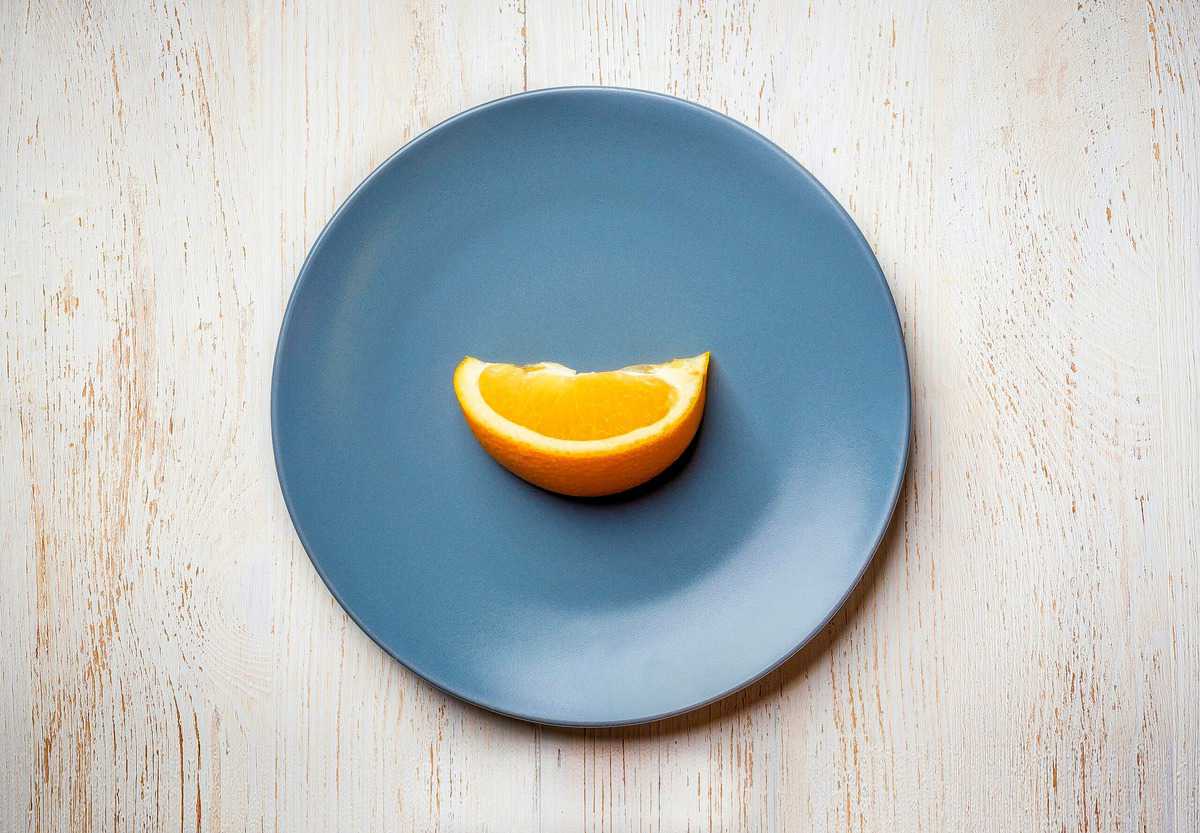
A single orange wedge on a blue plate to show how restrictive intuitive fasting is.

Week 3 involves extending your fast to 20-22 hours every other day. Meaning you only have a 2-4 hour eating window 3 days a week, and you get a 12-hour eating window the remaining 4 days. Um thanks? Apparently, popping in these enhanced fasts help reduce the risk of disease, increase longevity, improve chronic disease symptoms, increase cellular renewal, and increase stem cells. So again, lots of buzzy buzzy bs words that people want to hear, but is there any science to back them up? 

Well, sure, if you are an animal or a cell in a petri dish, because that’s what Dr Cole relies on to substantiate his claims. The few human studies he does cite were very short-term studies on intermittent fasting ALONE and NOT on his bs Frankenstein of various diets. So, to continuously make such bold claims about these long-term outcomes like disease prevention with no long-term research to back them up is again, grossly misleading. 

Week 4

Now, finally, we have arrived at week 4 which involves transitioning back to a 12-hour fasting window and working in 2-4 “clean carb days”. So, same same but different right? Even though by week 4 you are permitted a longer eating window, the meal plan is still CRAZY restrictive and punishing.

Ironically, the major focus of week 4 is to “cultivate a healthier relationship with food” by “practicing mindfulness”. And this is where I have to go off. 

Mindfulness or Mental Gymnastics?

Here is how Dr Cole defines mindfulness in his book. 

“Maybe you’re in your fasting window but you’re dying for a cookie. Or maybe you just ate your break-a-fast meal but you’re still feeling hungry. Whatever the situation, step back and take a few deep breaths… Maybe make yourself a cup of tea and while you sip it, observe any thoughts and emotions that come up. Notice any urges you have to eat or indulge in certain foods. And then, that’s it! You don’t have to do anything about those emotions or urges other than notice them with no judgement or resistance. This is how you grow your mindfulness muscle, which helps you get yourself back into the present moment and connect with your intuition”

Okay so mindfulness to Cole is hearing your body scream for more nourishment and then actively ignoring it by getting yourself a cup of tea. This is the same problematic pro-ED diet culture tips we have been fed since I was a little girl. Want that cupcake? Eat celery instead. Craving chocolate? Go brush your teeth. Want chips? Drink a gallon of water. Will yourself through using your mind power to not – be – hungry.

No amount of deep breathes is going to change the fact that your body needs energy to sustain itself and the longer and more fiercely you restrict, the more likely you are to crack and become completely out of control with food.
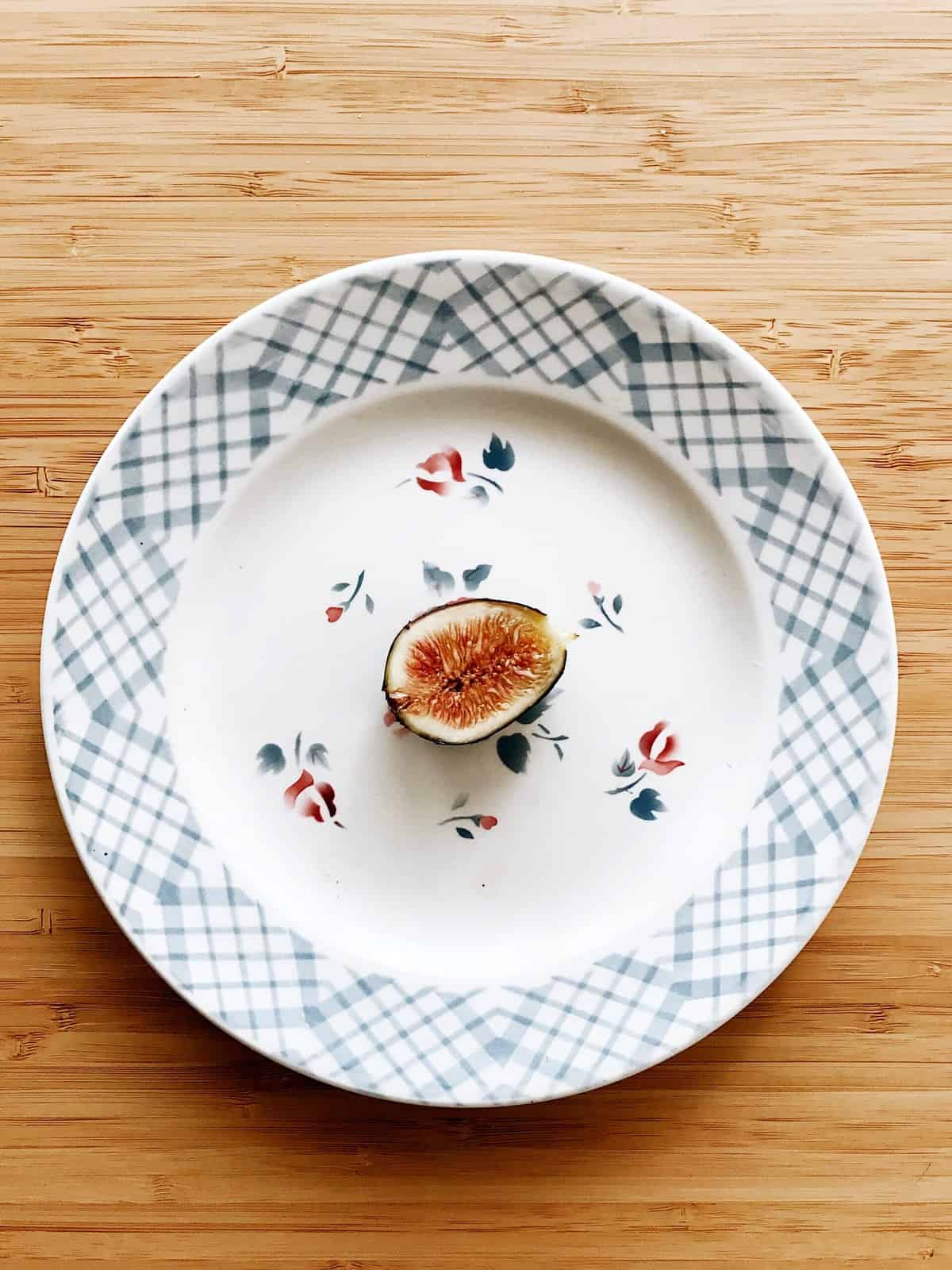
A single fig on a plate to demonstrate how restrictive intuitive fasting is.

And while I do appreciate that Dr. Cole provides a VERY small disclaimer that individuals with a history of eating disorders should not follow this diet plan while also mildly acknowledging that disordered eating can be triggered by fasting, he still insists that his plan is not “disordered eating disguised as a wellness practice”. I mean, it’s similar to the way that he insists that his meal plan is not restrictive, yet he admits that you are likely to feel hungry and fatigued and that you should eat what you want, oh but you will face grave danger if you don’t do it HIS way to a T. The kind of mental gymnastics going on here are highly manipulative and just straight up dangerous.

What is worse is that he claims that “eliminating foods during the plan is not a way to punish your body, but a way to show yourself honour and respect”. So, in other words – he is saying that starving yourself and denying your hunger is a form of “self-love”.

My friends – this is all kinds of effed up and encourages an extremely dysfunctional relationship with food. There is nothing intuitive about denying your body food when its begging to be fed or for following a bunch of bogus food rules in the name of “wellness”.

Is Intuitive Fasting Even Intuitive?

A sign that says "nope".

The short answer is no. Absolutely not.

Here’s the thing. Intuitive eating is not a weight loss diet, and we need to stop seeing wellness influencers or “experts” try to co-opt this language to fit a restrictive agenda. 

Can you lose weight while practicing intuitive eating? Maybe, some people will naturally lose weight.

Can you TRY to actively lose weight through intermittent fasting while also doing intuitive eating? Yes and no.

As it was originally conceptualized, intuitive eating wasn’t a weight loss diet. But I don’t think all of the principals are for everyone in its entirety. So, I do think that if your goal is to lose weight, however that may be, you can still incorporate some of the key principals of intuitive eating into your plan. Things like respecting your body and gentle nutrition. I will also say that some people naturally and intuitively eat in a shortened eating window. That’s what feels intuitive and good to them.

But it comes down to intention. When you pile restriction onto restriction, cutting out foods you love and abstaining for 22 hours from food even when your body wants it, and then have to drink tea to distract yourself from your hunger cues, that my friends could not be farther than an intuitive life.

Bottom Line

Obviously, Dr. Cole is simply jumping on the intuitive eating bandwagon because it is “trendy” and “diet” has become a dirty word. Talking about weight loss is now a hell of a lot less sexy than talking about digestion, energy levels, or generally how we feel.

But if you are going to write a whole book about an eating philosophy, at least pick up a copy and do some homework. You can’t throw around words like “intuitive”, “food peace” and “food freedom” next to “” clean” “detox” “ketotarian” and “22 hour fast”, while also providing tips on how to suppress your hunger cues. Dr. Cole and Paltrow do not belong in this space. 

So, if the Gweny endorsement wasn’t enough to steer you away from this book, the problematic, dangerous, manipulative advice from the book that I presented to you, hopefully will. End rant.

Written by: Giselle Segovia RD MHSc

More Blog Posts You Might Like

  • Intuitive Eating: Food Waste and Challenging the Food Police
  • Intermittent Fasting and Working Out: Will it Help or Hinder Your Performance
  • Keto Diet – What This Dietitian Actually Thinks about the Ketogenic Diet for Weight Loss

Abbey Sharp

Abbey Sharp is a Registered Dietitian (RD), regulated by the Ontario College of Dietitians. She is a mom, YouTuber, Blogger, award winning cookbook author, media coach specializing in food and nutrition influencers, and a frequent contributor to national publications like Healthline and on national broadcast TV shows.
www.abbeyskitchen.com/about-abbey/

Last Updated June 9, 2021. Published May 13, 2021 By Abbey Sharp 25 Comments

Mixed Berry Pancakes for BLW (Sheet Pan Recipe)

This Mixed Berry Pancakes recipe is perfect for baby led weaning (BLW). New eaters, toddlers, kids, and adults will love this easy pancake recipe. They’re amazing first foods, great for on the go snacks, and packed with great nutrition you will feel good about serving your family.

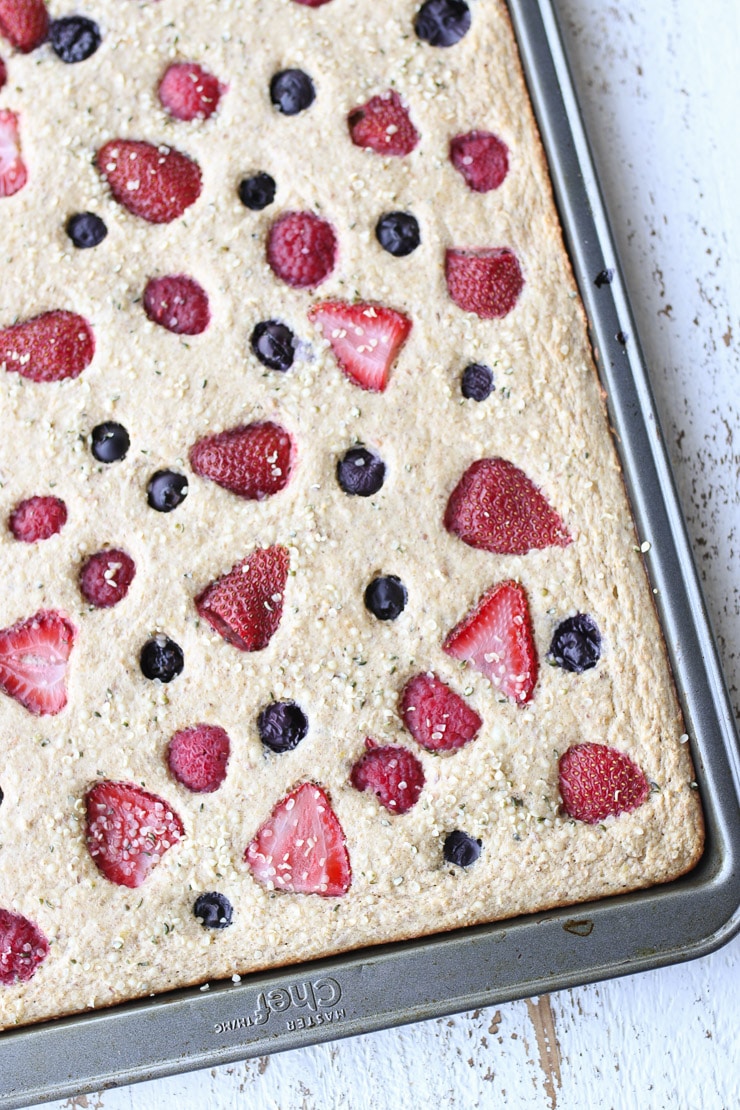
birds eye view close up of sheet pan pancakes with berries.

We love protein pancakes in this house, and when my protein sheet pan pancakes went off REALLY well, I knew I had to adapt them to be ideal for baby led weaning and new eaters.

Table of contents

  • Why This Recipe Works
  • Key Ingredients
  • How to Make This Recipe
  • Expert Tips
  • Recipe FAQs
  • More Recipes You Might Like

Why This Recipe Works

As I discuss in my starting solids beginners guides and meal plan, I always recommend starting with finger-shaped foods so baby can easily pick it up even without having pincer grasp. These mixed berry pancakes are also:

  • Nutrient packed
  • Good source of iron
  • Protein packed
  • Easy to make
  • Make ahead friendly
  • No flipping needed!

Key Ingredients

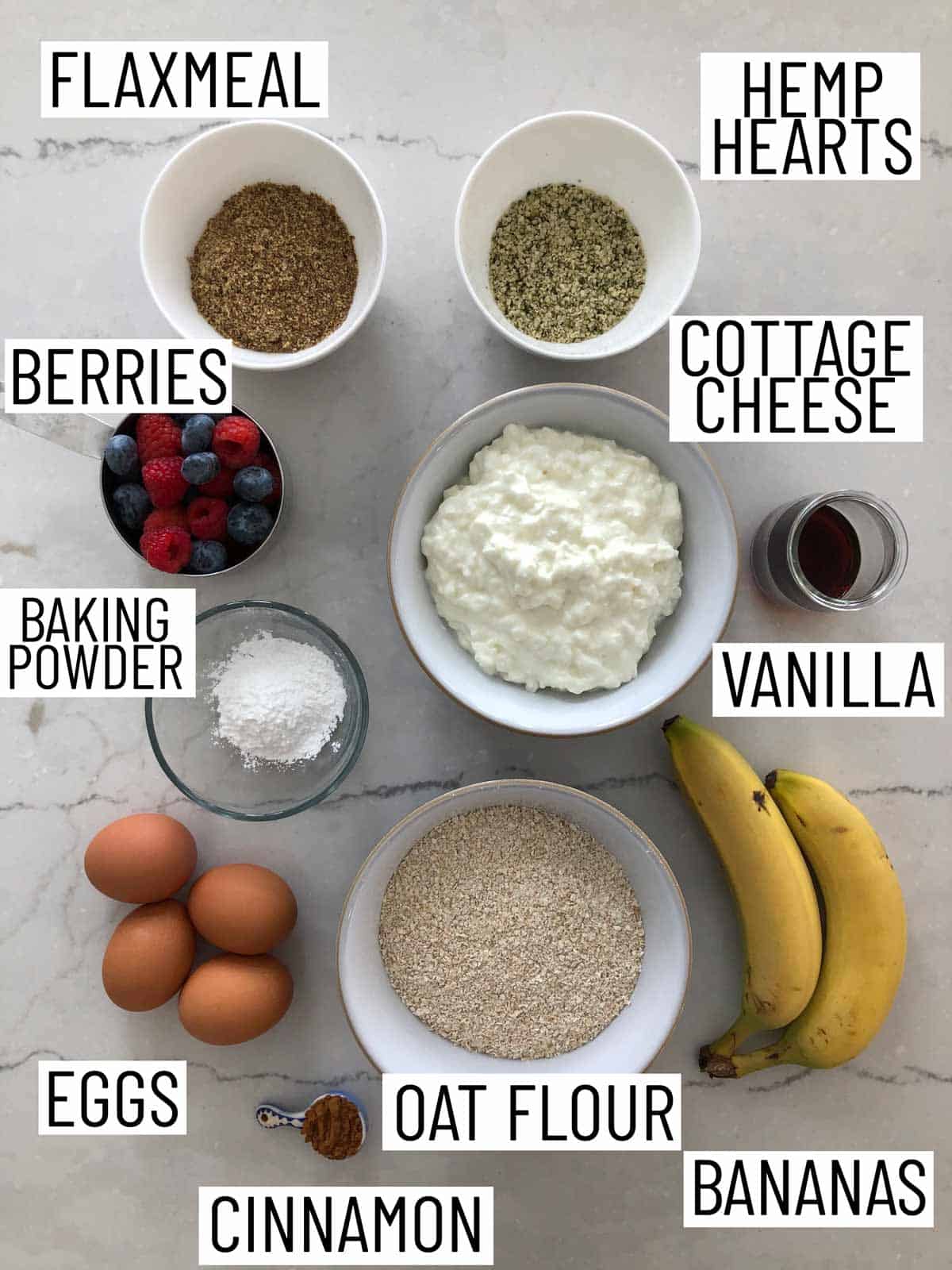
Ingredients needed to make a sheet pan pancake.

Oat flour– Oats are not a major allergen so this is an ideal option if you haven’t yet tested wheat for allergies. You can make your own oat flour by pureeing rolled or quick cooking oats in the food processor. You can also make these gluten free if you choose gluten free oats.

Flaxmeal – Love the added omega 3s, fibre and protein in flax!

Cottage cheese – When pureed in the food processor, cottage cheese gets super smooth and thick like whipped cream. Look for a low sodium option if you can, but also just know that in the context of this whole recipe and how much baby is going to eat, it’s not a huge deal in my opinion.

Eggs – I like using omega 3 eggs if you can find them just as an added source of these important fats.

Bananas – This is your chance to use really nice super ripe bananas to add natural sweetness without any added sugar! I always keep ripe bananas in the freezer for making recipes like this (or these baby led weaning muffins that everyone loves).

Berries – This is to add some extra nutrition, colour and flavour. Change things up by using different berries for these mixed berry pancakes.

How to Make This Recipe

Set of three photos showing dry ingredients in a bowl, cottage cheese in a food processor, and then all ingredients combined.

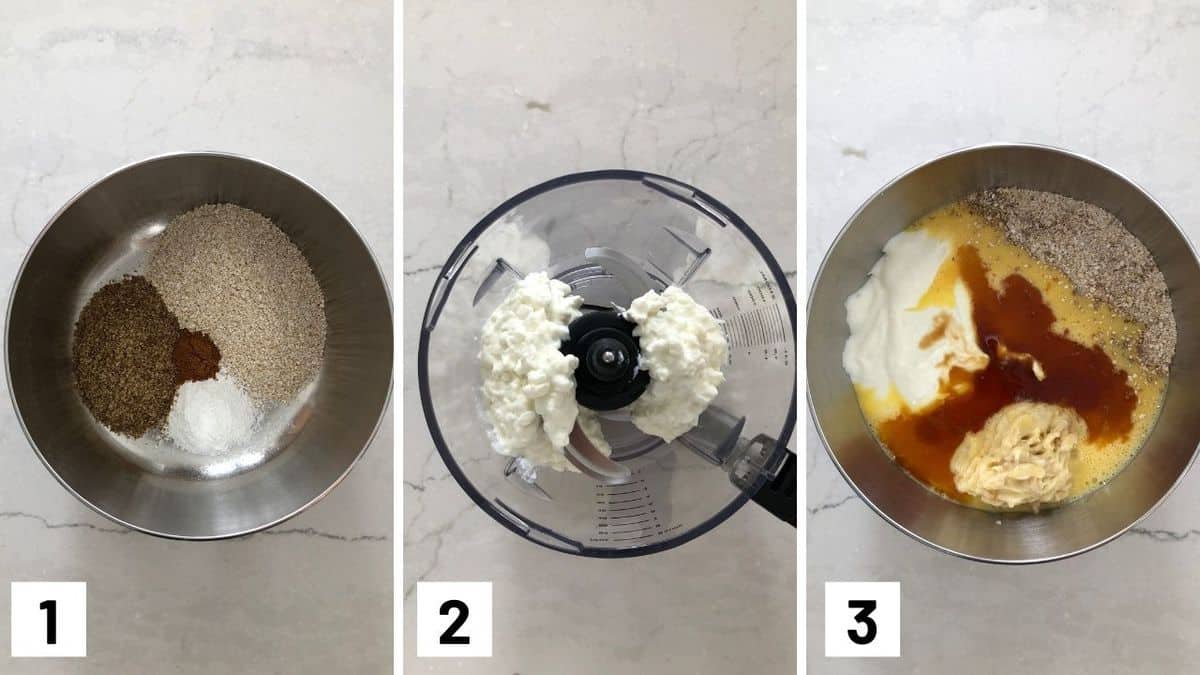
Step 1: Preheat oven to 425 F and spray a 19”x 12” baking sheet with cooking spray. To a large bowl, mix together the oat flour, baking powder, cinnamon, flax and salt.

Step 2: To a food processor, puree the cottage cheese until very smooth.

Step 3: Add that to the dry ingredients, along with the vanilla, eggs, and banana.

Set of two photos showing before and after baking pancakes.

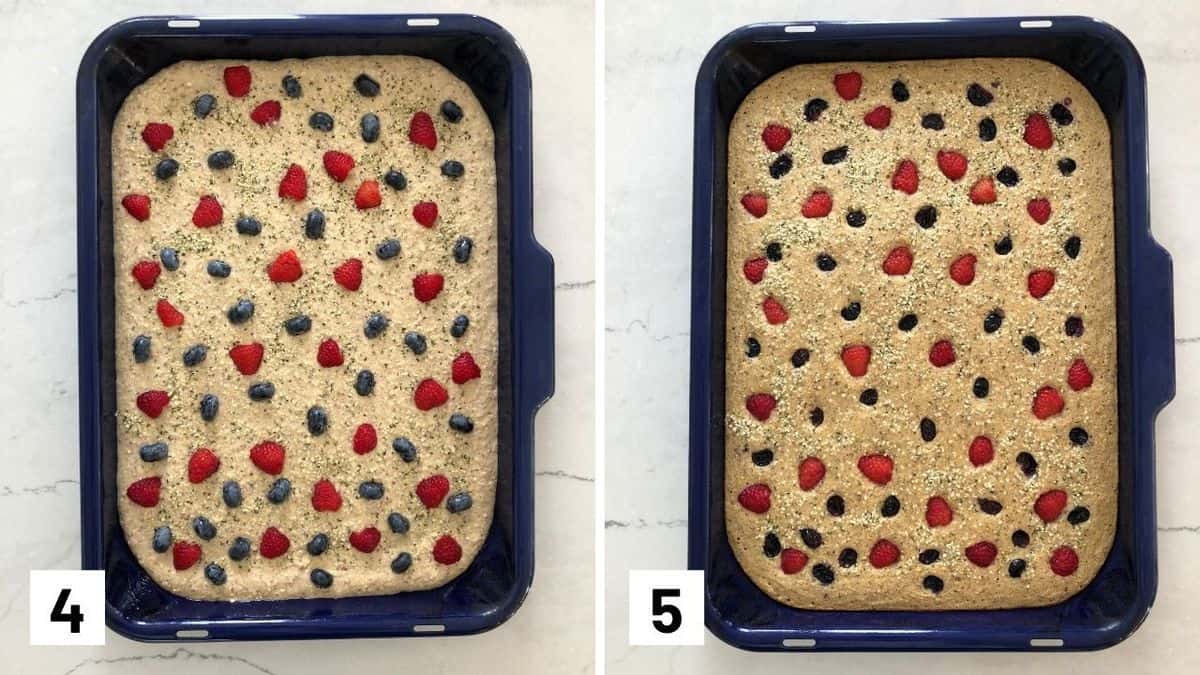
Step 4: Spread into the prepared baking sheet and top with berries and hemp hearts.

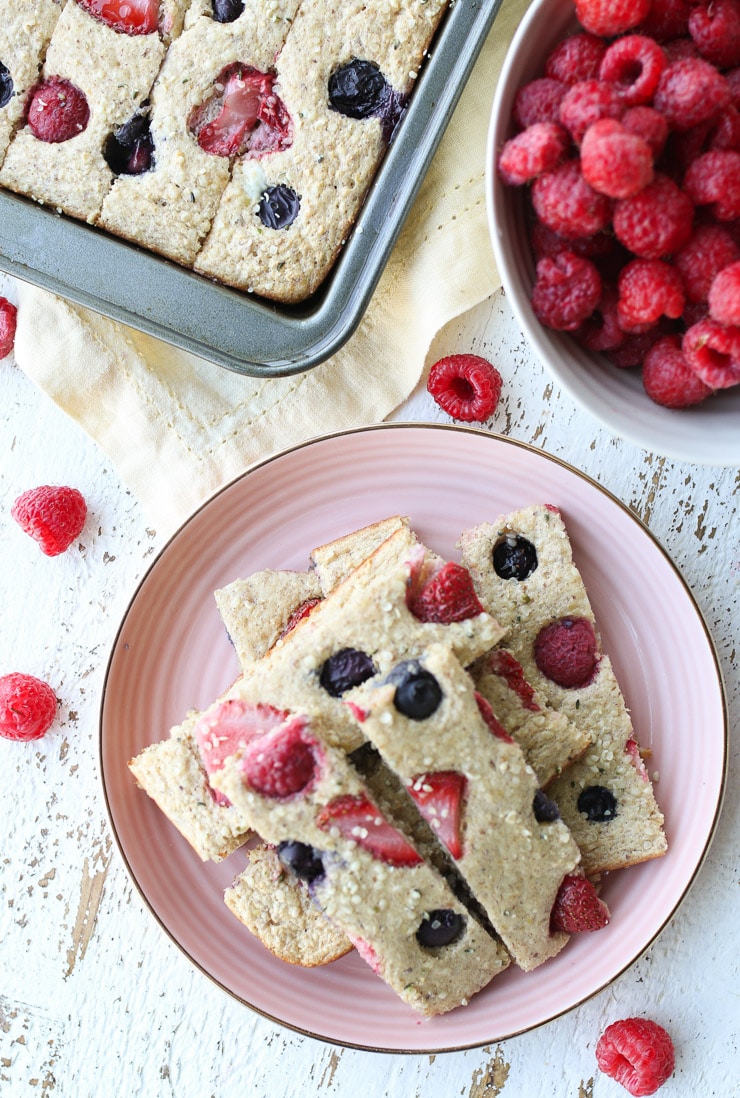
Step 5: Bake at 425 for 12 minutes, turning the pan around half way through the cooking period to ensure it cooks evenly. Cut the mixed berry pancakes into strips so it’s easy for baby to pick up and eat.

Expert Tips

The sky is the limit so add in whatever fruit or flavours your kids like. If you want to throw in some extra baking spices (ginger, nutmeg, star anise etc.) – go for it! Or you can add some cooked apple or pear for a nice fall option. You can also go tropical and throw in mango, pineapple and coconut!

Everyone has different favourites? You can make half of the the pancakes a different flavour or even in quarters. Now you can have multiple flavours in a single sheet pan.

The best part about these mixed berry pancakes is that you don’t have to flip them like on the stovetop! Do not skip the sheet pan with cooking spray or it’ll stick to the pan and you won’t be able to flip them even if you wanted to! They should be able to slide right out of your sheet pan.

Recipe FAQs

Can I batch prep these and freeze the mixed berry pancakes?

Absolutely, and I suggest that you do! I always cut these into strips, then transfer them to a baking sheet to freeze individually before transferring to a freezer bag for up to 3 months in the freezer. When you’re ready to eat, you can pull one out and thaw in the microwave for just 20 seconds or so, or fridge overnight.

Can I use yogurt instead of cottage cheese if I can’t find a lower salt option?

Yes! I have had fans and followers make these with full fat Greek yogurt instead of cottage cheese, so that is an option as well. I do find the cottage cheese is thicker, so the batter is less wet, so you may need an extra 1-2 tablespoons of flour and a few minutes extra in the oven.

Can I use frozen berries instead of fresh?

You can use frozen berries in place of fresh berries for these mixed berry pancakes. No need to thaw them before using, simply add them to the batter, straight from frozen.

birds eye view of berry pancake fingers on a pink plate with sheet pan and raspberries in the background

More Recipes You Might Like

Want more protein packed pancakes like my mixed berry pancakes? Try these ones!

  • Sheet Pan Protein Pancakes with PB, Chocolate and Banana 
  • Baby Cereal Pancakes 
  • Baby Spinach and Avocado Green Pancakes 
  • Chocolate Peanut Butter Banana Protein Pancakes 
  • Nutella Protein Pancakes 

What are your favourite pancake recipes? Have you tried making pancakes in a sheet pan yet? Leave me a comment below with your thoughts! 

Print Recipe
5 from 14 votes

Mixed Berry Pancakes for BLW (Sheet Pan Recipe)

This Mixed Berry Pancakes recipe is perfect for baby led weaning (BLW). New eaters, toddlers, kids, and adults will love this easy pancake recipe. They're amazing first foods, great for on the go snacks, and packed with great nutrition you will feel good about serving your family.
Prep Time10 minutes mins
Cook Time15 minutes mins
Total Time25 minutes mins
Course: Breakfast, Snack
Cuisine: American
Servings: 32 fingers
Calories: 63kcal
Author: Abbey Sharp

Ingredients

  • 1 ½ cup oat flour gluten free if needed
  • ¼ cup ground flaxmeal
  • 2 ½ tsp baking powder
  • 1 tsp cinnamon
  • 1 ½ cup high fat cottage cheese ideally low sodium
  • 4 tsp vanilla
  • 4 eggs beaten
  • 2 large mashed very ripe bananas
  • 1 cup berries halved if large
  • 2 tbsp hemp hearts
  • 1 pinch salt

Instructions

  • Preheat oven to 425 F and spray a 19”x 12” baking sheet with cooking spray.
  • To a large bowl, mix together the oat flour, baking powder, cinnamon, flax and salt.
  • To a food processor, puree the cottage cheese until very smooth. Add that to the dry ingredients, along with the vanilla, eggs, and banana.
  • Spread into the prepared baking sheet and top with berries and hemp hearts.
  • Bake at 425 for 12 minutes, turning the pan around half way through the cooking period to ensure it cooks evenly.
  • Cut into strips so it’s easy for baby to pick up and eat.

Video

Notes

  • The sky is the limit so add in whatever fruit or flavours your kids like. If you want to throw in some extra baking spices (ginger, nutmeg, star anise etc.) – go for it! Or you can add some cooked apple or pear for a nice fall option. You can also go tropical and throw in mango, pineapple and coconut!
  • Everyone has different favourites? You can make half of the the pancakes a different flavour or even in quarters. Now you can have multiple flavours in a single sheet pan.
  • The best part about these pancakes is that you don’t have to flip them like on the stovetop! Do not skip the sheet pan with cooking spray or it’ll stick to the pan and you won’t be able to flip them even if you wanted to! They should be able to slide right out of your sheet pan.

Nutrition

Calories: 63kcal | Carbohydrates: 7g | Protein: 3g | Fat: 2g | Saturated Fat: 1g | Cholesterol: 22mg | Sodium: 46mg | Potassium: 117mg | Fiber: 1g | Sugar: 2g | Vitamin A: 55IU | Vitamin C: 1mg | Calcium: 37mg | Iron: 1mg
Abbey Sharp

Abbey Sharp is a Registered Dietitian (RD), regulated by the Ontario College of Dietitians. She is a mom, YouTuber, Blogger, award winning cookbook author, media coach specializing in food and nutrition influencers, and a frequent contributor to national publications like Healthline and on national broadcast TV shows.
www.abbeyskitchen.com/about-abbey/

Last Updated May 9, 2022. Published May 12, 2021 By Abbey Sharp 1 Comment

What to Look for in a Protein Powder

We break down the top protein powder on the market including whey, casein, and vegan options and help you get a better understanding of third party testing to help you select an option that is right for you.

Protein Powders Cheat Sheet
A person sitting on a yoga matt with free weights and holding up a protein smoothie.

It is no surprise that protein powder is one of the most popular nutrition supplements on the market. While you may find fitness and nutrition influencers crediting their gains to their daily shake, the truth is there’s nothing magical about protein powder when it comes to building muscle or losing weight. Protein is important for both of these things but protein powder is just a convenient source of it. It’s not necessarily superior to food based sources like chicken, tofu or fish. But I do think it has an important place, and it is so easy to add a scoop to a morning smoothie or stir some into your oats for a balanced snack or meal.

With that said, it’s important to note that not all protein powders are created equal, and I get a lot of questions on how to choose the right one. In some cases, protein powder might even be dangerous. There have actually been a few high-profile lawsuits where protein powders were called out for containing unlisted fillers, or inaccuracies in ingredients or quantities. 

So, in today’s blog post, we will be sorting through some of the most popular protein powders on the market to help you get a better understanding of protein powders that may suit your lifestyle.

Protein Powder 101

White protein powder and a scoop.

Just like any supplement, protein powders are not regulated by the Food and Drug Administration (FDA), meaning there’s no strict set of rules or guidelines about what’s in them or how they’re marketed. While the FDA does get involved when there is a complaint or some kind of health scare, the onus is mostly on the manufacturers to properly evaluate their products and be transparent in their labelling and marketing. In other words, no one’s really checking their homework.

This is why choosing a brand that completes third-party testing is really important when purchasing any supplement, especially one that is likely to be consumed regularly like protein powder. Third-party certification essentially means that an independent organization has reviewed the manufacturing process of a product and has independently determined that the final product complies with specific standards for safety, quality or performance.

Third Party Testing

There are three places that I turn to when choosing a protein powder to evaluate its safety and purity, and that includes Labdoor, NSF and Informed Choice.

Labdoor.com is an awesome website that purchases products then sends a sample of each product to an FDA-registered laboratory for a detailed chemical analysis, which includes measurements of active ingredients and potential contaminants. Based on the findings, Labdoor calculates a quality score for each product based on label accuracy, product purity, nutritional value, ingredient safety, and projected efficacy. 

NSF Sport is certification program that lends a stamp of approval to products that are free of unsafe levels of contaminants, prohibited substances or masking agents. They also ensure that what’s listed on the label matches what is in the product. 

Informed Choice is another company that verifies the products with their quality mark through a 4 stage certification process that involves product & manufacturing reviews, sample testing, product certification, and post-certification requirements and testing. 

If you’re unsure about your product and don’t see them listed with these three regulatory bodies, you can always reach out to the brand directly to ask for their certification information.

And that is exactly what we did for this blog post. We did the research to help you find an option that’s been third party tested and deemed safe.  So lets get into it.

Top Whey Protein Powders

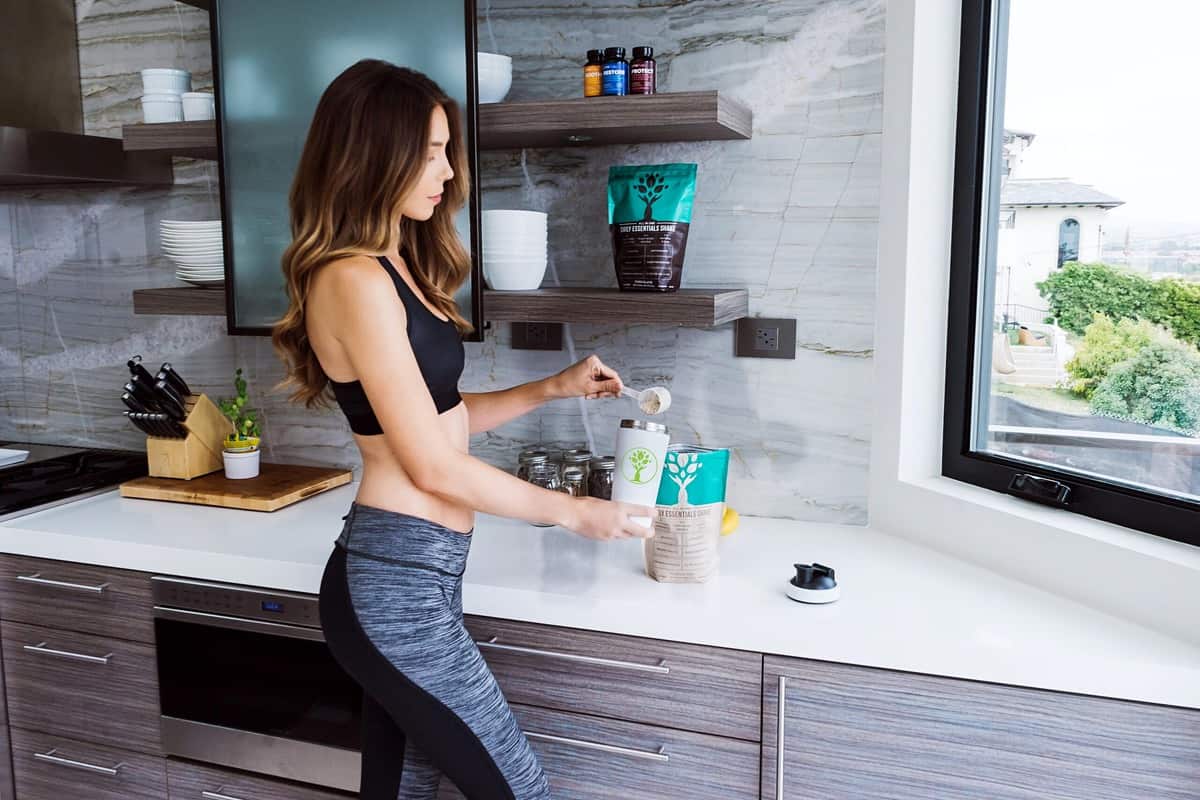
A woman scooping protein powder into a tumbler mug.

If you are looking for the best quality protein in terms of bioavailability and quality, experts agree that whey protein is your best bet.  If you’ve tried a whey protein powder in the past and found it caused gas, or bloating, you’ll want to look for an option that uses whey protein isolate or hydrolyzed whey. Compared to whey protein concentrate, which is a cheaper option, whey protein isolate contains less lactose, fat, and carbs and slightly more protein per scoop, so its ideal for those with lactose intolerance.

Whey protein hydrolysate is “predigested” by enzymes and acids so it’s available to the muscles even faster and may also be a bit easier on the gut. Hydrolyzed whey and whey isolate are much more expensive, so if you can tolerate lactose, you might be fine with a basic whey concentrate formula.

Based on the most popular whey protein brans, this is what I can recommend. Also, keep in mind that the prices were in USD.

Muscle Feast is one of the top-rated protein powders on LabDoor.com with a super simple ingredient list and 21 grams of grass-fed whey isolate protein. It’s also one of the more affordable options at just over a dollar per serving.

Alani Nu is a popular third party tested option with 23 grams of isolate and hydrolysate whey. They have some fun flavours like confetti cake and munchies, but some flavours do contain artificial food colours, so something to note if you’re sensitive to food dye.

MyProtein Impact Whey Isolate is Labdoor approved with 19 grams of whey protein per scoop and is available in fun flavours like chocolate brownie batter, snickerdoodle, and s’mores. It’s one of the most affordable options but it does contain Ace-K sweetener, which (while safe) has been a controversial sweetener for a while now since early animal research has linked it to cancer. That does not mean that it causes cancer, of course, but if you personally avoid artificial sweeteners, you may want to avoid this brand.

Ghost is NSF certified and packs 25 grams of whey protein into each scoop – they use a blend of isolate, concentrate and hydrolyzed and is sold in fun childhood flavours like Nutter Butter and Chips Ahoy. They also advertise as having digestive enzymes which sounds great, but there is currently no evidence that enzymes other than lactase (aka lactaid and alpha-galactosidase aka beano) are at all effective. So just note that that alone isn’t likely worth the higher price.

Garden of Life Whey Isolate is informed choice and NSF certified with 24 grams of grass-fed whey isolate per scoop plus 2 billion added probiotics.  It is however one of the pricier options so something to keep in mind.

IdealFit for Women is also approved via Labdoor with 20 grams of whey isolate protein per scoop. They also have fun flavors like fruity cereal, red velvet, spiced pumpkin and buttered pecan. I was weary about a pink tax with them marketing this supplement to women but I actually found the prices were quite reasonable.

Dymatize ISO-100 contains 25 grams of hydrolyzed isolate whey with a glowing review on Labdoor for its accuracy and safety.

Top Casein Protein Powders

A man at the gym sitting on a bench and scooping protein powder into a tumbler mug.

While whey may be the gold standard of protein powder, there are scenarios where casein protein is actually preferred. Namely, as a bedtime snack. Casein protein is digested and absorbed slower than whey, so it’s often used before bed to promote satiety and to aid in muscle recovery while you sleep. For this reason, most people prefer casein micellar which is digested more slowly than casein hydrolysate or whey protein when they’re mixing up their bedtime shake.

Optimum Gold Standard 100% Casein is a Labdoor recommended option that we love because it has 24 grams of micellar casein per scoop, but it also contains that Ace-K mentioned before and some flavours have high fructose corn syrup and gums so keep that in mind if you are sensitive to that.

Ascent Native Fuel Micellar is informed Choice certified with 25 grams of casein protein per scoop. This one is sweetened with monk and stevia if you’re looking for natural sweeteners. However, it is a pricier option.

Kaged Muscle Kasein Isolate Powder is another informed choice pick with 25 grams of miscellar casein protein per scoop and it’s mixed with a coconut creamer powder for a silkier texture.

PEScience Select this brand is unique because it’s got 24 grams of a blend of both whey and casein protein so if you don’t want to have two different powders for post workout and pre-bed, this could be a good option. It’s also not only third party tested but they actually allow you to look up your container’s lot # online to see all of the test results.

Top Vegan Protein Powders

A women scooping supplement into a portable bottle.

It’s important to note that some people who have sensitive guts and are sensitive to fodmaps, may also find some vegan proteins bloating, particularly ones that are made from pea protein (which most are). This is something to keep in mind if you suffer from IBS or are FODMAP sensitive.

Vega Sport is vegan, and NSF sport certified with 30 grams of pea and seed protein per scoop. It also contains beet powder and tart cherry powder, both of which have sport-based benefits for performance and recovery.

Nuzest Clean Lean Protein is vegan and third party tested with 20 grams of pea protein per scoop. Obviously I dislike the “clean lean” verbiage and it is one of the most expensive options on the list, but it does have a very short ingredient list – literally just three ingredients. So, if that is a priority for you, this might be worth the cost.

Sunwarrior Classic Plus is third party tested with 17-18 grams of protein per scoop, and they use a unique blend of brown rice, pea, quinoa, chia and amaranth. The result is also rich in vitamin C and plant-based iron with a relatively simple ingredient list. 

Vivo Life Perform Raw Plant Protein is highly recommended on Labdoor, serving up 25 grams of pea and hemp seed protein. It’s definitely a more expensive option at $2.57 per serving probably thanks to the addition of a variety of “superfood” powders like maca, acai, reishi mushrooms and lucuma fruit.  The result however is high in iron, zinc and selenium, which not all protein powders can boast so if these are lacking in your diet otherwise, it might be worth the price.

Four Sigmatic is another third party tested option with 18 grams of plant-based protein from hemp, pumpkin seeds, chia, peas, and coconut. It also is unique in that they add organic adaptogenic herbs like ashwagandha and mushrooms, the research for the former being a lot more robust than the latter. But honestly, thats a whole other blog post in itself. It’s also an option in that it’s free of added gums and artificial sweeteners but you’re definitely paying for all those bells and whistles – it clocks in at $3.33 per serving. So this may or may not be worth it.

Protein Powders That Are Not Third Party Tested

I also think it’s important to mention some of the companies that could not confirm that they have been third party tested. I not only checked the usual websites for information about their testing procedures, but our team reached out to them personally to see if they could offer any more details.

Premier Protein said “Unfortunately, the information you are requesting is proprietary. Our ingredients are listed on the packaging in order by weight (heaviest to lightest).” okay…

BULK protein said “We only do third party test if we don’t have an in-house method or the proper equipment to test the products ourselves, so to answer your question that is a no.” kay.

Orgain’s website states “We carefully source our ingredients and review testing to ensure products conform to our rigid specifications for quality and consistency. Our products are tested for arsenic, cadmium, mercury and lead.” So that sounds good, but they wouldn’t answer our emails regarding third party testing and their website didn’t confirm that had been done either.

And finally, Tropeaka never answered my email about testing, and I could find nothing online to confirm they are regularly tested at all.

A woman holding up a milk shake.

Bottom Line

So that’s not to say that these brands are unsafe or even that they’re not third party tested, but I just couldn’t obtain hard proof either way. Also its important to clarify that this is NOT an extensive list and I am literally just scratching the surface. I also can’t confirm how all of these taste since well, protein powder is damn expensive, and I can’t exactly order myself a container of every one of these to try. So I do recommend trying to order sample packs before you invest in a whole container. If you’re wondering how your protein powder stacks up, check out labdoor.com and read the manufacturers website carefully for information on their testing procedures.

https://www.youtube.com/watch?v=hTD8xFvryFI&ab_channel=AbbeySharp

More Blog Post You Might Like

  • Are Supplements Safe? | How to Choose the Right Supplement For You
  • Can Collagen Supplements Tighten Skin?
  • Fertility Supplements and Foods for Getting Pregnant
Abbey Sharp

Abbey Sharp is a Registered Dietitian (RD), regulated by the Ontario College of Dietitians. She is a mom, YouTuber, Blogger, award winning cookbook author, media coach specializing in food and nutrition influencers, and a frequent contributor to national publications like Healthline and on national broadcast TV shows.
www.abbeyskitchen.com/about-abbey/

Last Updated June 9, 2021. Published May 10, 2021 By Abbey Sharp Leave a Comment

Raspberry Muffins with Kombucha (Vegan)

These kombucha raspberry muffins are an easy vegan snack that can be whipped up in no time! They are also kid friendly and perfect for on-the-go.

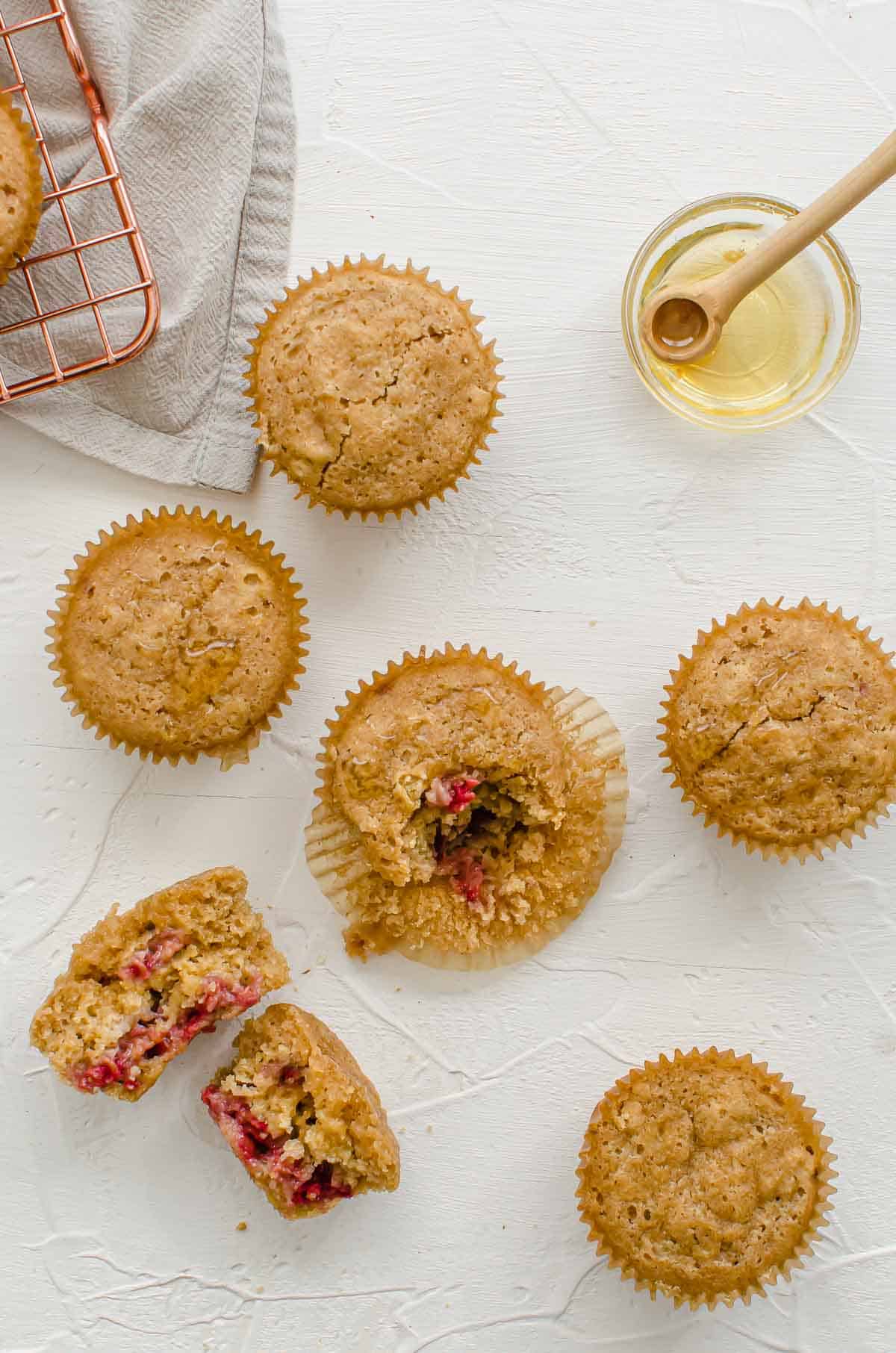
Birds eye view image of raspberry muffins.

Friends, when I learned that you can throw kombucha into muffin batter and cut down on bake time, up the flavour profile , and produce the fluffiest of muffins my MIND. WAS. BLOWN. Thanks to the folks over at Food 52 for bringing this idea to life and giving me freaking whiplash by how inspired I was to create my very own kombucha muffins.

Little did I know, these kombucha raspberry muffins were about to change my life forever. Okay, okay thats a little dramatic but I just love kombucha, and muffins, and raspberries, so let me live okay?!

Real talk though – whether you love to bake, or you love kombucha, or you just love to mow down on a baked good (or all of the above!), these kombucha raspberry muffins are IT.

Table of contents

  • Why This Recipe Works
  • Key Ingredients
  • How to Make This Recipe
  • Expert Tips
  • Recipe FAQs
  • More Recipes You Might Like

Why This Recipe Works

If you can’t already tell, I am just a wee bit excited over these kombucha raspberry muffins and am extremely excited to share them with you all. Here are a few more reasons why you HAVE to try these muffins ASAP.

  • Not too sweet and fluffy AF
  • High in protein (4 grams per serving)
  • High in fibre (4 grams per serving)
  • Requires less than 10 ingredients
  • Only takes 30 minutes to prepare
  • Perfect as an on-the-go snack

Key Ingredients

Flat lay images showing portioned recipe ingredients including kombucha, vegan butter, flour, raspberries, maple syrup, baking soda, and salt].

Kombucha – Kombucha is the genius secret ingredient that not only adds flavour to these raspberry muffins but nearly cuts the bake time in half! The carbonation from the kombucha yields a light and foamy batter that bakes in no time and produces a super fluffy muffin!

Flour – To make these raspberry muffins we opted for oat flour to add a bit more fibre into the mix. If you have other flour options on hand that you want to try out, you can refer to our guide on healthy flours for best uses.

Raspberries – We are using raspberries for this recipe as the tart flavour really stands out against the mild sweetness of the muffins. However, feel free to explore here and pair different fruit and kombucha combinations.

Vegan Butter – To make this recipe vegan friendly we are using vegan butter, but you can certainly use regular butter if you don’t need to make this. vegan.

Maple Syrup – These raspberry muffins have a subtle sweetness to them, so feel free to add a bit more maple syrup (or honey if you ain’t vegan) if you prefer to enjoy a sweeter muffin.

How to Make This Recipe

Three side by side images showing how to prepare dry and wet batter.

Step 1: In a mixing bowl, combine flour, baking soda and salt.

Step 2: In a separate bowl, combine kombucha, melted butter, mashed banana and maple syrup. Mix dry and wet ingredients together until fully combined.

Step 3: Carefully fold raspberries into the batter.

Two side by side images showing how to portion batter in muffin tin and final baked muffins.

Step 4: Place baking cups into a muffin tin and scoop two spoonful’s of the batter into each well (or until the well is 3/4 full).

Step 5: Bake muffins for 15 mins or until golden brown and a toothpick comes out clean.

Expert Tips

Not all kombucha options are made equal, so make sure to take a little gander at the sugar content of the kombucha bottle you are purchasing if you are concerned about the sugar content of these raspberry muffins. In addition, some varieties tend to be sweeter (sweetened with sugar or artificial sweeteners), while others tend to be more on the vinegary/earthy side. So keep this in mind, as the kombucha brand that you select will ultimately impact the flavour of these raspberry muffins. I’d suggest giving the kombucha a little taste test prior to using to ensure that you will be happy with the flavour profile of the muffins.

Four raspberry muffins on a white plate.

Recipe FAQs

Are these muffins gluten free?

If you need to make these gluten free, we suggest looking for a gluten free flour.

Can I batch prep and freeze these?

Absolutely! These can be stored for up to 3 months in a freezer bag or air tight container. When you are ready to eat you can simply pop them in the microwave or let them thaw at room temperature.

Can I enjoy these for breakfast?

Yes these raspberry muffins make for a great on-the-go breakfast option because they are protein and fibre packed. I will usually have 2 muffins per serving if I am enjoying these for breakfast, but honestly eat to your hearts desire.

Are these kid and allergy friendly?

If wheat is an issue for your kiddo then you would have to sub in an allergy-friendly flour alternative that works for you. But otherwise, these raspberry muffins are totally egg and nut free and can be enjoyed by the little people in your life.

More Recipes You Might Like

If you liked these raspberry muffins, then you’re going to love these recipes on the blog!

  • Breakfast Berry Bread Pudding Muffins
  • Baby Muffins with Carrots
  • Kombucha Fruit Popsicles
  • Vegan Apple Oatmeal Muffins

What are your thoughts on these kombucha raspberry muffins? Let me know down in the comments below!

Print Recipe
5 from 1 vote

Raspberry Muffins with Kombucha (Vegan)

These kombucha raspberry muffins are an easy vegan snack that can be whipped up in no time! They are also kid friendly and perfect for on-the-go.
Prep Time15 minutes mins
Cook Time25 minutes mins
Total Time40 minutes mins
Course: Snack
Cuisine: American
Diet: Vegan
Servings: 12
Calories: 204kcal
Author: Abbey Sharp

Ingredients

  • 14 oz bottle of raspberry kombucha
  • 3.5 cups oat flour
  • 2.5 tsp baking soda
  • 2 tbsp flax seed ground
  • Pinch of salt
  • 1 stick of unsalted vegan butter melted (about 1/2 cup)
  • 1/2 cup maple syrup
  • 1 ripe banana mashed
  • 1.5 cup raspberries lightly chopped

Instructions

  • Preheat oven to 400 degrees F.
  • In a mixing bowl, combine flour, baking soda, flax seed and salt.
  • In a separate bowl, combine kombucha, melted butter, mashed banana and maple syrup.
  • Mix dry and wet ingredients together until fully combined.
  • Carefully fold raspberries into the batter.
  • Place baking cups into a muffin tin and scoop two spoonful’s of the batter into each well (or until the well is 3/4 full)
  • Bake muffins for 15 mins or until golden brown and a toothpick comes out clean.

Nutrition

Calories: 204kcal | Carbohydrates: 37g | Protein: 6g | Fat: 4g | Saturated Fat: 1g | Polyunsaturated Fat: 2g | Monounsaturated Fat: 1g | Trans Fat: 1g | Sodium: 237mg | Potassium: 231mg | Fiber: 4g | Sugar: 10g | Vitamin A: 11IU | Vitamin C: 5mg | Calcium: 42mg | Iron: 2mg
Abbey Sharp

Abbey Sharp is a Registered Dietitian (RD), regulated by the Ontario College of Dietitians. She is a mom, YouTuber, Blogger, award winning cookbook author, media coach specializing in food and nutrition influencers, and a frequent contributor to national publications like Healthline and on national broadcast TV shows.
www.abbeyskitchen.com/about-abbey/

Last Updated May 7, 2021. Published May 7, 2021 By Abbey Sharp 9 Comments

Pineapple Oatmeal with Coconut (High Protein)

Take advantage of the summer holiday flavours with this pineapple oatmeal with coconut. This high protein breakfast is gluten free, dairy free and a great balanced healthy breakfast for powering through your day.

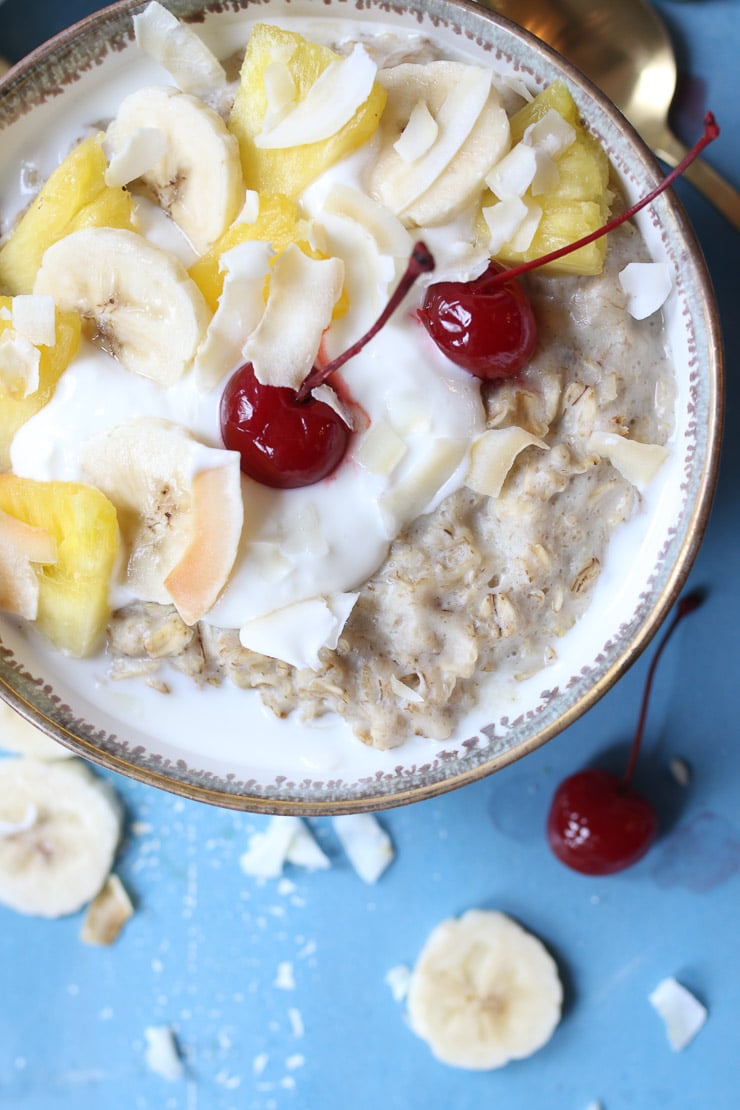
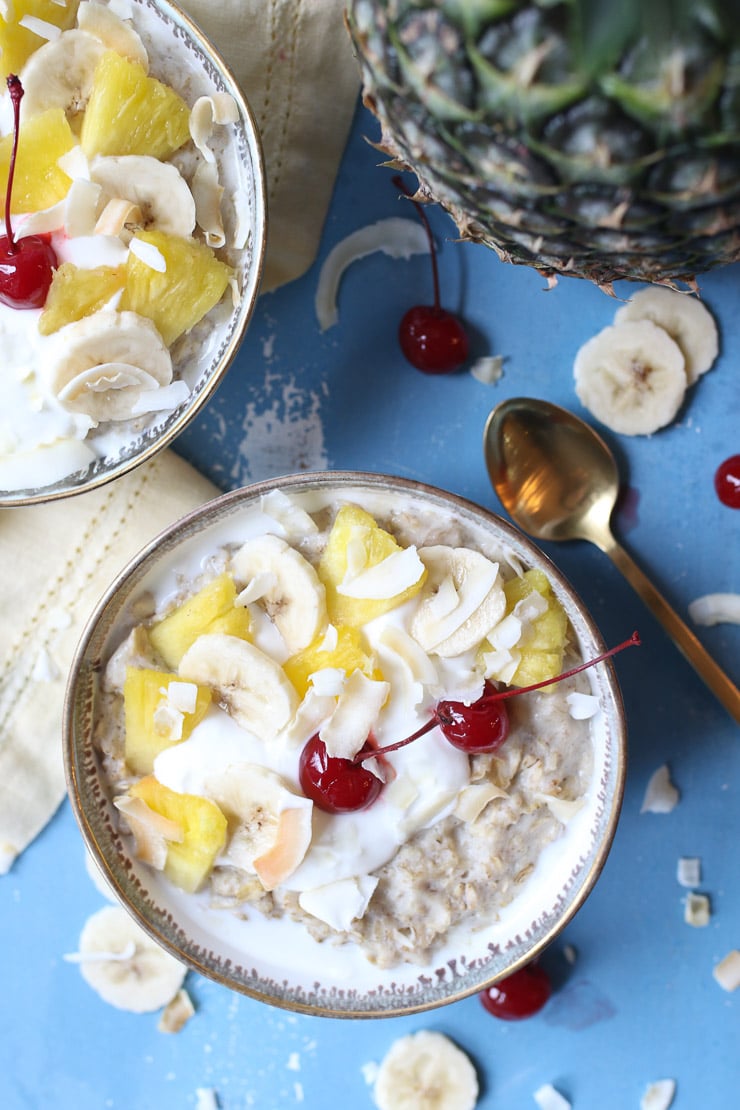
Bowl of pineapple oatmeal topped with pineapple, cherries and yogurt.

It’s evident by now that PROATS (aka protein oatmeal) make a weekly appearance in my kitchen. While a lot of people think oatmeal is a winter breakfast idea, I thought it would be a good idea to summer-ify it! I mean, since we can’t perpetually be at the beach, I’m bringing the beach to your morning routine with this pineapple oatmeal with coconut. These tropical oats taste like a piña colada and will have you day dreaming of sunny boozy beach days!

Table of contents

  • Why This Recipe Works
  • Key Ingredients
  • How to Make This recipe
  • Expert Tips
  • Recipe FAQs
  • More Recipes You Might Like

Why This Recipe Works

Besides the fact that this pineapple oatmeal tastes like all the yummy goodness of a piña colada, here are a few more reasons why we get hyped over this recipe!

  • Gluten free
  • Dairy free
  • High protein (17 grams per serving)
  • Source of fibre (4 grams per serving)
  • Easy to prepare
  • Requires minimal ingredients

Key Ingredients

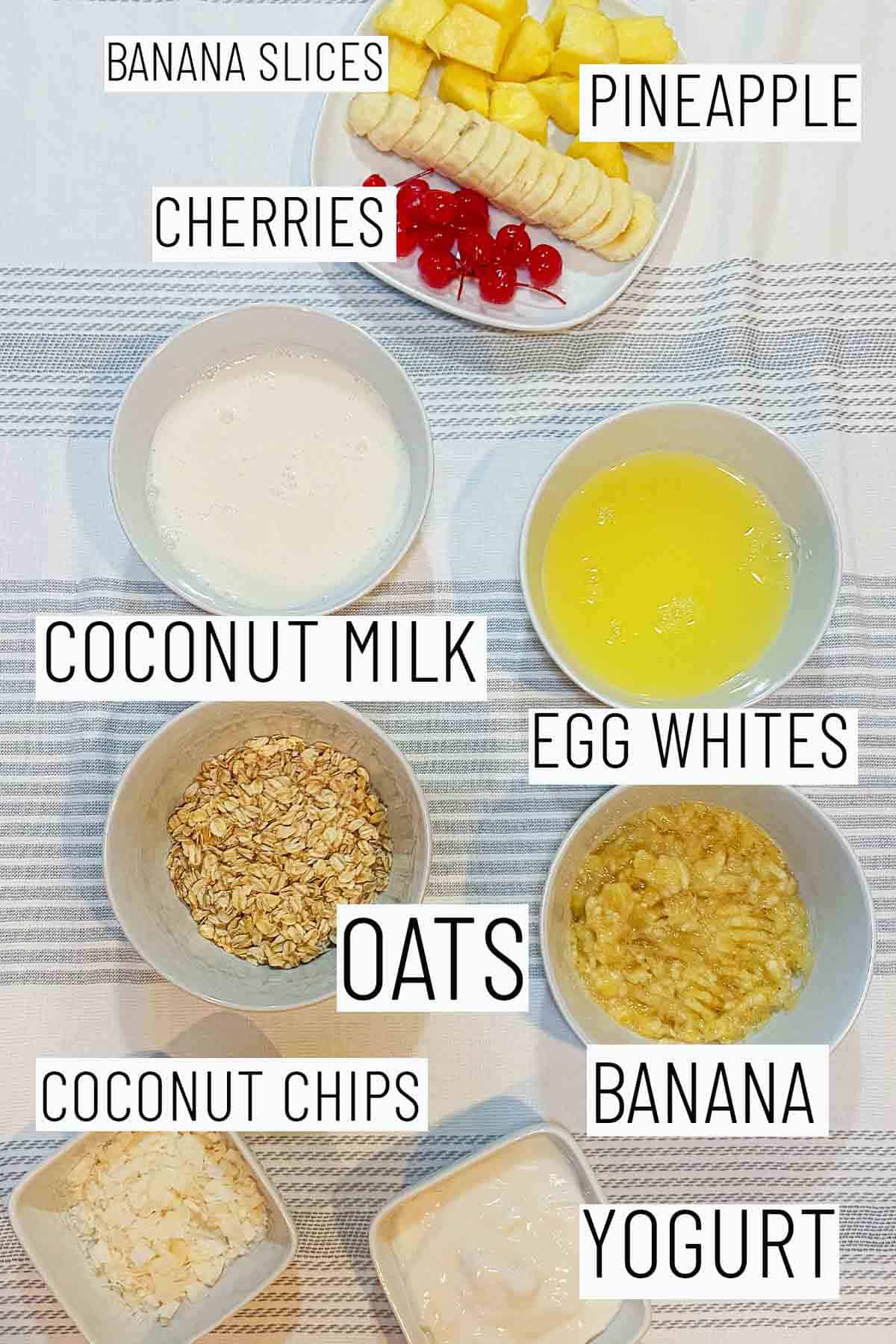
Flay lay image of recipe ingredients.

Rolled oats – to make these pineapple oats gluten free, we opted for gluten free rolled oats. However, if you don’t need to make these gluten free you can use regular rolled oats.

Coconut almond milk – Whats a piña colada without a little coconut flavour? I used coconut almond milk because its what I had on hand but you can definitely use regular coconut milk or mix in some coconut yogurt.

Egg whites – Egg whites gives this pineapple oatmeal an extra boost of protein to make it even more satiating and nutrient packed. I also love adding egg whites to my oats because they provide a creamy fluffy texture making it absolutely DELISH. 

Bananas – Bananas give these pineapple oats some natural sweetness without needing to add sugar or sweetener.

Toppings – I like to top these pineapple oats with coconut chips, banana slices, pineapple slices, cherries, and coconut yogurt to really bring the piña colada flavours together. 

How to Make This recipe

Three side by side images showing how to prepare oats.

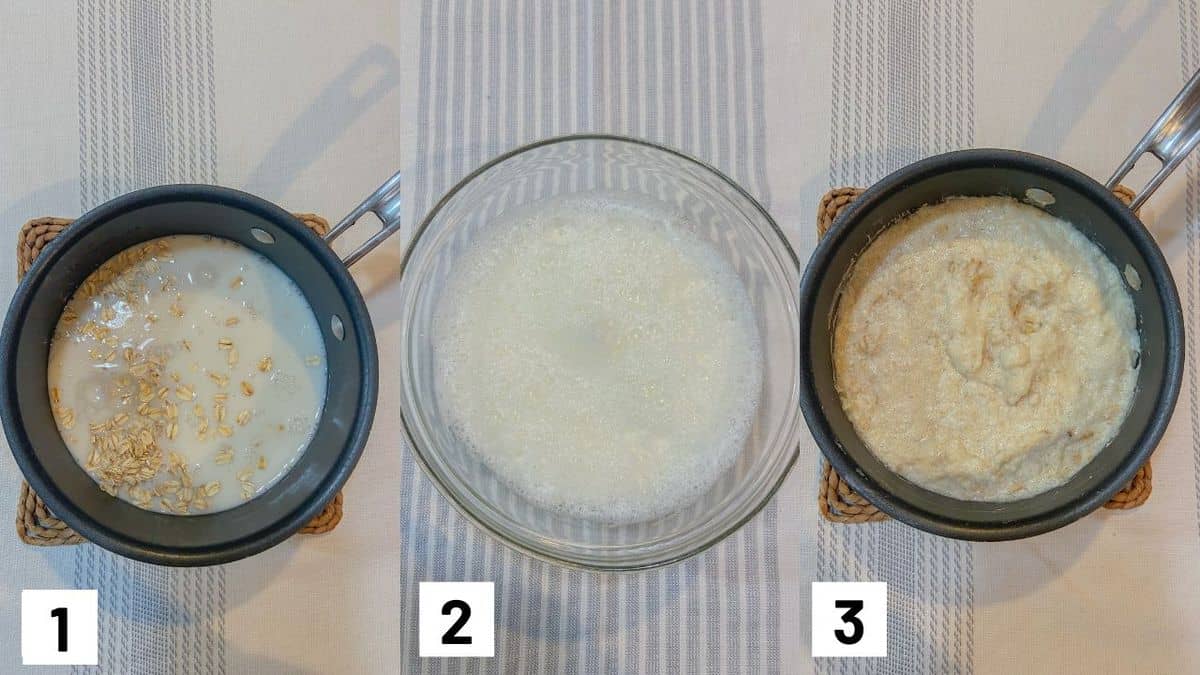
Step 1: In a small saucepan, combine the oats, coconut almond milk and salt. Bring to a simmer over medium high heat, then reduce the heat to medium and cook, stirring occasionally until the oats have absorbed almost all the milk, but are moist and thick, about 3 to 5 minutes.

Step 2: In a small bowl, beat the egg whites until white and foamy, then whisk into the oats.

Step 3: Cook, whisking constantly, until the mixture looks creamy and light, about 3 minutes.

Two side by side images showing how to add bananas into oats and garnishing with sliced bananas, cherries, and pineapple.

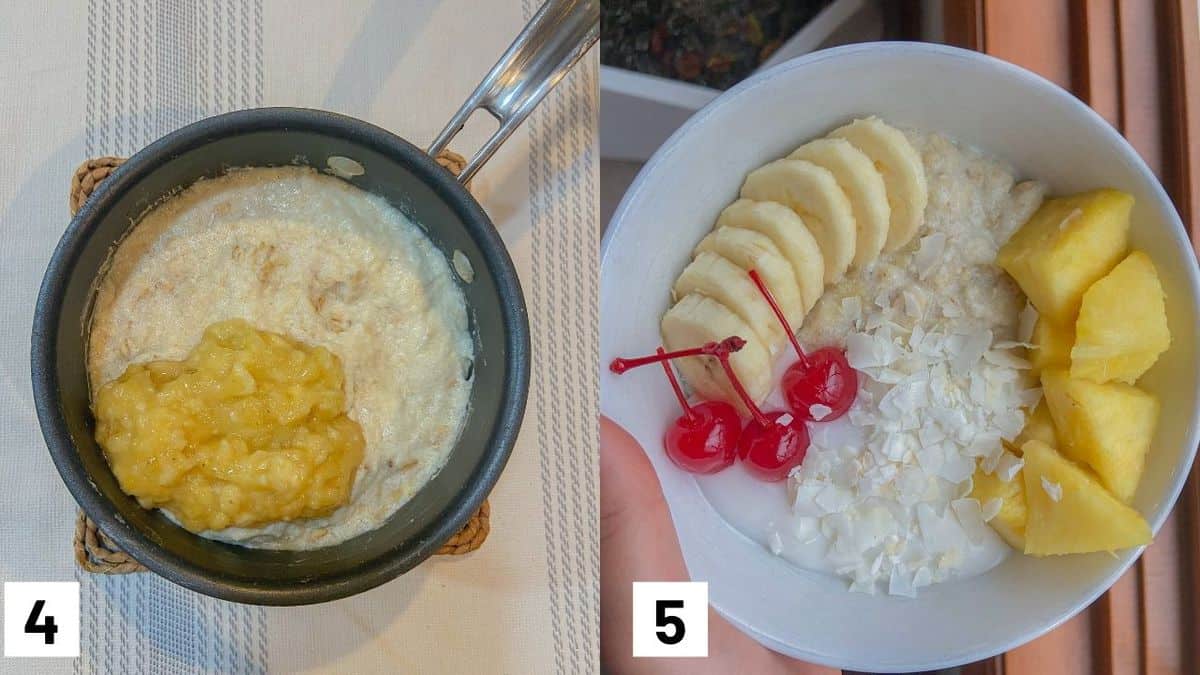
Step 4: Add the ripe banana and stir until combined. Remove from the heat, cover the pot with a lid, and let sit for another 3 minutes until it puffs up and gets very creamy.

Step 5: Top it off with coconut yogurt, banana, pineapple maraschino cherry and toasted coconut.

Expert Tips

If you like your oats to be on the sweeter side, use very ripe bananas as these will yield more sweetness and will also be easier to mash.

You can also feel free to use any type of oat that you have on hand, however we prefer to use rolled oats because they cook a little faster than steel cut oats and absorb more liquid which adds more texture to the pineapple oatmeal.

Recipe FAQs

What makes these oats gluten free?

If you choose gluten free oats, you can ensure your pineapple oatmeal is completely gluten free for celiac or gluten.

Can this oatmeal breakfast be made in advance?

I don’t recommend it, to be honest, only because the fluffiness deflates and that’s most of the fun of this recipe. Having said that, I have had people tell me they make a batch ahead and rewarm. So if you are going to do that, just add another splash of coconut milk when you’re rewarming in the microwave.

Can I make this vegan?

Absolutely! Instead of the egg whites you can use vegan protein powder and/or add a high protein vegan yogurt.

Bowl of pineapple oatmeal topped with pineapple, cherries and yogurt.

More Recipes You Might Like

  • Peanut Butter Cup Cauliflower Oatmeal
  • Oatmeal Pudding 
  • Chocolate Zucchini Bread Oatmeal
  • Whipped High Protein Oatmeal Three Ways

Now loves, tell me – what are some of your favourite recipes that remind you of a tropical holiday? Leave me a comment below with your thoughts!

Bowl of oatmeal topped with pineapple, cherries and yogurt.
Print Recipe
4.86 from 7 votes

Pineapple Oatmeal with Coconut (High Protein Breakfast)

This pineapple oatmeal with coconut tastes exactly like a piña colada and is a high protein healthy breakfast that will power you through your day.
Prep Time5 minutes mins
Cook Time11 minutes mins
Total Time16 minutes mins
Course: Breakfast
Cuisine: American
Diet: Gluten Free
Servings: 2 people
Calories: 219kcal
Author: Abbey Sharp

Ingredients

  • ½ cup rolled oats
  • 1 ½ cup coconut almond milk
  • Pinch salt
  • 1 cup pasteurized egg whites
  • 1 very ripe banana mashed
  • Garnish:
  • Coconut chips toasted
  • Banana slices
  • Pineapple slices
  • Maraschino cherries
  • Coconut yogurt

Instructions

  • In a small saucepan, combine the oats, coconut almond milk and salt. Bring to a simmer over medium high heat, then reduce the heat to medium and cook, stirring occasionally until the oats have absorbed almost all the milk, but are moist and thick, about 3 to 5 minutes.
  • In a small bowl, beat the egg whites until white and foamy, then whisk into the oats. Cook, whisking constantly, until the mixture looks creamy and light, about 3 minutes.
  • Add the ripe banana and stir until combined. Remove from the heat, cover the pot with a lid, and let sit for another 3 minutes until it puffs up and gets very creamy.
  • Top it off with coconut yogurt, banana, pineapple maraschino cherry and toasted coconut.

Nutrition

Calories: 219kcal | Carbohydrates: 29g | Protein: 17g | Fat: 4g | Saturated Fat: 1g | Sodium: 447mg | Potassium: 483mg | Fiber: 4g | Sugar: 8g | Vitamin A: 38IU | Vitamin C: 5mg | Calcium: 244mg | Iron: 1mg

Did you enjoy this pineapple oatmeal with coconut?

Abbey Sharp

Abbey Sharp is a Registered Dietitian (RD), regulated by the Ontario College of Dietitians. She is a mom, YouTuber, Blogger, award winning cookbook author, media coach specializing in food and nutrition influencers, and a frequent contributor to national publications like Healthline and on national broadcast TV shows.
www.abbeyskitchen.com/about-abbey/

Last Updated March 8, 2022. Published May 5, 2021 By Abbey Sharp 2 Comments

Are Supplements Safe? (How to Choose the Right Supplement)

We answer the question – are supplements safe? We take a look at regulatory requirements, safety concerns, marketing, choosing the right supplement.

Several supplements against a blue background.

Alrighty folks, let’s talk about the wild world of the wellness supplement industry. According to one study, 150 million Americans use dietary supplements and 10% of them are taking more than 5 every day. Almost 23 million are taking supplements in lieu of actual drugs, and based on what i’m about to discuss, that could be a really dangerous stat. The same study also estimated that at least 1 in every 12 American adults are taking some kind of supplement known to cause kidney damage, while other supplements are known carcinogens or hormone modulators. In other words, just because they’re natural, doesn’t mean they’re benign. But let’s do a quick little history lesson on supplements, shall we?

The Wild World of Supplements

Pills against a pink background.

Back in 1976, the US passed legislation called the Proxmire amendment that prohibited the FDA from being able to monitor some aspects of how dietary supplements were made and sold. This was actually a response from supplement companies directed at the FDA who was originally attempting to tighten regulations. The Proxmire amendment also made it so that the FDA could not classify dietary supplements as drugs. So basically, the de-regulation of supplements in the U.S. all really began with this amendment.

Then in 1994, we saw the passing of the Dietary Supplement Health and Education Act or D-S-H-E-A. The purpose of this act was to legally broaden the definition of what a supplement is, and all of the regulations that were passed in the Proxmire amendment are applicable to a new set of products. So now, supplements would include herbs, botanicals, amino acids, enzymes, metabolites, organ tissues, and glandulars. They would also be available in liquids, powders, gel capsules, and some bars, as opposed to just pills.

Obviously, no one wants the deregulation of prescription or over the counter medications, that would probably create some serious major public uproar. But I guess because “natural” has often been seen as inherently healthy, safe, and not “corrupt” by the government or big pharma, there hasn’t been any major push to have this re-evaluated. In fact, for a lot of people who don’t trust big pharma and other major authorities, regulation may actually be seen as the government meddling in there, which a lot of “natural heath” communities might not want. 

Supplements, even if they are “natural”, have actually killed people in some cases.  In 1989, 40 people died taking an isolated L-tryptophan supplement. And in 2013, a weight loss supplement called oxy-elite pro caused one death and numerous cases of heart and liver problems. In both cases, the FDA had no clue what was going on until ultimately it was too late.

How Does the FDA Define a “Supplement”?

Several supplements with smiley faces on a white surface.

Supplements have become almost a catch all term for compounds that aren’t considered food or drugs. Which means they can include: vitamins, minerals, herbs, botanicals, amino acids, enzymes, metabolites, glandulars and organ tissues. Yep, organ tissues. Now do you want better regulation? 

In a lot of ways, you could argue that it’s better for a supplement manufacturer to have their product regulated as a supplement since the FDA is far less involved in the production, marketing, and selling of a supplement thanks to the DSHEA. Obviously, that would save these companies a lot of money in testing and evidence collection. 

What Does a Supplement Need to do Before Appearing on Store Shelves?

A cross sign to signify a pharmacy where supplements are sold.

Well as you might expect, there are a lot of strict policies in place to protect consumers before a food product or pharmaceutical reaches the market. This includes things like importer accountability laws, facility examinations, sample analyses and registration of foreign products has to occur before they can be sold in the country.

In fact, under the pharmaceuticals section of the FDA website, it explicitly states that the “FDA requires that all drugs in the United States be shown to be both safe and effective prior to marketing”. While supplements must also theoretically be checked for any issues before it’s put on the market, the responsibilities of safety and labeling are left up to the discretion of the supplement company themselves, as opposed to in the hands of the FDA. 

The good companies take this responsibility really seriously because the liability here is huge. But unfortunately, some of the not-so-great ones either don’t bother because no one is checking their homework, or for the sake of marketing to the consumer, they stage “studies” where they make their product look great in a very controlled environment.

Either way, 75 days before a product goes to market, companies just have to send FDA a little note that suggests WHY they believe the product will be safe. The FDA only gets involved in taking action against any “adulterated” or “misbranded” products AFTER it reaches the market. And considering there are close to 6,000 companies pumping out 75,000 supplements in America alone, this only really happens when there’s been a reported problem. There’s just too much to police and the FDA just doesn’t have those kinds of resources.

So that means they’re not regularly hitting up manufacturing plants, especially those located abroad, as a lot of supplement companies source their raw ingredients from places like India and China. They also don’t have the resources to be checking in on the accuracy of ingredient lists and label claims. Unlike with pharmaceuticals which often need to undergo months of trials and demonstrate their safety and effectiveness prior to marketing, there are no standards on the rigour of evidence needed to support a supplement’s marketing claim. 

As for the introduction of new or novel ingredients into the market, this is when the FDA would need to be notified. If all of the ingredients have been previously used in other products or supplements, they can repackage it and bring it to market right away.  But supplement companies can often skirt around this too through what’s now known as Generally Recognized as Safe (GRAS).

What Does it Mean to be “Generally Recognized as Safe”?

Several white supplements in a white dish.

GRAS or the Generally Recognized as Safe affirmation was introduced in 1958 for use by supplement companies and also by food.  The GRAS expedition allows manufacturers to make safety determinations that the uses of whatever chemicals, additives or other ingredients they are putting into products are “generally recognized as safe”, without having to notify the FDA for evaluation or testing.

Again, owners of the supplement companies can choose the scientists, regulators, and inspectors to legitimize their products. For example, Arbonne could hire their own team of scientists and researchers to conduct their own industry funded study. This means that the research isn’t done by a third party. It might still be quality research but it’s not without bias.

More recently, in 2007, the FDA published a set of guidelines called the current good manufacturing practices or cGMP, which requires manufacturers at cGMP facilities to test their products to ensure product quality, confirm the absence of contaminants, verify accuracy of labelling, and more. And the FDA does audit manufacturers at cGMP facilities! But in 2013, the FDA inspected only about 10% of the estimated 4000 manufacturers covered by cGMP regulations and 2.8% of the 14 995 domestic and international dietary supplement firms registered with the FDA. Looking for a supplement company that is manufactured in a cGMP facility is definitely good reassurance for a consumer since this is an optional and rigorous program, but again, it’s still not perfect. 

With that said, supplements don’t have to do a whole lot to prove they’re actually safe before you’re able to purchase them.

What Should A Buyer Be Aware of When Purchasing Supplements?

1. They don’t have to list any side effects or interactions.

This means that the onus is on you as a consumer or patient to know what you can and can’t take with a particular supplement, or for your doctor to somehow keep tabs on all your supplements and warn you of how they may interact with other medications or conditions. In some cases, starting a new vitamin could have major health repercussions.

For example, St John’s Wart, a very common supplement used for depression, anxiety and menopause, interferes with as many as 50% prescription drugs on the market including birth control and pharmaceutical anti-depressants. I would bet there have been quite a few oopsie moments related to this herb alone.

2. Companies can hide behind proprietary blends

This means that even if you are in the know on what herbs and vitamins are safe for you, you might not even know what you’re getting if the ingredients are packaged under the guise of “proprietary blends”. 

3. Supplements may be marketed at any concentration, as long as the daily recommended value is specified on the label

One example of this is vitamin B12 which is often sold in 2500 mcg doses aka… 1000 times more than a person needs in one day. I know that to many of you, this might sound like a good thing. I mean, the more vitamins and minerals we eat, the better, right? Well, not exactly.

Tolerable upper intake levels actually exist for most vitamins and minerals. Even water-soluble vitamins which can be excreted in excess, can have dangerous repercussions in some situations. In the case of vitamin b12, getting too much or too little in pregnancy has been linked to autism. More doesn’t always equal better, and it’s really best to not self-medicate, and to instead consult with a health professional about your individual needs.

4. Raw “natural” ingredients are often sourced internationally and often are hard to carefully manipulate, measure or control

Unlike pharmaceuticals which are carefully measured and compounded in a lab, nature is not always so precise. This can result in major discrepancies about how much of a nutrient actually ends up in a product compared to what the label says. Reports suggest that overages and underages in supplements are a surprisingly common problem. A review recently published in The Journal of Nutrition showed that certain supplements tend to have ingredient overages of 20 percent or more. Specifically, multivitamins had approximately 10-20% more calcium than their label had stated.  It’s important to note that consuming too much calcium can cause a number of adverse consequences, such as constipation. In adults, too much calcium, particularly from dietary supplements, might also increase the risk of kidney stones. 

5. There is a risk of contaminants.

In2010 US Government Accountability Office report analyzed 40 different dietary supplements looking for the presence of lead, arsenic, mercury, cadmium, or pesticides. The results were at least trace amounts of at least 1 or more of these contaminants in 93% of those samples.  In the case of botanicals, there can be huge variation in strength and quality depending on the genetic variety and environmental conditions of the plants of origin. One study reported that 59% of tested botanical supplements contained plant species not listed on the label, and that active ingredient substitution was observed among 83% of companies tested. Yikes.

Beware of Supplement Marketing

Several yellow supplements on a grey surface.

So we’ve established that supplements may or may not always contain what they claim to contain, and may or may not be healthy or safe for you, depending on a wide range of unregulated factors. But what about how they’re marketed to you? 

Well turns out, that can be a little shady too. In 1994, the DSHEA came up with “structure function claims”. Unlike drugs, supplements are not permitted to be marketed for the purpose of treating, diagnosing, preventing, or curing diseases. So that’s good. They can’t say that something cures heart disease, or lowers cholesterol, or reverses erectile dysfunction. What they can do is use words like “supports”, or “targets”. That’s why you often see supplements with verbiage like “supports a healthy immune system” or “targets stress response”. You may also notice that any claims they do make need to be accompanied by a little disclaimer that “these statements have not been approved by FDA”.

How Can You Choose the Right Supplement?

A pill bottle on a shelf.

Now before I get into how to choose a reputable supplement, I quickly want to note that what I’m discussing is largely American regulations. I can’t speak to how supplements are regulated in Europe or the UK, and its only slightly different where I am here in Canada. 

Supplements in Canada are licensed as natural health products or NHPs which help create safe product formula standards, dosages, and claims about usage. NHPs have approved blurbs about the ingredients on packages that include more detail about ingredient types, dosages, and claims of a product. There are also a few more details provided about specific dietary ingredients, nutrients and other substances on the supplement label and Canadian regulations license all of the businesses involved in manufacturing, holding, processing, and distributing a supplement.

Finally, there is a legal dietary ingredient database that exists in Canada where all legitimate and licensed ingredients are registered. Unfortunately, even with all of these safe guards in place, the system if far from perfect. The standard is pretty low for what passes as an effective supplement, marketing regulation is crap, and there are major backlogs in adverse event reports to Health Canada so it can take a long time for something to be taken off the market.

Despite what we’ve discussed, I want to note that supplements are not inherently bad and not all supplement companies are out to scam you or make you sick. Absolutely not. I think supplements are vitally important in a lot of cases, it’s just a matter of finding the right one for your needs.

So what should you be aware of when choosing your supplements?

1. Look for a third party tested product.

I use websites like labdoor, InformedChoice, and NSFsport to look for a product that has been tested by a company other than the one you’re buying from to look for impurities, accuracy of labelling and quality. Labdoor, for example, will send a sample of each product to an FDA-registered laboratory for a detailed chemical analysis, which includes measurements of active ingredients and potential contaminants.

Some sport supplements will include certifications on their product’s packaging, such as NSF or informed choice labels, which are intended to provide assurance that the product has been tested by respected independent certification organizations. That is something I recommend looking for when you can and if you can’t find your go-to supplement on one of these websites, email their support team and ask to see proof of their third party testing.

2. Use non-commercial websites to learn about supplement ingredients. 

Birds eye view of several supplements in a clear mug.

Credible authorities like NIH, FDA, and USDA often have fact sheets on common ingredients and their respective evidence, which provides a more unbiased source on the legitimacy of marketing claims compared to the brand’s website which we now know is not so well regulated. 

3. Know that if claims sound too good to be true, they probably are.

Be mindful of product claims such as “works better than [a prescription drug],” its “100% safe,” or has “zero side effects.” If they have enough of an effect in the body to “work”, they also have the potential for unwanted side effects.

4. Be aware that the term natural doesn’t always mean safe.

As mentioned, there are a lot of potential for interactions and contraindications depending on your health status.

5. Supplements are never meant to replace an actual healthy diet or pharmaceuticals when needed.

 I prefer to think of them as complimentary, not supplementary in the quest for good health.

6. Always speak to your healthcare provider before starting any supplement regimen.  

7. Report any serious side effects or issues associated with a supplement to the FDA as soon as possible.

Your reporting could save someone else or many other people serious harm by getting an unsafe or misleading product off the shelves asap. 

BOTTOM LINE

In conclusion, a reminder that I am not insinuating that supplements are bad. I buy and take a lot of supplements, but I also know what a wild west rodeo it is out there, so I am sharing this information to help you become more informed consumers.

More Blog Posts You Might Like

  • The Unregulated World of Natural Health Supplements
  • Can Collagen Supplements Tighten Skin?
  • Fertility Supplements & Foods for Getting Pregnant
  • Evidence on the Best Probiotics for Weight Loss, IBS, Constipation & More
Abbey Sharp

Abbey Sharp is a Registered Dietitian (RD), regulated by the Ontario College of Dietitians. She is a mom, YouTuber, Blogger, award winning cookbook author, media coach specializing in food and nutrition influencers, and a frequent contributor to national publications like Healthline and on national broadcast TV shows.
www.abbeyskitchen.com/about-abbey/

Last Updated May 4, 2021. Published May 3, 2021 By Abbey Sharp 1 Comment

Vegan Strata (Healthy, Egg Free)

This vegan strata is a healthy breakfast option that the whole family will love! This strata is loaded with veggies and totally egg free.

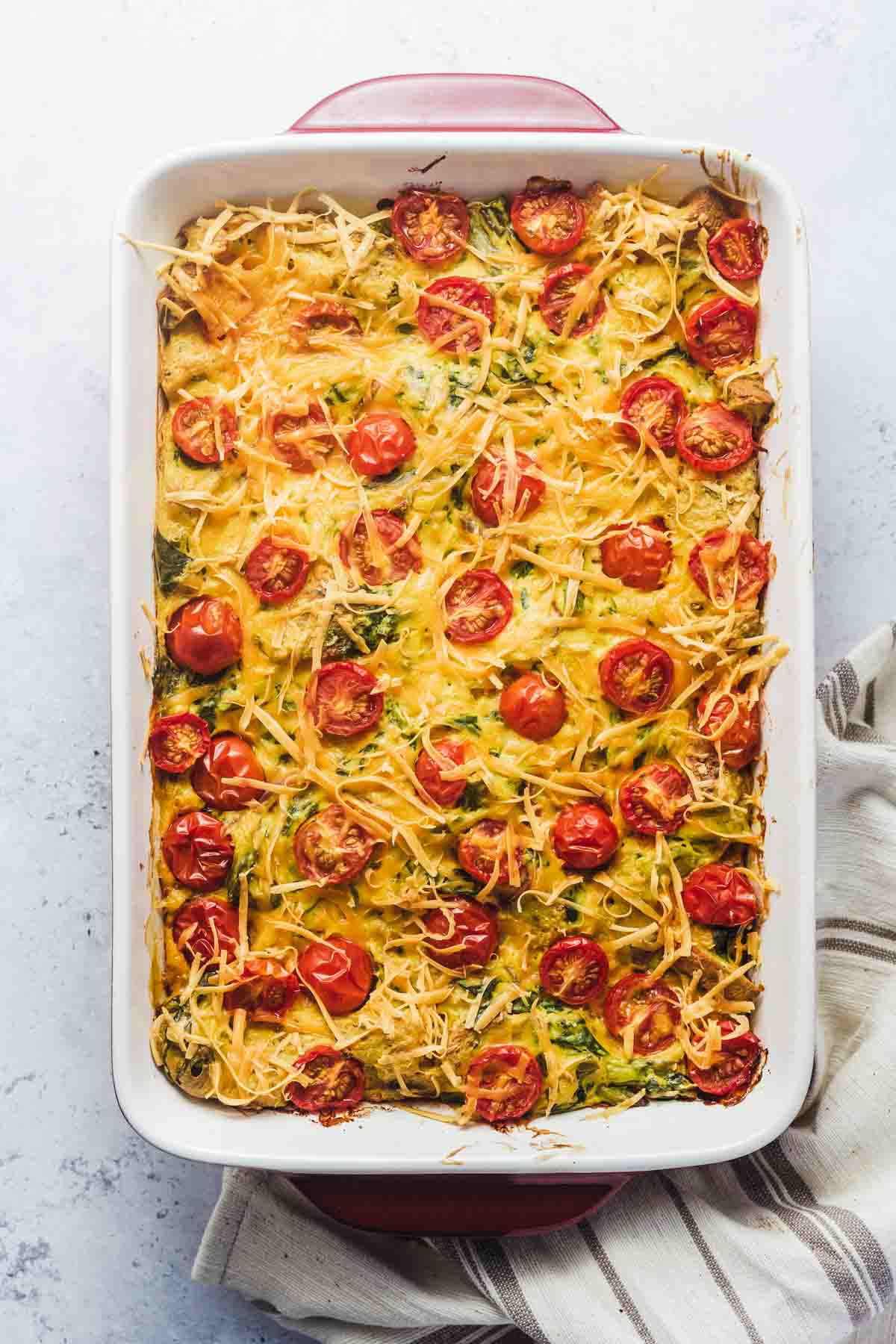
Birds eye view of vegan strata in a casserole dish topped with cheese and tomatoes.

One silver lining of working from home on a full time basis is having a bit more time in the morning to prep a solid breakfast. Now that you don’t have to worry about rushing the kiddos off school and commuting to your 9 to 5, means that those extra hours can be put towards making healthy eating a priority.

This Vegan Breakfast Strata falls neatly into that category and is an excellent meal prep breakfast for mornings when you have a bit more time on your hands! This vegan strata is packed with a creamy and rich tofu filling and loads of veggies and oh my you will be wondering what you ever did without it!

Table of contents

  • Why This Recipe Works
  • Key Ingredients
  • How to Make This Recipe
  • Expert Tips
  • Recipe FAQs
  • More Recipes You Might Like

Why This Recipe Works

If you are a big fan of strata’s, then you have to get in on this vegan strata STAT. Here are a few reasons why we are loving this recipe for breakfast meal prep!

  • 100% plant-based
  • Egg-free
  • Loaded with veggies
  • High in protein (10g per serving)
  • Perfect for weekday meal prepping

Key Ingredients

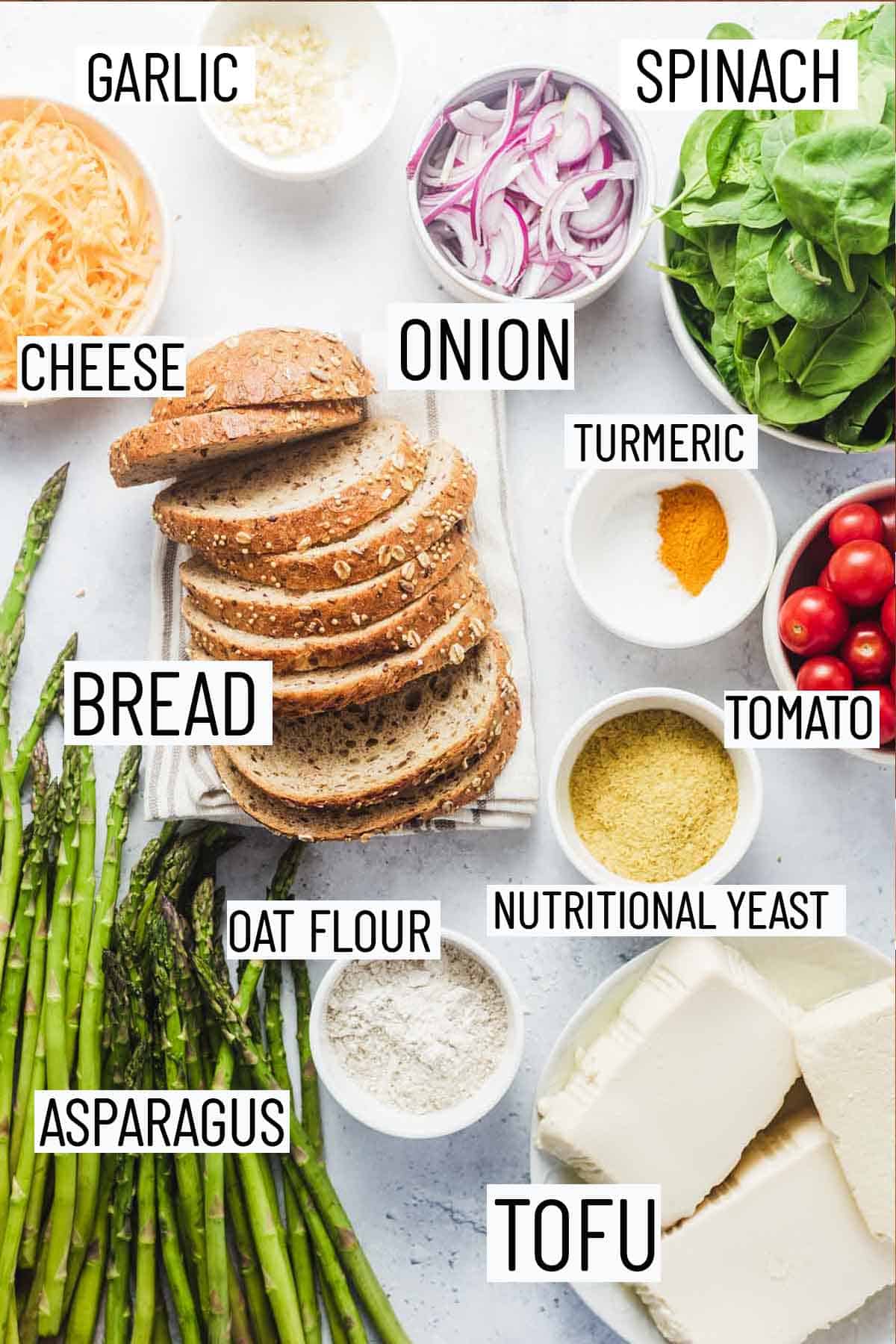
Flat lay image of recipe ingredients including bread, spinach, onion, garlic, cheese, oat flour, tofu, asparagus, nutritional yeast, tomato, and turmeric.

Tofu – this vegan strata uses a combo of soft and firm tofu to create a creamy “egg-like” sauce. I also recommend purchasing tofu that is calcium-set so you can get an extra calcium boost.

Cheese – To make this strata vegan, we use vegan shredded cheese. If you don’t need to make this recipe vegan but want to keep it egg-free, you can use regular cheese instead.

Bread – We use diced whole grain bread for this recipe to up the fibre content, but you can use any bread that you have on hand.

Veggies – This recipe uses a simple combo tomatoes, asparagus, and spinach but you can totally feel free to mix it up!

How to Make This Recipe

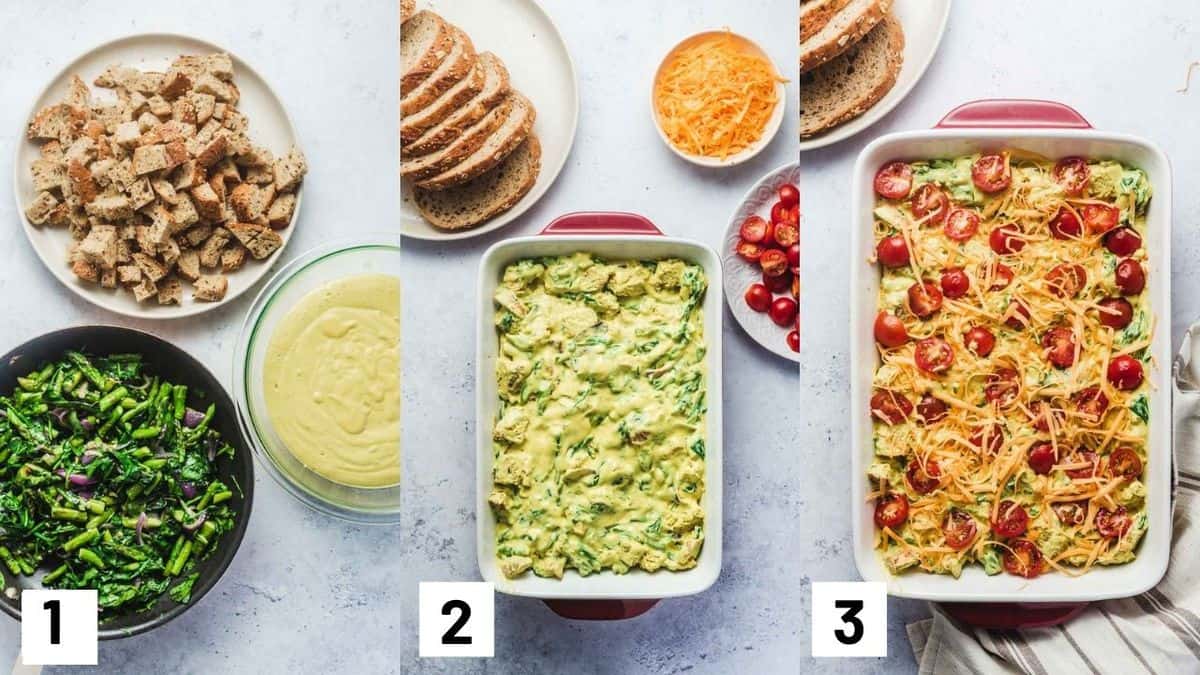
Three side by side images showing how to prepare recipe including cooking the vegetables; layering cooked vegetables, tofu mixture, and bread cubes in a casserole dish; and topping off with cherry tomatoes and cheese.

Step 1: In a skillet, sautee onions, garlic, asparagus, and spinach until cooked through and spinach is wilted. Meanwhile, in a high-speed blender (or food processor), combine the tofu, nutritional yeast, flour, turmeric, sea salt, and blend until nice and smooth. 

Step 2: Add tofu mixture, diced bread, and cooked vegetable to a casserole dish.

Step 3: Decorate with tomato halves and shredded cheese. Bake in preheated oven for 35-45 minutes until edges are golden and the top feels set. Remove casserole from the oven. Cool for 10-15 minutes before serving. Enjoy!

Expert Tips

Blending a combination of soft and medium or firm tofu creates the best texture. You’ll need a total of 900g of tofu to make the vegan egg mixture, which would include two 300g blocks of soft tofu and one 300g block of firm tofu.

Recipe FAQs

How long does this last in the fridge?

This should last in the fridge for about 3-4 days.

What others veggies can I add to this?

Honestly, you can add anything that your heart desires! You can easily use up any veggies sitting in your fridge and throw them into this vegan strata – mushrooms, kale, bell peppers. You name it!

Is this recipe gluten free?

You can make this recipe gluten free by using gluten free bread and gluten free oat flour.

Is this recipe kid friendly?

My little guy gobbled it up so I am going to go out on a whim and say YES.

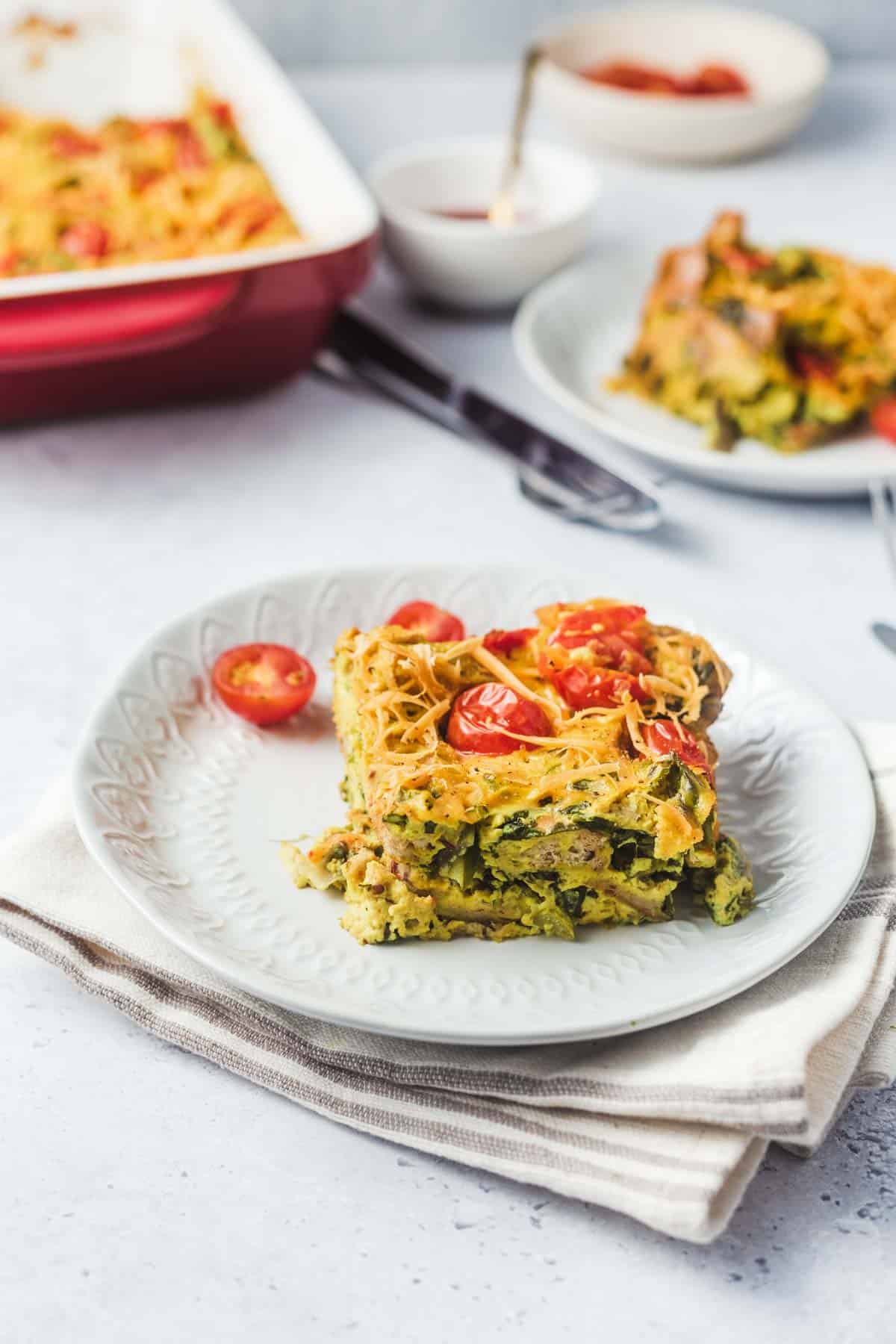
Close up a piece of vegan strata on a white plate.

More Recipes You Might Like

If you liked this vegan strata, then you’re going to love these vegan breakfast recipes on the blog!

  • Vegan Breakfast Tofu Sandwich
  • Vegan Breakfast Burrito with Tofu Scramble
  • Vegan Breakfast Casserole

Did you enjoy this vegan strata recipe? Let me know you’re thoughts down in the comments below!


Print Recipe
5 from 3 votes

Vegan Strata (Healthy, Egg Free)

This vegan strata is a healthy breakfast option that the whole family will love! This strata is loaded with veggies and totally egg free.
Prep Time10 minutes mins
Cook Time1 hour hr
Total Time1 hour hr 10 minutes mins
Course: Breakfast
Cuisine: American
Diet: Vegan
Servings: 5 -6
Calories: 233kcal
Author: Abbey Sharp

Ingredients

  • 2 tablespoons olive oil
  • 1 onion thinly sliced
  • 2 fresh garlic cloves minced
  • 1 bunch asparagus trimmed and cut into 1” pieces
  • 3 cups organic baby spinach 142g, roughly chopped
  • 2 x 300g blocks soft tofu
  • 1 x 300g block firm tofu
  • 1/4 cup nutritional yeast
  • 1/4 cup gluten free oat flour
  • 1 teaspoon turmeric powder
  • 1 teaspoon sea salt
  • ½ loaf whole grain bread diced
  • 2 cups cherry tomatoes halved
  • 1 cup grated vegan cheese

Instructions

  • Preheat oven to 400°F. Grease a large 13 x 9-inch casserole dish with olive oil.
  • Heat the oil in a large nonstick skillet over medium heat. Add the onions and garlic and cook for 5 minutes. Add the asparagus for another 4-5 minutes, then the spinach just until wilted.
  • In a high-speed blender (or food processor), combine the tofu, nutritional yeast, flour, turmeric, sea salt, and blend until nice and smooth.
  • Pour the tofu mixture in the large bowl with all the other cooked ingredients. Combine and pour overtop the diced bread in the casserole dish. Decorate with tomato halves and shredded cheese. Bake in preheated oven for 35-45 minutes until edges are golden and the top feels set.
  • Remove casserole from the oven. Cool for 10-15 minutes before serving. Enjoy!

Notes

Blending a combination of soft and medium or firm tofu creates the best texture. You’ll need a total of 900g of tofu to make the vegan egg mixture, which would include two 300g blocks of soft tofu and one 300g block of firm tofu.

Nutrition

Calories: 233kcal | Carbohydrates: 19g | Protein: 10g | Fat: 13g | Saturated Fat: 3g | Sodium: 777mg | Potassium: 478mg | Fiber: 3g | Sugar: 4g | Vitamin A: 2004IU | Vitamin C: 21mg | Calcium: 81mg | Iron: 3mg
Abbey Sharp

Abbey Sharp is a Registered Dietitian (RD), regulated by the Ontario College of Dietitians. She is a mom, YouTuber, Blogger, award winning cookbook author, media coach specializing in food and nutrition influencers, and a frequent contributor to national publications like Healthline and on national broadcast TV shows.
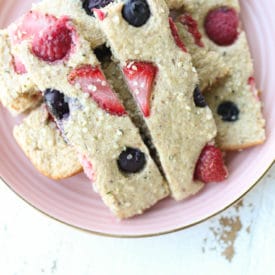
www.abbeyskitchen.com/about-abbey/

Last Updated November 15, 2021. Published April 29, 2021 By Abbey Sharp 3 Comments

Gochujang Soup (Vegan & Gluten Free)

This healthy Gochujang soup is an easy vegan soup option that is ready in 20 minutes and requires less than 10 ingredients! It is also gluten free and family friendly.

Close up image of two portions of gochujang soup in a bowl and garnished with chickpeas and scallions.

Despite being more than enthused that the Spring weather is upon us, I am not quite ready to let go of soup season just yet! A good no-fuss soup is literally like a warm hug to the body and soul (and the wallet because it can be easy and inexpensive AF).

This Gochujang soup is as easy as it gets when it comes to a nourishing, warming soup that requires simple ingredients and is ready in no time at all! So if you have 20 minutes to spare, some veggies, and need a little spice in your life, this soup may be just the weekday pick-me-up that you need.

Table of contents

  • Why This Recipe Works
  • Key Ingredients
  • How to Make This Recipe
  • Expert Tips
  • Recipe FAQS
  • More Recipes You Might Like

Why This Recipe Works

Not only do I love that this Gochujang soup gives me a good excuse to use one of my favourite spicy ingredients of all time, but it also couldn’t be simpler to prepare and is hella tasty. Here are a few more reasons why we LOVE this recipe!

  • Veggie loaded
  • Vegan & gluten free
  • Made in 20 minutes
  • Requires less than 10 ingredients
  • Family Friendly

Key Ingredients

Flat lay image with portioned recipe ingredients including green onion, parsnips, Gochujang, garlic, ginger, broth, and coconut milk.

Aromatics – The base of this gochujang soup is a simple combo of garlic, ginger, and green onion that is sauteed until beautifully fragrant.

Gochujang – Gochujang is arguably the star ingredient of this dish as it adds a delicious kick and depth of flavour to the soup.

Veggies – We use a simple combo of carrots and parsnips. Thats it thats all! Super simple and delish.

Garnish – Here is the fun part. To garnish this Gochujang soup we use crispy chickpeas, coconut cream, and scallion greens.

How to Make This Recipe

Three side by side images showing how to prepare recipe.

Step 1: Heat oil in a large saucepan over high heat. Add the scallion, garlic and ginger, saute till everything is fragrant, about a minute. Add the 2 tablespoons Gochujang paste and the vegetables and stir till the vegetables are well coated. 

Step 2: Add in the broth, coconut milk and gently simmer until the vegetables are tender but not mushy about 12-15 minutes. 

Step 3: Garnish with crispy chickpeas, coconut cream, and scallion greens. You can stir in the remaining ½ table Gochujang.

Expert Tips

When it comes to using Gochujang, a little goes a long way but feel free to modify the spice level based on your personal tolerance.

If you love a good chunky soup, you can keep as is. Otherwise, you can use an immersion blender to blend it up for a thicker pureed soup!

Recipe FAQS

Where can I buy Gochujang?

You can buy Gochujang at any Asian market or speciality grocery store. Otherwise, you can purchase it online. Make sure to purchase one that is gluten-free as some contain gluten.

How long does this keep in the fridge?

This Gochujang soup should last for about 3-4 days in the fridge.

Can I freeze this soup?

Absolutely! Simply transfer the Gochujang soup to a freezer bag on a baking tray and let it freeze flat, then transfer to your freezer until you’re ready to eat it.

Is this soup kid friendly?

It may be a tad on the spicy side for your kiddo, but ultimately you know your little one best! If they don’t tolerate spice too well, you may have to omit the Gochujang all together.

Birds eye view image of two bowls of Gochujang soup topped with scallions.

More Recipes You Might Like

If you loved this recipe, then you have to try more of our asian-inspired recipes on the blog!

  • Vegan Buddha Bowl with Gochujang Sauce
  • Korean Savoury Oatmeal with Runny Egg
  • Korean Stuffed Sweet Potato
  • Szechuan Cacio e Pepe (Easy Spicy Pasta Recipe)

What are your thoughts on this Gochujang soup? Sound off in the comments below!

Print Recipe
5 from 4 votes

Gochujang Soup (Vegan & GF)

This healthy Gochujang soup is an easy vegan soup option that is ready in 20 minutes and requires less than 10 ingredients! It is also gluten free and family friendly.
Prep Time10 minutes mins
Cook Time10 minutes mins
Total Time20 minutes mins
Course: Soup, Main Course
Cuisine: American, korean
Diet: Gluten Free, Vegan
Servings: 4
Calories: 426kcal
Author: Abbey Sharp

Ingredients

  • 1 tablespoon vegetable oil
  • 1 bunch scallions white and pale-green parts chopped, dark-green parts reserved for garnish
  • 3 garlic cloves minced
  • 1- inch piece of ginger peeled and grated
  • 2 + 1/2 tablespoons gochujang korean hot pepper paste
  • 4 cups vegetable broth 900 ml
  • 1 can coconut milk
  • 4-5 parsnips 1 bag, peeled and chopped into 1 inch piece
  • 5-6 carrots peeled and chopped into 1 inch piece

Garnish

  • Crispy Chickpeas
  • Coconut cream
  • Scallion greens

Instructions

  • Heat oil in a large saucepan over high heat. Add the scallion, garlic and ginger, saute till everything is fragrant, about a minute.
  • Add the 2 tablespoons gochujang paste and the vegetables and stir till the vegetables are well coated.
  • Add in the broth, coconut milk and gently simmer until the vegetables are tender but not mushy about 12-15 minutes.
  • Garnish with crispy chickpeas, coconut cream, and scallion greens. You can stir in the remaining ½ table gochujang.

Notes

When it comes to using Gochujang, a little goes a long way but feel free to modify the spice level based on your personal tolerance.
If you love a good chunky soup, you can keep as is. Otherwise, you can use an immersion blender to blend it up for a thick pureed soup!

Nutrition

Calories: 426kcal | Carbohydrates: 45g | Protein: 5g | Fat: 28g | Saturated Fat: 24g | Sodium: 1024mg | Potassium: 1115mg | Fiber: 12g | Sugar: 17g | Vitamin A: 13270IU | Vitamin C: 35mg | Calcium: 104mg | Iron: 3mg
Abbey Sharp

Abbey Sharp is a Registered Dietitian (RD), regulated by the Ontario College of Dietitians. She is a mom, YouTuber, Blogger, award winning cookbook author, media coach specializing in food and nutrition influencers, and a frequent contributor to national publications like Healthline and on national broadcast TV shows.

www.abbeyskitchen.com/about-abbey/

Last Updated August 3, 2021. Published April 28, 2021 By Abbey Sharp 1 Comment

Quarantine Weight Gain (Dietitian’s 6 Easy Tips)

We discuss the link between stress and quarantine weight gain and share six gentle tips on how to get yourself back on track.

Several scrabble letters pushed together to say "stay home".

It’s no question that this has been a challenging year for all of us and that the effects of the pandemic have impacted our mental health in one way or another. With increased levels of stress as well as more time spent being sedentary and in isolation, we are definitely seeing an impact on our mental wellbeing. In fact, a survey by Statistics Canada found that about 1 in 5 Canadian adults reported experiencing depression, anxiety, or posttraumatic stress disorder (PTSD) during the onset of the pandemic.

When we experience increased levels of stress and anxiety, it is common to turn to food for comfort. However, now that our routines are totally flipped upside down our relationship with food and the body may also feel like it is being put through the ringer, with many individuals reporting struggling with overeating and quarantine weight gain. In fact, one U.S. study found that 61% of Americans reported undesired weight changes since the start of the pandemic.

Several levels on a blue plate spelling out "weight gain".

This is not surprising as research has shown that increased stress can alter eating behaviours, impact our motivation to exercise, and increase the likelihood to use food to cope with stress. With that said, if you are struggling with quarantine weight gain and/or your relationship with food during this time, know that you are not alone. In fact, it is totally and completely NORMAL to experience these effects given how straight up banana’s our lives have become. But if you need a little guidance on how to manage your relationship with food and quarantine weight gain during these times, these 6 gentle nutrition tips may make all the difference for your overall wellbeing – including your physical, mental, and emotional health.

1. Be Gentle with Yourself

A computer screen background that says "be kind" while dealing with quarantine weight gain.

First and foremost – be kind and compassionate with yourself. Despite being in isolation and dealing with quarantine weight gain, remember that this isn’t an experience you are going through alone and we are all in this together. It is also okay to not feel your best or totally productive all day every day. Remember, we are living through a freaking pandemic and the emotional effects can be extremely draining. Try not to be too hard on yourself if you can’t keep up with your workout routine or you don’t have the energy to prepare a healthy meal every day. Sometimes a rest day and take-out are all you can muster and that is a-okay.

Ask yourself – how can you bump up the self-care during days that are particularly challenging? This could mean going to bed a little earlier, taking a social media break, going for a walk in nature, taking a long shower or bath, calling a friend, or anything else that can help to ground you and relieve some anxiety.

It can also be helpful to focus on little things to feel grateful for – whether it’s a sunny day, the first sip of your morning coffee, hugging your pet, trying a new recipe, or quite simply just making it through your day. Research has even shown that gratitude can have a positive impact on mental health and improve feelings of overall happiness. So perhaps starting or ending your day by writing a few things you are grateful for may help to shift your mindset in a positive way.

2. Eat Foods That Improve Mood

Several pieces of toast to improve mood when dealing with quarantine weight gain.

While it is important to aim to eat a variety of foods (even comfort foods), we do know that there is a link between what we eat and our mood. This is because the foods we eat provide the building blocks needed to create the neurotransmitters in the brain responsible for our mood – this includes neurotransmitters like serotonin, dopamine, GABA, norepinephrine, and endorphins.

Protein-rich foods in particular are essential for mood as they contain the amino acid tryptophan which is needed to develop the “happy hormone” serotonin. You can obtain protein from animal-based foods such as lean meats and dairy, as well as plant-based foods such as nuts, seeds, tofu, and legumes. With that said, aim to include a protein-rich food at every meal and snack.

B-vitamins are also essential in the production of dopamine and serotonin and research has found a link between low levels of B vitamins and symptoms of depression and decreased cognitive thinking. This is particular true for deficiencies in specific B vitamins such as thiamine, niacin, folate, and B12. Luckily, B vitamins are found in a variety of foods including lean meats, citrus fruits, dark leafy greens, nuts and seeds, as well as whole grains. Therefore, aiming for a variety of foods is key.

A healthy gut has also been gaining a spotlight when it comes to mental health as the brain and gut are closely connected – this is also known as the gut-brain axis. In fact, 90% of our serotonin is produced in the gut. In addition, our gut microbes are also involved in producing the neurotransmitter GABA, which helps to regulate feelings of stress and anxiety.

More research has been pointing to the benefits of “psychobiotics” (otherwise known as probiotics that affect the brain) as some probiotic strains may improve symptoms of depression, anxiety, and stress. Therefore, aim to consume probiotic rich foods such as yogurt, kefir, kimchi, and miso. In addition, you can also support your gut health by eating prebiotic rich foods (i.e. bananas, artichoke, garlic, asparagus, garlic), drinking enough water throughout the day, and consuming a variety of high-fiber foods like fruit, vegetables, whole grains, nuts, seeds, and legumes.

3. Engage in Joyful Movement

A woman doing yoga outside.

When it comes to gaining a few lbs from quarantine weight gain, your knee jerk reaction may be to go a little harder in your workout routine or to increase the frequency of your exercise in order to drop the weight. While this may or may not be effective for your overall weight loss goals, engaging in exercise for the sole purpose of getting smaller may actually have more negative implications for your mental health.

What I mean by this, is that when your intention behind exercise is strictly goal driven (in this case, weight loss) and the method by which you intend to reach these goals is unsustainable, you may be setting yourself up for increased feelings of stress and low self-esteem if you are unable to reach your goals. In other words, working out like a mad woman may not guarantee weight loss and may leave you feeling more miserable in the process as a result – and we obviously want to avoid anything that will make us feel even MORE stressed out in the current pandemic climate.

With that said, try to shift your mindset from being goal-drive to purpose-driven. This means, thinking about the intention and bigger picture when it comes to movement and how it should feel. Ask yourself – what type of movement will make me feel good right now? Not just physically, but also mentally.

  • Do you want to feel relaxed and at ease? Maybe try a yoga flow or go for a gentle walk outside.
  • Do you want to feel energized and more alert? Perhaps going for a run or doing an at home HIIT workout may be just what you need.
  • Do you want to blow off some steam and move yourself into a good mood? Throw on your favourite tunes and dance it out.

Find a way of moving that is sustainable, easy to implement, and makes your body and mind feel good. Moving your body should absolutely NOT feel like a punishment. Also, remind yourself that even small progress, is progress. Let the weight loss land where it lands without setting an arbitrary weight loss goal, but instead enjoy the process and soak up all the joy and “feel good” benefits of your movement.

4. Explore Other Coping Mechanisms

A neon sign that says "breath" when dealing with quarantine weight gain.

While food can absolutely offer comfort during a period of stress (and there is no shame in that), it should not be your only coping mechanism. This pattern can be particularly hard to break especially for emotional eaters or those with binge eating tendencies. If you are struggling with emotional eating and binge eating during the pandemic you can check out my blog post here.

Regardless of whether or not you are an emotional eater, I encourage you to explore other coping mechanisms that don’t involve food. This can look different for everyone, but some common coping mechanisms might include:

  • Relaxation in the form of yoga, meditation, bathing, listening to music, reading, spending time in nature etc. – basically any activity or outlet that will help you feel at ease
  • Seeking emotional support from a friend, family member, or therapist
  • Establishing healthy boundaries (i.e., taking social media breaks)
  • Engaging in physical activity

As you explore what other coping mechanisms might work for you, when you DO turn to food for comfort, ask yourself:

  • What is the intention?
  • Will this make me feel good – emotionally and/or physically?

For example, reaching for a few spoons of Ben & Jerry’s ice cream may not make you feel good physically, but it may offer some emotional benefits if it provides comfort. On the other hand, you can also try to incorporate foods or meals that have both emotional AND physical benefits. For me personally, this might look like a veggie loaded pasta with a yummy sauce, pancakes topped with a generous portion of berries, or fish tacos with all the fixings.

5. Self-care over self-control

A woman in a robe, drinking coffee, and reading a magazine.

The pandemic has all of use feeling like we are losing our sense of control given how precarious things have become. One of the ways in which we will often seek to reduce stress is to try to regain our sense of control. However, because we have a lack of control over external factors, our sense of control can often turn inward and manifest itself as self-control over our food intake and body size.

But in order to be gentle with ourselves (as per tip #1) and take care of our mental well-being, we must approach food and exercise from a place of self-care rather than self-control. Like I’ve said, it is important to tune into how food and exercise makes you feel, both on a physical and emotional level, rather than how it makes you look.

When it comes to approaching food from a self-care lens, you should aim to feel nourished and satisfied. Explore your *why* with your food choices and consider whether your food decisions feel balanced and flexible, or if they feel rigid and restrictive. For example, this can look like eating a salad for lunch because you know that it will nourish your body and make you feel good physically, rather than making the decisions from a place of restriction with the intention to lose weight.

6. Focus on Overall Health

A woman holding up a watermelon in the shape of a smile.

Our health exists on a spectrum and despite what diet culture wants you to believe, your health is not defined by your weight. Unfortunately, the predominate message we receive around health is that it should involve restricting food and exercising more. Unfortunately, this message becomes even LOUDER when it comes to quarantine weight gain.

However, this can cause a disconnection between food and the body because when we focus solely on weight as a measure of health, we lose sight of our mental health needs and overall wellness. Since we don’t want to compromise our mental health, we should aim to put less emphasis on weight and focus on other measures of health instead. This can include things like sleep quality, stress management, water intake, moving your body, eating a balanced diet, connecting with loved ones etc.

Ask yourself:

  • What else can you focus on beside weight?
  • What else can give you a sense of control or comfort?
  • What else makes you feel healthy?
  • What else makes you feel connected?

This is not to say that you can’t strive towards a weight loss goal, but it should not be your only goal or means of optimizing your health – pandemic or no pandemic. Try to approach your health and wellness routine with a holistic approach that encompasses more than one measure of health, whatever that may look like for you.

Bottom Line

I just want to reiterate that it is normal to feel less than optimal right now – whether that means feeling down in the dumps or feeling uncomfortable in your body from quarantine weight gain. Which is why now, more than ever, exploring new ways to give ourselves a little extra love and establishing healthy routines can make all the difference. By focusing on healthy and sustainable behaviours, we can reap the benefits for both the body and mind without letting a weight loss goal steer the ship. 

Written by Giselle Segovia RD MHSc

More Blog Posts You Might Like

  • How to Stop Emotional Eating While In Isolation
  • Intuitive Eating Weight Loss? Sustainable Gentle Nutrition Tips
  • How to Reach Your Health Goals While Social Distancing
Abbey Sharp

Abbey Sharp is a Registered Dietitian (RD), regulated by the Ontario College of Dietitians. She is a mom, YouTuber, Blogger, award winning cookbook author, media coach specializing in food and nutrition influencers, and a frequent contributor to national publications like Healthline and on national broadcast TV shows.
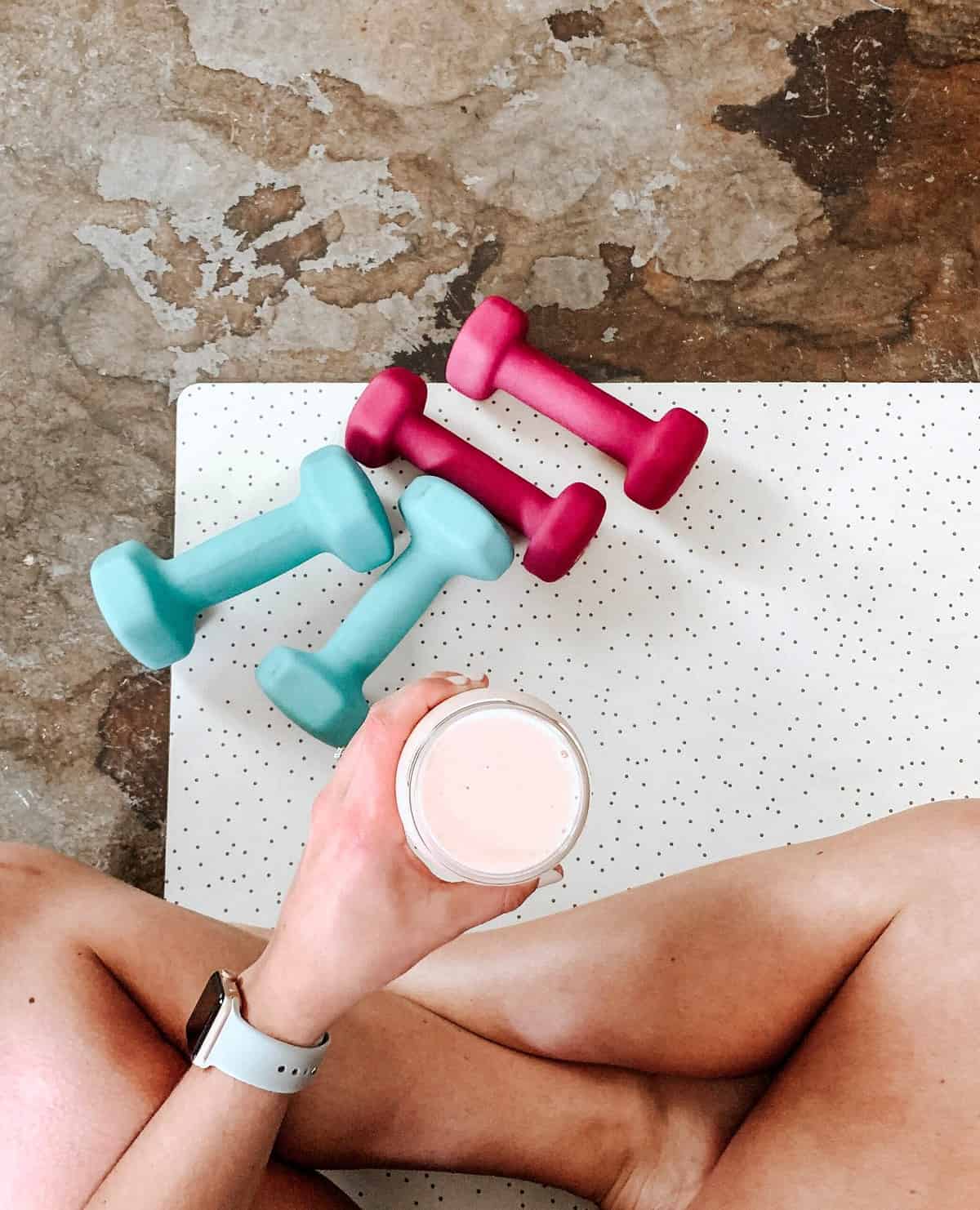
www.abbeyskitchen.com/about-abbey/

Last Updated June 6, 2024. Published April 26, 2021 By Abbey Sharp 7 Comments

Spicy Black Bean Burger Recipe | Vegan

vegan black bean burger on a plate with a pickle and tomatoes

This is the Best Spicy Black Bean Burger Recipe for a reason! These vegan burgers are PACKED with flavour, protein, healthy fats, fibre and even a little vegetables! Perfect for vegetarians and omnivores, alike!

Close up of vegan black bean veggie burger on a white plate.

The weather is getting warmer so I know a lot of us are looking to add more grilled recipes to our repertoire! As you all know, I’m not vegan, but I do make an effort to try to incorporate more plant based recipes into my diet, and this spicy vegan black bean burger has been SUCH a family hit. I’ve eaten a LOT of veggie burgers and if I’m being honest, usually they’re a little bland. But I was determined to make a flavour PACKED spicy black bean burger recipe the whole family loved!

Table of contents

  • Why This Recipe Works
  • Key Ingredients
  • How To Make This Recipe
  • Expert Tips
  • Recipe FAQs
  • More Recipes You Might Like

Why This Recipe Works

While most black bean burgers contain some black beans mixed with breadcrumbs and eggs, mine combines fibre rich oats, nutritional yeast, flax and even mushrooms to the party for a nutrient dense burger! Here are a few more reasons why we LOVE this burg.

  • Loaded with protein (24 grams per serving)
  • Fibre packed! (20 grams per serving)
  • Family friendly
  • Perfect summer meal
  • Vegan & gluten free

Key Ingredients

Flat lay image of recipe ingredients.

Mushrooms – This gives an umami flavour and extra nutrition, just make sure you squeeze out the excess moisture REALLY WELL after you pulverize the mushrooms in a food processor.

Oats – This is your binder, and is a lot more nutrient dense and fibre rich than traditional breadcrumbs.

Black Beans – This lends your protein and fibre, and also makes a nice paste to bind everything together.

Nutritional Yeast- Nutritional yeast is packed with protein and if you get a fortified version, it also contains vitamin B12 which is really important for people following a vegan diet.

Ground flax – Loaded with protein, fibre and omega 3s, this lends a ton of nutrition and also some binding properties to boot!

How To Make This Recipe

Three side by side images showing how to prepare onions and mushrooms.

Step 1: Heat the olive oil in a nonstick skillet over medium low heat. Add the onion and garlic and saute  for 30 minutes until caramelized and golden. Add to a bowl.

Step 2: Pulse the mushroom caps in a food processor until it looks like ground meat.

Step 3: Put in cheesecloth or a sieve and squeeze out the liquid as best as you possibly can. Add to the bowl.

Three size by side images showing how to prepare the patties.

Step 4: Puree the black beans, oats, chili, cumin, paprika, BBQ sauce, worchestershire, sugar, yeast, flax, salt and pepper until fairly smooth. Add to the bowl.

Step 5: Add the black bean paste to the onion, garlic and mushroom and mix well. Form into 4 patties and refrigerate the patties for 30-60 minutes.

Step 6: Heat the olive oil over medium high heat and pan-fry on each side until golden brown. Serve on a bun topped with your favourite veggies and sauces.

Expert Tips

If you don’t want to pan fry the spicy black bean burger you can grill or barbecue them instead!

We also don’t want the patties to hold too much moisture otherwise they won’t stick together very well. So squeezing out the liquid from the mushrooms is a really important step as well as draining and rinsing the black beans. If you find that the patties aren’t sticking together, you can add an extra tablespoon of oats.

Recipe FAQs

Are these kid friendly?

These absolutely can be kid friendly but if your kiddo is sensitive to spice, make sure you choose a mild BBQ sauce and you can leave out the chili powder (or just add a bit).

Where is the protein in these burgers?

You are getting a good amount of protein from the beans, nutritional yeast, and flax – plus a little in the burger bun depending on if you go whole grain.

Can you freeze these and batch prep the burgers?

Absolutely. I recommend placing these burgers once formed onto parchment or wax paper and then freezing them on top of one another in a freezer bag. These will keep in the freezer for up to 4 months.

Are these burgers gluten free?

They actually can be completely gluten free if you just make sure to choose a gluten free tamari or worchestershire sauce, and of course use a gluten free bun.

What can I serve with these burgers?

There are so many great summer recipes on my blog. I would definitely make sure you have some kind of salad or veggie dish with this burger. You can also do a nice fresh fruit dessert. Here are some favourites:
Watermelon Avocado Salad
Grilled Sweet Potato Wedges with Avocado Sauce
Watermelon Gazpacho
Brussels Sprout Slaw

Close up of two hands holding up spicy black bean burger.

More Recipes You Might Like

Yes, we love burgers and just totally want to get grilling as soon as it gets nice out. Here are some of our favourite burgers (vegan and meat based)!

  • VEGAN HAWAIIAN BURGER WITH LIME AIOLI 
  • VEGAN WALNUT QUINOA BURGERS 
  • BEST HEALTHY BURGER RECIPES FOR THE SUMMER 
  • HUMMUS BURGERS 

What makes a great veggie burger to you? Have you tried these spicy vegan black bean burgers? Leave me a comment below with your thoughts!

vegan black bean burger on a plate with a pickle and tomatoes
Print Recipe
5 from 4 votes

Spicy Black Bean Burger Recipe | Vegan

These are the Best Spicy Vegan Black Bean Burgers for a reason! They're PACKED with flavour, protein, healthy fats, fibre and even a little vegetables! Perfect for vegetarians and omnivores, alike!
Prep Time1 hour hr
Cook Time15 minutes mins
Total Time1 hour hr 15 minutes mins
Course: Main Course
Cuisine: American
Servings: 4
Calories: 463kcal
Author: Abbey Sharp

Ingredients

  • 2 tsp olive oil
  • 1 small onion finely minced
  • 2 cloves garlic minced
  • 227 g mushrooms stems removed and cut into pieces
  • 1 19 oz can about 2 cups black beans, drained and rinsed
  • ½ cup plus 2 tbsp quick cooking oats gluten free if needed
  • 1/2 – 1 ½ tsp chili powder depending on how spicy you like it
  • 1 ½ tsp cumin
  • ½ tsp smoked paprika
  • 3 tbsp barbeque sauce
  • 1 ½ tsp vegan worchestershire sauce soy sauce or gluten free tamari
  • 2 tsp brown sugar
  • 6 tbsp nutritional yeast
  • ¼ cup ground flax
  • ½ tsp salt
  • ½ tsp pepper
  • 2 tbsp Olive oil for frying

Burger accompaniments:

  • Burger buns
  • Vegetables lettuce, tomato, pickles
  • Sauce BBQ sauce, mustard, ketchup

Instructions

  • Heat the olive oil in a nonstick skillet over medium low heat. Add the onion and garlic and saute  for 30 minutes until caramelized and golden. Add to a bowl.
  • Pulse the mushroom caps in a food processor until it looks like ground meat. Put in cheesecloth or a sieve and squeeze out the liquid as best as you possibly can. Add to the bowl.
  • Puree the black beans, oats, chili, cumin, paprika, BBQ sauce, worchestershire, sugar, yeast, flax, salt and pepper until fairly smooth. Add to the bowl.
  • Add the black bean paste to the onion, garlic and mushroom and mix well. Form into 4 patties and refrigerate the patties for 30-60 minutes.
  • Heat the olive oil over medium high heat and pan-fry on each side until golden brown. Serve on a bun topped with your favourite veggies and sauces.

Nutrition

Calories: 463kcal | Carbohydrates: 61g | Protein: 24g | Fat: 16g | Saturated Fat: 2g | Sodium: 459mg | Potassium: 1129mg | Fiber: 20g | Sugar: 9g | Vitamin A: 153IU | Vitamin C: 4mg | Calcium: 89mg | Iron: 6mg
Abbey Sharp

Abbey Sharp is a Registered Dietitian (RD), regulated by the Ontario College of Dietitians. She is a mom, YouTuber, Blogger, award winning cookbook author, media coach specializing in food and nutrition influencers, and a frequent contributor to national publications like Healthline and on national broadcast TV shows.
www.abbeyskitchen.com/about-abbey/
  • Previous Page
  • Go to page 1
  • Interim pages omitted …
  • Go to page 34
  • Go to page 35
  • Go to page 36
  • Go to page 37
  • Go to page 38
  • Interim pages omitted …
  • Go to page 89
  • Next Page

Get started with

Eight Free Recipe Books

From the co-founder of Neue Theory and creator of the Hunger Crushing Combo

Sign me up!
Abbey smiling at table
Abbey Sharp

“Foods may never be nutritionally equal. But we can make them morally equal by recognizing that our worth is never determined by what's on our plate.”

— Abbey Sharp, RD About Abbey ◥

Books

  • HCC™
  • Mindful Glow
  • Free E-Books

Blog

  • Nutrition
  • Recipes
  • Motherhood
  • Life

Explore

  • Neue Theory™
  • Bite Back
  • YouTube

Abbey

  • About
  • Coaching
YouTube TikTok Instagram Facebook X Pinterest
Abbey Sharp - The No BS Dietitian From Abbeys Kitchen

© Abbey's Kitchen 2026  All Rights Reserved •  ACCESSIBILITY STATEMENT •  Privacy Policy

This site uses cookies. By continuing to browse the site, you are agreeing to the use of cookies Accept Privacy Policy
Privacy & Cookies Policy

Privacy Overview

This website uses cookies to improve your experience while you navigate through the website. Out of these, the cookies that are categorized as necessary are stored on your browser as they are essential for the working of basic functionalities of the website. We also use third-party cookies that help us analyze and understand how you use this website. These cookies will be stored in your browser only with your consent. You also have the option to opt-out of these cookies. But opting out of some of these cookies may affect your browsing experience.
Necessary
Always Enabled
Necessary cookies are absolutely essential for the website to function properly. This category only includes cookies that ensures basic functionalities and security features of the website. These cookies do not store any personal information.
Non-necessary
Any cookies that may not be particularly necessary for the website to function and is used specifically to collect user personal data via analytics, ads, other embedded contents are termed as non-necessary cookies. It is mandatory to procure user consent prior to running these cookies on your website.
SAVE & ACCEPT

Rate This Recipe

Your vote:


A rating is required
A name is required
An email is required