• Skip to main content

Abbey's Kitchen

Healthy Recipes, Nutrition Myth Busting, Healthy Eating Tips

  • Books
    • HCC™
    • The Mindful Glow Cookbook
    • Recipe eBooks
      • Family
      • Hypothyroidism
      • BLW
      • Vegan Week 1
      • Vegan Week 2
      • Vegan Week 3
      • Keto
      • Gluten Free Week 1
      • Gluten Free Week 2
      • Fitness
      • Paleo
  • Blog
    • Nutrition
    • Recipes
    • Motherhood
    • Life
  • Explore
    • Neue Theory™
    • Bite Back With Abbey Sharp
      • Apple Music
      • Spotify
      • Amazon Music
    • YouTube
  • Abbey
    • About
    • Coaching
    • Contact

Abbey Sharp

Last Updated January 23, 2023. Published January 23, 2023 By Abbey Sharp 3 Comments

Lemon Poppyseed Cookies (Vegan Lactation Recipe)

Lemon poppyseed cookies on a cooling rack.

These Lemon Poppyseed Cookies are gluten-free, vegan and packed with nutritious ingredients to help increase breast milk supply for breastfeeding mamas.
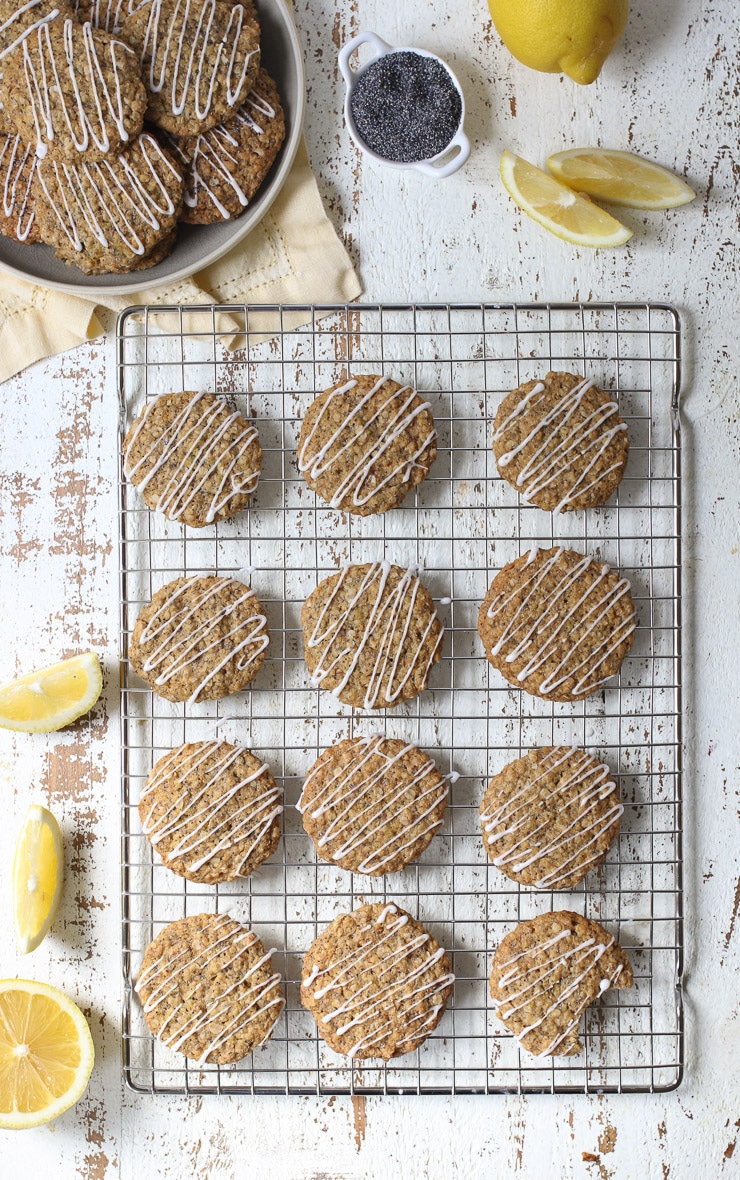
Birds eye view of lemon poppyseed cookies on a cooling rack.

Is there anything more lip puckering and delicious than the combination of lemon poppyseed ANYTHING? Didn’t think so. While this is a classic muffin flavour (and let’s be real- it’s a delicious one), I thought I would pack those same flavours into an oatmeal cookie. But this is not your grandma’s boring cookie. These are for us mamas who are struggling with our breast milk supply and need a little boost (and a treat for all our hard work!!). They are exactly what you’re going to look forward to postpartum.

I’ve already shared a few of my favourite lactation cookies on the blog like these classic salted chocolate chunk and these carrot cake lactation cookies. They have been such a hit in my house among literally anyone who tries them (breastfeeding and not) that I had to get back at it with these sweet and tangy lemon poppyseed cookies.

Table of contents

  • Why This Recipe Works
  • Key Ingredients
  • How to Make This Recipe
  • Expert Tips
  • Recipe FAQs
  • More Recipes You Might Like

Why This Recipe Works

There are a couple key reasons why I always recommend these lemon poppyseed cookies to all my fellow mamas.

  • Gluten-free and vegan – perfect for every dietary need
  • A delicious way to increase breast milk supply
  • Enjoyable for the whole family (not just breastfeeding mamas)

Key Ingredients
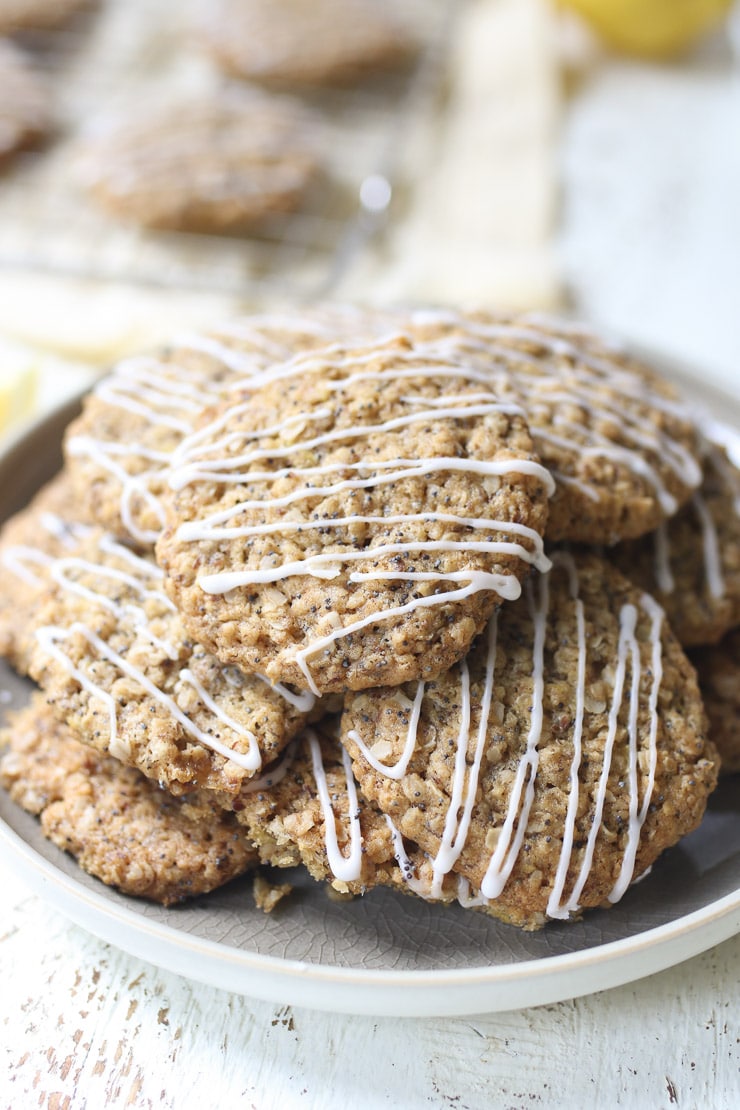
Pile of lemon poppyseed cookies garnished with a glaze on a plate.
  • Flaxseed – To keep this recipe vegan, I used a flax egg.
  • Light brown sugar – I love the added depth of flavour with brown sugar.
  • Vegan butter – You can swap for regular butter if you’re not vegan.
  • Rolled oats – One of my favourite affordable whole grains.
  • All purpose flour – To keep things simple.
  • Brewers yeast – This is the secret ingredient, packed with minerals and B vitamins.
  • Salt – Never skip the salt, it does wonders for enhancing flavour.
  • Vanilla extract 
  • Lemon zest and lemon juice – This is our key for that citrusy zing.
  • Poppyseeds 
  • Powdered sugar 

How to Make This Recipe
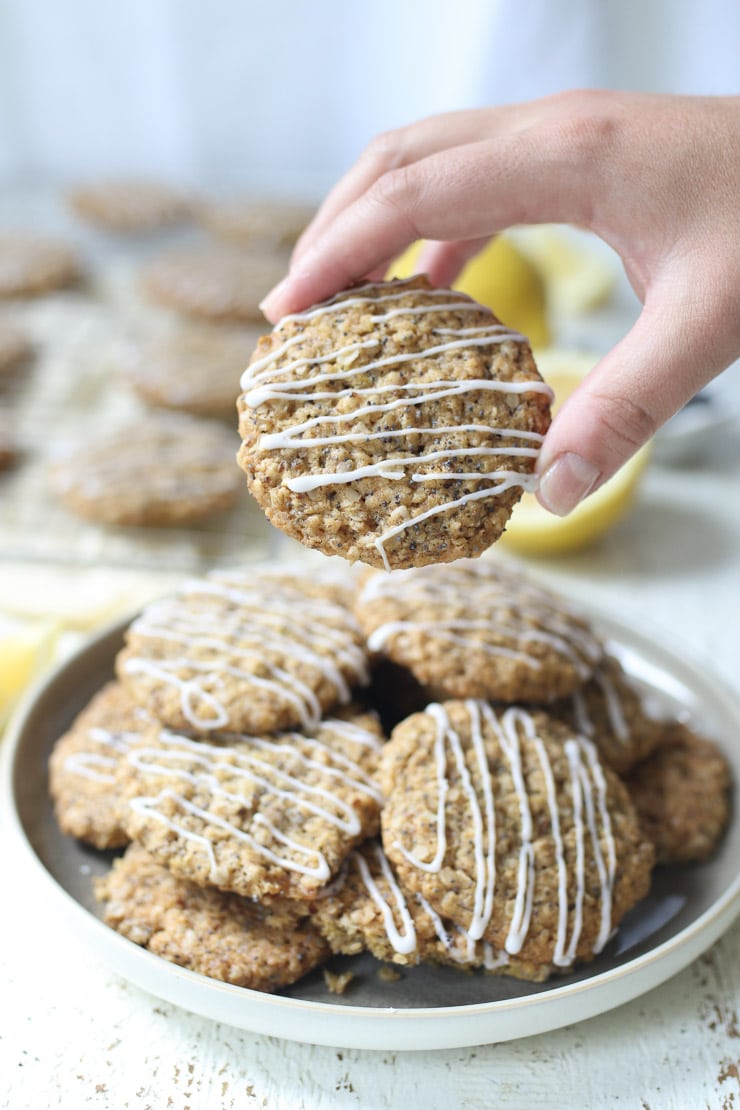
Hand holding lactation cookie above a plate of cookies drizzled with a glaze.

Step One: Prepare the flax eggs and let them sit in the fridge for 30-60 minutes.

Step Two: Preheat oven to 350 F and prepare two baking sheets with silpats.

Step Three: In a bowl, beat together the butter and brown sugar until creamed. Add in the flax eggs, oats, flour, yeast, flax, baking powder, soda, salt, vanilla, lemon zest and 2 tablespoons of poppyseeds.

Step Four: Scoop out a 2-tablespoon ball of cookie dough and roll into a ball. Flatten out onto the silpat. The cookies require a lot of space to spread, so you’ll likely want to put 8 per pan. Repeat with the other pan. I do two batches, so that’s equal to 4 pans depending on the size of your pans. Sprinkle with the remaining 1 tablespoon of poppyseeds.

Step Five: Bake in the middle of the oven for 14-15 minutes, or until lightly golden around the edges. Allow the cookies to cool on a cooling rack.

Step Six: Meanwhile, in a bowl, mix together the powdered sugar with lemon juice and transfer to a piping bag. Drizzle the cooled cookies with the lemon glaze. Enjoy and happy nursing mamas!

Expert Tips

If you’re having a hard time rolling out the dough, chill in the fridge for 15-20 minutes.

You can also batch make these cookies and freeze the raw dough. They bake from raw, but may take a couple extra minutes in the oven.

Recipe FAQs

Do these lemon poppyseed cookies ACTUALLY increase breast milk supply?

Meh, it’s debatable. While the oats, flax and brewers yeast are known galactagogues, there isn’t much research in the area of foods that increase breast milk supply (I’ve written about it here). However, calories DO help, so making sure you have tasty and nutritious snacks around can help when you feel yourself getting a little low on energy.

Can I eat lactation cookies if I’m NOT breastfeeding?

OMG yes. There is NO danger in eating these lactation cookies and starting to lactate. HA, don’t we wish it was that easy. Seriously though, my husband has eaten an entire batch of these and he had yet to grow boobs or breastfeed our son. Unfortunately.

Are these lemon poppyseed cookies gluten-free?

Yes! I used a gluten-free all purpose flour and gluten free rolled oats, but if you’re not gluten-free, just use whatever oats and regular whole wheat flour for extra nutrition.
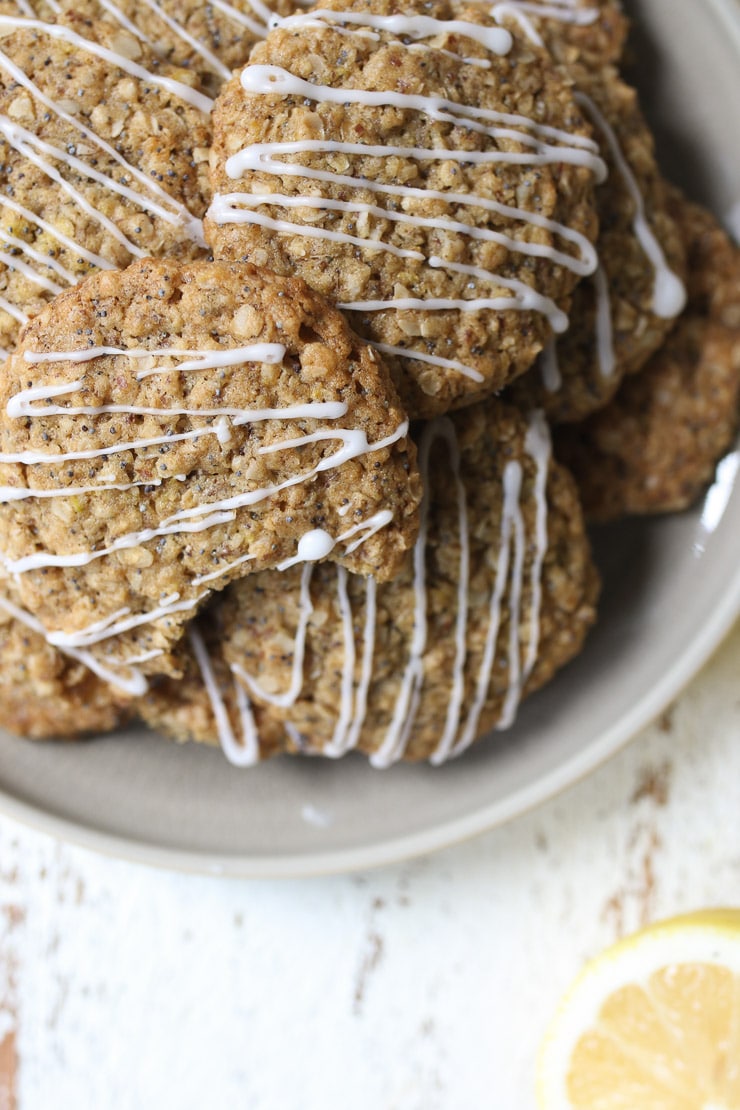
Pile of lemon poppyseed lactation cookies on a plate.

More Recipes You Might Like

Lactation recipes are one of the fun ways to pump up mamas about breastfeeding. Here are some more yummy ones you can try it when you need a snacky pick-me-up!

  • Salted Chocolate Almond Vegan Lactation Cookies
  • Vegan Carrot Cake Lactation Cookies
  • Carrot Cake Vegan Lactation Smoothie
  • Salted Toffee Cookies (Vegan Lactation Recipe)

Now mamas, tell me – have you found that lactation cookies help with your supply? What has helped you boost your breast milk production? Leave me a comment below with your thoughts!
Lemon poppyseed cookies on a cooling rack.
Print Recipe
5 from 6 votes

Lemon Poppyseed Cookies (Vegan Lactation Recipe)

These Lemon Poppyseed Vegan Lactation Cookies are gluten free, dairy free and plant based, while being packed with nutritious ingredients to help increase breast milk supply for breastfeeding mamas.
Prep Time1 hour hr 10 minutes mins
Cook Time15 minutes mins
Total Time1 hour hr 25 minutes mins
Course: Snack
Cuisine: American
Servings: 16 cookies
Calories: 371kcal
Author: Abbey Sharp

Ingredients

  • 2 flax eggs 2 tbsp ground flaxseed with 5 tbsp unsweetened vanilla almond milk or water
  • 1 1/2 cups  light brown sugar
  • 1¼ cup vegan butter melted
  • 3 cups gluten free rolled oats
  • 1 1/2 cups  gluten free all purpose flour
  • 6 tablespoons brewers yeast
  • 3 tablespoons ground flaxseed
  • 1/2 teaspoon baking powder
  • 1/2 teaspoon  baking soda
  • 1/4 teaspoon  salt
  • 2 teaspoons vanilla extract
  • 1 tbsp Lemon zest
  • 3 tbsp poppyseeds divided
  • Lemon juice powdered sugar glaze:
  • 1/2 cup powdered sugar
  • 4 1/2 tsp lemon juice

Instructions

  • Prepare the flax eggs and let them sit in the fridge for 30-60 minutes.
  • Preheat oven to 350 F and prepare two baking sheets with silpats.
  • In a bowl, beat together the butter and brown sugar until creamed. Add in the flax eggs, oats, flour, yeast, flax, baking powder, soda, salt, vanilla, lemon zest and 2 tablespoons of poppyseeds.
  • Scoop out a 2-tablespoon ball of cookie dough and roll into a ball. Flatten out onto the silpat. The cookies require a lot of space to spread, so you'll likely want to put 8 per pan. Repeat with the other pan. I do two batches, so that's equal to 4 pans depending on the size of your pans. Sprinkle with the remaining 1 tablespoon of poppyseeds.
  • Bake in the middle of the oven for 14-15 minutes, or until lightly golden around the edges.
  • Allow the cookies to cool on a cooling rack.
  • Meanwhile, in a bowl, mix together the powdered sugar with lemon juice and transfer to a piping bag. Drizzle the cooled cookies with the lemon glaze. Enjoy and happy nursing mamas!

Nutrition

Calories: 371kcal | Carbohydrates: 54g | Protein: 8g | Fat: 15g | Saturated Fat: 3g | Sodium: 208mg | Potassium: 285mg | Fiber: 6g | Sugar: 26g | Vitamin A: 674IU | Vitamin C: 1mg | Calcium: 80mg | Iron: 3mg
Abbey Sharp

Abbey Sharp is a Registered Dietitian (RD), regulated by the Ontario College of Dietitians. She is a mom, YouTuber, Blogger, award winning cookbook author, media coach specializing in food and nutrition influencers, and a frequent contributor to national publications like Healthline and on national broadcast TV shows.

www.abbeyskitchen.com/about-abbey/

Last Updated January 20, 2023. Published January 20, 2023 By Abbey Sharp 27 Comments

Caramel Truffles with Tahini and Dates (Vegan & No Sugar Added)

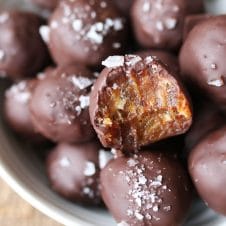
These Salted Tahini Date Caramel Truffles are the perfect Vegan, Gluten Free, No Sugar Added treat for Mother’s Day or any occasion.

These Salted Tahini Date Caramel Truffles are the perfect Vegan, Gluten-Free, No Sugar Added treat for any occasion. They’re so easy to make with only a few ingredients!

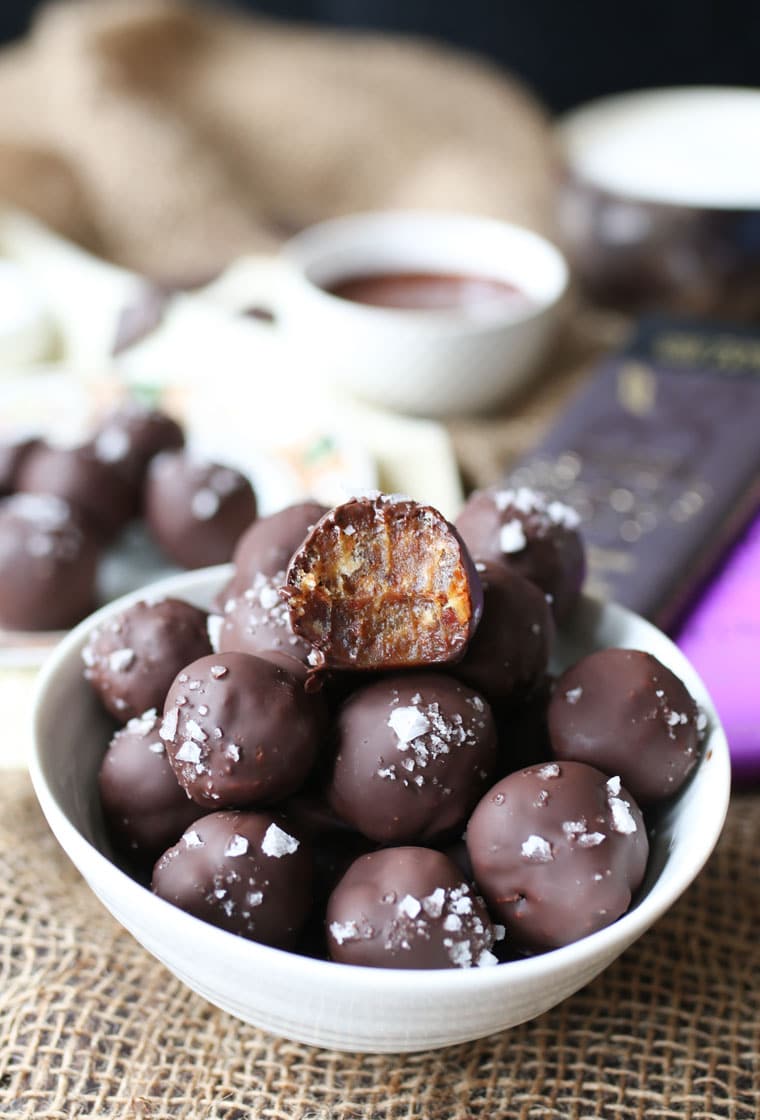
Bowl containing salted tahini date caramel truffles.

Anyone who knows me knows I’ll take any excuse to celebrate. I throw elaborate birthday parties (for myself and everyone else I know), volunteer to host every holiday meal (even all the random holidays no one cares about), and have annual theme parties (just because!). That’s why I LOVE these easy caramel truffles as they can be serve with any occasion. They always disappear quickly when I bring out a bowl.

They’re also a sinch to whip up in a hurry. Sticky, sweet medjool dates get blitzed together with nutty tahini and then mixed with some crispy brown rice cereal. I like creating two layers- one with the crunch, and one without it, to yield a really decadent caramel-y treat with texture. Then I coat that in my melted dark chocolate and finish these Salted Tahini Date Caramel Truffles with a very generous sprinkle of crispy fleur de sel. Yes, you could use kosher salt, but man, there is nothing like that crackle sensation of good salt. If you’re making these for mom, I highly recommend you splurge on good stuff.

Table of contents

  • Why This Recipe Works
  • Key Ingredients
  • How to Make This Recipe
  • Expert Tips
  • Recipe FAQs
  • More Recipes You Might Like

Why This Recipe Works

This caramel truffle is one of my favorite easy recipes!

  • They come together quickly.
  • They’re packed with wholesome ingredients.
  • There’s no added sugar as the dates are sweet.
  • They’re vegan-friendly!

Key Ingredients

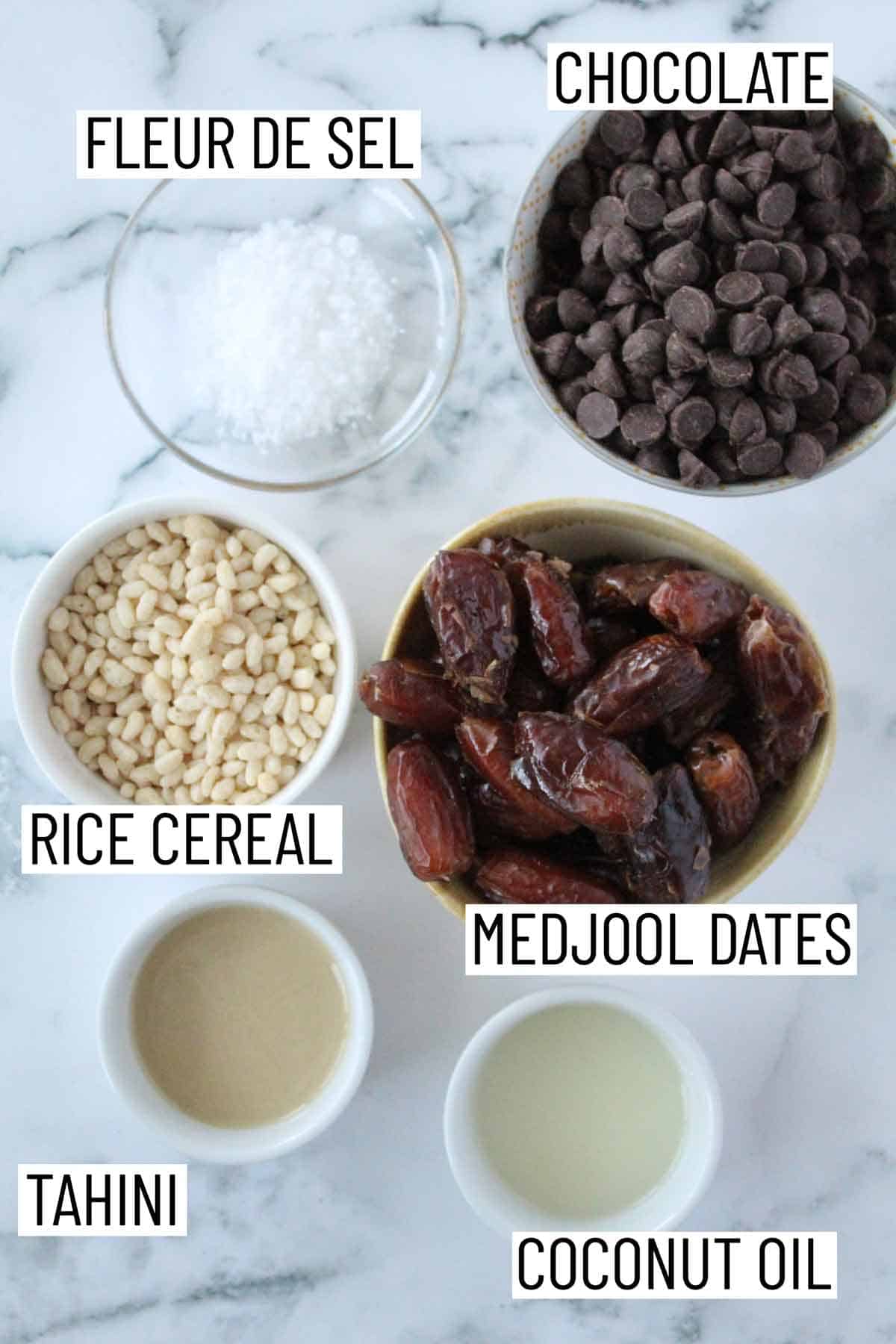
Ingredients needed to make Caramel Truffles with Tahini and Dates.

Medjool dates — buy the dates that are already pitted to save yourself time.

Rice cereal — rice ceral adds extra texture to the caramel truffles.

Chocolate — you want a good-quality chocolate to melt. Chocolate chips are great as they are uniform in size so they melt smoothly. Here are a few methods of melting chocolate.

How to Make This Recipe

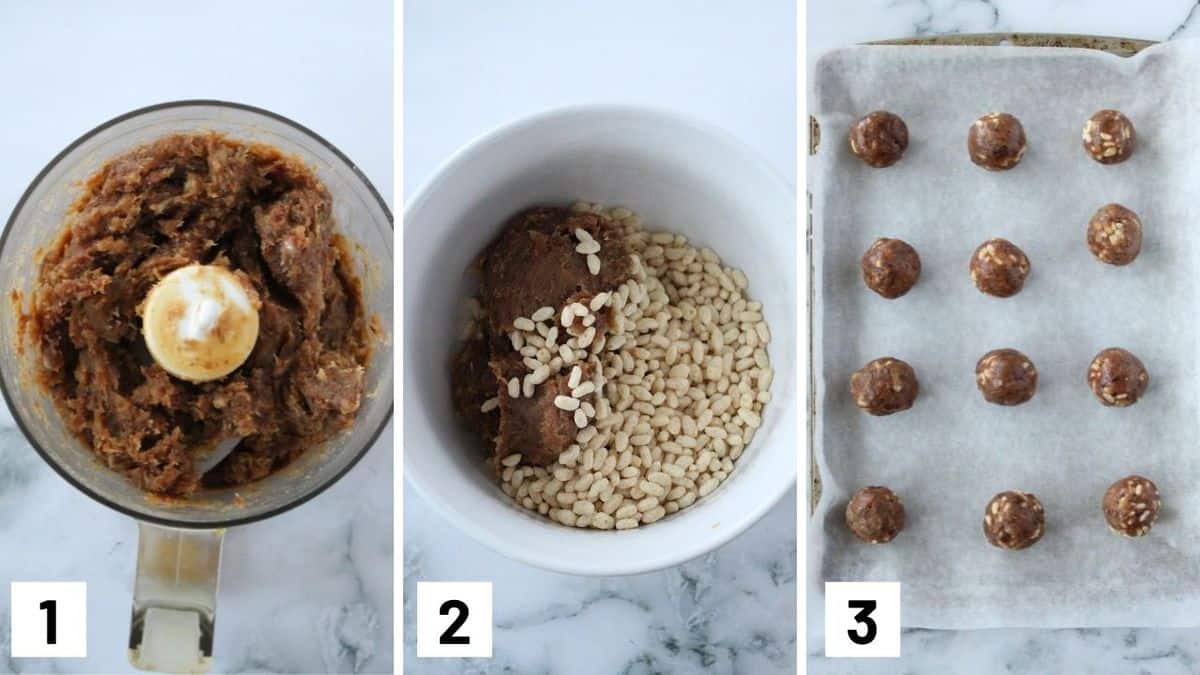
Set of three photos showing how to blend and mix the ingredients and roll them into a ball.

Step 1: In a food processor or high power blender, puree the dates until sticky and smooth. Add the tahini and salt, and puree again until smooth.

Step 2: In one bowl, set aside 1/3 of the mixture for the filling, and in another bowl, set aside another 2/3 of the mixture. To the larger portion, add in the brown rice cereal to the caramel.

Step 3: Grab about 2 tablespoons of the brown rice caramel and a tablespoon of the pure date caramel. Pop the date caramel on top of the brown rice and roll into a ball. Place on a baking sheet lined with a silpat or parchment. Continue with the remaining balls and place in the freezer for 10 minutes.

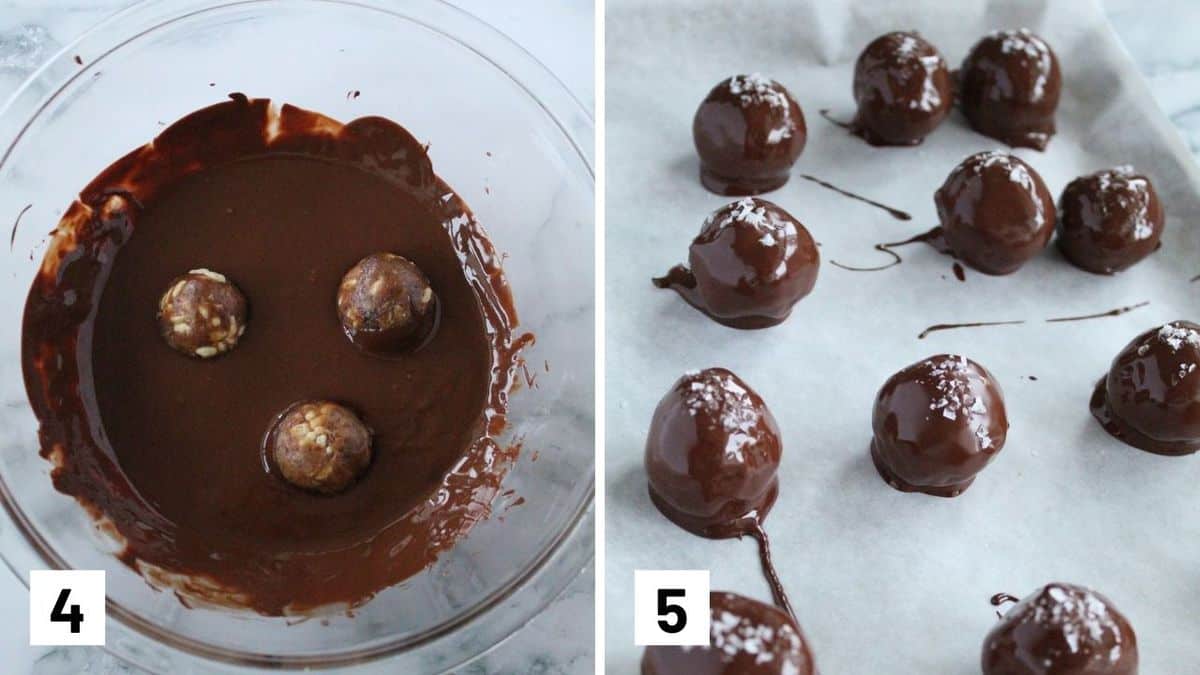
Set of two photos showing the balls dipped in melted chocolate and set to harden.

Step 4: Meanwhile, place the chocolate in a glass bowl set over a medium-sized pot filled an inch up with water. Bring the water to a simmer and all the coconut oil. Simmer the water until the chocolate melts. Remove the balls from the freezer and toss in the chocolate until fully coated.

Step 5: Transfer the caramel truffles to the baking sheet and sprinkle generously with the fleur de sel. Refrigerate until ready to eat.

Expert Tips

Do not let any water splash into your chocolate as you are melting it as it will cause the chocolate to seize.

Plan ahead and be sure to allow enough time for refrigeration of the caramel truffles. The chocolate will be need to set in the fridge so keep that in mind as you plan.

Don’t have chocolate chips? Feel free to finely chop up a chocolate bar.

Recipe FAQs

How do I store these caramel truffles if I’m making them ahead?

Store leftover caramel truffles in an airtight container in the fridge for 2 weeks. You can also freeze the truffles for several months. Bring them to room temperature for a few minutes before serving.

What else can I top these caramel truffles with?

Try coating the chocolate covered truffles with cocoa powder, fine shredded coconut, sprinkles, and crushed freeze dried berries. Check out my chocolate covered espresso beans for more ideas.

Are these kid-friendly?

They are! Your kids will love these easy truffles.

What makes a truffle a truffle?

A truffle has a core is gooey and it is almost always round. You can top them however you’d like but as long as it’s got that soft core, you’ve made a truffle!

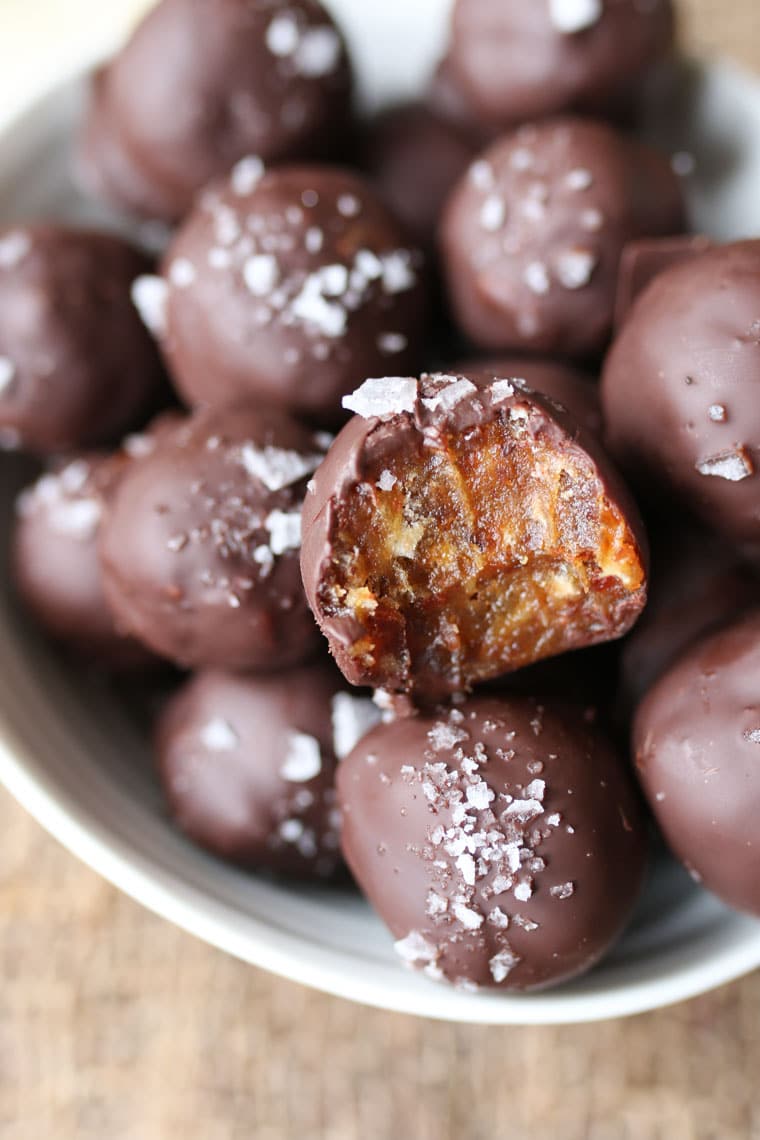
Close up of salted tahini date caramel truffles.

More Recipes You Might Like

If you love chocolate like I do, here are some more chocolate desserts, like my caramel truffles, you might like!

  • BEST ALMOND CHOCOLATE BARK WITH GRANOLA CRUNCH
  • CHOCOLATE CUPS WITH CHIA JAM
  • VEGAN BANANA PEANUT BUTTER CHOCOLATE BARS
  • VEGAN TAHINI STUFFED DATES WITH SALTED CHOCOLATE

So ladies, tell me, what are your favourite ways to make truffles and your go-to toppings!

These Salted Tahini Date Caramel Truffles are the perfect Vegan, Gluten Free, No Sugar Added treat for Mother’s Day or any occasion.
Print Recipe
4.75 from 8 votes

Caramel Truffles with Tahini and Dates (Vegan & No Sugar Added)

These Salted Tahini Date Caramel Truffles are the perfect Vegan, Gluten Free, No Sugar Added treat for any occasion.
Prep Time25 minutes mins
Cook Time10 minutes mins
Total Time35 minutes mins
Course: Dessert
Cuisine: American
Servings: 20 Truffles
Calories: 114kcal
Author: Abbey Sharp

Ingredients

Filling:

  • 3 cups super sticky Medjool dates pitted and diced
  • 8 tsp. tahini
  • Generous pinch of fleur de sel
  • 6 tbsp brown rice cereal

Chocolate Coating:

  • 2 x 100 gram bars of Green & Black’s Organic 70% Dark Chocolate chopped
  • 4 tsp coconut oil
  • Generous pinch of fleur de sel

Instructions

  • In a food processor or high power blender, puree the dates until sticky and smooth. Add the tahini and salt, and puree again until smooth. 
  • In one bowl, set aside 1/3 of the mixture for the filling, and in another bowl, set aside another 2/3 of the mixture. To the larger portion, add in the brown rice cereal to the caramel.
  • Grab about 2 tablespoons of the brown rice caramel and a tablespoon of the pure date caramel. Pop the date caramel on top of the brown rice and roll into a ball. Place on a baking sheet lined with a silpat or parchment. Continue with the remaining balls and place in the freezer for 10 minutes.
  • Meanwhile, place the Green & Black’s Organic 70% Dark Chocolate in a glass bowl set over a medium-sized pot filled an inch up with water. Bring the water to a simmer and all the coconut oil. Simmer the water until the chocolate melts.
  • Remove the balls from the freezer and toss in the chocolate until fully coated. Transfer to the baking sheet and sprinkle generously with the fleur de sel. Refrigerate until ready to eat.

Notes

  • Do not let any water splash into your chocolate as you are melting it as it will cause the chocolate to seize.
  • Plan ahead and be sure to allow enough time for refrigeration of the caramel truffles. The chocolate will be need to set in the fridge so keep that in mind as you plan.
  • Don’t have chocolate chips? Feel free to finely chop up a chocolate bar.

Nutrition

Calories: 114kcal | Carbohydrates: 22g | Protein: 1g | Fat: 3g | Saturated Fat: 1g | Sodium: 1mg | Potassium: 187mg | Fiber: 1g | Sugar: 15g | Vitamin A: 35IU | Vitamin C: 0.1mg | Calcium: 19mg | Iron: 0.7mg
Abbey Sharp

Abbey Sharp is a Registered Dietitian (RD), regulated by the Ontario College of Dietitians. She is a mom, YouTuber, Blogger, award winning cookbook author, media coach specializing in food and nutrition influencers, and a frequent contributor to national publications like Healthline and on national broadcast TV shows.
www.abbeyskitchen.com/about-abbey/

Last Updated January 17, 2023. Published January 17, 2023 By Abbey Sharp 44 Comments

Vegan Avocado Toast with Roasted Tomatoes (High Protein!)

This vegan avocado toast with roasted tomatoes is a super easy and delicious high protein breakfast or snack for any time of day.

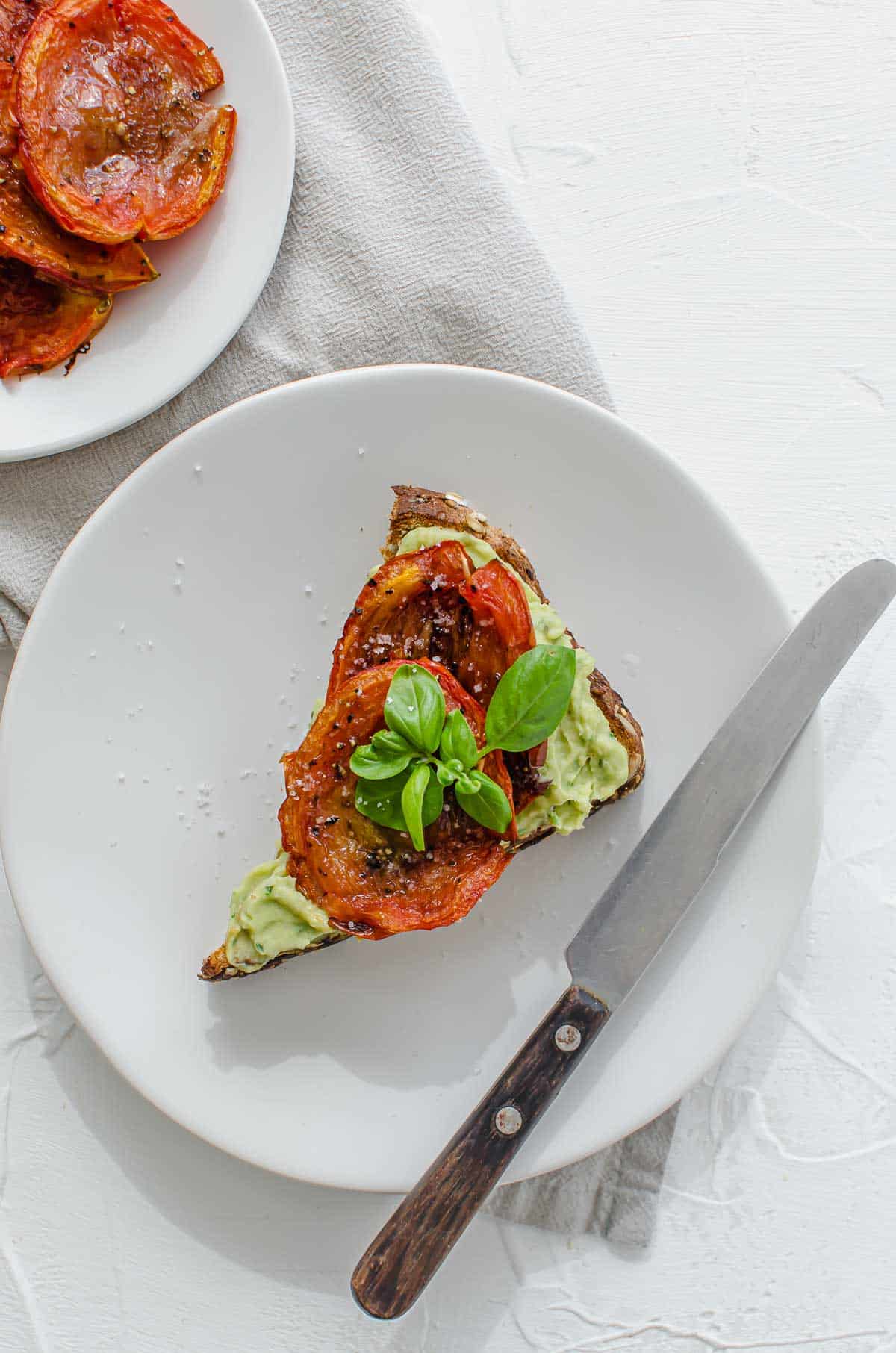
Close up of vegan avocado toast on a white plate topped with roasted tomato and a basil leaf with extra roasted tomatoes in the background.

I love coming up with creative and easy ways to add extra protein into my favourite meals (especially those that typically lack protein). Case in point – the classic avocado toast.

Millennials like me LOVE a good avo toast – its rich in healthy fats and fibre, its creamy, easy to whip up, and is just oh so tasty when spread on top of some crunchy bread with a generous squeeze of lemon juice on top! Yes, I may or may not be salivating at the thought.

But unless you pair the avocado toast with some cheese or an egg on top, it is seriously lacking in protein. Plus, if you are vegan you are pretty much sh*t out of luck. My solution? This high protein vegan avocado toast recipe made possible by one of my favourite protein hacks – cannellini beans.

Table of contents

  • Why This Recipe Works
  • Key Ingredients
  • How to Make This Recipe
  • Expert Tips
  • Recipe FAQs
  • More Recipes You Might Like

Why This Recipe Works

If you are already part of the avocado toast fan club, I doubt you will need more convincing to try this high protein vegan version. But if you DO, here are a few more reasons why this is my go-to vegan avocado toast recipe.

  • Nutrition packed (high in protein and fibre!)
  • Insanely flavourful
  • Uses up pantry staples
  • Plant-based
  • Gluten free (if using GF bread)
  • Perfect as a meal or a snack

Key Ingredients

Flat lay image of recipe ingredients including lemon, pepper, Roma tomatos, olive oil, salt, basil, balsamic, parsley, white bean, avocado, and bread.

White Beans – White beans, cannellini beans, white kidney beans -whatever you wanna call them – are the secret ingredient to making this vegan avocado toast high protein and that much more satiating! About 1/2 cup of white beans provides 7 grams of protein and 6 grams of fibre. It also has a very neutral flavour, which is perfect because it doesn’t outshine the avocado and just adds to the creaminess.

Roma Tomatoes – Compared to other tomatoes, I find that Roma tomatoes are the best in terms of flavour and texture. Roasting them brings out their amazing tomatoe-y flavour, and you seriously have to fight me to not eat the whole batch. To make the roasted tomatoes even MORE flavourful, we are roasting them with garlic and a generous drizzle of balsamic vinegar. DE-LISH!

Fresh Herbs – We are doing things right with this vegan avocado toast, meaning that we aren’t just mashing up avocado with a bit of salt and pepper and calling it a day. No, no, no my friends. We are adding all the good stuff to make this vegan avocado toast super flavourful and that includes fresh parsley and fresh basil.

Avocado – It goes without saying that you will want to use ripe avocados for this recipe. Your best bet is to buy them already ripe by looking for avocados that are soft but still slightly firm upon squeezing. Otherwise, you can speed up the ripening process by letting the avocado hang out with bananas and other fruit (you can also place them all in a brown bag if you have that available). The ethylene gas (a natural chemical that causes fruit to ripen) emitted from these fruits will help your avocados to ripen in no time.

How to Make This Recipe

Two side by side images showing how to roast the tomatoes with garlic, balsamic vinegar, and pepper.

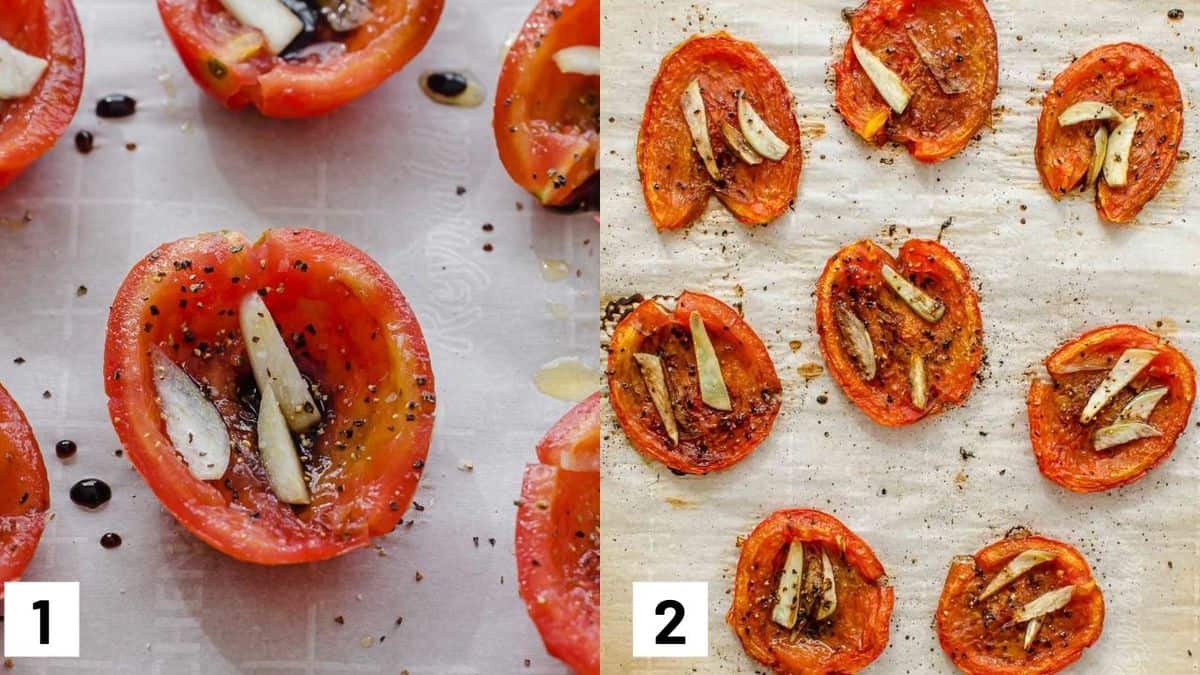
Step 1: Toss the tomatoes with the oil and spread out onto a baking sheet, cut side up. Add the garlic into the cavities of the tomatoes, drizzle with balsamic and add a pinch each of salt and pepper. Lightly press the tomatoes down to flatten.

Step 2: Roast until the tomatoes soften and caramelize, about 20-30 minutes. Allow them to cool completely, then carefully remove and discard the skin.

Two side by side images showing how to prepare the mixture in the food processor and spreading onto a piece of toast.

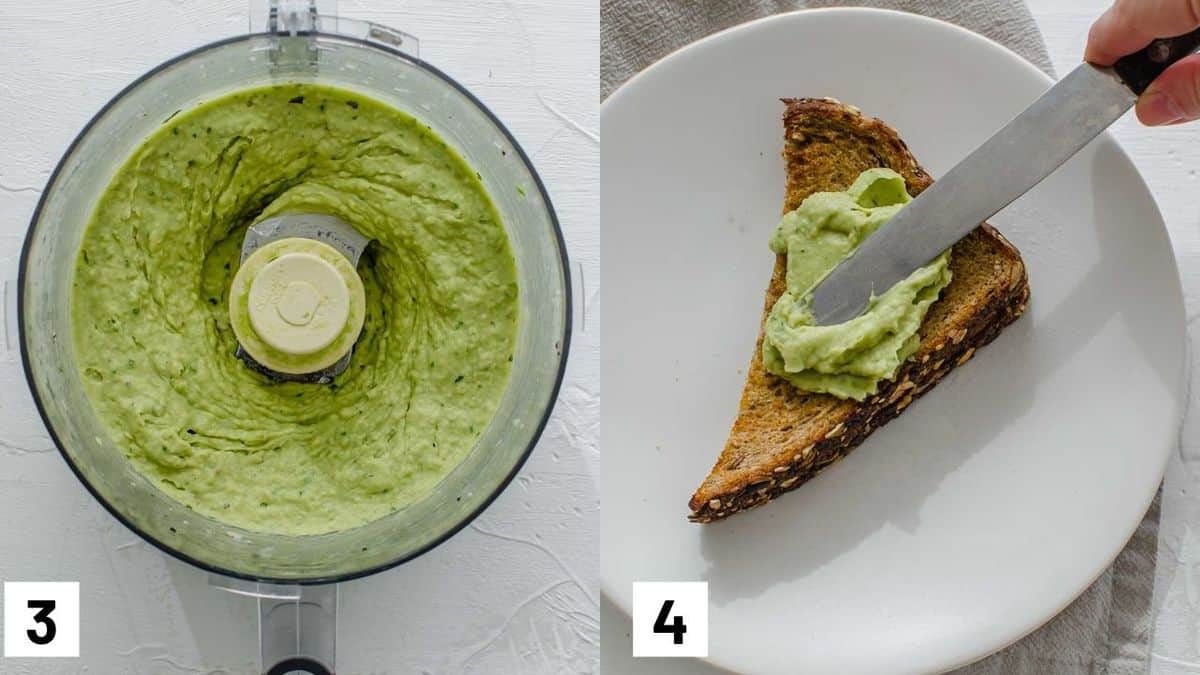
Step 3: Add the beans, avocado, lemon juice, parsley, basil, garlic, salt and pepper to a food processor and puree until smooth.

Step 4: Once the tomatoes are finished, brush the bread with the remaining oil and toast on the baking sheet in the hot oven until lightly golden brown, about 5 minutes. To assemble, divide the avocado between the four slices of toast, top with a piece of roasted tomato and garnish with the fresh basil leaves and fleur de sel.

Expert Tips

To speed things along for this vegan avocado toast recipe, we combine the avocado mixture in a food processor or high speed blender to yield a smooth and creamy texture that is easily spreadable. However, if you do not have this equipment available its no biggie. You can totally mash everything up by hand! To do this I would recommend finely mincing up the garlic and fresh herbs, mashing up the white beans and the avocado separately (you can use a fork or a wooden spoon to do this), and then combining everything together in one bowl. This will obviously result in a chunkier texture than if you were to use a food processor.

Recipe FAQs

Is this gluten free?

If you use a gluten free bread, then yes this recipe is gluten free.

What other vegan protein alternatives can I use if I can’t tolerate beans?

If you have a hard time tolerating beans then its no problem! Another vegan protein alternative is to add silken tofu to the avocado mixture instead. You can also add in about 1/4 cup of nutritional yeast, however keep in mind that while this will add protein (about 6 grams of protein per 1/4 cup) the end result will not be as high in protein if you were to use the tofu or beans.

How long does this keep in the fridge?

The avocado mixture lasts about 1-3 days in the fridge. It will likely start to brown immediately, however you can reduce the browning by storing in an air tight container, squeezing lemon juice on top, and storing it with the avocado pit in the center.

Can I use this avocado spread as a guacamole?

Absolutely! I don’t see why not. Pair it with some tortilla chips or some veggies and you have a delicious high protein snack.

Birds eye view of vegan avocado toast on a white plate topped with roasted tomatoes and garnished with fresh basil.

More Recipes You Might Like

I loooooooooove me some avocado. So you best believe there are more avocado recipes where that came from. Here are some of my favs:

  • Avocado Stuffed Sweet Potato
  • Best Avocado Salad Dressing (Healthy & Vegan)
  • Vegan Avocado Zucchini Noodles
  • Grilled Avocado Bruschetta

What are your favourite avocado toast toppings? I’d love to know!

Print Recipe
4.92 from 23 votes

Vegan Avocado Toast with Roasted Tomatoes (High Protein!)

This vegan avocado toast with roasted tomatoes is a delicious high protein breakfast or snack for any time of day.
Prep Time10 minutes mins
Cook Time40 minutes mins
Total Time50 minutes mins
Course: Snack
Cuisine: American
Diet: Vegan
Servings: 4 people
Calories: 413kcal
Author: Abbey Sharp

Ingredients

Avocado Smash

  • 15 oz can no salt added cannellini beans rinsed and drained
  • 2 avocados pitted, peeled and chopped
  • 3 tbsp lemon juice
  • 1/4 cup parsley roughly chopped
  • 1/4 cup basil leaves roughly chopped
  • 1 clove garlic minced
  • Salt and pepper to taste

Tomatoes

  • 4 Roma Tomatoes cut in half, seeds and juice removed
  • 1 Tbsp extra virgin olive oil
  • 2 cloves garlic thinly sliced
  • 2 tsp balsamic vinegar
  • Pinch each of salt and pepper

Toast

  • 1 Tbsp extra virgin olive oil
  • 4 slices thickly cut gluten free bread
  • leaves Basil for garnish
  • Fleur de sel for garnish

Instructions

  • Preheat oven to 450 F.
  • Toss the tomatoes with the oil and spread out onto a baking sheet, cut side up. Add the garlic into the cavities of the tomatoes, drizzle with balsamic and add a pinch each of salt and pepper. Lightly press the tomatoes down to flatten.
  • Roast until the tomatoes soften and caramelize, about 20-30 minutes. Allow them to cool completely, then carefully remove and discard the skin.
  • Meanwhile, add the beans, avocado, lemon juice, parsley, basil, garlic, salt and pepper to a food processor and puree until smooth.
  • Once the tomatoes are finished, brush the bread with the remaining oil and toast on the baking sheet in the hot oven until lightly golden brown, about 5 minutes.
  • To assemble, divide the avocado between the four slices of toast, top with a piece of roasted tomato and garnish with the fresh basil leaves and fleur de sel.

Nutrition

Calories: 413kcal | Carbohydrates: 45g | Protein: 10g | Fat: 24g | Saturated Fat: 3g | Cholesterol: 6mg | Sodium: 358mg | Potassium: 683mg | Fiber: 14g | Sugar: 5g | Vitamin A: 1135IU | Vitamin C: 29mg | Calcium: 133mg | Iron: 4mg

Did you enjoy this high protein vegan avocado toast? Let me know your thoughts down in the comments below!

Abbey Sharp

Abbey Sharp is a Registered Dietitian (RD), regulated by the Ontario College of Dietitians. She is a mom, YouTuber, Blogger, award winning cookbook author, media coach specializing in food and nutrition influencers, and a frequent contributor to national publications like Healthline and on national broadcast TV shows.
www.abbeyskitchen.com/about-abbey/

Last Updated January 14, 2023. Published January 11, 2023 By Abbey Sharp 36 Comments

Food Combining Diet: The Shocking Truth About the Diet for Weight Loss, Bloating, & IBS

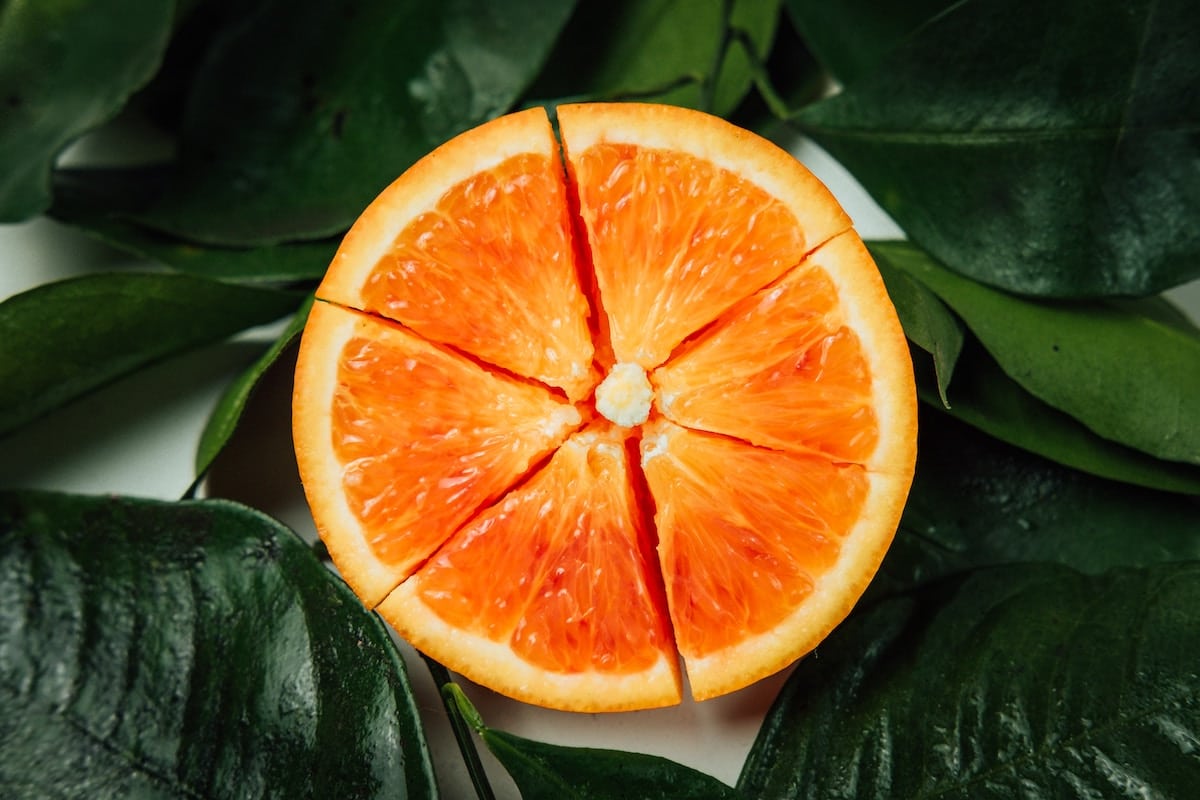
Half an orange cut into segments

We discuss the shocking truth about the food combining diet for weight loss, bloating & IBS, along with some food combining strategies that are ACTUALLY good for you.

Half an orange cut into segments

This past month, I reviewed a YouTuber named Kenzie Burke’s video about the Food Combining Diet, diving deep into the research (or lack thereof) and poking some serious holes in her theory. It got a lot of great attention, and lead to her removing her video from the platform, likely as a result of the obvious misinformation it contained. But I get that some of you want to see the science first hand, so I thought I would go a little more in depth in this blog.

What is the Food Combining Diet?

The food combining diet isn’t about what to eat or how much to eat. But rather, it emphasizes HOW you eat- particularly how you eat foods together (or apart). The food combining diet has its root in Ayurvedic practice, and features an extensive list of rules on which foods should be eaten together or on their own.

Here’s a list of these basic rules.

Food Combining Rules

Only eat fruit on an empty stomach
Don’t combine starches and proteins
Don’t combine starches with acidic foods
Don’t combine different types of protein
Only consume dairy products on an empty stomach, especially milk
Protein should not be mixed with fat
Sugar should only be eaten alone
Fruits and vegetables should be eaten separately

So What’s The Theory Behind Food Combining?

If you’re reading this and thinking, “WTF, WHY?! WHY can’t I have peanut butter on my toast? I’ve ALWAYS thought that was a reasonable, balanced thing to do?!” You’re not alone.

The theory behind food combing is that when we combine starches and protein we are putting too much strain on our digestive system. To use the PB and toast analogy, food combining proponents believe that when you eat fast digesting foods (like bread) and slow digesting foods (peanut butter), you’ll cause a “traffic jam” in your digestive tract. This peanut butter toast traffic jam will supposedly negatively affect your digestion, resulting in disease, toxic buildup, bloating, IBS and other forms of digestive stress. To prevent that, food combiners eat the peanut butter and toast separately.

Claims of the Food Combining Diet

So does strategically combining (or more realistically, separating) foods actually impact our health? Food combining supporters claim eating this way improves digestion, normalizes acidity levels, decreases toxins in the body, reduces bloating and of course- promotes weight loss. That’s a pretty big rap sheet. Is there legitimacy to any of these claims? Let’s take a closer look.

Food Combining Improves Digestion and Reduces Bloating & IBS

Person holding their hands over their stomach

Theory Behind The Claim: Like I mentioned earlier, the goal behind food combining is to reduce the strain or work for your digestive system by only giving it a few foods to digest at a time. By doing this, food combiners claim your food will digest very quickly. However, does this give our digestive system a break, and does it need a break?

What the Evidence Says: One of the biggest flaws in the food combining movement is that they seem to ignore the very science-based principles of how our digestive system works. Unless there’s an underlying digestive issue, a healthy digestive system doesn’t get any kind of traffic jam. Each step in our digestive system, from our mouth to our anus (sorry for putting those words so close together), is carefully carried out by a variety of processes and they do a damn good job without any hiccups. That has nothing to do with the food we put in our body, and has more to do with our very experienced and efficient digestive system. Our intricate digestive system triggers the release of the appropriate enzymes to break down a variety of foods at once. It is made to multitask with not just one enzyme, but the right cocktail of enzymes for the job since our meals are almost ALWAYS a cocktail of macro and micronutrients. Let’s go back to our PB and toast analogy. Say you decide to just eat the peanut butter with a spoon (which, let’s be real, is also good). Like most foods, peanut butter contains all three macronutrients: fat, protein and carbohydrates. According to the food combining rules, you’d be breaking, like three rules, just by eating a single spoonful of peanut butter sans bread. Because of peanut butter, and quinoa, and legit everything, your body has lots of experience sending out the right enzymes and you are not giving it a head start or lessening the work by separating these foods.

This brings me to a more important question: do we need, or WANT, to fast track digestion?

Food is fuel, so if food “passes right through us” as our friend Ms. Burke suggests, you’ll end up with an empty tank pretty quickly. In an ideal scenario, food is meant to sustain us so we can use it later for exercise and even emergencies like if you enter starvation mode. Foods that tend to pass right through us (think simple sugars like candy) can cause a spike in our blood sugar levels which actually overwork our body, and leave us susceptible to overeating shortly after. This is why we always recommend combining fruit with a source of protein or fat to prevent those spikes (a suggestion that would be refuted on the food combining diet.)

Food Combining Improves Enzyme Function

Croissant on a white plate

Theory Behind The Claim: Since different enzymes require different pH ranges to function, food combiners believe if two foods require different pH levels, the body can’t properly digest both at the same time which leads to digestive distress. This is why food combiners often describe food groups as either acidic, neutral, or alkaline. The theory behind these foods is that if you eat too many acidic foods then you can alter the pH levels in your body and thus hinder the function of those enzymes.

What the Evidence Says: If you fell asleep during your high school chem class, here’s a brief refresher on enzymes. I briefly mentioned enzymes earlier, but we need to take a closer look because they’re the protagonist in this digestion story. Depending on the food, a variety of enzymes are released to help with digestion, each with their own optimal pH ranges for function. Here are some common ones:

Amylase = breaks down carbohydrates (4.6 – 7.0)
Protease = breaks down proteins (1.5 – 7.0)
Lipase = breaks down fats (4.0 – 8.0)

As you can see these are very wide ranges, and that’s because these enzymes exist throughout our body in a variety of different pH environments.

Now that you understand enzymes and their function, let’s refer back to those food combining claims.

Enzyme Claim #1: Our body can’t simultaneously digest foods that require different pH levels.

First of all, our enzymes work throughout our body, not just in one place, so this means that there are different pH levels throughout our body (see the optimal pH ranges above) and even given that, digestion is still possible. Lipase works in your stomach and small intestine, protease work from your stomach into your small intestine and finally amylase breaks down on starches in the mouth and small intestine. The lipase that works in your stomach requires a more acidic environment, while the lipase that works in your small intestine requires a more basic environment. The system that regulates the appropriate pH for each enzyme’s reaction is not based on the types of food you eat, but rather our amazing bodies!

pH Claim #2: Certain foods alter pH and enzyme function

The second point I want to make is that there is absolutely NO evidence that eating alkaline, acidic or neutral foods can suddenly change the pH of your digestive tract. Some evidence has found that the pH of certain foods may change the pH of your urine, which is why it may be helpful for people with kidney disease to pay attention to pH, but to date no evidence suggests it can change our body’s blood pH.

There are instances when the pH in our body changes, but our bodies are able to quickly find a way to correct that and normalize those levels in healthy individuals and return to homeostasis.

Want to know how? *puts her geek glasses on*

Well, your stomach lining contains cells that control the pH level. When your stomach’s acidity level changes, your body simply releases gastric acid to normalize your pH levels. If your small intestine’s pH changes, your body releases bicarbonate to neutralize the acid coming from your stomach. Even stevens!

Bottom line, folks: your digestive tract and the enzymes within it are smart cookies. Everything is very tightly controlled and regulated by your body and not by the food that you eat.

Food Combining Eliminates Toxic Buildup

Theory Behind This Claim: When we combine the wrong foods, certain foods don’t get properly digested and remain in our stomach or intestines undigested, leading to fermentation, gas, bloating and toxic buildup. Sounds pretty nasty, but is it true?

What the Evidence Says: Not so much. First of all, food doesn’t just sit in our stomach. Our stomach’s acidic environment lets very few things live in those stark conditions. Any food in our stomach starts to get broken down by enzymes and mixed in with our stomach acid before being pushed through our small intestines.

The fermentation they claim can happen, but only in our large intestines. Our large intestines house a huge amount of good bacteria and you will find some undigested foods there like fibre, for example. However, the undigested fibre left behind doesn’t lead to a toxic buildup, it ferments, releasing gas and good-for-you byproducts like short chain fatty acids. These fatty acids can actually do wonders for our health like reducing our risk of cardiovascular disease by improving our blood sugar control and reducing inflammation. The bottom line is that food doesn’t hang out in our stomach for long in a healthy person, and if you are having delayed gastric emptying, it’s time to speak to a doc.

Food Combining Promotes Weight Loss

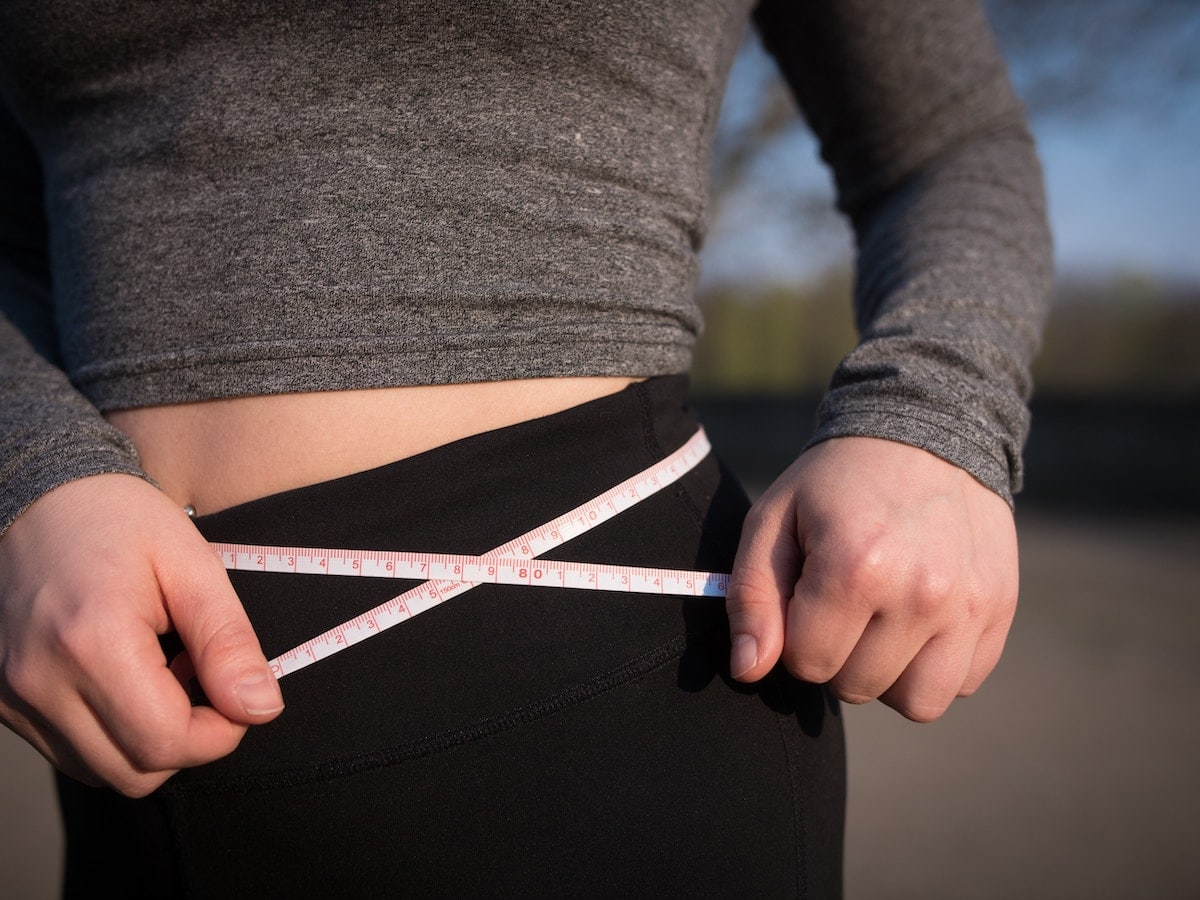
woman measuring her waist line with measuring tape

Theory Behind This Claim: That toxic buildup that we just mentioned in the last claim is said to lead to all sorts of problems including gas, bloating and weight gain. The theory here is that if you combine the right foods, your digestion improves, there are no leftover “rotting” foods in your stomach and you will inevitably lose weight.

What the Evidence Says: The research on food combining and weight loss is pretty lacking. I mean the research on food combining in general is hella scarce! What we did find in our research was one single itty bitty study that looked at food combining and weight loss and the results don’t really tell us anything we didn’t already know. Let me tell you what I mean by that. In a 2000 study, participants were separated into either a food combining diet group or a regular balanced diet. Both diets were defined as low calorie diets (when I say low I mean LOW, like around 1,100 calories/day). I would call that a starvation diet by my standards and I’m honestly surprised this got past ethics. But anyway, unsurprisingly, both groups lost around 13 to 18 pounds. Researchers concluded that the food combining diet offered no benefit over the balanced diet group, and the calorie restriction was the cause of the weight loss, not the food combining component. Shocker. Given this was a short term study (obvs because WHO WOULD DO THIS FOR LONG), it is also likely that they would have gained all that weight back and then some, because that’s what the research tells us happens with severe restriction. The moral of the story is that restricting calories may lead to modest weight loss, that will likely not last, and that food combining does not play a role in that.

When Food Combining Works

So I hope we’ve made it clear that the food combining diet is BS. But there are instances when combining certain foods can actually improve their nutrition.

Vitamin C & Iron Absorption

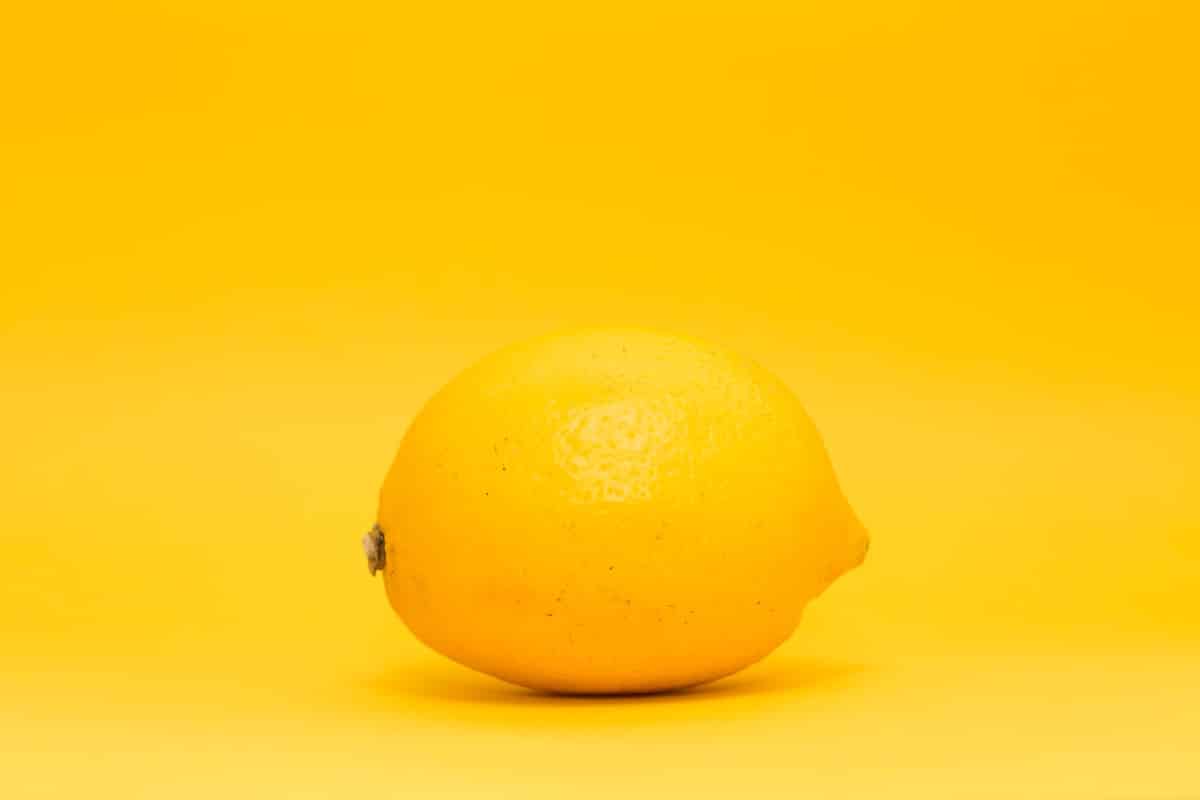
lemon on a yellow background

Iron comes in two forms: heme and non heme. Heme iron is more easily absorbed, and non heme is not, so to increase the absorption of plant-based non heme iron, it is recommended to combine non heme iron sources (like beans, peas and lentils) with vitamin C rich foods (citrus fruits, bell peppers and tomatoes). This would be REALLY important information for Kenzie and her plant based followers, but sadly this would be prohibited by food combing rules.

Fat Soluble Vitamins and Fat

Fat soluble vitamins like A,D,E ,and K play a key role in our health and they are best consumed with fat in order to be properly absorbed by the body. For example, research suggests that carotenoid rich foods like red, orange and dark green vegetables are best combined with oils or fat to reap the benefits of these vitamins. This is why putting salad dressing on our veggies is actually really important! Likewise, serving your vitamin A rich fruit with some sort of fat also helps reap the benefits. Think mango with cashews, or watermelon with avocado- all yummy option! This would again negate the food combining guidelines, but it would be a shame not to squeeze all that nutrition out of your produce.

Carbohydrates and Protein or Fat

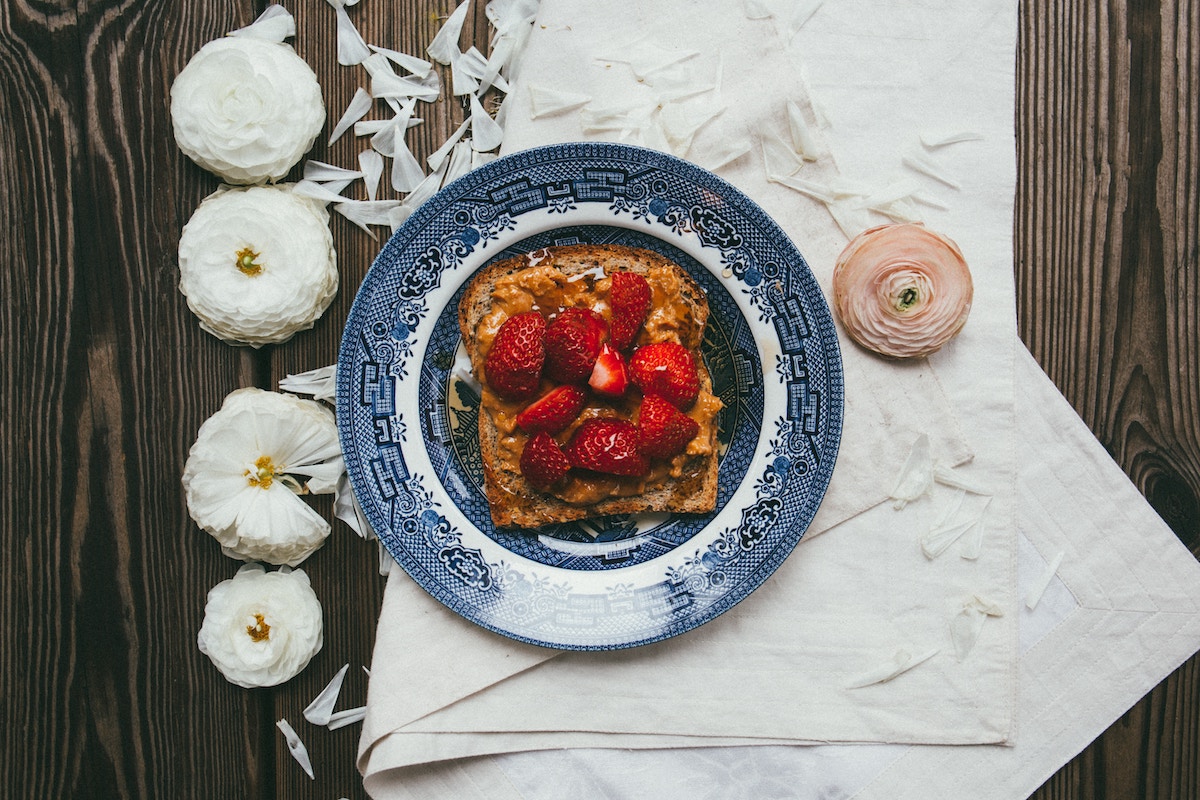
toast with peanut butter and berries

Contrary to the food combining philosophy, combining carbohydrates and protein or fat have a lot of important benefits. In sports nutrition for example, evidence has found that consuming carbs and protein together after a workout can help to speed up muscle recover and replenish glycogen stores that were depleted during exercise.

We also recommend combing carbohydrates (like fruit) with fat or protein for blood sugar control. In fact, one study found that people’s blood sugar levels were lowered when they consumed a potato with lentils compared to potato alone in healthy individuals. Again this wouldn’t be allowed if you’re following those rules.

Protein Combining

When it comes to protein, not all proteins you eat are created equal. Complete proteins provide us with all the nine essential amino acids our bodies need to function optimally. These types of protein are animal-based and include meat, poultry, fish, milk, eggs and cheese. Incomplete proteins are missing one or more of the essential amino acids, and include vegetables, grains, legumes and nuts. We used to think that in order to get all of the essential amino acids from plant based protein, that we needed to combine these incomplete sources together to form a complete version (i.e. beans and rice). However, we now know that it’s not necessary to combine these incomplete proteins at the same time, but just rather, to ensure you’re getting a variety of these proteins throughout the day and week.

Bottom Line on the Food Combining Diet for Weight Loss & Digestion

Sorry avid food combiners, based on the available research and the many hours I’ve spent in a biology and chemistry lab, and there is just no evidence to suggest food combining cures digestive woes or even leads to weight loss. Granted, there are occasions when you can benefit nutritionally when combining certain foods, but this has nothing to do with the kooky rules set out by the food combining diet. The last thing we need in the health and wellness space is more bogus rules. Listen to your body’s cues and combine foods the way that is satisfying and enjoyable to you. That’s as close to a “rule” as you’ll ever need.

Become an Abbey’s Kitchen Subscriber

If you liked this post, you may like:

  • Should You Be Eating Your Placenta?
  • Does the Boy Diet and Girl Diet for Sex Selection Work?
  • Is the Sirtfood Diet the Key To Successful Weight Loss?
  • The Alkaline Diet Review | Does pH Balance Help You Lose Weight?
Contribution By:
Sofia Tsalamlal, RD, MHSc Nutrition Communication
Abbey Sharp

Abbey Sharp is a Registered Dietitian (RD), regulated by the Ontario College of Dietitians. She is a mom, YouTuber, Blogger, award winning cookbook author, media coach specializing in food and nutrition influencers, and a frequent contributor to national publications like Healthline and on national broadcast TV shows.
www.abbeyskitchen.com/about-abbey/

Last Updated January 9, 2023. Published January 9, 2023 By Abbey Sharp 7 Comments

Vegan Breakfast Burrito with Tofu Scramble (High Protein)

Hands holding two halves of breakfast burrito.

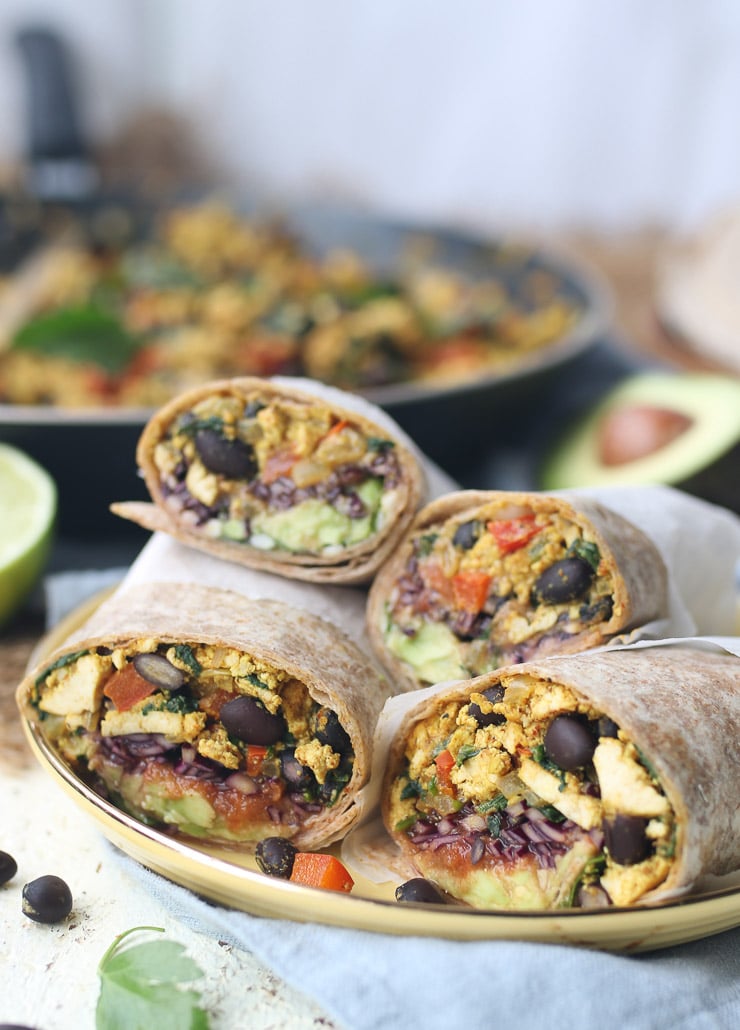
This vegan breakfast burrito with tofu scramble and black beans is a perfect high protein meal that is also ideal for a healthy meal prep.

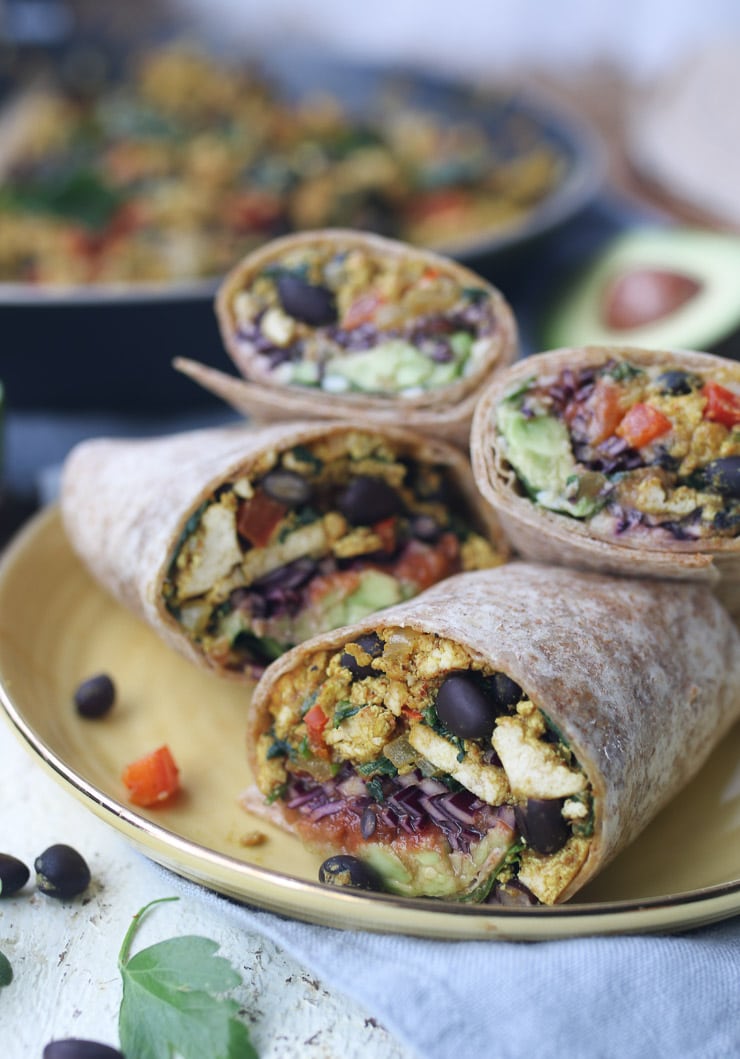
Vegan breakfast burritos on a plate.

A few weeks ago I was working with my girl Edgy Veg‘s friend Louis on some strategies for sports and fitness nutrition while he transitioned to a plant-based diet. One of the things we worked on were healthy post-workout breakfast or meals that could be made ahead. Working with him on his diet got me thinking of great vegan breakfast options and that was the inspiration for this amazing vegan breakfast burrito with tofu scramble.

Table of contents

  • Why This Recipe Works
  • Key Ingredients
  • How to Make This Recipe
  • Expert Tips
  • Recipe FAQs
  • More Recipes You Might Like

Why This Recipe Works

In general, after a solid morning workout, I recommend around 30 grams of protein and a source of carbohydrates to help get that protein into the muscles faster. This vegan breakfast burrito is the perfect post-workout meal as it fits the bill. But if you’re not here for the meal planning tips, there are some more reasons to love this recipe!

  • High in protein (24g per serving)
  • Meal-prep friendly
  • Packed with flavour
  • Uses pantry staples
  • Simple but delicious

Key Ingredients

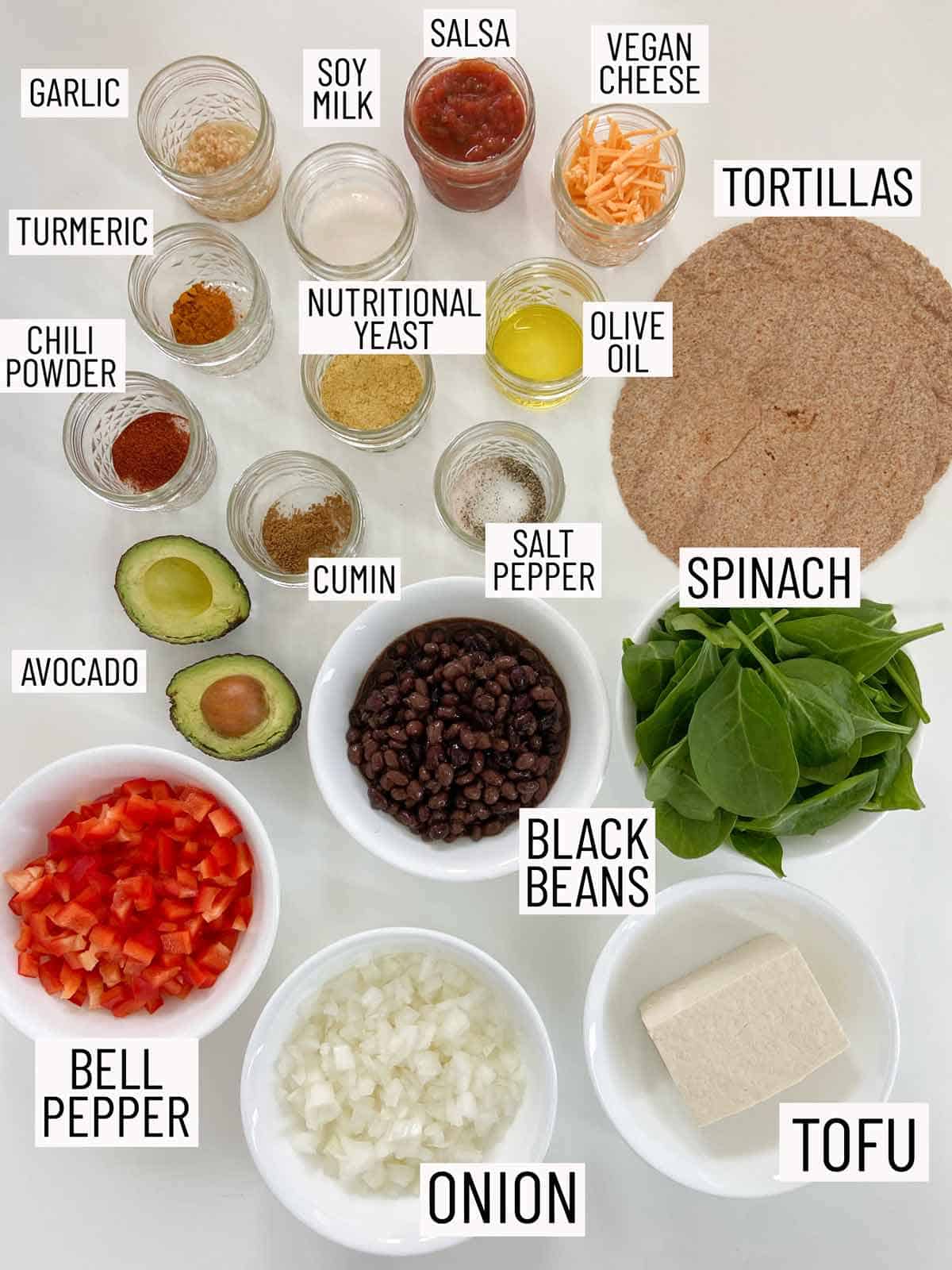
Overhead photo of ingredients needed to make vegan breakfast burritos.

Tofu — Be sure you pick up extra firm tofu. No need to press the tofu ahead of time as any liquid will cook out in the skillet.

Seasoning and Spices — We use a handful of seasoning and spices to pack flavour into this burrito! We’ve got turmeric, cumin, chili powder, nutritional yeast, salt, and pepper.

Vegetables — We’ve got onion, belly peppers, and spinach but you can also add whatever else is in your fridge!

Tortillas — I like large whole grain flour tortillas for these vegan breakfast burritos. You can swap for whatever tortilla you like or even spinach tortillas to pack some extra healthy goodness into your meal.

How to Make This Recipe

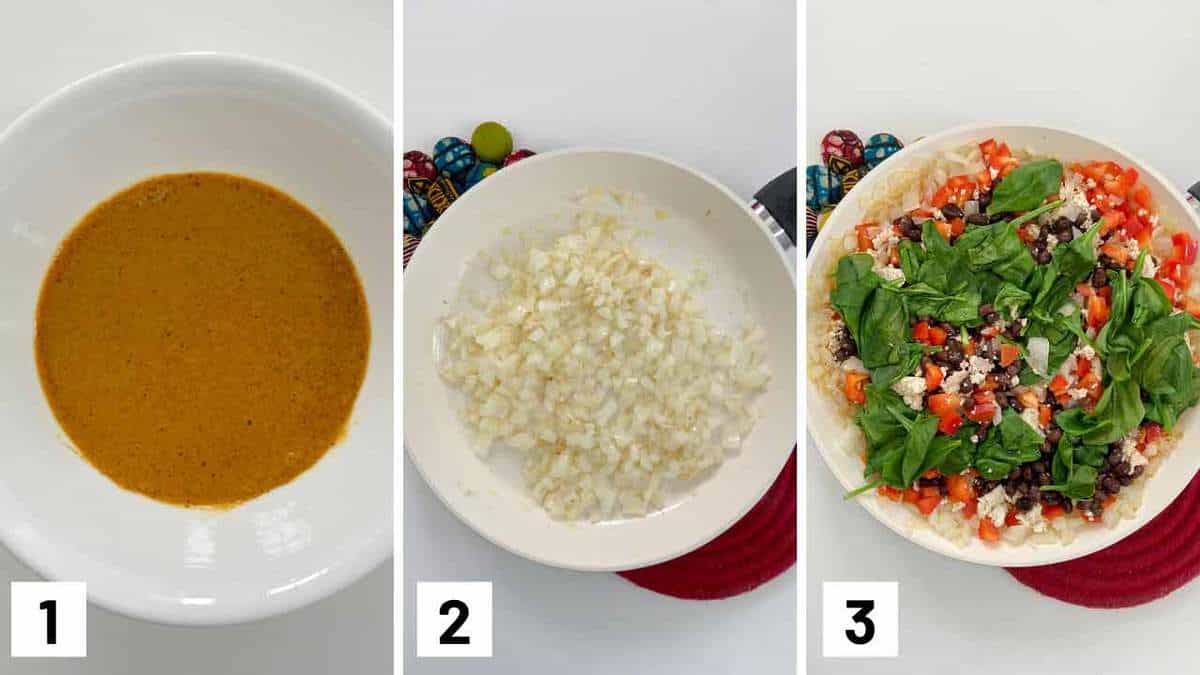
Set of three photos showing mixing of a sauce, sauteing onions, adding in burrito filling.

Step 1: In a small bowl, mix together the turmeric, chili, cumin, nutritional yeast, and soy milk. Set aside.

Step 2: Preheat a large nonstick skillet over medium heat with the olive oil. Add the garlic and onion and saute until softened, about 4 minutes.

Step 3: Crumble the tofu and add that to the pan along with the red pepper, spinach and black beans.

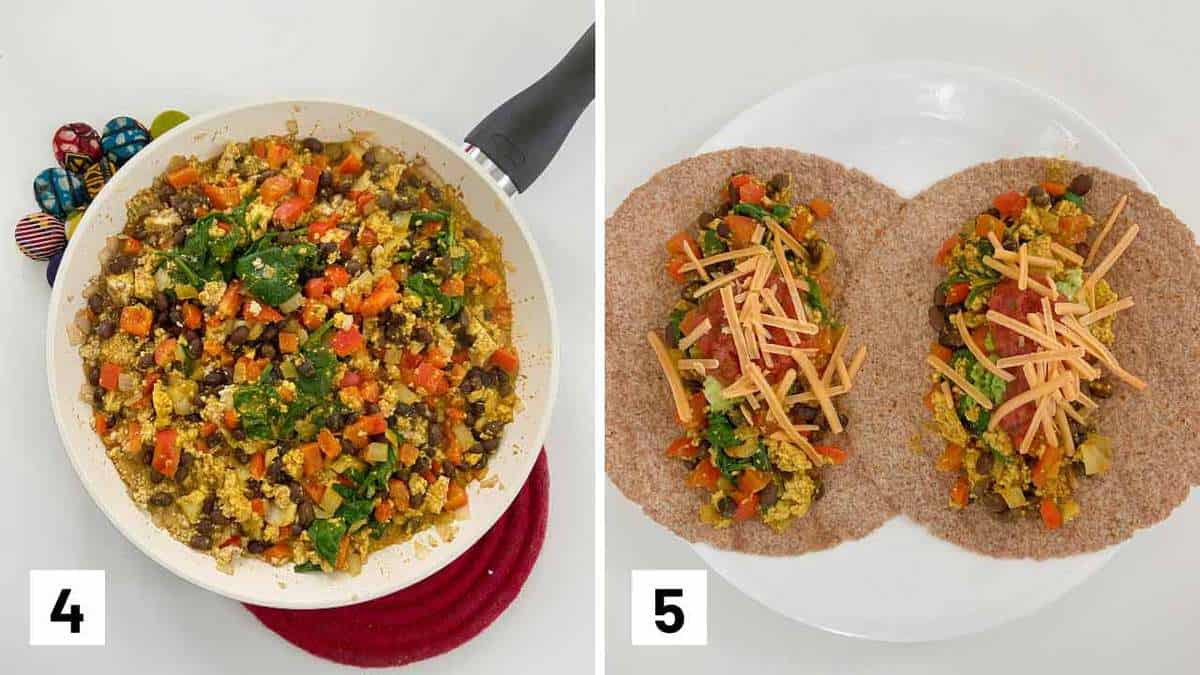
Set of two photos showing turmeric soy milk mixture added to the skillet and then plated on tortillas.

Step 4: Pour in the turmeric soy milk mixture and toss everything in the “sauce”. Cook just until the spinach wilts.

Step 5: Divide between two large flour tortillas and add any desired toppings (salsa, avocado, vegan cheese, cabbage etc.) Roll up into a burrito and enjoy.

Expert Tips

The easiest way to crumble tofu is to simply crumble it up with your hands, a fork, or a potato masher!

Avoid overfilling your burrito as it’ll make it difficult to roll them up.

Make this breakfast burrito spicier by adding a pinch of cayenne powder. You can also serve your burritos with a spicy salsa instead of mild one.

You are welcomed to swap the seasoning and spices to whatever you prefer or have in your pantry.

If you’re having trouble rolling up the burritos, you can warm the tortilla up on a clean skillet so it’s more pliable.

Recipe FAQs

If I’m not vegan, can I substitute or add eggs?

You absolutely can — simply use 1 to 2 eggs per person depending on how hungry you are. With the swap, your breakfast burritos will still be a high protein breakfast.

Can I freeze/make ahead these vegan breakfast burrito?

You can make a big batch of these burritos, roll them up tin foil, and then pop in the freezer. Then when it’s time to eat, unwrap them from the foil and wrap them in a damp paper towel. Microwave on high for 2 minutes and enjoy!

How long will these freezer vegan breakfast burritos last?

You can store this make ahead breakfast in the freezer for 1 month, so go ahead, make a big batch.

What else can I add to this?

You can swap black beans for pinto beans or navy beans. Add some jalapeno to make this spicier, add some roasted potatoes, swap the spinach for a different leafy green, and more! This recipe is very flexible for you to do as you please!

Breakfast burritos on a plate.

More Recipes You Might Like

If you want more easy vegan post-workout breakfast recipes like this vegan breakfast burrito, here are some more to choose from!

  • Gluten Free Vegan No Bake Protein Bars Three Ways
  • Apple Pie Vegan Protein Granola Cups
  • Peanut Butter Chocolate Protein Balls
  • Vegan Sweet Potato Breakfast Bowl
  • High Protein Avocado Toasted with White Beans Roasted Tomatoes
  • Banana Peanut Butter Protein Pudding
  • Peanut Butter and Jelly Chia Pudding

Now tell me, what are some of your favourite post-workout snacks and breakfasts? Leave me a comment below with your go-tos!

vegetarian burritos on a plate.
Print Recipe
5 from 5 votes

Vegan Breakfast Burrito with Tofu Scramble

This vegan breakfast burrito with tofu scramble and black beans is a perfect post-workout snack that is ideal for healthy meal prep.
Prep Time10 minutes mins
Cook Time10 minutes mins
Total Time20 minutes mins
Course: Breakfast, Dinner, Lunch
Cuisine: American, Mexican
Servings: 2 people
Calories: 389kcal
Author: Abbey Sharp

Ingredients

  • 1/2 tsp turmeric
  • 1/2 tsp cumin
  • 1/2 tsp chili powder
  • 1/4 cup nutritional yeast
  • 1/4 cup unsweetened soy milk
  • 2 tsp extra virgin olive oil
  • 1 small onion diced
  • 2 clove garlic minced
  • 8 oz extra firm tofu crumbled
  • 1 red bell pepper diced
  • 2 cups baby spinach
  • 1 cup black beans drained and rinsed
  • Salt and pepper to taste
  • 2 large whole grain flour tortillas
  • Salsa for serving
  • Avocado for serving
  • Vegan cheese if desired

Instructions

  • In a small bowl, mix together the turmeric, chili, cumin, nutritional yeast, and soy milk. Set aside.
  • Preheat a large nonstick skillet over medium heat with the olive oil. Add the garlic and onion and saute until softened, about 4 minutes.
  • Crumble the tofu and add that to the pan along with the red pepper, spinach and black beans.
  • Pour in the turmeric soy milk mixture and toss everything in the “sauce”. Cook just until the spinach wilts.
  • Divide between two large flour tortillas and add any desired toppings (salsa, avocado, vegan cheese, cabbage etc.)
  • Roll up into a burrito and enjoy.

Notes

  • The easiest way to crumble tofu is to simply crumble it up with your hands, a fork, or a potato masher!
  • Avoid overfilling your burrito as it’ll make it difficult to roll them up.
  • Make this vegan breakfast burrito spicier by adding a pinch of cayenne powder. You can also serve your burritos with a spicy salsa instead of mild one.
  • You are welcomed to swap the seasoning and spices to whatever you prefer or have in your pantry.
  • If you’re having trouble rolling up the burritos, you can warm the tortilla up on a clean skillet so it’s more pliable.

Nutrition

Calories: 389kcal | Carbohydrates: 52g | Protein: 24g | Fat: 10g | Saturated Fat: 2g | Sodium: 327mg | Potassium: 1046mg | Fiber: 13g | Sugar: 8g | Vitamin A: 4887IU | Vitamin C: 89mg | Calcium: 176mg | Iron: 6mg
Abbey Sharp

Abbey Sharp is a Registered Dietitian (RD), regulated by the Ontario College of Dietitians. She is a mom, YouTuber, Blogger, award winning cookbook author, media coach specializing in food and nutrition influencers, and a frequent contributor to national publications like Healthline and on national broadcast TV shows.
www.abbeyskitchen.com/about-abbey/

Last Updated January 1, 2023. Published January 1, 2023 By Abbey Sharp 1 Comment

BLW French Toast Sticks Recipe (Vegan)

This French Toast Sticks recipe is so easy to make and are the perfect finger food for baby-led weaning! They’re also vegan and a quick, simple breakfast option.

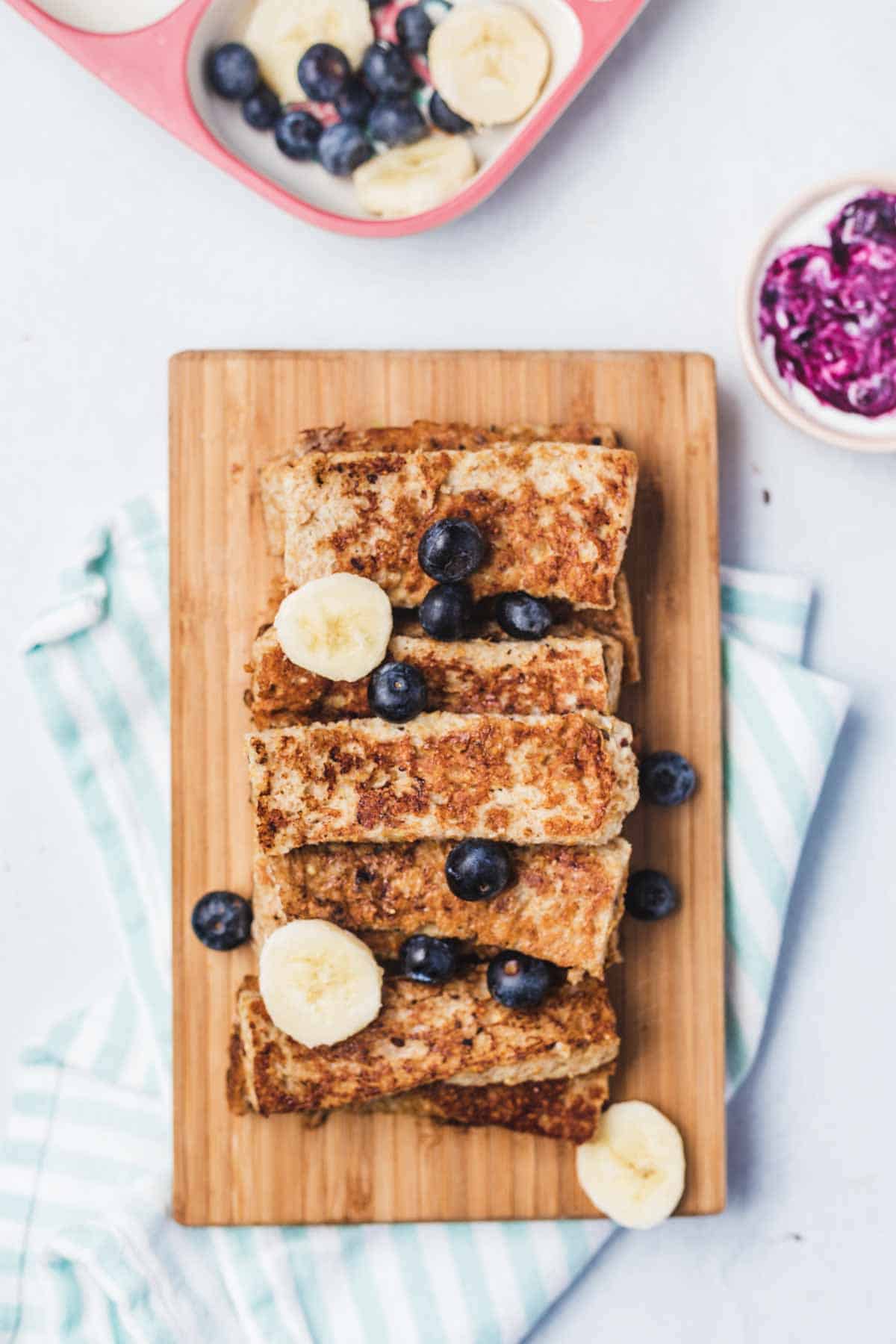
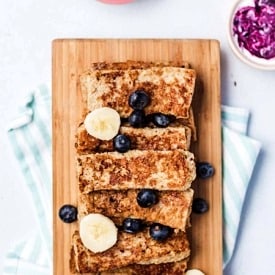
Overhead view of a serving board with a stack of French toast sticks.

Your little one is going to love breakfast time when you whip up this easy French toast sticks recipe! They’re packed with healthy goodness and perfect for their little hands to grab and eat themselves. Even better, it only requires a handful of everyday ingredients so you can make these sticks last-minute without having to run out to the store. I mean, who has time for that?

Table of contents

  • Why This Recipe Works
  • Key Ingredients
  • How to Make This Recipe
  • Expert Tips
  • Recipe FAQs
  • More Recipes You Might Like

Why This Recipe Works

Is quick and easy not enough to convince you to make these French toast sticks? Well, here are some more reasons!

  • They’re egg-free French toast so if your baby has an egg allergy, or if you haven’t introduced eggs yet, this is perfect.
  • Crowdpleaser- the whole family will enjoy them, not just babies!
  • Packed with healthy goodness
  • Made with only 5 ingredients!

Key Ingredients

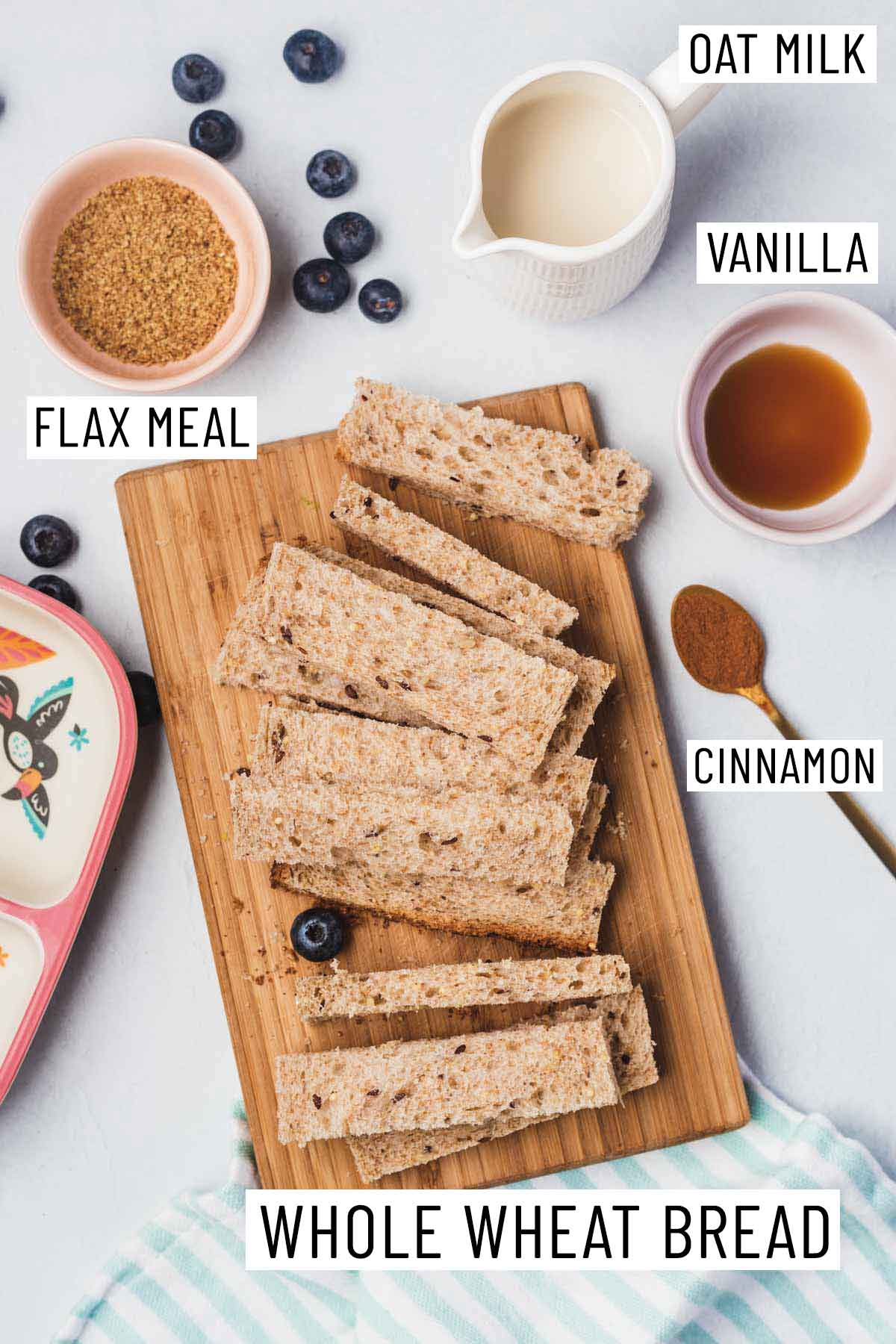
Overhead view of ingredients needed to make French toast sticks recipe.

Whole wheat bread — I went with whole wheat bread for these French toast sticks as it has a higher amount of fibre and protein than regular white bread.

Flax meal — Instead of using egg, we make an egg substitute by using flax meal. It also has a nutty flavour to it, so it compliments the cinnamon!

Vanilla — I always recommend using real vanilla extract instead of artificial vanilla extract. It just tastes so much better.

How to Make This Recipe

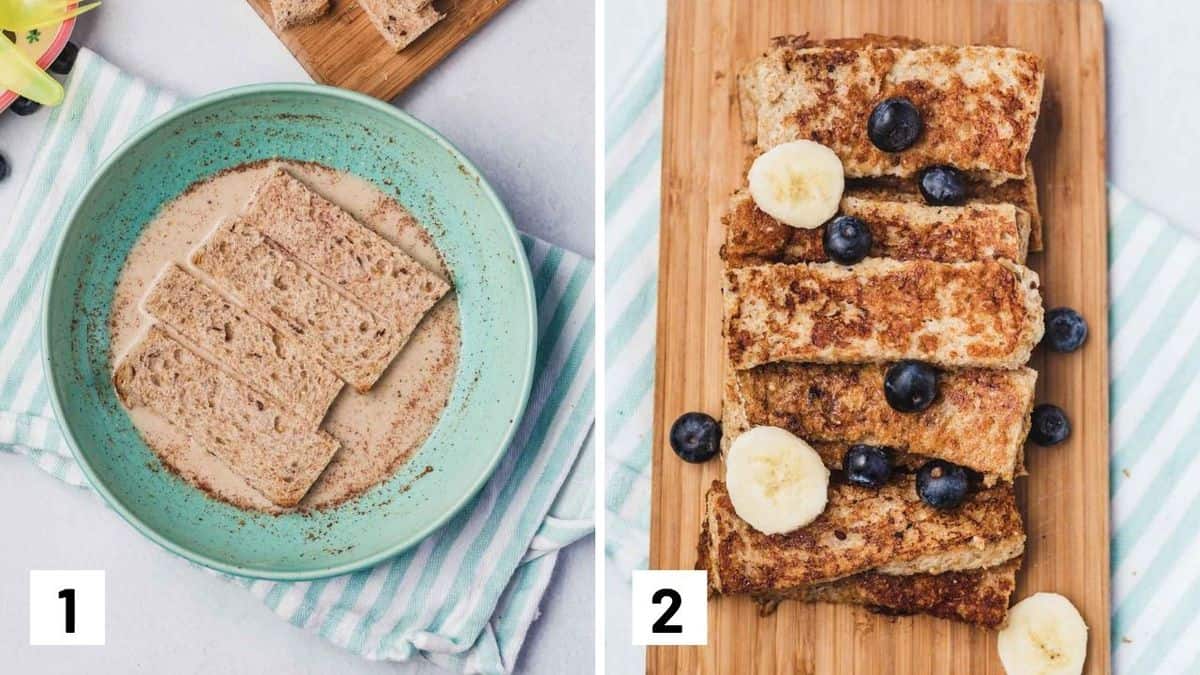
Set of two photos showing bread being soaked and then the finished recipe with fruit on top.

Step 1: In a small bowl mix flax meal, oat milk, vanilla, and cinnamon. Set it aside for 10 to 15 minutes for it to thicken. Then, submerge the bread into the flax egg mixture to coat it evenly on both sides, for approximately 30 seconds.

Step 2: Heat a griddle or large nonstick pan with the oil or butter over medium heat. Add the bread and cook on each side for about 3-4 minutes.

Expert Tips

I use oat milk to make this recipe but you can also use almond milk, cashew milk, or a different nut milk if you do not have to be nut-free.

Avoid soaking the bread in the flax mixture for too long, or the French toast sticks will turn mushy and fall apart.

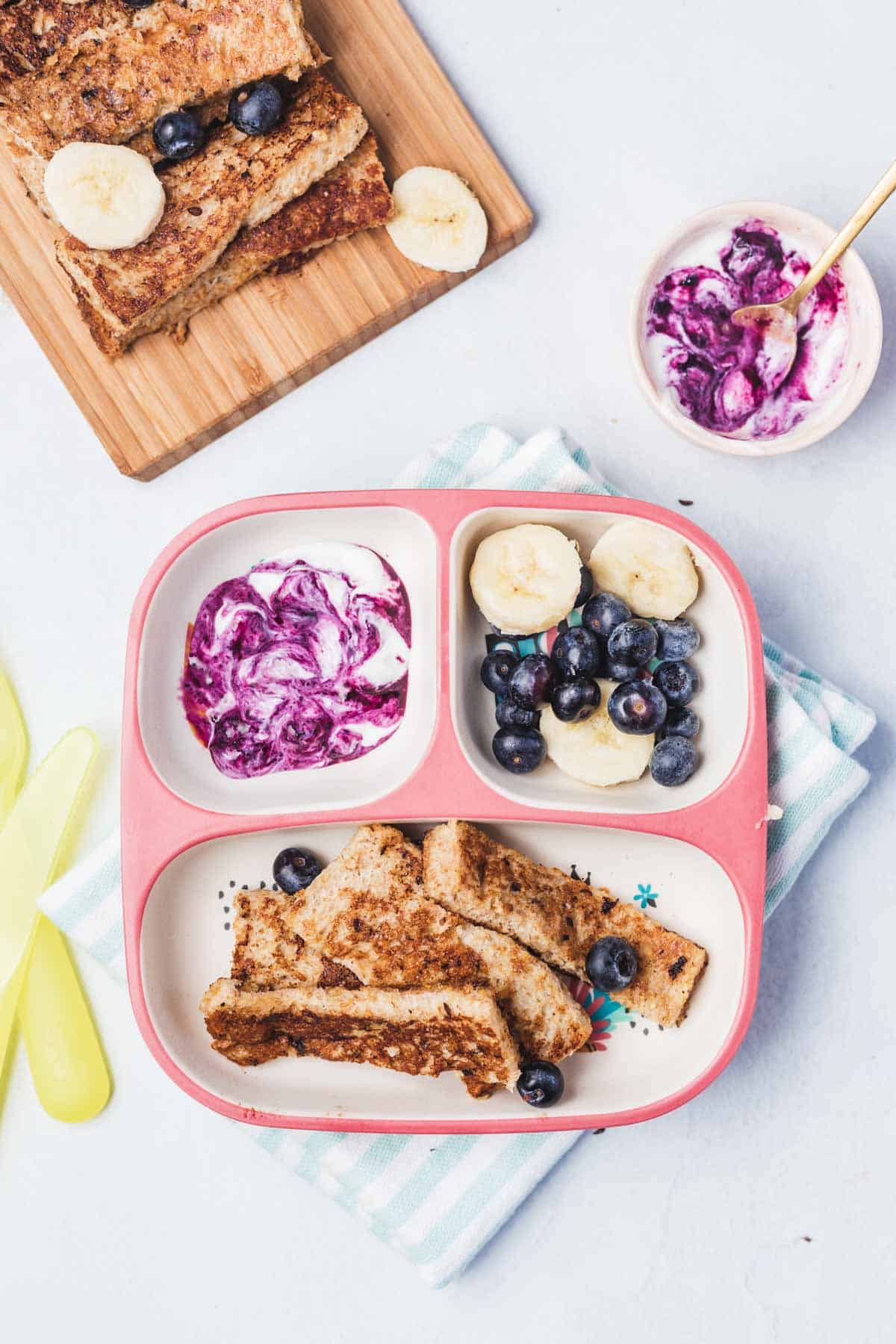
I like serving this with a bit of berry yogurt sauce so my little ones can practice dipping their foods. Cook some berries with a little water and lemon zest until soft and glossy, let it cool, and stir in a couple of tablespoons of yogurt to make a sauce. Be sure to use a non-dairy yogurt if you want to keep this recipe vegan-friendly.

Recipe FAQs

Is French toast safe for babies to eat?

As long as you have introduced each of the ingredients on a regular basis to ensure that your baby is not allergic, French toast is safe to eat. Please consult with your doctor if you have any questions.

How do I prep the bread for babies?

I recommend removing the bread’s crust, as it can be tougher for babies and toddlers to chew. Also, avoid cooking the bread for too long as you don’t want the bread to be too hard.

Can I make this ahead of time?

You most certainly can make this ahead of time. Simply reheat the French toast sticks in the microwave or stovetop until warmed through.

Can I freeze these?

You can freeze these French toast sticks! You can flash freeze them on a lined sheet pan before transferring them to a freezer-safe bag or container so you can pull them out as needed.

A toddler plate with a section with French toast sticks, a section with fruit, and a section with berry yogurt sauce.

More Recipes You Might Like

Want more BLW ideas like this French toast sticks recipe? Try these ones:

  • Lentil Meatloaf Muffins
  • Spinach Chicken Muffins
  • Broccoli and Cheese Egg Muffins
  • Peanut Butter Banana Mini Muffins
  • Sweet Potato Muffins with Apple (High Iron BLW recipe)

Now tell me, what are some of your kiddo’s go-to breakfast recipes? Leave me a comment below!

Overhead view of a serving board with a stack of French toast sticks.
Print Recipe
5 from 5 votes

French Toast Sticks for BLW (Vegan)

These baby led weaning French Toast Sticks are so easy to make and are the perfect finger food! They're also vegan friendly and are a quick and simple breakfast option.
Prep Time15 minutes mins
Cook Time10 minutes mins
Total Time25 minutes mins
Course: Breakfast
Servings: 4 servings
Calories: 104kcal
Author: Abbey Sharp

Ingredients

  • 2 tbsp flax meal
  • 1 cup oat milk or any non dairy milk
  • ½ tsp vanilla extract
  • ¼ tsp ground cinnamon
  • 3-4 slices whole wheat bread cut into long strips

Instructions

  • In a small bowl mix flax meal, oat milk, vanilla and cinnamon. Set it aside for 10 to 15 minutes for it to thicken.
  • Submerge the bread into the flax egg mixture to coat it evenly on both sides.
  • Heat a griddle or large nonstick pan with the oil or butter over medium heat. Add the bread and cook on each side for about 3-4 minutes.

Notes

  • I use oat milk to make this French toast sticks recipe but you can also use almond milk, cashew milk, or different nut milk if you do not have to be nut-free.
  • Avoid soaking the bread in the flax mixture for too long or the French toast sticks will turn mushy and fall apart.
  • I like serving this with a bit of berry yogurt sauce so my little ones can practice dipping their foods. Cook some berries with a little water and lemon zest until soft and glossy, let it cool, and stir in a couple of tablespoons of yogurt to make a sauce. Be sure to use a non-dairy yogurt if you want to keep this recipe vegan-friendly.

Nutrition

Calories: 104kcal | Carbohydrates: 16g | Protein: 4g | Fat: 3g | Saturated Fat: 1g | Polyunsaturated Fat: 1g | Monounsaturated Fat: 1g | Sodium: 113mg | Potassium: 111mg | Fiber: 3g | Sugar: 6g | Vitamin A: 124IU | Vitamin C: 1mg | Calcium: 119mg | Iron: 1mg
Abbey Sharp

Abbey Sharp is a Registered Dietitian (RD), regulated by the Ontario College of Dietitians. She is a mom, YouTuber, Blogger, award winning cookbook author, media coach specializing in food and nutrition influencers, and a frequent contributor to national publications like Healthline and on national broadcast TV shows.
www.abbeyskitchen.com/about-abbey/

Last Updated December 28, 2022. Published December 28, 2022 By Abbey Sharp Leave a Comment

Red wine, Chocolate, and Tea for Heart Health – Myth or Fact?

DISCLAIMER: This post was developed in sponsored partnership with CocoaVia, however, as always, all opinions are genuine.

We discuss the truth about chocolate, red wine, tea and other sources of dietary flavanols, and whether you can truly get enough of them through food alone to improve heart health.

Several wine glasses cheersing.


For the first time in history, census data projects that older adults over the age of 65 will outnumber children under 18 by 2034. So if we are now living longer lives, we will also want to live well, so proactively supporting and protecting our heart is key.

What are Flavanols?

Flavanols are a type of phytonutrient found in a variety of fruits, vegetables, and other plant-based foods- including cocoa, red wine and teas. The last 2 years have been a turning point on flavanol research confirming the benefits of a diet rich in flavanols to improve heart health. One of the primary ways that flavanols improve heart health is by promoting blood vessel function and enhancing blood flow. When consumed, flavanols help increase the production of nitric oxide, which helps to relax and dilate blood vessels. This allows for better oxygen and nutrient delivery throughout the body, and for maintaining healthy blood pressure levels and stronger cardiovascular health.

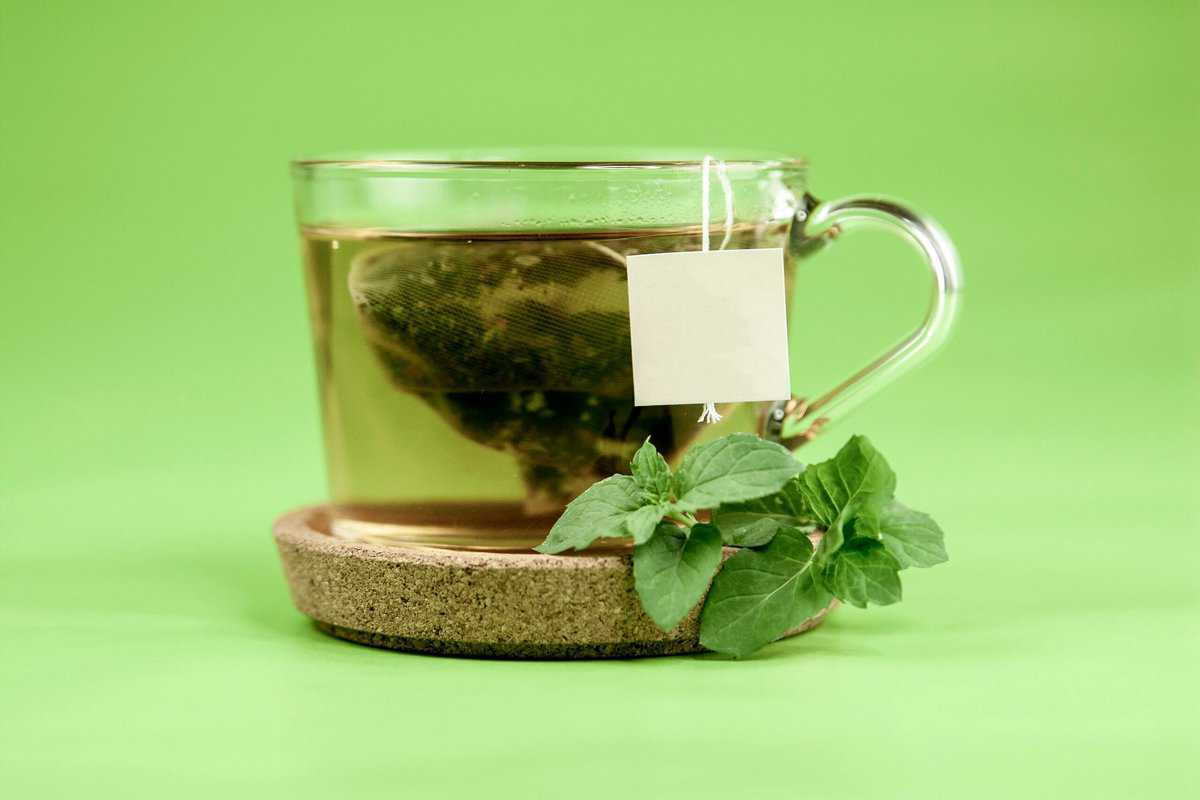
Close up of a clear glass mug with green tea leaves presented as an example for foods that promote heart health.

What are the Best Sources of Flavanols?

Generally, good sources of flavanols are fresh fruits such as apples, berries, and grapes, as well as tea, certain cocoa products, and – even some red wine. Incorporating a variety of these foods into your diet can be a great way to boost your flavanol intake.

How Much Flavanols is Recommended for Heart Health?

As a result of this mounting evidence on the benefits of flavanols for living and aging well, the Academy of Nutrition and Dietetics, the world’s largest organization of nutrition and dietetics practitioners, issued a first of its kind recommendation on flavanols for cardiometabolic health. They officially suggest that adults aim for a minimum of 400-600 mg of flavanols per day. And while cocoa products, berries, apples, tea and yes, even red wine, can all contribute to that tally, it may be difficult to meet your needs
consistently every day through food.

Birds eye view of several dark chocolate squares.


How Can I Easily Meet My Flavanol Needs for Cardiovascular Health?

Because flavanol levels in foods are not labeled and can vary greatly, a daily flavanol supplement, like CocoaVia™, is an easy way to incorporate cocoa flavanols into your diet. CocoaVia™ is backed by 20+ years of research and over 30 human clinical trials, including the landmark COSMOS study. This study followed over 21,000 adults over 5 years and demonstrated the benefits of a daily cocoa flavanol supplement for heart health.

Close up of flavanol supplements for heart health.

CocoaVia™ offers Cardio Health supplements in capsules and chocolate-flavoured powder, with 500 mg of cocoa flavanols per serving and both containing the proprietary Cocoapro™ cocoa extract – the most concentrated and proven flavanol extract on the market today. Both formats have been third party reviewed and verified by ConsumerLab.com to ensure quality, potency and efficacy.

I have been incorporating the Cardio Health powder into my smoothies and overnight oats as a flavourful way to get flavanols in my day. So if you want to learn more about cocoa flavanols for heart health and cognitive health and how CocoaVia™ supplements can help contribute to your daily needs, you can check out the link right here.

More Blog Posts You Might Like

  • Is Tea for Bloating Relief and Weight Loss Healthy or Hype?
  • A Heart Healthy Diet According to a Dietitian
  • Does Saturated Fat Cause Heart Disease?

Abbey Sharp

Abbey Sharp is a Registered Dietitian (RD), regulated by the Ontario College of Dietitians. She is a mom, YouTuber, Blogger, award winning cookbook author, media coach specializing in food and nutrition influencers, and a frequent contributor to national publications like Healthline and on national broadcast TV shows.
www.abbeyskitchen.com/about-abbey/

Last Updated December 30, 2022. Published December 22, 2022 By Abbey Sharp 36 Comments

Minding Your Business | Food Intolerance & Diet Shaming of Others Food Choices

I explain why you should mind your own plate as so many people with specific diets have developed terrible food intolerance of others and diet shaming.

I explain the importance minding your business and keeping your eyes on your own plate, as so many people suffer from diet shaming.

Remember a time when everyone could go out to dinner in peace and not get a lecture from your mother-in-law about the dangers of gluten?

Remember a time when you could walk through the check-out at Whole Foods without getting side eye from the woman behind you for the hot dogs in your haul?

Remember a time when you could post a picture of your bacon and eggs and not get blasted by some troll for eating “chicken periods”?

Remember a time when you could send your kids to school with Dunkaroos without getting a note sent home with them scolding your poor parenting skills?

Yeah, I do too. Since the explosion of digital media, we’ve seen a concurrent explosion of what I like to call diet-ism – or the assignment of morality to a specific way of eating and an intolerance of “different” diets. What happened to simply minding your business?

Over the years, I’ve enduring a HELL of a lot of food intolerance, both personally and professionally. Especially on the anonymous internet. Everyone has their own unique opinion on how to eat and seem to spend way too much time trying to convince others to eat that way too. But if you follow my blog, you know that I don’t condemn any one kind of food. I may deliver facts on the safety and efficacy of certain restrictive diets, but that’s the key- I’m against restriction. I’m not against the butter in the keto diet, or the rice flour in gluten free diets, or the soy in vegan diets. I’m against anything that gets in your way of enjoying food. Unfortunately, for a lot of people, if I’m not 100% aligned with their way of eating, I’m doing something really really wrong. Here are some examples of my food intolerant trolls.

Screenshot image of text referring to food shaming/
Screenshot image of text referring to success of keto diet.
Screenshot image of text referring to food shaming of egg yolks.

Vicious, eh? Obviously humans are way worse on the internet than in person, but I know a lot of people who get shamed about their food choices everywhere they go. So how did we get here? Well, I think it all started with our inherent need to find identity.

How Food Choices Shape Our Identity

Meat in a black skillet with pita bread.

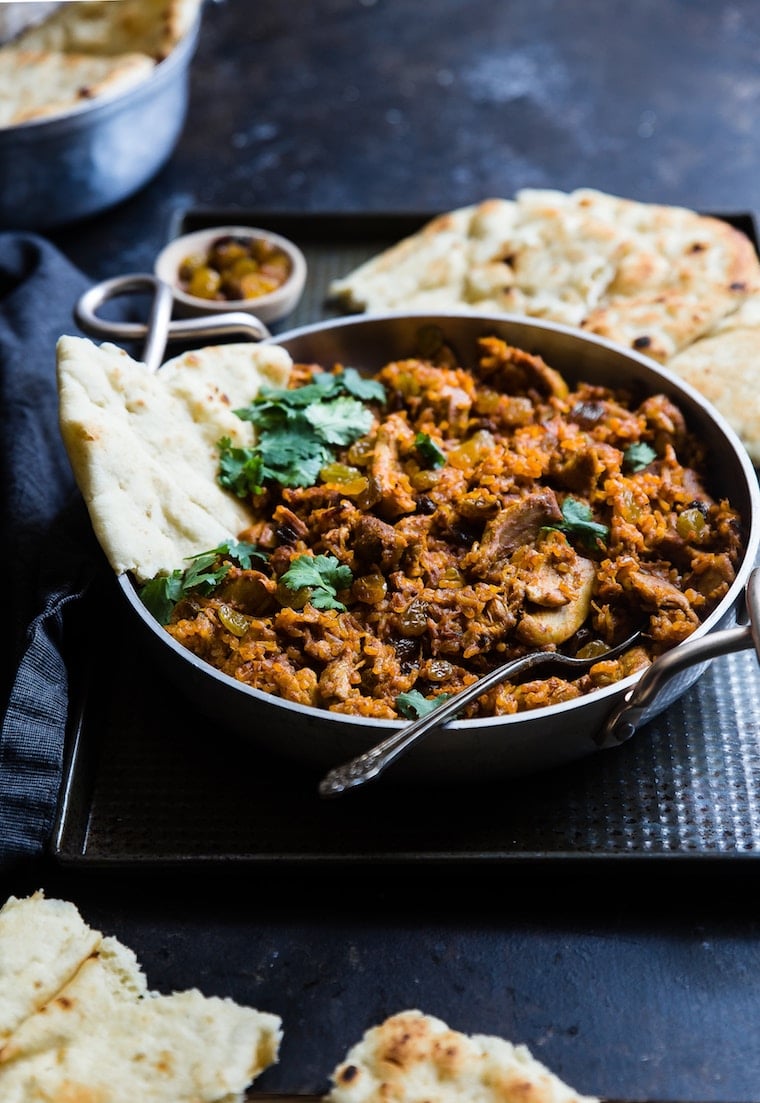
You’ve probably heard the popular phrase, “You are what you eat”, a quote that comes from Brillat-Savarin’s quote, “tell me what you eat and I’ll tell you what you are”. In other words, food is an inherent part of our identity. And that makes sense. A lot of us (especially those of us living in multi-cultural countries like Canada and the United States) hold onto our cultural identity by continuing to cook and eat the traditional foods of our motherland. My Italian friends still make tomato sauce and sugo, my Jewish friends make challah for Shabbat, and my Indian friends make a mean biryani. But cultural or geographical background is just one tiny piece of who we are, and for many, may not be enough when it comes to finding avenues to assert our identity through food.

Just think about how many mindless Facebook quizzes you’ve done that will tell you what kind of a lover you are depending on what your favourite comfort food is. Or if you’re an extrovert or introvert based on how you drink your coffee. Apparently, research legit shows that psychopaths drink theirs black (insert massive *eye roll* here).

Screenshot of internet personality quiz on food.

Since we can’t imagine eating a meal without sharing it first on Instagram, food has become more of a marker of identity than ever before and it’s used to divide us over the tiniest of differences. Let’s do a little history lesson looking at how this happened.

JUDGEMENT OF PEOPLE’S FOOD CHOICES

Let’s bring it back to the grocery store. Have you ever placed your 2L bottle of coke up on the counter and felt the immediate need to tell everyone around you: “It’s not for me, I’m just having a party!” Have you ever looked at someone else’s chip haul and thought: “Wow, where’s the vegetables?” You’re not alone. One study found that the vast majority of people (71%) believe that the contents of shopping carts send out powerful messages about the people pushing them. Apparently, another 11% of single people under the age of 25 said they scan for prospective partners at the grocery store based on what’s in their carts!

Shopping carts outside of a grocery store.

Another interesting study I found surveyed people about their perceptions of the type of people who have different diets. They listed foods in five diets: fast food (pizza, hamburgers, and fired chicken), synthetic food (Carnation Instant Breakfast, Cheez Whiz), health food (yogurt, protein shakes, and wheat germ), vegetarian (bean sprout sandwich, broccoli quiche, avocado, and brown rice), and gourmet food (French roast coffee, caviar, oysters). Apparently, people who ate fast food and synthetic food were classified as religious conservatives who often wore polyester clothing (HA!!). Health food eaters were characterized as antinuclear activists and Democrats. Vegetarians were likely to be perceived as pacifists who drive foreign cars (lol). And finally, gourmet food eaters were seen as individuals who were liberal and sophisticated. And as incredibly judgmental and hilarious as this seems, I kind of understand why we do it. Food has become such a huge part of who we are, so we may want to find someone “like us” based on our eating habits. A vegan may not feel comfortable dating a steak lover, and a hard-core health buff may not want to watch her partner nosh on chips all day.

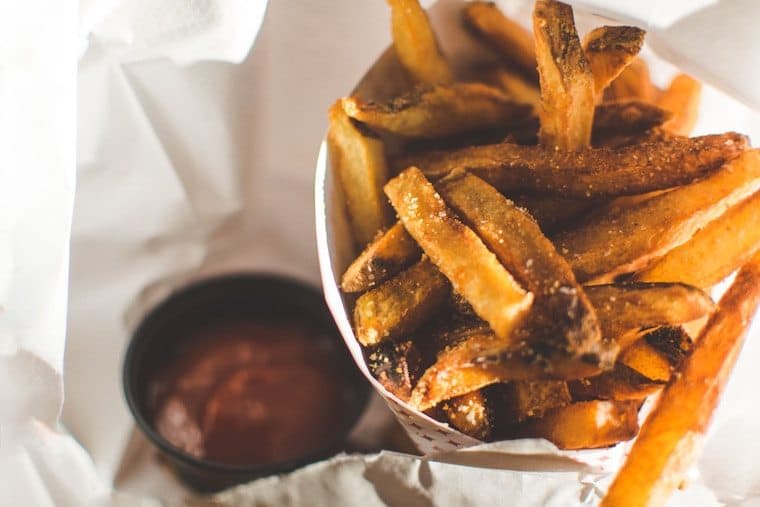
French fries and ketchup.

I would argue, however, that a basket of groceries on a single day cannot tell you anything concrete about a person. Food is nourishment, not a marker of character. It doesn’t tell you if that person is into the outdoors, quick to temper, smart, successful in their job, generous with their time, a good lover and so much more. It actually doesn’t even tell you about their eating behaviours or practices because you never know if they’re cooking for someone else, making a special meal (aka it’s not their usual diet), or just treating themselves that day. But let’s take a look at some other examples.

Gendered Food Choices

Certain foods tend to carry very specific gendered meanings.

Steaks are manly.

Salads are feminine.

Candy is for girls.

Protein shakes are for boys.

What does it say about us if we choose to eat outside our very restrictive gendered box? And how do these rules change depending on who we’re with?

We tend to make choices about what to eat based on the identity we want to portray in front of someone else. Maybe you’re with your boss and want to appear that you’re health-conscious and sophisticated, so you order the niçoise salad instead of the burger. Or maybe you’re on a date who’s a beer and burger kind of guy and want to appear “easy going”, so you order the cheeseburger and stout instead of the grilled fish you actually want. Research suggests that people, especially women, tend to choose certain foods to manage other people’s impressions of them. One study even found that women tend to eat less when they worry their femininity is being threatened. It’s hard minding your business and behaving normally when others are constantly judging you.

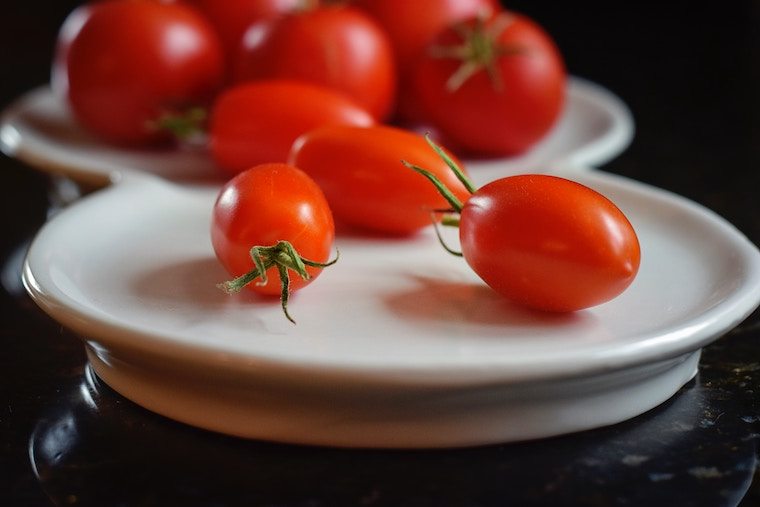
Close up of cherry tomatoes on a plate.

As a woman and a dietitian, I feel myself being judged on my food choices every single day. Women in the 50s definitely were more repressed than we are today, but it doesn’t mean our food choices are any less scrutinized. Where I may argue that women in my mother’s day were expected to “eat like a bird” to maintain their svelte figure, today we have an even more difficult space to occupy. We need to LOOK like we don’t eat much other than celery and iceberg lettuce, all while never acting as the typical “diet Debbie” buzzkill when out with the guys. Think for a second about every cool female protagonist you see in the movies or TV. The guys love her because she’s care free, laid back, and can “eat like a guy” with her burgers and beer, all while maintaining her size 2 frame. Minding your business? Pretty non-existent. It’s a shitty fucking fantasy to try to live up to.

Copy Cat Food Choices

I have always been someone who marches to her own drum, but even I can be swayed by my friends and family’s food choices. I cannot count how many times I’ve been out with girlfriends pining for a steak and a massive baked potato, but when they all decide they’re just having a cocktail and appetizers, I feel inclined to make the same choice. One study found that if people were given information that other people they were dining with were making low calorie or high calorie food choices, it would significantly increase the likelihood that they would make similar choices, as well. In this sense, food unifies us. It creates a cohesive social identity amongst a group that we so desperately want to fit into. So much so that we will forgo our steak for salad. Ugh, that sucks.

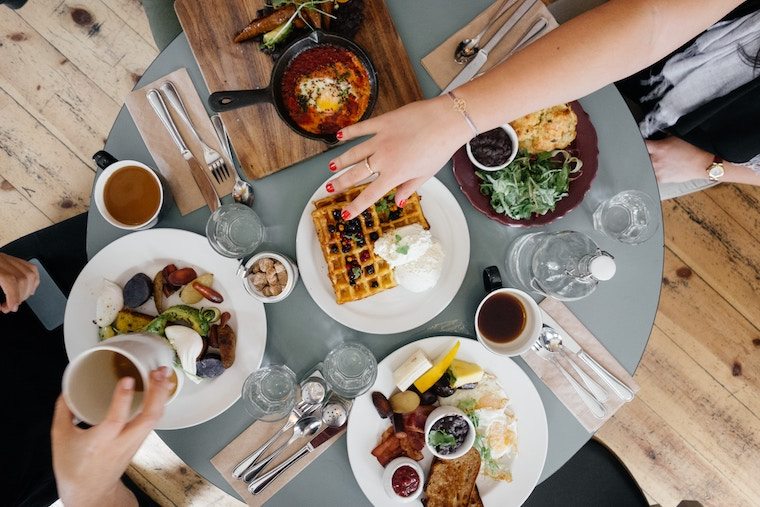
Hand reaching for a waffle from a brunch platter.

So all of that seems pretty innocent and as much as it sucks, somewhat innate. Food shapes our identity, and we want to maintain that identity (even if it’s super annoying for us women). But what happens when we bring morality to the table?

Food Intolerance, Morality and Food Choices

Good vs Bad Foods

I’ve spoken about this ad nauseam in the past, but we need to stop assigning moral weight to specific foods. It’s bad enough that salads are feminine and steaks are for men, but now suddenly you’re a BAD woman if you eat a slice of pizza? Like, fuck. This is exactly the kind of crap that got me, and so many other women suffering from orthorexia and disordered eating patterns.

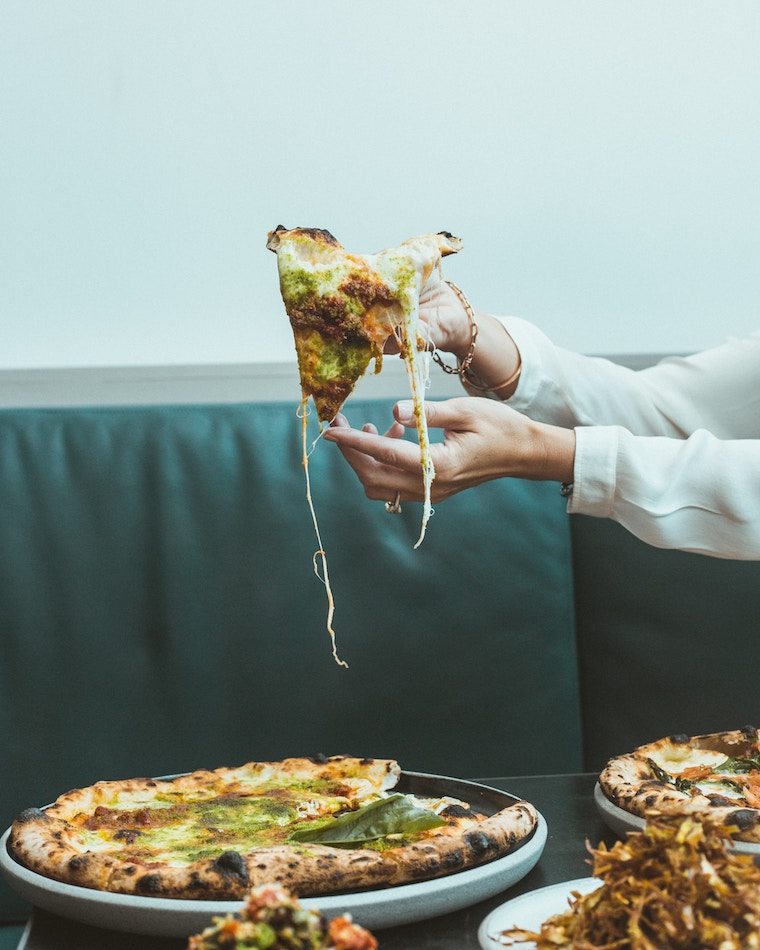
Person taking a cheesy slice of pizza from a pie.

One study asked university students to rate profiles of people based on their diets. The students were shown pictures of sets of two identical looking people, but one was classified as a “good” food eater, and the other a “bad” food eaters. Apparently, the students judged the “good” eaters as more attractive, likeable, quiet, practical, methodical and analytical than those who ate “bad” foods – even though everything else about them was identical!

Depending on whatever food dogma you subscribe to, being bad by eating a certain food could mean eating a chocolate bar because it has sugar in it. Or eating a burger because it’s meat. Or eating a moderate bowl of pasta because of the gluten. Whatever it is, we have assigned the moral weight of “bad” to a hell of a lot of foods, and that label is then transferred onto us. No one wants to feel like a lazy, stupid, fat, sloppy, BAD person, so we avoid any of these “bad” foods like the plague. But I want you all to know that we don’t have to be bad. Killing a dog is bad. Lying to your partner is bad. Stealing your best friend’s boyfriend is fucking bad. Eating a piece of meat isn’t bad and no one should make you feel like it is. Now, let’s move on to altruism.

Altruism and Food Choices

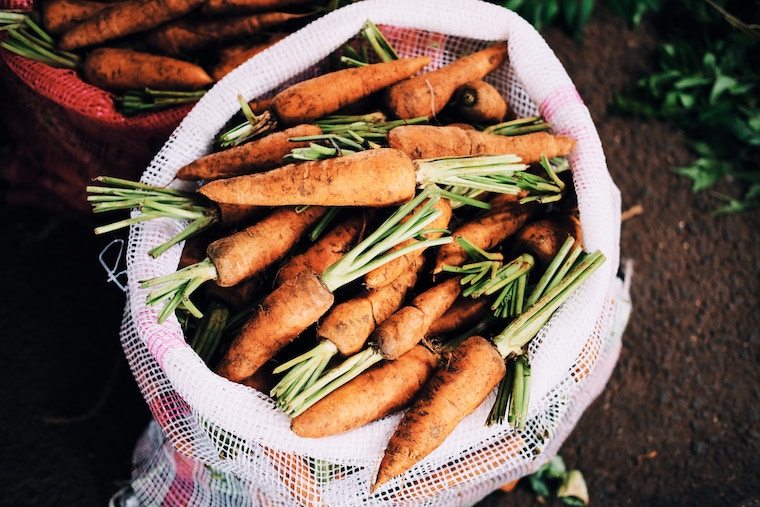
Carrots being harvested in a barrel.

A lot of today’s big food trends are based around the idea that certain ways of eating are better for the planet, animals, and our health (whether or not that’s true is a different blog post all together). One study I found looked specifically at eating organic. They divided participants into three groups- one group was shown pictures of clearly labelled organic food, another of comfort foods, and the third was a control group. After that they were asked to read brief sections describing moral transgressions, and subjects were asked to judge these actions on a scale of one (not so bad) to seven (evil). They were also asked how much of their time they would be willing to volunteer. People who were shown the organic images were found to be more judgmental of the moral transgressions and less willing to volunteer their time. The authors theorized that spending extra money on organics was a way of buying “moral credit”, and that the feeling was that they had done their part, and didn’t need to give back in any other way later in life. Obviously this may not be true for everyone who buys or eats organic (I personally do and I don’t give a shit what others do or eat), but it’s definitely an interesting finding.

Social Status and Food Choices

I think it’s also important to discuss the impact of food choices on perceived social status. Minding your business is hard when we use others’ food choices to rank them socially. It’s a common (unfortunate) stereotype that people who are uneducated, unsophisticated and poor eat fast food, and people who are well read, have money and class eat healthy organic food. The food we choose has become a bit of a status symbol, and some people buy the free range, organic, gluten free bread for the same reason they buy the red Ferrari. It makes us seem wealthy.

The reality is, I know a lot of wealthy people who still eat frozen microwave dinners because that’s just what they like. And even if one does eat McDonalds because they can’t afford the Whole Foods salad bar, it doesn’t make them any better or worse of a person.

Why Do We Diet Shame People’s Food Choices?

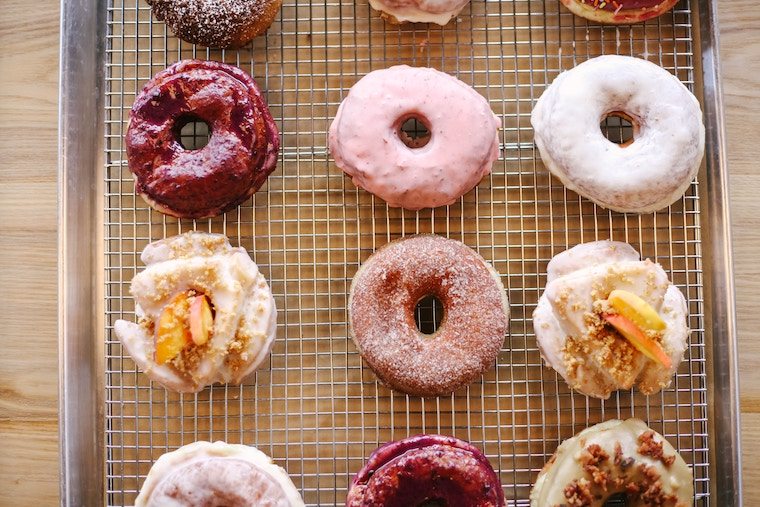
Birds eye view of various assortment of donuts.

Well, as I said before: Food is becoming so heavily bound up in identity and morality that people have become as emotional about it as religion or politics. One theory by Lori Lieberman in her book, Drop the Diet: Guided Recipes for Overcoming Your Food Rules, is that people are more likely to pass judgement on other people’s dietary choices when they’re less comfortable with their own way of eating. I don’t know about you, but I know for a fact that this has been the case for me. I have a family member who will literally push me to have dessert if she’s having dessert so that she feels better about her choice, and other days when she’s on a “diet” and I order ice cream, will look at my disapprovingly and say, “you’re not actually going to eat that, are you?”

Here’s the thing. We all have our own journey to health and wellness. For some that may mean not eating meat. For others that might mean a weekly double scoop of Ben & Jerry’s. But when we find what works for us, and we start to feel good- physically and emotionally- we don’t give a shit what anyone else is doing.

I strongly believe that people food shame and make cruel statements when they are jealous that you have a strong sense of self and relationship with your body and food that they don’t have. Some may be struggling with the restrictive set of rules they’ve given themselves, but are so caught up in the moral and identity they’ve assigned to these rules that they can’t easily let go. Others may just be in denial that the rules don’t even really align with who they are.

Minding Your Business and Moving On

Red light up sign that reads "do what makes you happy".

I don’t care where you’re at. I know, finding your own personal way of eating that makes you truly happy can take time and a lot of experimenting. But my ask is that you do your absolute best to keep your journey to yourself.

If you don’t like what someone else is eating, don’t eat it.

If you don’t like a recipe someone posted on their blog, don’t make it.

If you don’t have something nice to say, just move on. Minding your business is all there is to it. It’s really that simple. If you absolutely feel the need to talk about your diet, do so with those who have similar dietary values and always without judgement. We don’t need any big loud communities of intolerant food enthusiasts gaining hateful steam.

And if you’re the victim of diet shaming, I suggest letting that person know that their shaming words hurts you. If it keeps up, just get out. You don’t need jealous and resentful people in your life shaking up your solid relationship with food. Keep on eating and loving food and say a big #ByeFelicia to the haters.

More Blog Posts You Might Like

  • Intuitive Eating Principles: How to Reject the Diet Mentality
  • Body Shaming and Dinner Table Shaming (Best Tips to Combat)
  • Health at Every Size (HAES) Explained by an Ex-Dieter Dietitian

Now lovelies, tell me, have you been minding your business and keeping your eyes on your plate? What about your friends and family? Leave me a comment below with your thoughts!

Abbey Sharp

Abbey Sharp is a Registered Dietitian (RD), regulated by the Ontario College of Dietitians. She is a mom, YouTuber, Blogger, award winning cookbook author, media coach specializing in food and nutrition influencers, and a frequent contributor to national publications like Healthline and on national broadcast TV shows.
www.abbeyskitchen.com/about-abbey/

Last Updated December 12, 2022. Published December 12, 2022 By Abbey Sharp Leave a Comment

Chocolate Peppermint Cookies (Vegan)

These vegan chocolate peppermint cookies with oatmeal are completely plant-based and baked with chocolatey goodness – perfect for Christmas cookie swaps or holiday parties!

Chocolate peppermint cookies served on a white plate.

One of my favourite holiday traditions is to do a cookie exchange this time of year. I love the idea of getting a nice variety of cookies to share with coworkers, friends and family, especially because I get bored of eating ONE type of cookie from a single batch. This year, my family and I are all putting together a little cookie exchange, and these vegan chocolate peppermint chip cookies with oatmeal are going to be my contribution.

Table of contents

  • Why This Recipe Works
  • Key Ingredients
  • How to Make This Recipe
  • Expert Tips
  • Recipe FAQs
  • More Recipes You May Like

Why This Recipe Works

When I set out to create plant-based holiday cookies, I knew it had to be both festive and delicious.

It’s surprisingly easy to make a classic cookie vegan or dairy-free with just a few simple substitutions. I swapped out regular butter with vegan butter, I used dairy-free dark chocolate and I used a chia egg instead of a regular egg.

After the swaps were done, I added in the classic delicious holiday-themed ingredients: peppermint extract and candy canes, to give these cookies the true Christmas feel. Plus, can you really ever go wrong with peppermint and chocolate?

Key Ingredients

Chia Egg – It’s so simple to make a chia egg at home as a plant based alternative to a real egg (with added omega 3s). I just mix together some ground chia with water and let it sit in the fridge for 20 minutes until gloopy. Then I add the chia egg to my vegan cookie batter recipe with the rest of the wet ingredients. The standard ratio for a chia egg is about 1 part chia to 3 parts water, but if you don’t have chia seeds, you can also use flax or any egg replacer!

Quick Oats – Not only does this ingredient give this this recipe the delicious chew of an oatmeal cookie, they also bump up the fibre and satiety factor of the cookies! Win-win!

Vegan Butter – Every delicious cookie needs butter to make it soft and chewy, and the swapping regular butter for vegan butter ensures that these cookies stay plant-based. Easy peasy.

Chocolate Chips – Is a cookie really a cookie without chocolate chips? Although the cocoa powder in this recipe gives these cookies a chocolate-y flavour, the chocolate chips make sure that you have a little piece of extra chocolate in every bite. Just make sure your chocolate chips contain no milk ingredients if you want to keep these cookies vegan.

Peppermint Extract & Candy Canes – These ingredients work together to give this recipe its delicious holiday feel. The extract flavours the whole recipe with delicious peppermint, and the crushed candy canes are not only super festive, but also a very pretty addition to the top of the cookie.

Hand dipping a chocolate peppermint cookie in a glass of milk.

How to Make This Recipe

Step 1: Preheat oven to 350F and line two baking sheets with a silpat or parchment paper. Mix together the chia and water and place in the fridge for 20 minutes.

Step 2: In a bowl, mix together the oats, flour, baking powder, cocoa, cinnamon and salt. To another bowl, cream together the butter with brown sugar using electric beaters until fluffy. Add in the vanilla and peppermint, along with the chia egg or regular egg. Add the wet to the dry, and fold in the chocolate chips.

Step 3: Roll into one tablespoon balls, flatten slightly on a baking sheet with an inch between them and sprinkle with crushed candy canes.

Step 4: Bake for 12 minutes. Allow to cool before transferring to a cooling rack. Enjoy!

Expert Tips

If you find you take your chia egg out of the fridge and it still seems too runny, no problem! Pop it back in the fridge for another 5-10 minutes so it can harden more. Alternatively, if your chia egg appears too thick, you can also add some more water to thin it out until you have an egg-like consistency.

If you would like to make bigger cookies, you can roll the dough into 1 and a half or 2 tablespoon balls. However, be sure to space these out more on the parchment sheets, as they will expand when baking.

Recipe FAQs

Can these chocolate peppermint cookies be made with a real egg and butter?

If you don’t need these cookies to be plant-based, then you can use a real egg and real butter in the recipe, along with chocolate that contains some dairy.

Are candy canes vegan?

Technically, candy canes should be, as most candy canes are just sugar, peppermint flavouring and food colouring. However, some food dyes have been tested on animals so if you’re truly strict about this, then you’ll want to look for an explicitly labelled vegan candy cane.

Can these chocolate peppermint cookies be made gluten free?

I tried REALLY hard to make these gluten free, but you know what, they just fell apart. Cookies need the gluten to be chewy and delicious, so I think it’s a lot to ask these oatmeal cookies to be both vegan and gluten free. If you want to experiment with a gluten free flour, by all means, you do you. But I don’t expect it will work out so well.

Are these cookies chewy or crispy?

These are definitely a chewy cookie, which is my preference. If you want them to be more crispy, you could flatten them out even more until they’re pretty thin, and bake them a bit longer.

Can these cookies be made ahead and frozen?

You can make these cookies about a week ahead and store in an air tight container. I recommend freezing them on a baking sheet lined with a silpat and then transferring the frozen cookies to a freezer bag.

Chocolate peppermint cookies served on a white plate.

More Recipes You May Like

If you love allergen friendly desserts, like these vegan chocolate peppermint cookies, give these other delicious cookie recipes a try!

  • Gluten Free Almond Cherry Meringue cookies
  • Vegan Salted Chocolate Chip Cookies
  • Vegan Carrot Cake Oatmeal Cookies
  • Vegan Lemon Poppyseed Oatmeal Cookies
  • Vegan Tahini Cookies
  • Vegan & Gluten Free Peanut Butter Cookies

What are some of your favourite nostalgic holiday recipes? Let me know in the comments below!

Chocolate candy cane cookies served on a white plate.
Print Recipe
5 from 4 votes

Chocolate Peppermint Cookies (Vegan)

These vegan chocolate peppermint cookies with oatmeal are completely plant-based and baked with chocolatey goodness – perfect for Christmas cookie swaps or holiday parties!
Prep Time1 hour hr
Cook Time12 minutes mins
Total Time1 hour hr 12 minutes mins
Course: Dessert
Cuisine: American
Servings: 24 cookies
Calories: 126kcal
Author: Abbey Sharp

Ingredients

  • 2 tbsp ground chia seeds + 6 tbsp water or one regular egg
  • 1 1/2 cups quick oats
  • 3/4 cups plus 2 tbsp whole wheat flour
  • 1/2 tsp baking powder
  • 2 tbsp unsweetened cocoa powder
  • 1 tsp cinnamon
  • 1/4 tsp salt
  • 1/2 cup vegan or regular butter softened
  • 1 cup brown sugar
  • 1 tsp Vanilla extract
  • 1/2 tsp peppermint extract
  • 1/2 cup mini chocolate chips dairy free, if desired
  • 3 tbsp crushed chopped candy canes

Instructions

  • Preheat oven to 350F and line two baking sheets with a silpat or parchment paper.
  • Mix together the chia and water and place in the fridge for 20 minutes. Omit if you do not want to make this vegan and simply use a regular egg.
  • In a bowl, mix together the oats, flour, baking powder, cocoa, cinnamon and salt.
  • To another bowl, cream together the butter with brown sugar using electric beaters until fluffy. Add in the vanilla and peppermint, along with the chia egg or regular egg.
  • Add the wet to the dry, and fold in the chocolate chips.
  • Roll into one tablespoon balls, flatten slightly on a baking sheet with an inch between them and sprinkle with crushed candy canes.
  • Bake for 12 minutes. Allow to cool before transferring to a cooling rack. Enjoy!

Notes

If you find you take your chia egg out of the fridge and it still seems too runny, no problem! Pop it back in the fridge for another 5-10 minutes so it can harden more. Alternatively, if your chia egg appears too thick, you can also add some more water to thin it out until you have an egg-like consistency.
If you would like to make bigger cookies, you can roll the dough into 1 and a half or 2 tablespoon balls. However, be sure to space these out more on the parchment sheets, as they will expand when baking.

Nutrition

Serving: 1cookie | Calories: 126kcal | Carbohydrates: 20g | Protein: 2g | Fat: 5g | Saturated Fat: 1g | Cholesterol: 1mg | Sodium: 60mg | Potassium: 63mg | Fiber: 1g | Sugar: 13g | Vitamin A: 188IU | Calcium: 27mg | Iron: 1mg
Abbey Sharp

Abbey Sharp is a Registered Dietitian (RD), regulated by the Ontario College of Dietitians. She is a mom, YouTuber, Blogger, award winning cookbook author, media coach specializing in food and nutrition influencers, and a frequent contributor to national publications like Healthline and on national broadcast TV shows.
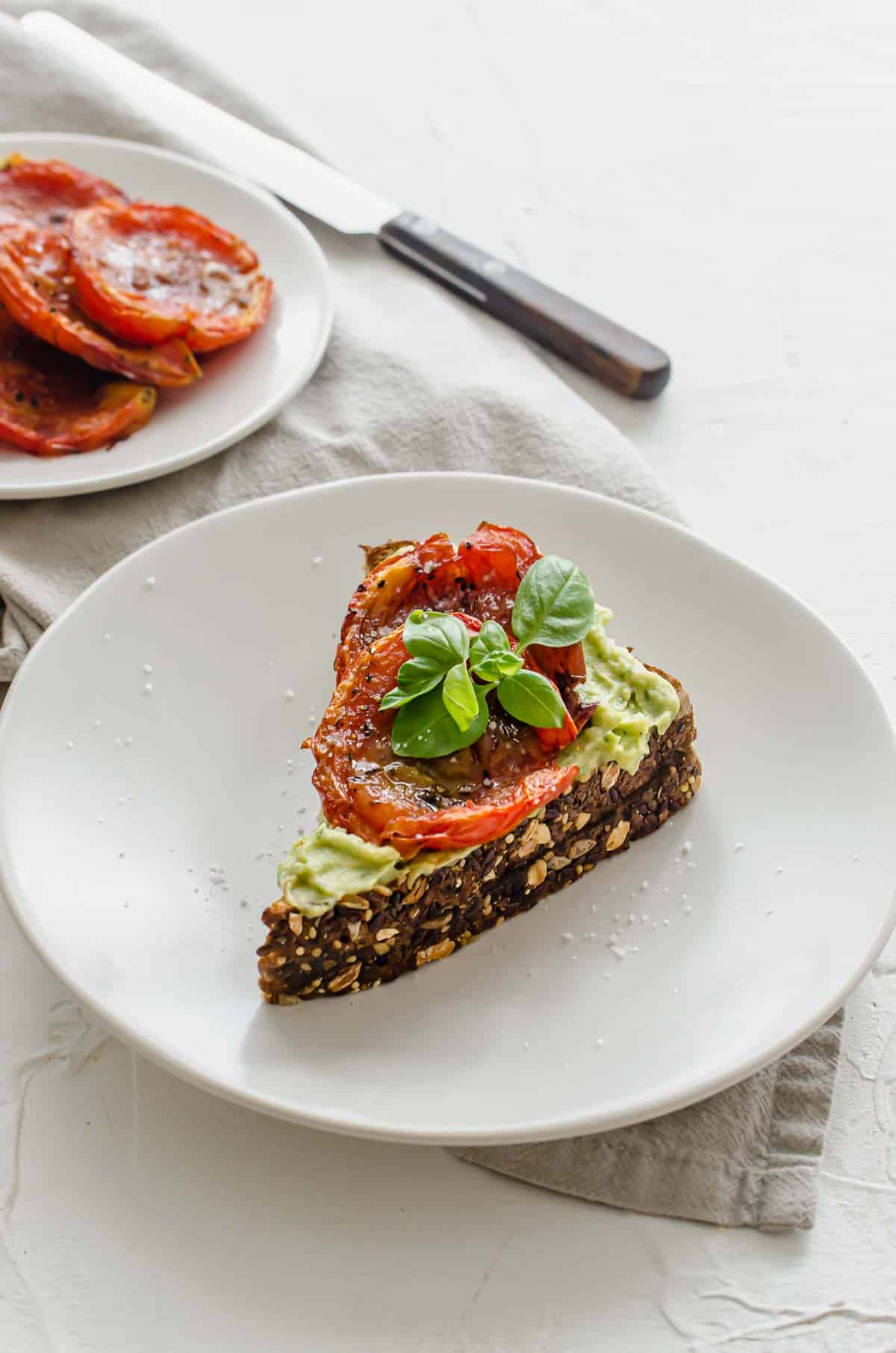
www.abbeyskitchen.com/about-abbey/

Last Updated December 30, 2022. Published December 7, 2022 By Abbey Sharp 25 Comments

Quick Heartburn Relief | Tips on How to Avoid the Holiday Heartburn & Indigestion

These Vegan Gluten Free Gingerbread Men Pancakes make the perfect Holiday breakfast recipe for decorating and enjoying with the kids.

For anyone struggling with indigestion, I’m sharing my best tips to help you achieve quick heartburn relief after a big holiday meal.

It felt like it creeped up on us, but we’ve officially made it to the holidays. Tis the season for awkward family reunions, a ton of food and inevitably the infamous Holiday Heartburn. Not so fun fact: 5 million Canadians experience heartburn at least once a week. I wonder how often they get it during the holidays.

What is Heartburn?

Heartburn is defined by a painful burning feeling in your chest or throat. Definitely not pleasant. This happens when acidic contents from your stomach actually back up into your throat. Your stomach’s basically saying to your esophagus: I don’t want this food, here you take it. It’s not life threatening, but it definitely puts a damper on your life. Also, if you begin to experience heartburn more than twice a week, you may have a condition known as gastroesophageal reflux disease (aka GERD). Typically, when you have this disease, there are certain foods that can trigger heartburn, however this varies person to person.

Some of the common food offenders include:

  • high fat/fried foods
  • acidic foods
  • spicy foods
  • peppermint, chocolate, garlic and onions
  • caffeinated beverages
  • alcohol
  • smoking

You’ve probably already guessed why they’ve coined the term: Holiday Heartburn. The holidays are a time when we make a few changes to our general diets when it comes to food. We have that little voice in our head that tells us: “Hey, it’s okay, it’s the holidays!” or “We’re celebrating, have another glass!” Sound familiar?

Box of chocolate and chocolates scattered.

Here are a few more reasons why heartburn typically makes an appearance at the holiday meal.

  • You’re eating rich foods you don’t normally eat on a regular basis (unless you eat turkey, gravy and stuffing on the daily)
  • You’re most likely drinking more than you normally do (you know, maybe as a way to cope with family)
  • You most likely eat more than you normally do (people tend to eat more when they’re around lots of people)
Plates of various holiday cookies.

Heartburn is no fun, and is definitely the last thing you want to worry about this holiday, so I’ve got some great tips to help you achieve quick heartburn relief as you navigate your holiday gatherings.

Tips for Quick Heartburn Relief

Have a Snack Before

A major cause of heartburn is eating a lot at once. Spread out your intake, but have your regular meals before the feast. Have a snack before to curb your appetite so you don’t go ham at the meal.

Bowls of yogurt, granola and peaches for quick heartburn relief after a holiday meal.

Wear Comfortable Clothing

Avoid skin tight clothing around the midsection, because this may push against your stomach and force acid into your esophagus. Avoid wearing tight belts and waistbands. Yes, you may have to sacrifice style, but your body will thank you later.

Use a Small Plate

This is a great trick to prevent overeating. When we are around lots of people, we tend to be distracted and eat more than we normally do. One tip is to use appetizer plates as your main meal plate. Instead of trying to pile your plate high with all of the food, pick just a few of your favourites for the first go. If you’re still hunger after you’ve finished your first plate, then by all means, return, but make sure you just ask yourself first if its hunger or boredom.

Cookies on a white plate.

Eat Slowly

Give your body time to digest your food. Eating too quickly can be a shock for your body, which may cause heartburn. Chew your food slowly, so you can enjoy it as well.

Choose Lean Cuts of Meat

People that experience regular heartburn will say that high fat foods may be a major trigger because they take more time for your body to digest. Limit fatty cuts of meat and remove the skin from the chicken or turkey for quick heartburn relief.

Drink in Moderation

Alcohol relaxes our lower esophageal sphincter, making it easier for stomach acid to creep into the esophagus. If you are prone to heartburn, you may want to cut back on your intake. Caffeine has been known to do the same, so stick to a small cup of coffee at the holiday meal.

People holding glasses of alcohol.

Gravy and Sauces on the Side

Like I mentioned earlier. high fat/fried foods may trigger heartburn, so have your sauces on the side as much as possible, instead of smothering your plate with gravy. That way, you can still enjoy the food in moderation.

Watch the Stress

Stress has been known to boost stomach acid levels which can lead to heartburn. Yes, the holidays can be a stressful time, that is inevitable, but there are always strategies to cope with it. If you’re cooking the feast, try to do as much as the cooking before, and find times in the day to step away from the cooking to take a break. If you’re dealing with annoying guests and their body shaming ways, check out my top tips for dealing with that here. For quick heartburn relief, you must first relieve your stress.

Take a Walk After

You may be tempted to lie down after a big meal, but instead, gather some friends and take a nice gentle walk. A simple walk can help to stimulate peristalsis and promote digestion. It’s also a good chance to have good conversation in a quieter environment.

People walking outside in the winter for quick heartburn relief.

Save for Leftovers

Don’t feel the pressure to eat everything on your plate. Just remember how good a leftover turkey sandwich feels, and whatever you feel you can’t eat, save it for leftovers to prevent the future discomfort. You will thank yourself later when you’re enjoying a turkey sammy or my leftover-turkey pot pie, heartburn-free.

Avoid Lying Down Right Away

Don’t lie down! Wait at least three hours after eating to lie down. Standing up helps to promote digestion. If you are going to lie down, researchers have found that lying on your right side makes heartburn worse, while lying on your left side tends to calm it. It’s unclear why this is the case but unless you have to crash, stand up as long as you can.

Go Easy on the Dessert

Obviously, I am all for treating yourself during the holidays, so of course say yes to dessert, but try not to overdo it just because “it’s the holidays”. Choose one of your fave desserts and enjoy it in moderation. Yes, you can have your cake and eat it too!

Blue frosted cupcakes lined up.

Ask your Doctor

Finally, there are over the counter meds that may provide quick heartburn relief, but you should be having this conversation with your doctor or pharmacist. If you’re still feeling these symptoms for two weeks, consider making an appointment with a gastroenterologist.

Bottom line on Holiday Heartburn and Indigestion

The holidays are a time to be with family and loved ones and most importantly indulge without the guilt. Making a few changes at the dinner table will save you a ton of discomfort later on so you can party the night away. I hope your holidays are spent heartburn free- here at Abbey’s Kitchen, we wish you a safe and tasty holiday!

Become an Abbey’s Kitchen Subscriber

More Blog Posts You Might Like

  • Hangover Food Cure: Does a Greasy Meal Cure a Hangover?
  • Skip the Post Holiday Detox Cleanse for Weight Loss with These Top 10 Tips
  • Natural Remedies for Bloating (Evidence Based Diet and Supplement Tips)
  • No More Bloating (The Real Reason You’re Bloated)

Have you struggled with holiday heartburn? What is the best way you cope with it? Leave me a comment below!

Contribution By:

Sofia Tsalamlal, RD, MHSc

Abbey Sharp

Abbey Sharp is a Registered Dietitian (RD), regulated by the Ontario College of Dietitians. She is a mom, YouTuber, Blogger, award winning cookbook author, media coach specializing in food and nutrition influencers, and a frequent contributor to national publications like Healthline and on national broadcast TV shows.
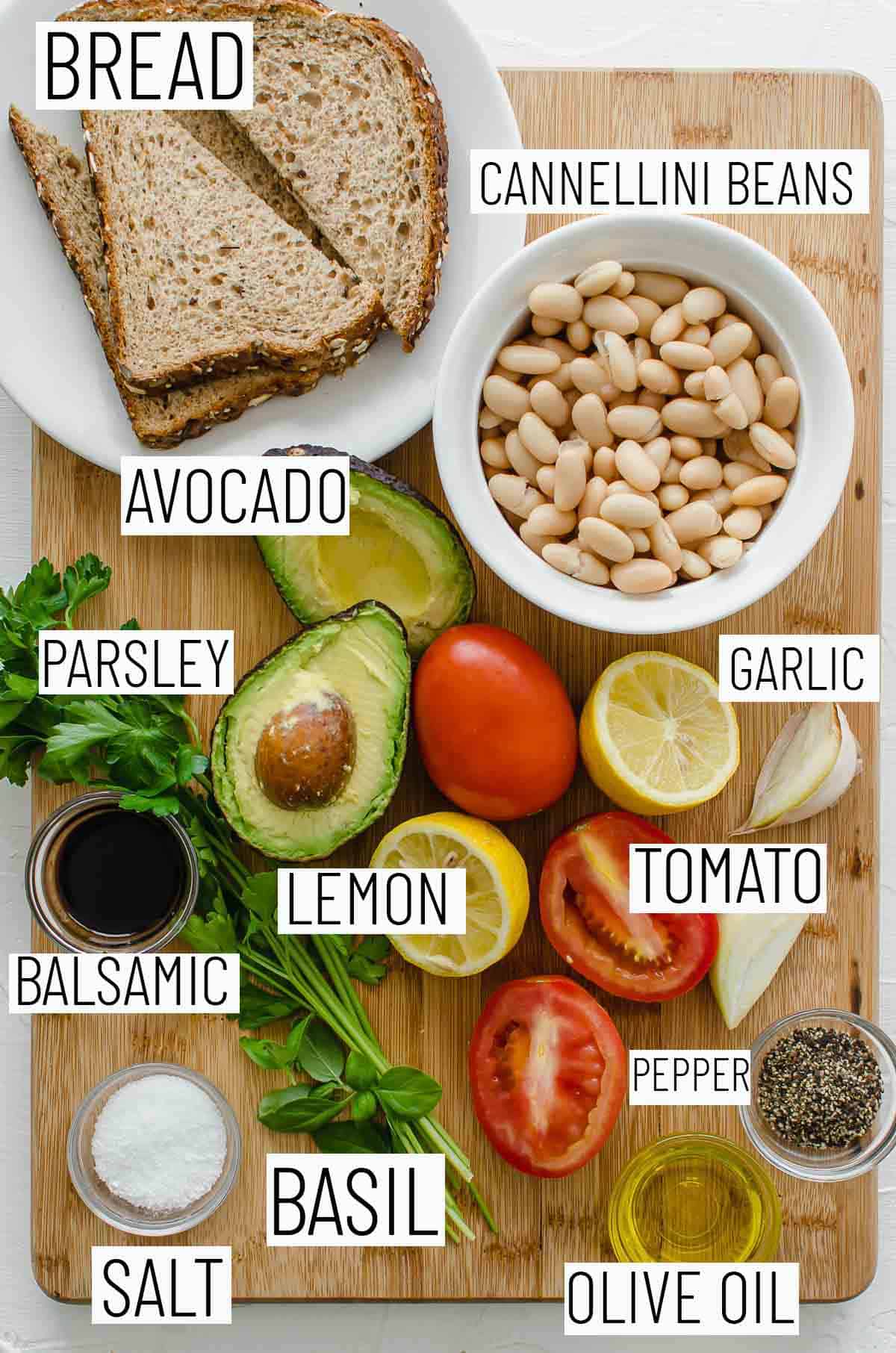
www.abbeyskitchen.com/about-abbey/
  • Previous Page
  • Go to page 1
  • Interim pages omitted …
  • Go to page 22
  • Go to page 23
  • Go to page 24
  • Go to page 25
  • Go to page 26
  • Interim pages omitted …
  • Go to page 89
  • Next Page

Get started with

Eight Free Recipe Books

From the co-founder of Neue Theory and creator of the Hunger Crushing Combo

Sign me up!
Abbey smiling at table
Abbey Sharp

“Foods may never be nutritionally equal. But we can make them morally equal by recognizing that our worth is never determined by what's on our plate.”

— Abbey Sharp, RD About Abbey ◥

Books

  • HCC™
  • Mindful Glow
  • Free E-Books

Blog

  • Nutrition
  • Recipes
  • Motherhood
  • Life

Explore

  • Neue Theory™
  • Bite Back
  • YouTube

Abbey

  • About
  • Coaching
YouTube TikTok Instagram Facebook X Pinterest
Abbey Sharp - The No BS Dietitian From Abbeys Kitchen

© Abbey's Kitchen 2026  All Rights Reserved •  ACCESSIBILITY STATEMENT •  Privacy Policy

This site uses cookies. By continuing to browse the site, you are agreeing to the use of cookies Accept Privacy Policy
Privacy & Cookies Policy

Privacy Overview

This website uses cookies to improve your experience while you navigate through the website. Out of these, the cookies that are categorized as necessary are stored on your browser as they are essential for the working of basic functionalities of the website. We also use third-party cookies that help us analyze and understand how you use this website. These cookies will be stored in your browser only with your consent. You also have the option to opt-out of these cookies. But opting out of some of these cookies may affect your browsing experience.
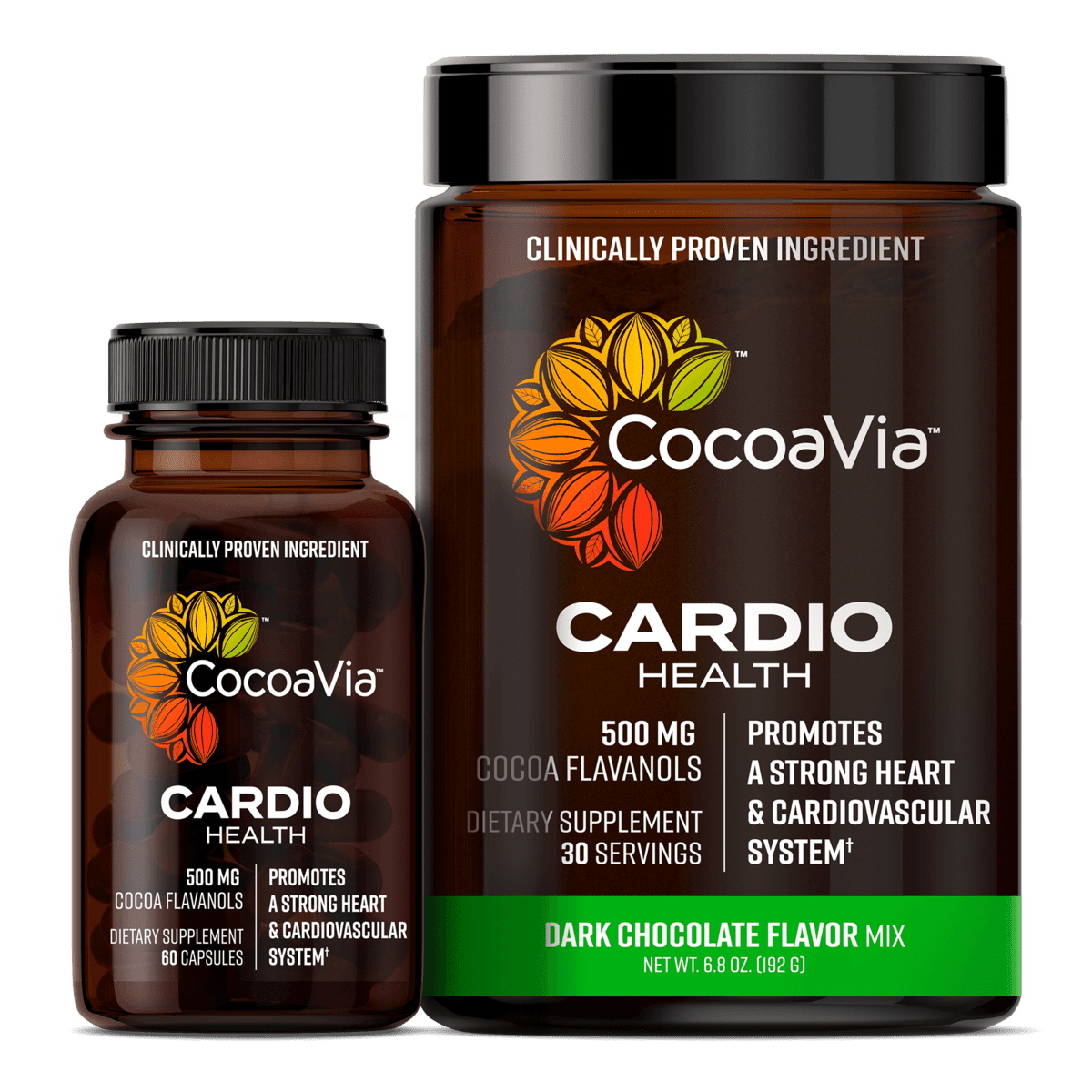
Necessary
Always Enabled
Necessary cookies are absolutely essential for the website to function properly. This category only includes cookies that ensures basic functionalities and security features of the website. These cookies do not store any personal information.
Non-necessary
Any cookies that may not be particularly necessary for the website to function and is used specifically to collect user personal data via analytics, ads, other embedded contents are termed as non-necessary cookies. It is mandatory to procure user consent prior to running these cookies on your website.
SAVE & ACCEPT

Rate This Recipe

Your vote:


A rating is required
A name is required
An email is required