• Skip to main content

Abbey's Kitchen

Healthy Recipes, Nutrition Myth Busting, Healthy Eating Tips

  • Books
    • HCC™
    • The Mindful Glow Cookbook
    • Recipe eBooks
      • Family
      • Hypothyroidism
      • BLW
      • Vegan Week 1
      • Vegan Week 2
      • Vegan Week 3
      • Keto
      • Gluten Free Week 1
      • Gluten Free Week 2
      • Fitness
      • Paleo
  • Blog
    • Nutrition
    • Recipes
    • Motherhood
    • Life
  • Explore
    • Neue Theory™
    • Bite Back With Abbey Sharp
      • Apple Music
      • Spotify
      • Amazon Music
    • YouTube
  • Abbey
    • About
    • Coaching
    • Contact

Abbey Sharp

Last Updated November 23, 2020. Published September 18, 2023 By Abbey Sharp 25 Comments

French Onion Chicken Recipe (Healthy One Pan Meal)

These French Onion Chicken Breasts are the perfect simple on pot dinner that is also Keto friendly, Gluten Free and packed with protein.

This French onion chicken recipe is a simple one pot dinner that puts a fun twist on the classic soup! It is also a great recipe for those who are keto or gluten free.
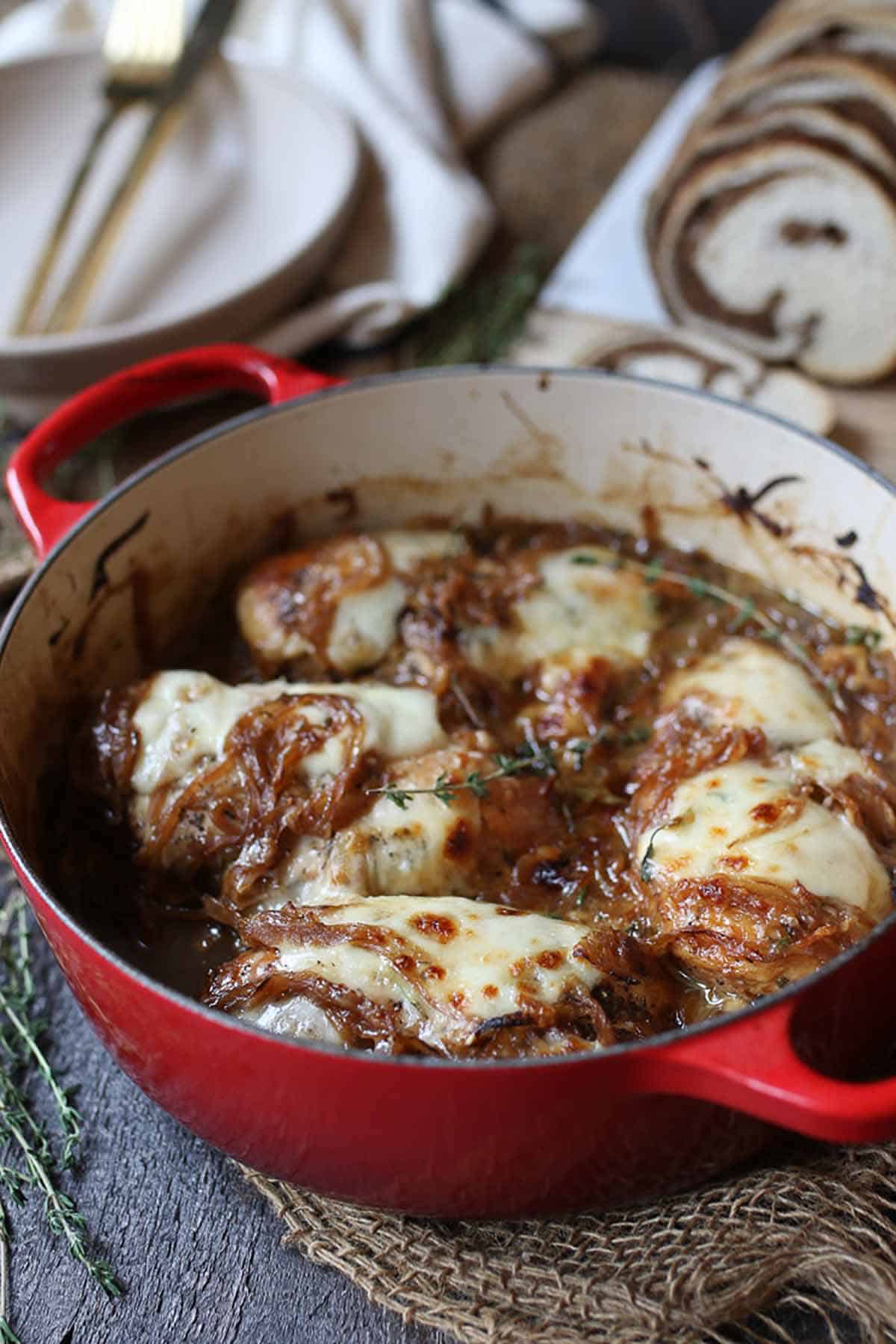
French onion chicken breast in a red pot garnished with a thyme sprig.

I LOVE a good chicken recipe any day of the week. They’re super versatile, relatively affordable and family-friendly. But after a while, I can get pretty bored with my standard go-to marinades and need to switch things up. So if you’re like me, you’re probably always on the hunt for something new to do with chicken that doesn’t feel boring and bland.

Lucky for us, this French onion chicken recipe dinner exists! Not only does it put a tasty spin on the rich, cheesy, and caramelized flavours of the classic soup, but it can be made in one pot. So get ready because your chicken recipe repertoire is about to get a serious glow up!

Table of contents

  • Key Ingredients
  • How to Make This Recipe
  • Expert Tips
  • Recipe FAQs
  • More Recipes

Key Ingredients

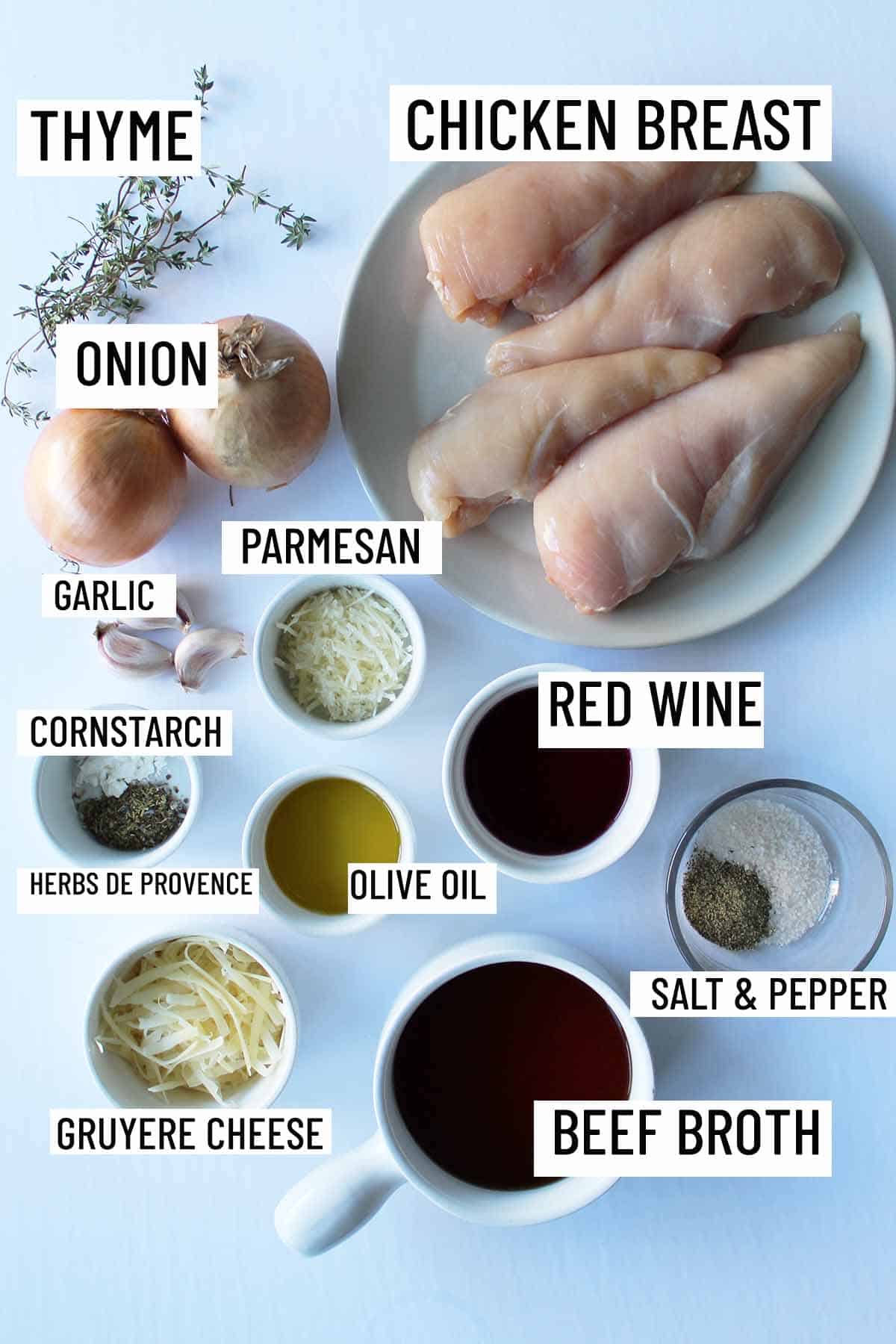
Birds eye view of portioned ingredients including chicken breasts, onions, thyme, cheese, red wine, beef broth, olive oil, salt and pepper, corn starch, and herbs de provence.

Red wine – This will add some delicious depth and flavour to the french onion chicken and, just like the soup, is definitely necessary. I would recommend a dry full-bodied red wine like a merlot or pinot noir. If you only have dry white wine on hand, no worries, you can totally use that instead!

Onion – I mean, it goes without saying that this ingredient is pretty essential to the whole french onion chicken recipe. I like to use yellow onion as it adds lots of bright flavour and sweetness. You can also use red onion for a deeper flavour with less sweetness.

Cheese – Also very important. For this recipe I use a good quality parmesan and gruyere cheese. If you don’t have gruyere cheese available, you can also use Emmental or Jarlsberg. Point is – we want a really flavourful cheese here so not just any cheese will do.

Chicken Breast – I prefer to use chicken breast here, but you can absolutely use chicken thighs as well. I’ll be honest, I have never experimented with any other protein besides chicken for this recipe, but I am sure you can get experimental as eff with this and it will still taste amazing.

How to Make This Recipe
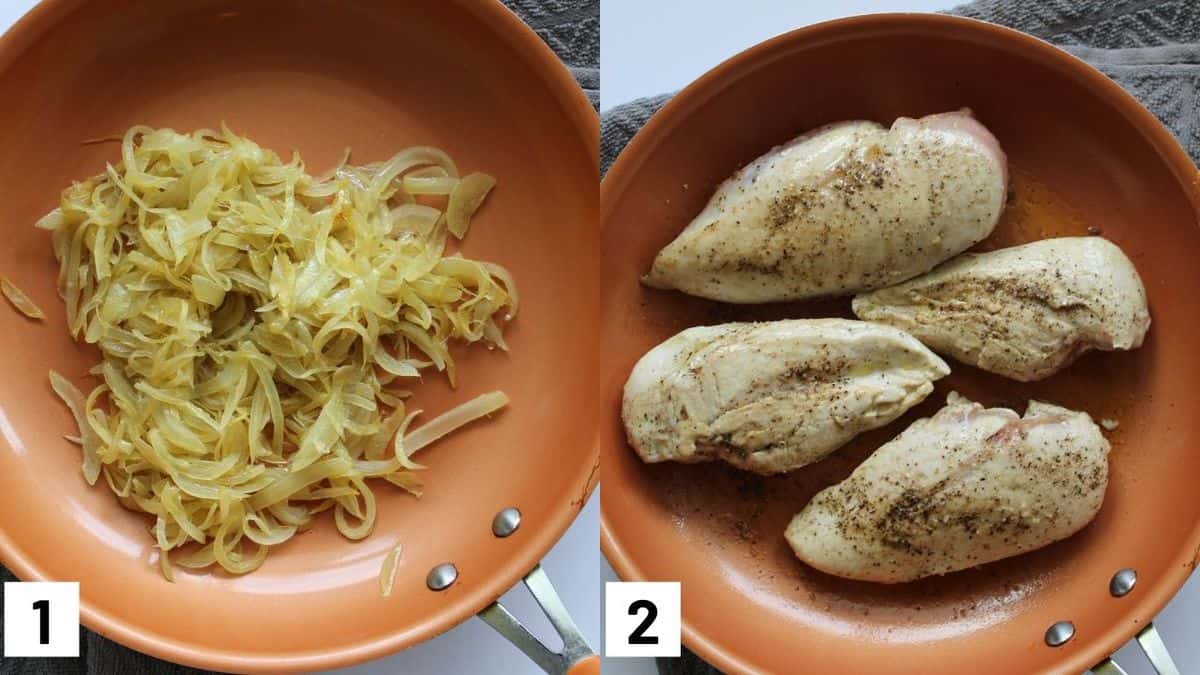
Images of the first two steps to make French onion chicken, including caramelizing onions and browning the chicken breasts.

Step 1: Caramelize onions on medium low until they reach a dark amber colour, about 1 hour. Set aside.

Step 2: Sprinkle the chicken breasts with salt and pepper. Pan fry on each side until golden brown, about 4 minutes per side. Remove from the pan and set aside.
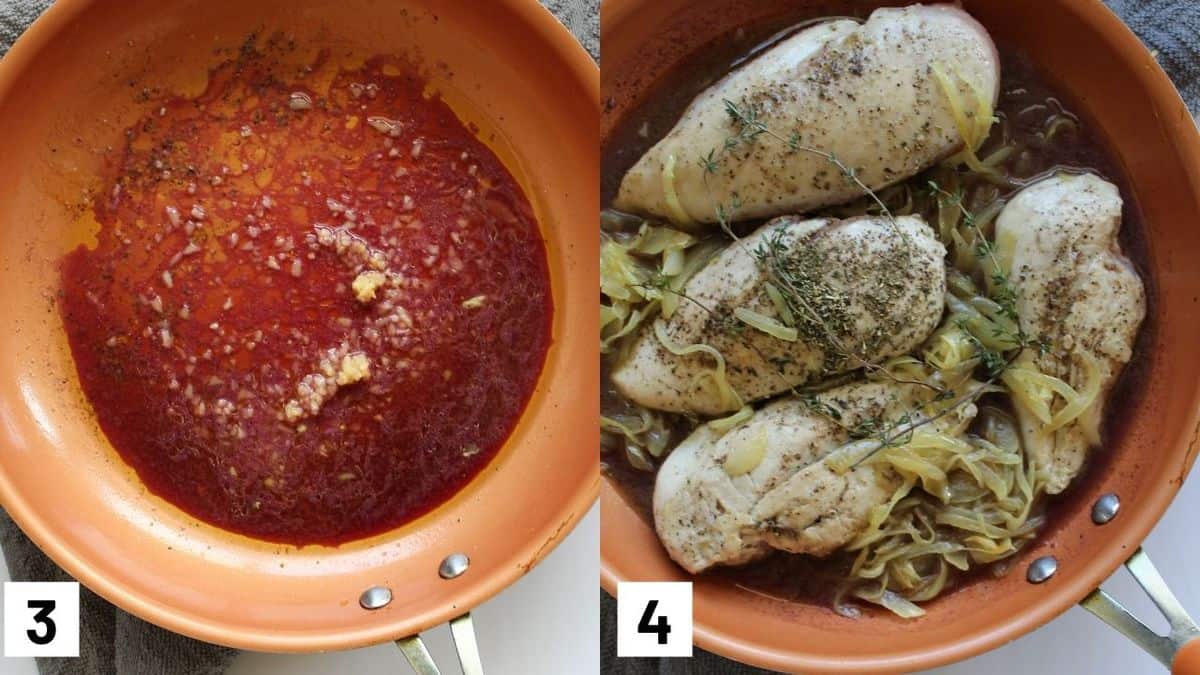
Images of the third and fourth step of the recipe including heating up the red wine with garlic, and combining all ingredients in a pan with chicken breast.

Step 3: Add in the garlic and stir until fragrant, then pour in the red wine and scrape up the bottom of the pan.

Step 4: Add 3/4 cup of beef broth, herbs de province, thyme, cooked onions and the browned chicken breasts. Cover and cook on medium low until the chicken breasts are cooked through, about another 10 minutes.
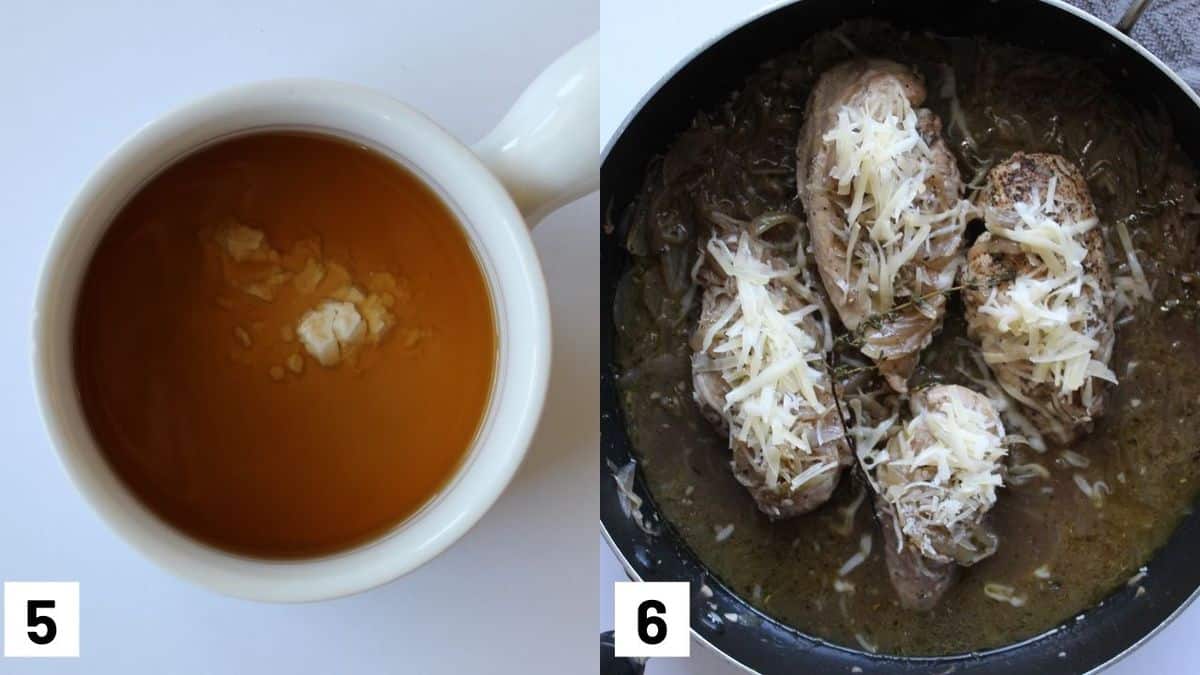
Images of the final two steps to make recipe including making a roux and adding cheese on top of the chicken breasts.

Step 5: Mix together the cornstarch with the remaining 1/4 cup of broth.

Step 6: Add broth to the pan, and stir. Top the chicken with the gruyere and parmesan and broil until bubbly and golden brown.

Expert Tips

To make this french onion chicken recipe we want to caramelize the onions low and slow here to bring out that delicious sweetness and flavour. Yes, this can take an hour, but they actually require very little babysitting and I just keep them cooking on low while I play with my son in the kitchen. A quick little stir every 5-10 minutes or so is all you need to keep them going.

Next, I give the chicken breasts a nice sear to get a little colour on top. My hubby says I make the BEST chicken breasts (#GoodJewishWife) and it’s really just because I never skip this step.

Finally, I make a wicked sauce with red wine and beef broth, top it off with a healthy amount of cheese (aka. all of the cheese you’ve got in the fridge) and pop it into the oven to finish cooking and get all gooey and bubbly. These french onion chicken breasts taste just like the classic French soup but with a solid hit of protein.

They’re also so good for you and well balanced, you totally can sop up all that extra sauce and onions with some crusty bread for the authentic french onion soup experience.
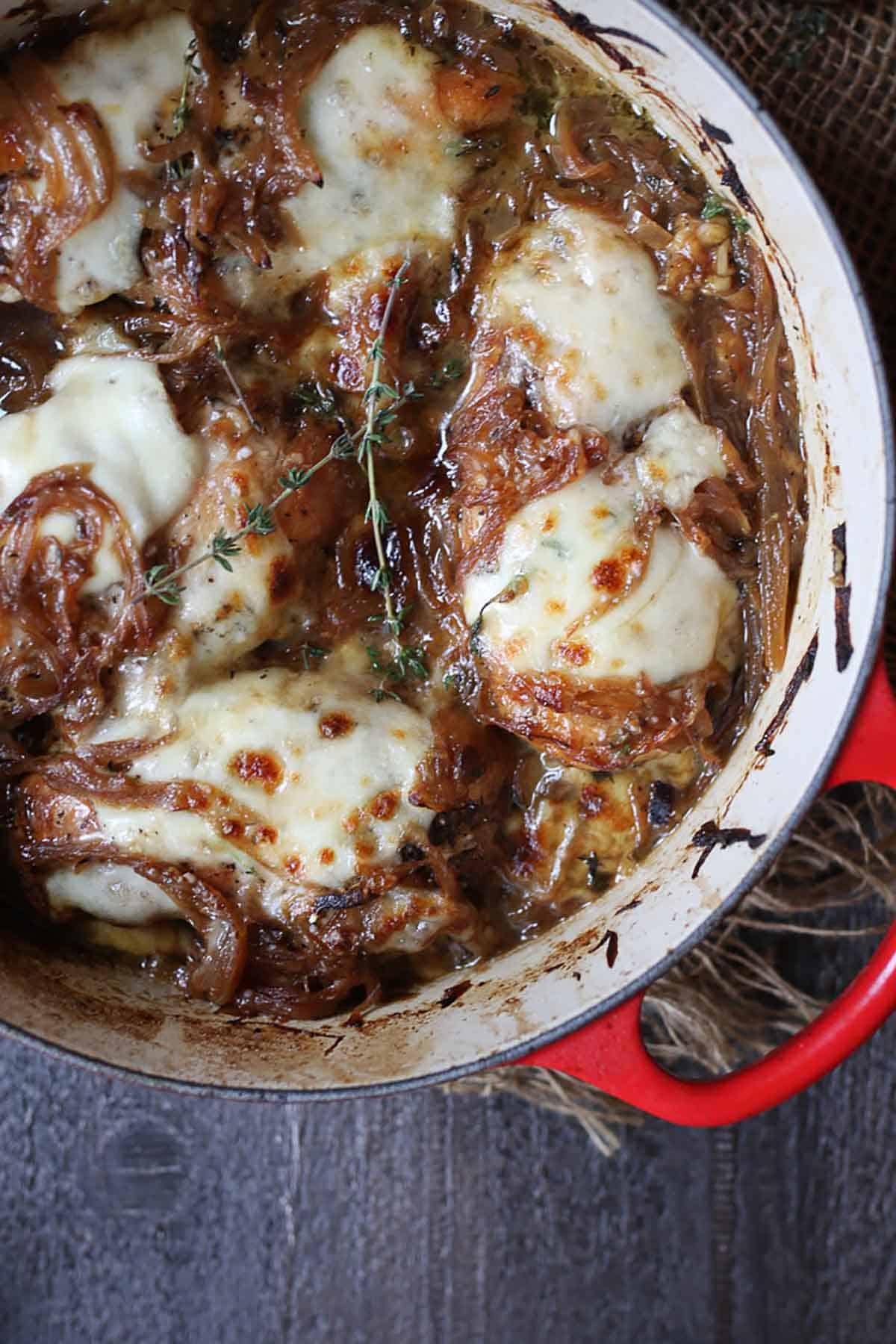
Birds eye view of French onion chicken breast in a red pot topped with thyme.

Recipe FAQs

How long does this recipe last in the fridge?

This French onion chicken recipe stays fresh for about 3-4 days in the fridge.

What can I pair this with?

You can pair this with some mashed potatoes or some crusty bread. If you preference is to keep things low carb, you can pair it with some greens or roasted veggies.

What can I use instead of Gruyere?

I am all for getting experimental with cheese. And while I like to stick to the traditional Gruyere for this recipe, you can also try provolone, swiss, or emmental cheese.

Is this recipe kid friendly?

My kid devours this recipe so i’m gonna go with yes it is! There is no need to worry about the wine in this French onion chicken recipe as the alcohol gets reduced with the heat.

More Recipes

If Here are some of my favourite one pot dinner recipes that you might like!

  • Hawaiian Chicken Meatballs
  • Enchilada Bowl with Rice & Beans (Vegan)
  • Minestrone Skillet Pasta (Vegan)
  • Mexican Street Corn Chilli Chicken

Now lovelies, I would love to know – are you a french onion soup fan? What are some of your go-to chicken breast recipes?

These French Onion Chicken Breasts are the perfect simple on pot dinner that is also Keto friendly, Gluten Free and packed with protein. #abbeyskitchen #frenchonionchicken #ketodinner
Print Recipe
4.08 from 28 votes

French Onion Chicken (Healthy One Pan Meal)

This French onion chicken is a simple one pot dinner that puts a fun twist on the classic soup version! It is also a great recipe for those who are keto or gluten free.
Prep Time15 minutes mins
Cook Time1 hour hr 20 minutes mins
Total Time1 hour hr 35 minutes mins
Course: Dinner
Cuisine: French, American
Diet: Gluten Free
Servings: 4 people
Calories: 298kcal
Author: Abbey Sharp

Ingredients

  • 3 tbsp olive oil divided
  • 2 large onions thinly sliced
  • 1 lb skinless boneless chicken breasts
  • Salt and pepper
  • 3 cloves garlic minced
  • 1/4 cup red wine
  • 1 cup reduced sodium beef broth divided
  • 1 tsp cornstarch
  • 1/2 tsp herbs de provence
  • 4 sprigs thyme
  • 3 oz shredded gruyere cheese
  • 1 oz parmesan cheese

Instructions

  • Heat 2 tablespoons of oil in a nonstick skillet over medium low heat and add in the onions. Cook on medium low until they reach a dark amber colour, about 1 hour. Set aside.
  • Return the pan to the heat along with another tablespoon of oil. Sprinkle the chicken breasts with salt and pepper and add to the pan. Pan fry on each side until golden brown, about 4 minutes per side. Remove from the pan and set aside.
  • Add in the garlic and stir until fragrant, then pour in the red wine and scrape up the bottom of the pan. Add 3/4 cup of beef broth, herbs de province, thyme, cooked onions and the browned chicken breasts. Cover and cook on medium low until the chicken breasts are cooked through, about another 10 minutes.
  • Mix together the cornstarch with the remaining 1/4 cup of broth. Add to the pot and stir. Season with salt and pepper, to taste.
  • Meanwhile, preheat the broiler. Top the chicken with the gruyere and parmesan and broil until bubbly and golden brown. Enjoy.

Video

Nutrition

Calories: 298kcal | Carbohydrates: 7g | Protein: 34g | Fat: 12g | Saturated Fat: 5g | Cholesterol: 100mg | Sodium: 523mg | Potassium: 665mg | Fiber: 1g | Sugar: 2g | Vitamin A: 360IU | Vitamin C: 7.8mg | Calcium: 328mg | Iron: 1mg

Have you tried making these french onion chicken breasts? Leave me a comment below with your thoughts!

Abbey Sharp

Abbey Sharp is a Registered Dietitian (RD), regulated by the Ontario College of Dietitians. She is a mom, YouTuber, Blogger, award winning cookbook author, media coach specializing in food and nutrition influencers, and a frequent contributor to national publications like Healthline and on national broadcast TV shows.
www.abbeyskitchen.com/about-abbey/

Last Updated September 9, 2023. Published September 15, 2023 By Abbey Sharp 21 Comments

Carrot Cake Smoothie (Vegan Lactation Recipe)

This Carrot Cake Vegan Lactation Smoothie is a delicious gluten free breakfast for breastfeeding moms who are struggling with their milk supply for baby!

This Carrot Cake Lactation Smoothie is a delicious breakfast for breastfeeding moms who are struggling with their milk supply for baby!

Vegan carrot cake lactation smoothie in a large glass with a straw and ginger candy on the rim.

I’m past my breastfeeding days, but I still remember the struggle. In those days I went crazy for my favorite lactation treat- aka my gluten free vegan lactation cookies. Today, I wanted to share another new breakfast favourite – my carrot cake smoothie which my favorite VEGAN lactation recipe! This beauty is nutrient-packed for anyone who needs a tasty morning or afternoon pick-me-up, but is particularly great for breastfeeding mamas who are looking to increase their milk supply. Lactation smoothies are seriously a win-win, even if you’re not breastfeeding anymore like me.

Table of contents

  • Why This Recipe Works
  • Key Ingredients
  • How To Make This Recipe
  • Expert Tips
  • Recipe FAQs
  • More Recipes You Might Like

Why This Recipe Works

Breastfeeding (especially at the beginning) is a full time job. It requires at LEAST one hand, and is super dehydrating. Lactation smoothies like this vegan carrot cake smoothie are the PERFECT fuel to keep you going! I also love this recipe because it’s:

  • Super quick to make – only 2 steps!
  • Packed with all good-for-you foods for your boobs
  • Vegan & Gluten Free
  • Packed with ~13 grams of protein

Key Ingredients

Carrot cake lactation smoothie in large glass.

Brewer’s Yeast – Brewer’s Yeast is packed with B vitamins which help provide energy to the body by breaking down macronutrients to utilize. It also has ~16 grams of protein per 2 tablespoons.

Natural Almond Butter – I love adding almond butter to smoothies because it makes the smoothie a bit thicker and natural almond butter is a bit “runnier” which makes it not too thick, just the perfect creamy consistency.

Flaxseed – Flaxseed is something I love sneaking into my diet wherever I can, including this lactation smoothie. It’s a great and easy way to help digestive health as there are ~2 grams of fiber for only 1 tablespoon of flaxseed!

How To Make This Recipe

Step 1: Add all of the ingredients to the blender and puree until smooth.

Step 2: Serve and enjoy!

Expert Tips

Let me tell you, lovelies. If you recall, there are a number of foods said to have an impact on breast milk supply. Although we need more research in this area, all of these foods are really delicious and nutritious regardless, so I say, hey WHAT THE HECK! Here are the ingredients that show up on a ton of recommended lists (including those that my lactation consultant and doula recommended) that I decided to incorporate into my lactation smoothie:

  • Oats
  • Brewers Yeast
  • Flaxseed
  • Almond Butter
  • Carrots
  • Ginger

Recipe FAQs

How can I batch prep this lactation smoothie?

You can make a huge batch of this carrot cake lactation smoothie by freezing it into ice cube trays and then just thaw a glass full of cubes out each morning on the go.

Can I use another type of nut butter?

Yes! Any type of natural nut butter of your choosing would be fine to swap in this smoothie.

Can I use another type of milk alternative?

Of course! Any milk would work in this recipe. If you weren’t set on keeping this recipe vegan, you can even add regular cow’s milk as the liquid base for extra added protein.

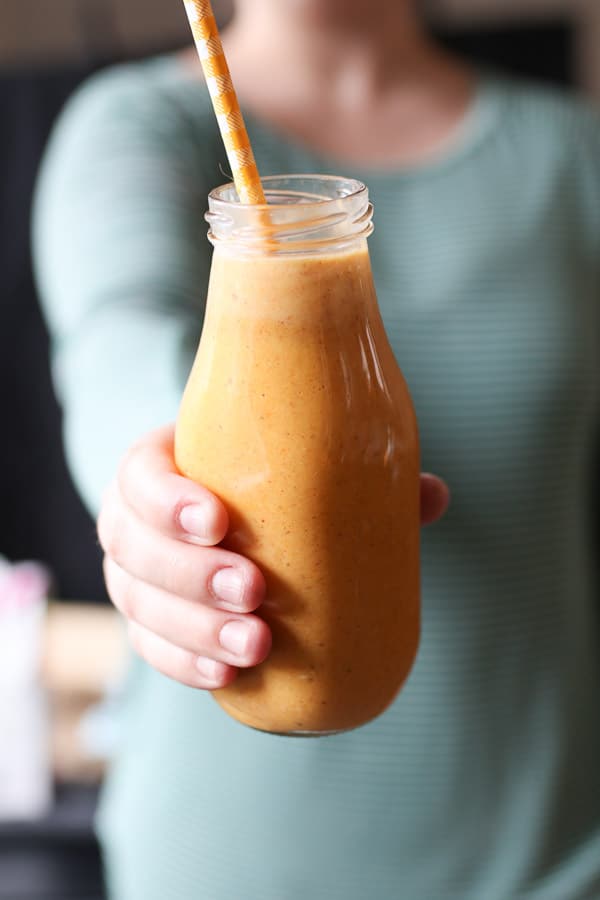
Person holding a glass of carrot cake lactation smoothie.

More Recipes You Might Like

If you loved this lactation smoothie, check out some other delicious lactation recipes below!

  • SALTED TOFFEE COOKIES (VEGAN LACTATION RECIPE)
  • LEMON POPPYSEED VEGAN LACTATION COOKIES
  • SALTED CHOCOLATE CHUNK COOKIES WITH ALMONDS (VEGAN LACTATION COOKIES)
  • VEGAN CARROT CAKE LACTATION COOKIES

Now moms, what did you eat as breastfeeding fuel to improve your milk supply? Have you tried lactation smoothies yet? Leave me a comment below with your thoughts!

This Carrot Cake Vegan Lactation Smoothie is a delicious gluten free breakfast for breastfeeding moms who are struggling with their milk supply for baby!
Print Recipe
4.70 from 13 votes

Carrot Cake Smoothie (Vegan Lactation Recipe)

This Carrot Cake Smoothie is a delicious gluten free breakfast for breastfeeding moms who are struggling with their milk supply for baby!
Prep Time5 minutes mins
Total Time5 minutes mins
Course: Snack
Cuisine: American
Servings: 2 people
Calories: 333kcal
Author: Abbey Sharp

Ingredients

  • 1/4 cup gluten free rolled or instant oats
  • 1 tbsp brewers yeast
  • 2 tbsp natural almond butter
  • 1 tbsp ground flaxseed
  • 2 1/2 cups carrots cooked
  • 1 cup fresh pineapple diced
  • 2 tbsp fresh ginger grated
  • 1 1/2 cups unsweetened vanilla almond milk
  • 1/4 tsp cinnamon
  • Maple syrup if desired to taste

Instructions

  • Add all of the ingredients to the blender and puree until smooth.
  • Serve and enjoy!

Nutrition

Calories: 333kcal | Carbohydrates: 43g | Protein: 13g | Fat: 15g | Saturated Fat: 1g | Sodium: 377mg | Potassium: 1029mg | Fiber: 12g | Sugar: 17g | Vitamin A: 26775IU | Vitamin C: 48.8mg | Calcium: 369mg | Iron: 3.3mg
Abbey Sharp

Abbey Sharp is a Registered Dietitian (RD), regulated by the Ontario College of Dietitians. She is a mom, YouTuber, Blogger, award winning cookbook author, media coach specializing in food and nutrition influencers, and a frequent contributor to national publications like Healthline and on national broadcast TV shows.
www.abbeyskitchen.com/about-abbey/

Last Updated October 8, 2023. Published September 13, 2023 By Abbey Sharp 10 Comments

Is Vegetable Oil Bad for You? | The Vegan Oil Free Diet

We take a scientific look at the vegan oil free diet and answer the question everyone is wondering: is vegetable oil bad for you?

You may or may not have heard about the hot new fad diet trend on the scene – the vegan oil free diet. This diet trend has become increasingly popular among members of the vegan community and has even been recommended by some plant-based doctors as a way to combat chronic disease. As the name implies, the vegan oil free diet is a predominately plant-based diet that does not include any added oils of any form. The so-called benefits of completely eliminating oil from the diet stem from claims that oil is too high in calories, has no nutritional value, is harmful to one’s health and avoiding oils may actually reverse chronic disease. So, we did what we always do here at Abbey’s Kitchen and took a deep dive into the research to answer the questions: is the vegan oil free diet beneficial for health or just another extreme? And, is vegetable oil bad for you?

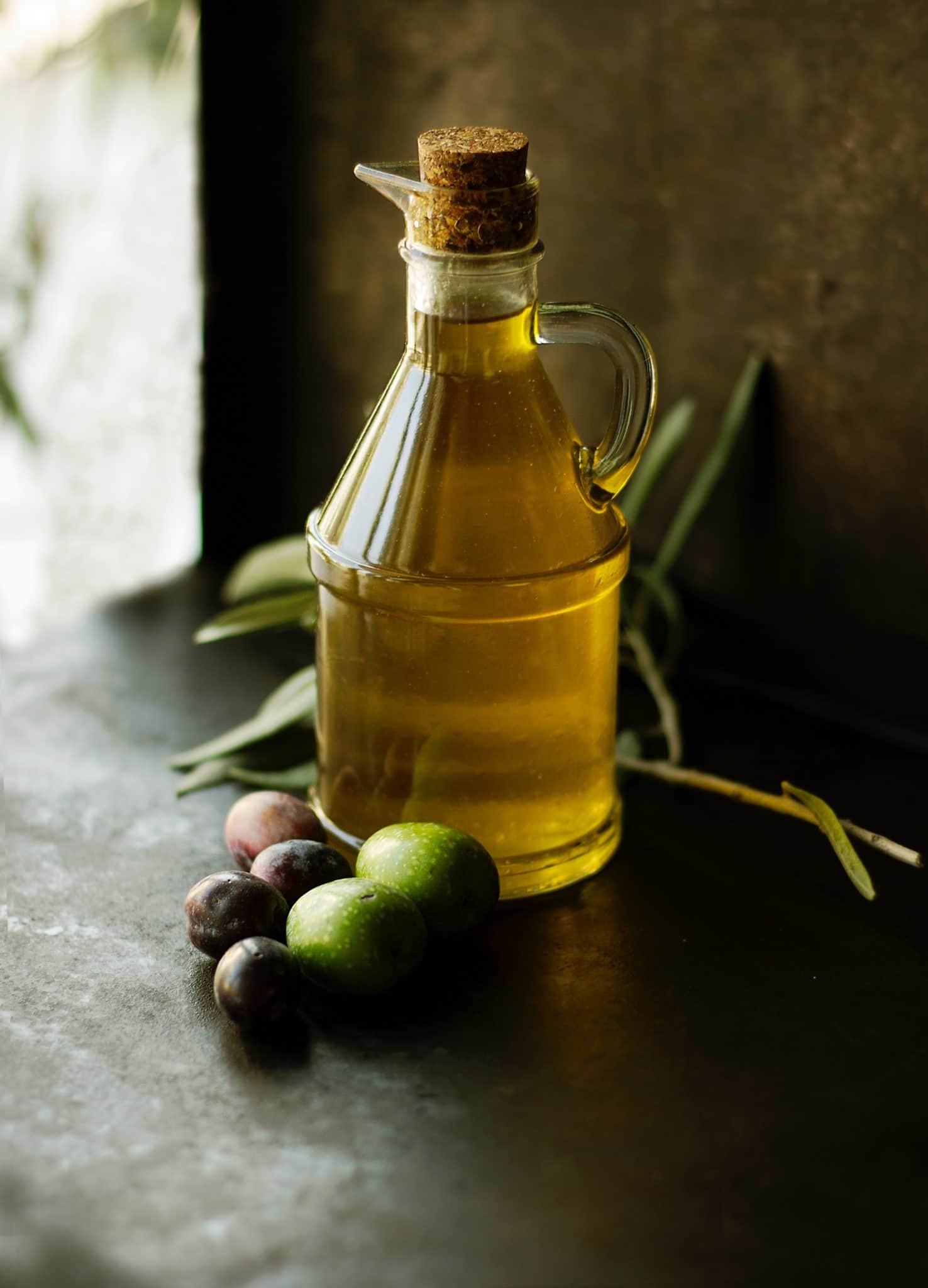
clear jug filled with olive oil on a wooden table next to a small bunch of fresh olives

What Do We Know About Dietary Fat?

Before we jump into the nitty-gritty of the science behind oils and their impact on health, let’s talk a bit about why dietary fat is important in the first place. Dietary fat is not only a major source of energy for the body, it’s also important for cell growth and the absorption of fat-soluble vitamins like vitamins A, D, E, and K. By now, we know that not all fats are equal and that we should mostly be consuming “good” sources of fat from monounsaturated and polyunsaturated fats. If you think back to your first health class, you may have learned that consuming “good” fats from sources like oils are important for a strong and healthy heart and brain. With this in consideration, I’m sure it must be a real head scratcher to have these beliefs flipped upside down with the claims behind the oil free diet so convincing. So, without further adieu, let’s break down what you need to know about oils and its role in inflammation, heart health, nutrition, and weight gain.

close up of half of a ripe avocado against a light pink background

Popular claims made by VEGAN OIL FREE DIET proponents

Let’s break down some of the popular concerns and claims of those who believe vegetable oil is unhealthy.

Added oils cause Inflammation

Inflammation has been a hot topic in the health and wellness world and some research suggests that it plays a role in the development of chronic diseases such as cancer, heart disease, diabetes, metabolic syndrome, and arthritis. Proponents of the no oil diet claim that oil causes inflammation and should therefore be avoided. This is where the conversation about oils, specifically the omega-6: omega-3 ratio, gets controversial.

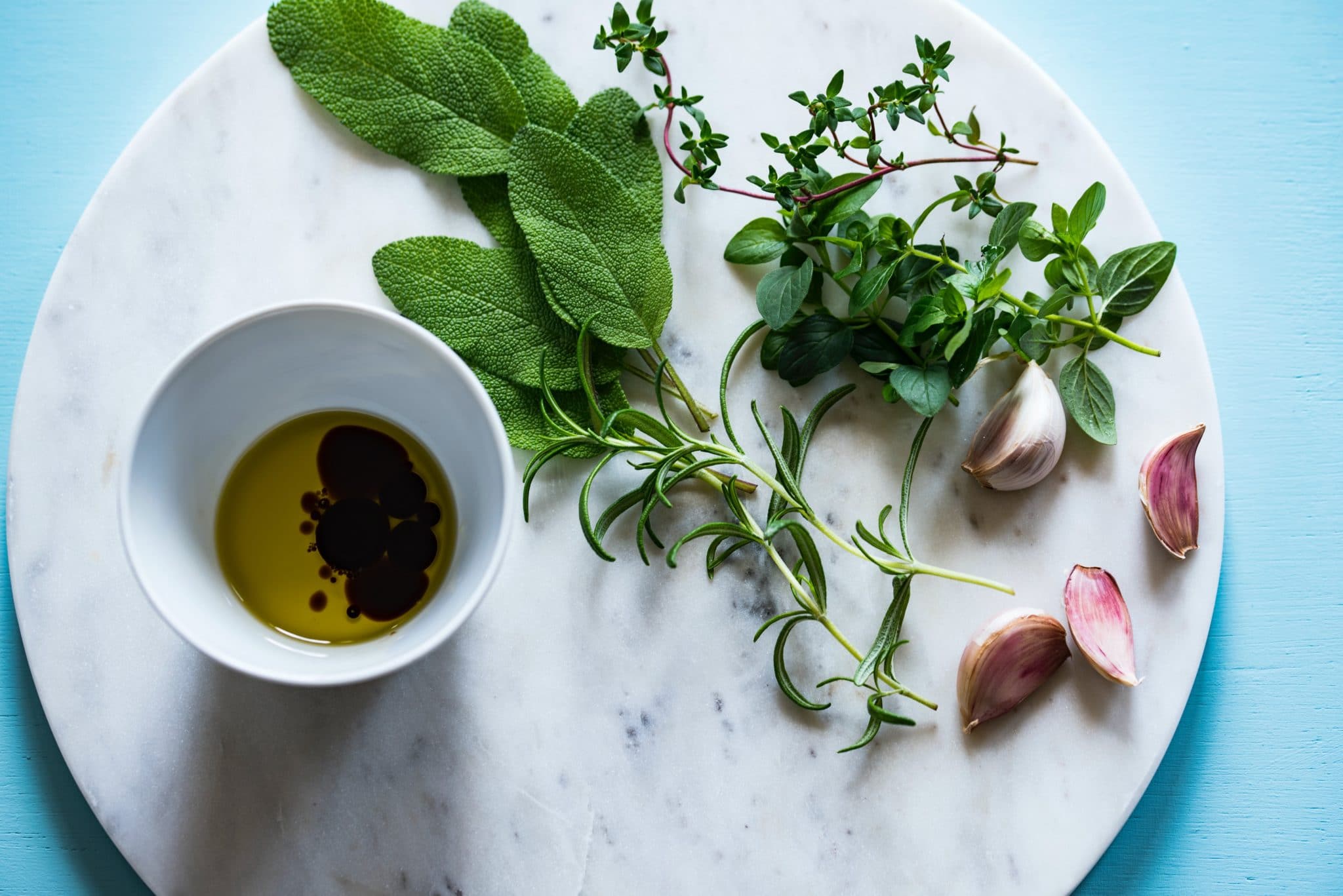
birds eye view of oil in a bowl surrounded by leaves

What is the omega 6:3 ratio anyway and why does it matter? It has long been hypothesized that omega-6 fatty acids are inflammatory, whereas omega-3 fatty acids are anti-inflammatory. As a result of this, it has been speculated that a diet high in omega-6 and low in omega-3 may increase inflammation. Even though most oils contain some amounts of omega-6 and omega-3 fatty acids, the relative ratio differs. For instance, some oils have higher amounts of omega-6 including oils such as soybean, corn, cottonseed, sunflower, peanut, sesame, and rice bran. Whereas, olive oil, flax seed oil, and canola oil have lower amounts of omega-6. Omega-6 fatty acids are generally more abundant in the Western diet compared to omega-3 fatty acids and, as a result, the omega 6:3 ratio of the average Western diet has increased to around 20:1.

However, is consuming too much omega 6 really a cause for concern, and should you completely swear off oils because of this? Well, according to the larger body of high-quality evidence, the answer is simply, no. Although, some studies have pointed to the potential inflammatory properties of too much omega-6 in the diet, a 2017 meta-analysis that looked at 30 randomized control trials found that increased dietary intake of linoleic acid (the most common omega-6 fatty acid), does not have a significant effect on blood concentrations of inflammatory markers. Another 2012 systematic review assessed the effects of dietary linoleic acid on inflammatory markers (including C-reactive protein, fibrinogen, cytokines, tumor necrosis factor) and also concluded that there exists no strong evidence to suggest that dietary linoleic acid increases inflammation.

Though more studies are needed to confirm the relationship between omega-6 and inflammation, what we can say is that omega-3 fatty acids absolutely do show more promise in their anti-inflammatory effects. A 2013 systematic review showed that some evidence suggests that omega-3 fats may help lower inflammation in healthy adults and in people with metabolic syndrome, and may also be an effective adjunctive treatment for joint pain. As well, a 2015 animal study found that oils rich in omega-3 may improve inflammatory damage in inflammatory bowel disease. In addition, the benefits of omega-3 fatty acids spread far beyond inflammation and may even help to fight depression and anxiety, improve eye health, reduce symptoms of metabolic syndrome, improve risk factors for heart disease, and may even prevent some types of cancers. In other words, it really is important to focus on those sources of omega 3s or take a fish oil supplement.

Therefore, even though it has been speculated that the omega-6 from oils may cause inflammation, the bottom line is that correlation does not equal causation. There is ultimately not enough strong evidence to make this claim. More importantly, the omega-3 fatty acids in a lot of seed or vegetable oils HAVE been proven to have a beneficial effect on inflammation. So why deprive yourself of this benefit? If you are at all worried or concerned about consuming too much omega-6 from your diet, then perhaps try sticking to oils that are rich in omega-3, such as olive oil, walnut oil, or flax seed oil, in order to really maximize on the anti-inflammatory benefits.

Vegetable Oils cause heart disease

image of a white heart against a black background

Heart disease is the number one cause of death in the world and the numbers continue to rise each year. Despite this scary statistic, heart disease can be preventable through lifestyle & dietary change. So, when it comes to dietary recommendations for heart health, I don’t take it lightly. Which is why the claims against oil and heart health that are promoted by advocates for the oil free diet have me in a MOOD. According to Dr. Esselstyn, a vegan doctor and no oil advocate, oils negatively impact the cardiovascular system because they “injure the endothelium, the innermost lining of the artery, and this injury is the gateway to vascular disease”. Other advocates likewise claim that oil slows down blood flow and increases the chance of cardiovascular disease. I diligently combed through the research on these claims, and one thing I did find (unsurprisingly) was an overwhelming amount of high-quality evidence on the cardiovascular benefits of oil, specifically olive oil. So, lets state the FACTS.

Blood Pressure

The Mediterranean diet has long been a key player in the prevention of heart disease and one of the main dietary recommendations is consuming olive oil. This is because a large body of evidence supports the benefit of olive oil in lowering the risk of heart disease. High blood pressure, one of the strongest risk factors for heart disease, has consistently been shown to be reduced with higher intakes of olive oil, and you can read all about the research on this here, here, here, here and here (just to name a few – I told you the evidence was overwhelming). What is it about olive oil that causes reductions in blood pressure, you ask? Well, research has shown that the polyphenols, a potent antioxidant in olive oil, may have something to do with it. As well, the nitro fatty acids in oils have a positive effect on blood pressure by relaxing the lining of the blood vessels.

image of tools used to monitor blood pressure

Stroke

Stroke and heart disease are significantly linked and up to 80% of cardiac events can be prevented through dietary intervention and lifestyle change. With this in mind, does added oil consumption play a role in preventing strokes? Absolutely it does. According to a large 2014 systematic review, there exists a significant association between olive oil consumption and reduced risks of cardiovascular events and stroke. In fact, the study found that olive oil was the ONLY source of monounsaturated fat to have preventative effects. Another study with a 140,000 study sample likewise found that those who consume olive oil have a much lower risk of stroke than those who do not. To drive this point home even further, a large prospective cohort study found that for every 10 g increase in daily olive oil consumption, cardiovascular disease decreased by 10% and mortality risk decreased by 7%. Come at me “no oil” aficionados.

Cholesterol

Similar to blood pressure, cholesterol is likewise a controllable risk factor for heart disease. The trick is, you want to increase your HDL cholesterol (the “good” cholesterol) and lower your LDL cholesterol (the “bad” cholesterol). We know that higher intakes of dietary saturated and trans fats increase bad cholesterol, but do other dietary fats increase good cholesterol? A 2019 meta-analysis confirmed that the polyphenols in olive oil increase HDL cholesterol and these beneficial effects were more significant in individuals with metabolic syndrome or other chronic diseases and conditions. Another 2018 systematic review compared the effects of different oils on blood lipids and found that unsaturated oils (including olive and flaxseed) were effective in reducing LDL cholesterol. The benefit of olive oil consumption, in particular, goes far beyond heart health and may also be beneficial in combating alzheimers disease, rheumatoid arthritis, and can reduce the risk of type 2 diabetes and some cancers. With all of this in consideration, I am definitely on team oil when it comes to heart health. If you want to learn more about the top heart healthy foods, you can read my blog post here where I talk all about it.

Vegetable Oils Lack Nutritional Benefit

birds eye view of oil and vinegar in a white bowl with a variety of herbs laid out on a plate

Another problematic claim against the consumption of oils is that they have no nutritional benefit and are essentially “empty calories” and “comparable to white bread”. *Insert eye roll here*. Let’s break down the facts. Monounsaturated oils (i.e. olive oil, avocado oil) are rich in vitamin E and vitamin K which are important for red blood cell formation and blood clotting, respectively. This also speaks to the cardiovascular benefit of olive oil, which we have already covered. In addition, a variety of oils are rich in antioxidants and omega 3s which both have anti-inflammatory effects. In fact, one study found that the oleocanthal, a phenolic compound in olive oil, has similar anti-inflammatory effects as ibuprofen. I’d like to see white bread do that!

I would also like to discuss the use of oil beyond nutrition for a hot minute. Oils have been used for centuries across a variety of cuisines and not entirely for nutritional purposes alone. Rather, for reasons like enhancing flavor and texture, which are just as important for our overall eating experience. Would Chinese or Korean food taste the same without sesame oil? Probably not. Do salads and marinades taste that much better with a drizzle of olive oil? Heck yes they do. Would brussels sprouts be that appealing without a little oil to help them crisp up in a hot oven? I don’t know about you, but I don’t want diet-y brussels sprouts. We use oils because we enjoy them, and they make the other healthy food we eat taste that much more satisfying. Is that not “nourishing” in and of itself?

The Effects of Heating vegetable oils

It has long been understood that some oils are unstable when heated and can release harmful free radicals which can have a negative impact on health. The same negative health effects are true when oils are repeatedly heated (i.e. reusing oils to deep fry food). Though science has confirmed this about some oils, I am not at all surprised that no oil dieters would take this information and run with it. So, the question is – does heat really ruin the health benefit of oils or make them dangerous?

image of oil in a clear bottle

To answer this question, it really comes down to the lipid profile of oils and the percentage of polyunsaturated, monounsaturated, and saturated fats they contain. Research shows that oils containing a higher percentage of polyunsaturated fats (PUFA) can be more damaging to health when exposed to high heat because they degrade more easily. Some examples of oils higher in PUFA that are not ideal for cooking in high heat include soybean, grapeseed, and sesame. Whereas, oils that have a higher percentage of monounsaturated fats and saturated fats are more stable and heat resistant. Evidence has shown that the most stable cooking oils include extra virgin olive oil (EVOO) and coconut oil. EVOO’s higher monounsaturated fat profile (75%) and antioxidant content makes it fairly resistant to heat. Whereas, coconut oil is ideal for high heat cooking because of its high saturated fat content (68%). Despite the higher amounts of saturated fat in coconut oil, studies have shown that coconut oil can in fact improve cholesterol by increasing HDL cholesterol (the “good” cholesterol), so it too can be used in moderation.

Fat from Vegetable Oils Makes You Fat

When are we going to finally put the “fat makes you fat” argument to bed? Yes, oil is a source of fat and, yes fat has more calories per gram than carbohydrates or protein. These are facts. However, the argument that consuming oils in your diet will make you gain weight is a bit of a stretch and I’ll tell you why.

close up of a measuring tape to measure weight

One of the main arguments for the Vegan No Oil Diet is that oils are calorie dense and thereby an easy way to add extra calories which can cause weight gain. Many “no oil” advocates are quick to mention that one tablespoon of oil contains roughly 100 calories and one cup contains around 2000 calories. First of all, who is shooting back a whole cup of oil in one go? Second of all, though 1 tablespoon of oil may sound like a lot or calories, when you think about your total daily caloric intake this amount is actually pretty negligible. For example, let’s say you use 1 tablespoon of oil to cook up a veggie stir-fry that yields 4 portions. When it comes time to dig into your stir fry bowl, is there an entire tablespoon of oil in that serving? No, there isn’t. Even if there was, that’s only around 4% of your total caloric intake for the day. Assuming you eat a balanced diet with a variety of fruits, vegetables, whole grains, and protein, this amount of fat is actually quite insignificant.

More importantly, food is more than just calories, and adding oils to food and cooking may actually aid in weight loss. One three year study found this to be true with a diet rich in olive oil. Similarly, a cohort study on 7000 participants found that higher intakes of olive oil was not associated with weight gain. This is not at all surprising as fats have a role in satiety by slowing down the rate of digestion and keeping blood sugar levels even keeled.

Overall, it may be seemingly easy to point the finger at a specific food or food group as the culprit behind weight gain or obesity. Especially because this is the common and most consistent message we get from the media and diet culture, in general. The truth is, weight loss and weight gain are sometimes out of our control and lot of it has to do with our genetic makeup and socioeconomic factors. This is a whole other topic for another day, but if you’re interested in what I have to say about the relationship between weight and health, I talk all about it here, here and here.

Vegetable oils are highly processed

image of several oil droplets

Another claim behind the oil-free diet is that oils are highly processed and should therefore be avoided. Before we get into oil processing, one thing we need to make clear is that processed foods, in general, exist on a spectrum and some amount of processing can actually make food healthier and safer. For example, minimally processed foods use little processing or preserve freshness – i.e. washed/pre-cut fruit and vegetables, canned beans, frozen vegetables etc. On the other end of the spectrum exists ultra-processed foods such as ready-to-eat convenience foods (think frozen meals, lunch meats etc) which should be consumed in moderation. But where do oils exists on the spectrum?

Well that actually depends on the type of oil, its intended use, and the manufacturer. Some oils are minimally processed and “unrefined” to retain the flavours and smell of the original oil seed. You can find these oils on the grocery shelves labelled as “cold-pressed”, “expeller-pressed”, “virgin”, or “extra-virgin”. However, because these oils are less processed they are less stable and have a shorter shelf life. Therefore, storage temperatures and exposure to light and oxygen are important things to consider. Oils that are more processed and refined are designed to withstand long term heat demands (i.e. deep fat frying), have a longer shelf life, and are more uniform in their taste, smell, and appearance. Refined oils are also less expensive than unrefined oils.

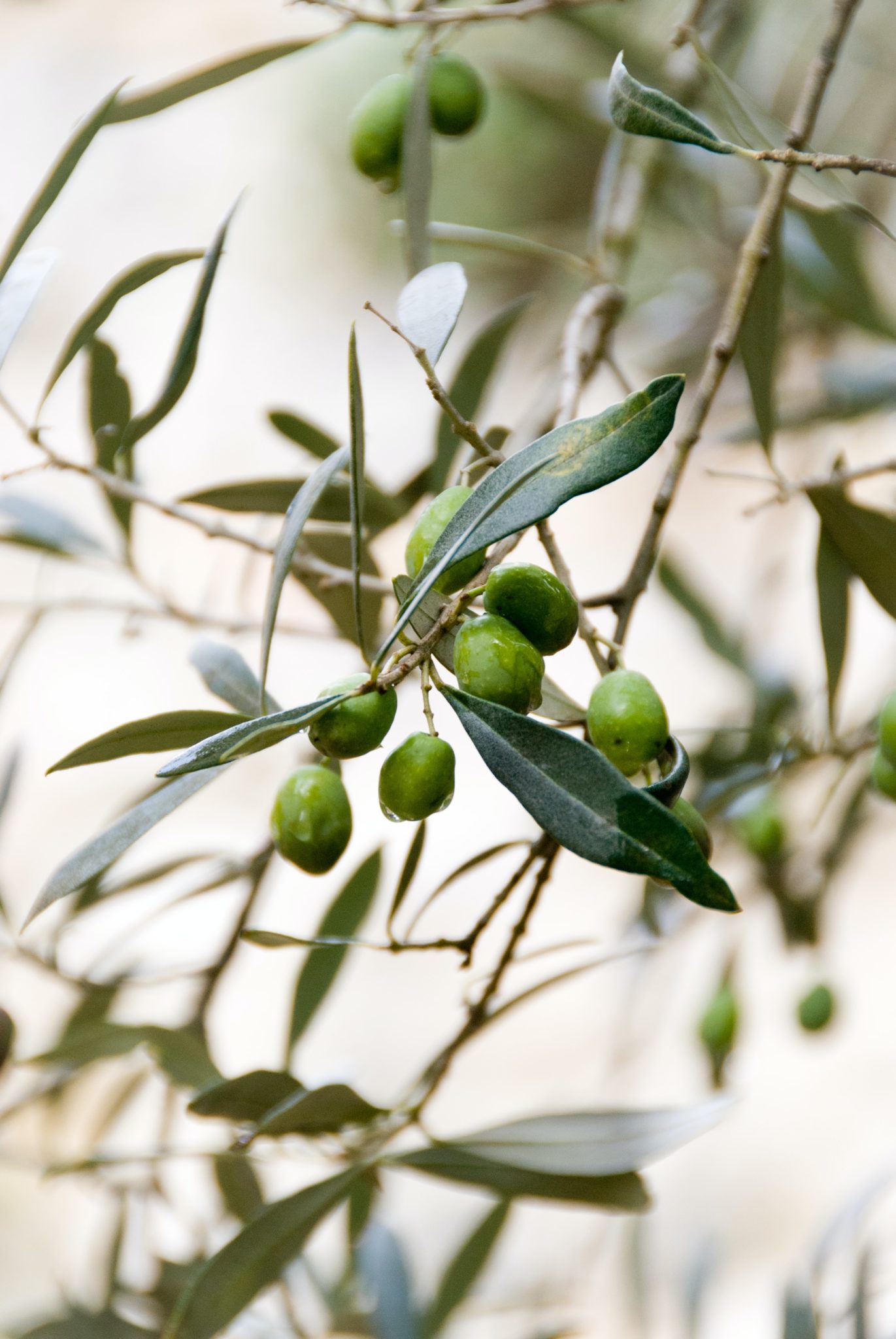
close up image of olives on an olive tree

When it comes to deciding what oils to use, unrefined oils are the ideal choice whenever possible, if your budget allows. If you are confused by all the processing labels and terms, just stick to this list of the most commonly unrefined oils:

  • Almond oil
  • Avocado oil
  • Canola oil*
  • Virgin Coconut oil
  • Flaxseed oil
  • Grapeseed oil*
  • Hemp oil
  • Olive oil/Extra virgin olive oil
  • Sesame oil*
  • Walnut oil*

*Note – some oils are available refined AND unrefined, so be sure to take an extra gander at the label to make sure that you are seeing “cold-pressed” or “expeller-pressed” labeling to ensure you are purchasing the intended oil.

The Role of No Oil in Disordered Eating

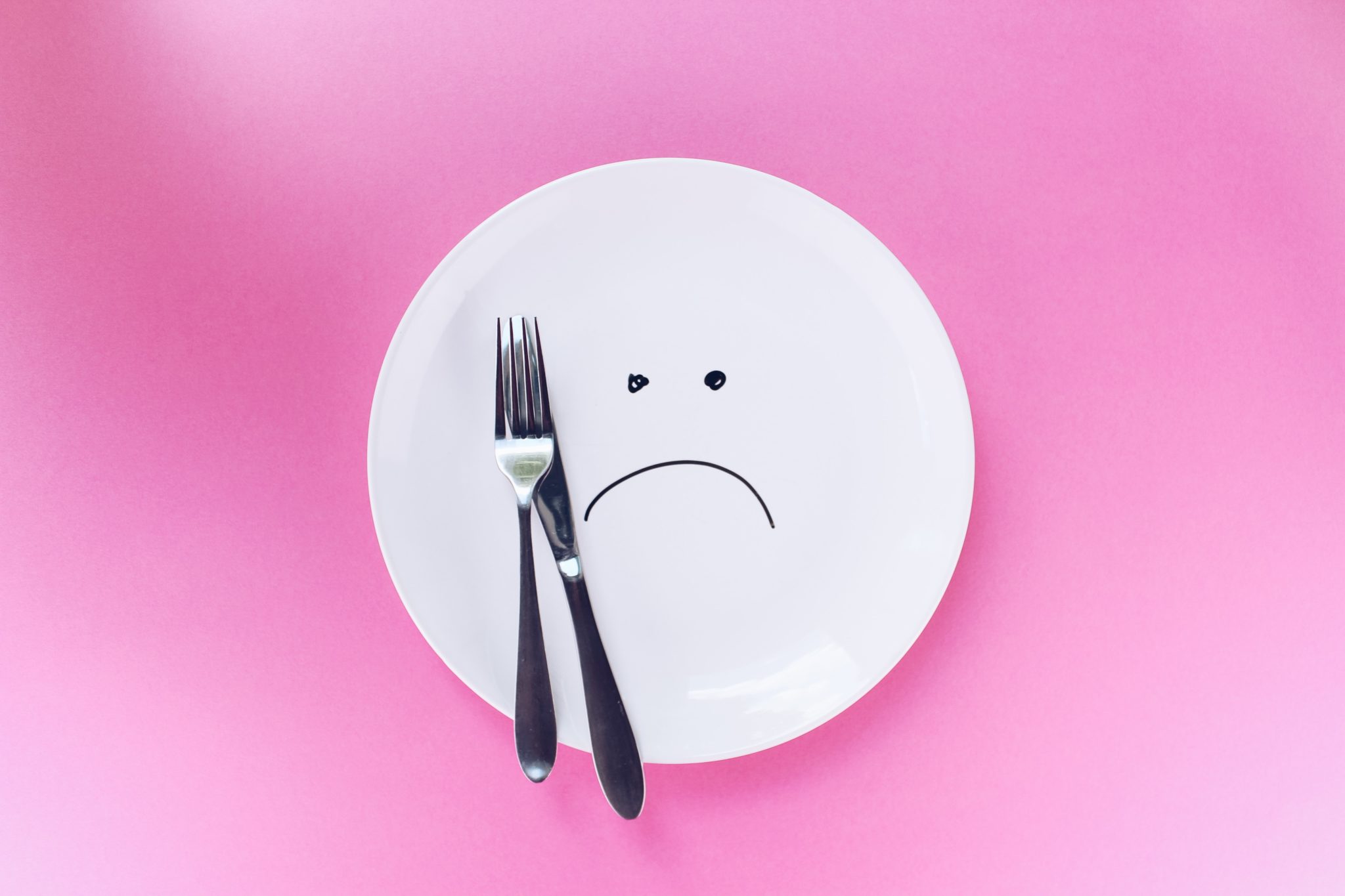
image of a plate with a sad face drawn on top next to a fork and knife against a pink background

Knowing what we know about oils, spreading the message that oil is harmful and “makes you fat” only perpetuates disordered eating and harmful eating disorder behaviours. Fear of oils is very common in eating disorder circles, especially those suffering with orthorexia or anorexia. Having someone who is highly respected in our society, like a doctor, recommend that we avoid oils like the plague will only perpetuate the restrictive food rules and rituals that keep millions of individuals suffering every day. Following a strict no oil rule can also be used to mask disordered eating or an eating disorder as this messaging can be easily be interpreted as being “healthy”. From my own personal experience with orthorexia, I remember how these types of messages would fuel and validated my anxiety around food, giving me another reason to eliminate something from my diet that I truly enjoyed. We need to stop demonizing food and letting go of the good vs bad mentality, and this goes for health professionals, especially! I’ve said it before, and I will continue to say it until I’m blue in the face – ALL foods can fit in the diet, even those that may or may not be considered “healthy”. 

So is Vegetable Oil Bad for You?

In conclusion, should we be swearing off oils as the oil free diet suggests? The answer is a big fat NO. Though not all oils or fats are considered equal, to completely eliminate healthy and beneficial oils from the diet is simply impractical and unfounded by solid scientific research. The benefits of olive oil on heart health are well-established, as are the benefits of coconut oil for improved cholesterol. Other oils like flaxseed and canola oil are rich in omega-3 fatty acids, which has been proven to be highly beneficial for overall health. So, the next time you want to drizzle a bit of olive oil on your salad or use some coconut oil to cook up some dinner on the frying pan, you don’t have to think twice!

Contribution by: Giselle Segovia RD MHSc

Abbey Sharp

Abbey Sharp is a Registered Dietitian (RD), regulated by the Ontario College of Dietitians. She is a mom, YouTuber, Blogger, award winning cookbook author, media coach specializing in food and nutrition influencers, and a frequent contributor to national publications like Healthline and on national broadcast TV shows.
www.abbeyskitchen.com/about-abbey/

Last Updated September 9, 2023. Published September 11, 2023 By Abbey Sharp 2 Comments

Tofu Tacos Recipe with Peanut Sauce | Vegan and Gluten Free!

This vegan tofu tacos recipe with vegan peanut sauce are a great grilled option for when you’re entertaining friends who are vegetarian.

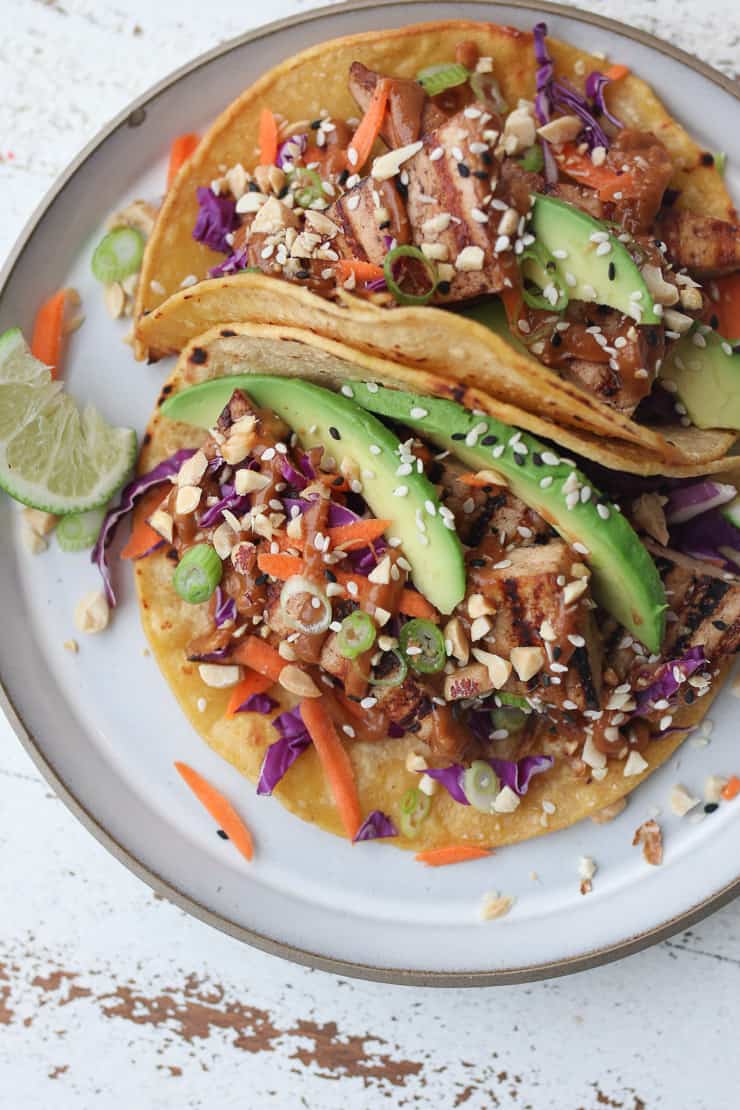
Birds eye view of tofu tacos.

I know when we think about grilled foods, we tend to automatically think meat. Specifically, we think hot dogs and hamburgers (side note: which side are you on?). Well, with so many people going plant-based, you’ll want to put this tofu tacos recipe on the menu.

Table of contents

  • Why This Recipe Works
  • Key Ingredients
  • How To Make This Recipe
  • Expert Tips
  • Recipe FAQs
  • More Recipes You Might Like

Why This Recipe Works

Who doesn’t love a dinner that is delicious, easy to prepare, kid friendly, and ready in just 1 hour? These tofu tacos with peanut sauce are both tasty and filling, and perfect for throwing together at the end of a long summer day.

To balance out the meal, we’ve got plant-based protein in the tofu, healthy fats in the peanut butter and cooking oils, and complex carbs from the tortillas. To bump up the fibre of this meal, I would suggest serving these tofu tacos with a cabbage slaw, or any kind of salad on the side! I promise that any person at your table, plant-based or omnivore, will love this recipe.

Key Ingredients

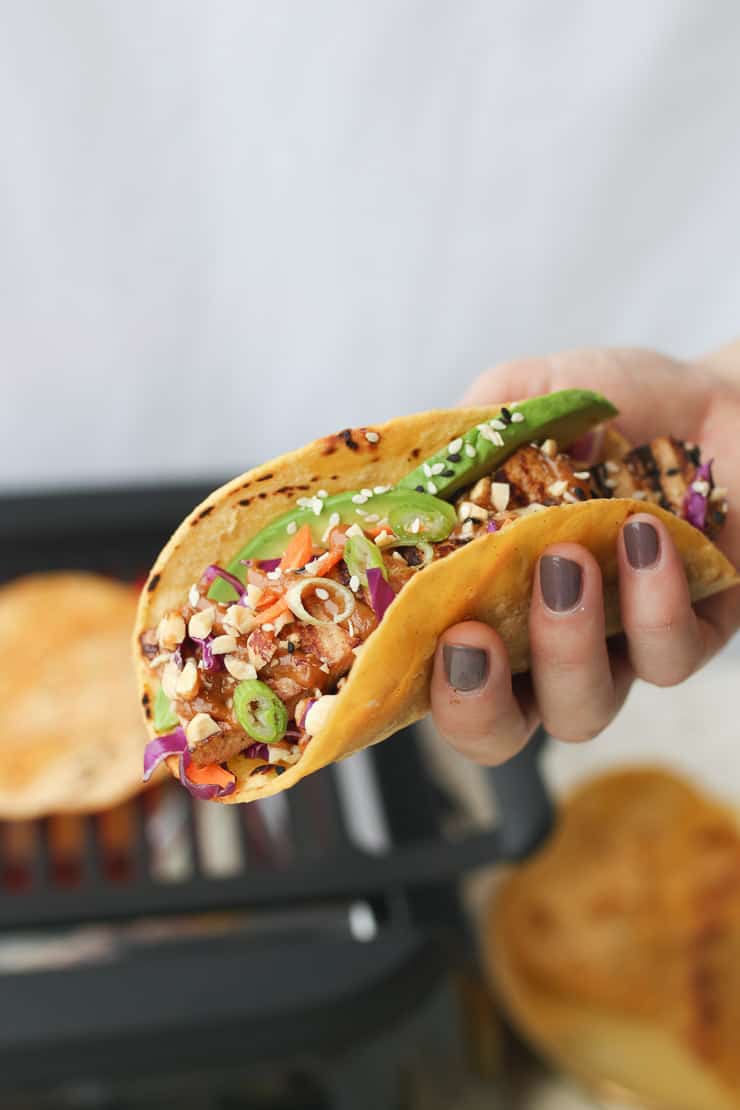
Person who made tofu tacos recipe, holding taco.

Rice Vinegar – I like using “seasoned” rice vinegar for a little extra flavour, but in a pinch you can also use any rice vinegar, or white wine vinegar to this tofu taco recipe.

Low Sodium Tamari – Soy sauce or even coconut aminos work here too, but if you are serving anyone who is gluten free, gluten free tamari is a safe choice.

Sesame Oil – I love a good toasted sesame oil, but again, any sesame oil works.

Coconut Sugar – I love the flavour of coconut sugar in this because it has a bit of a tropical aroma, but in a pinch, just go with brown sugar or maple syrup.

Light Olive Oil – I do prefer a light olive oil to a rich extra virgin olive oil because I don’t want to compete with the big flavour of extra virgin. You can also use any mild grapeseed, avocado oil or vegetable oil.

Ginger & Garlic – These are classic aromatics – you can’t really leave these out and in my opinion, dried do NOT do these two ingredients justice. You want some good punchy flavour.

Sriracha – If you like a good kick!

Extra Firm Tofu – I do prefer to use extra firm tofu so that it stays together on the grill.

Tortillas – I love authentic corn tortillas (and it keeps this recipe gluten free), but of course, use whole wheat flour if that’s what you like.

Creamy Peanut Butter – Sure you can use the chunky stuff, but the creamy version makes these tofu tacos much easier to serve, in my opinion.

Agave or Maple – Gotta balance out that richness!

How To Make This Recipe

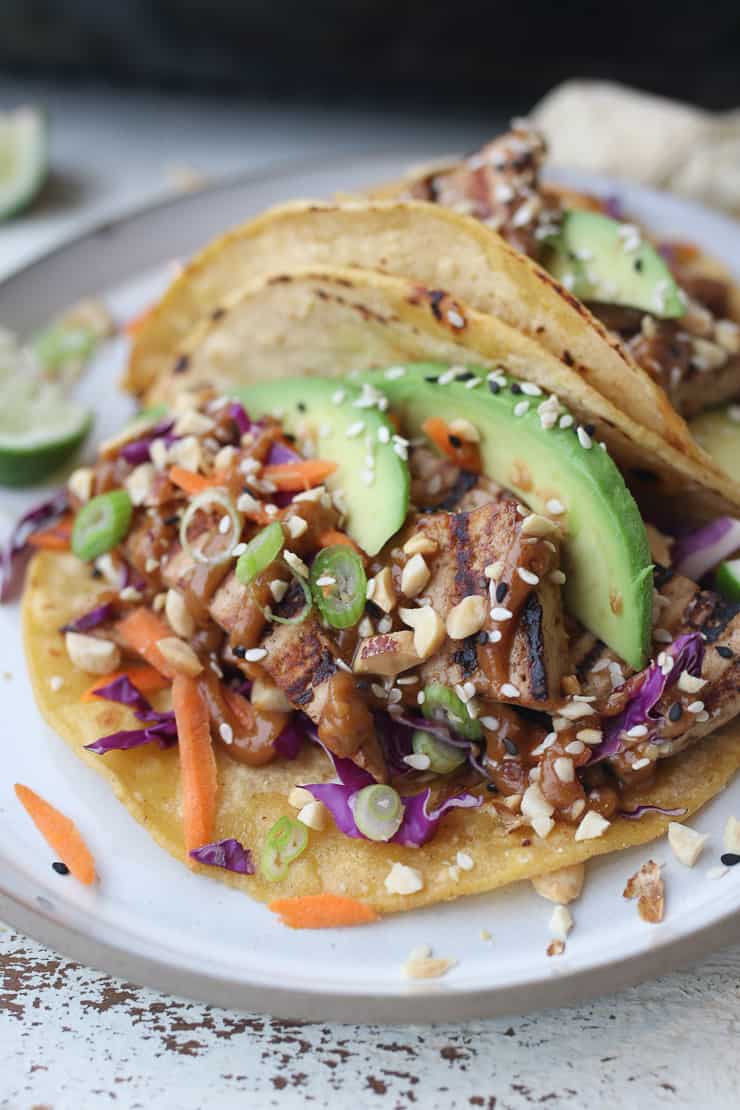
Close up of peanut tofu taco recipe.

Step 1: To a large plastic bag, add in the marinade ingredients and the tofu. Allow to marinate for at least an hour, up to overnight.

Step 2: In a bowl mix together the peanut sauce ingredients.

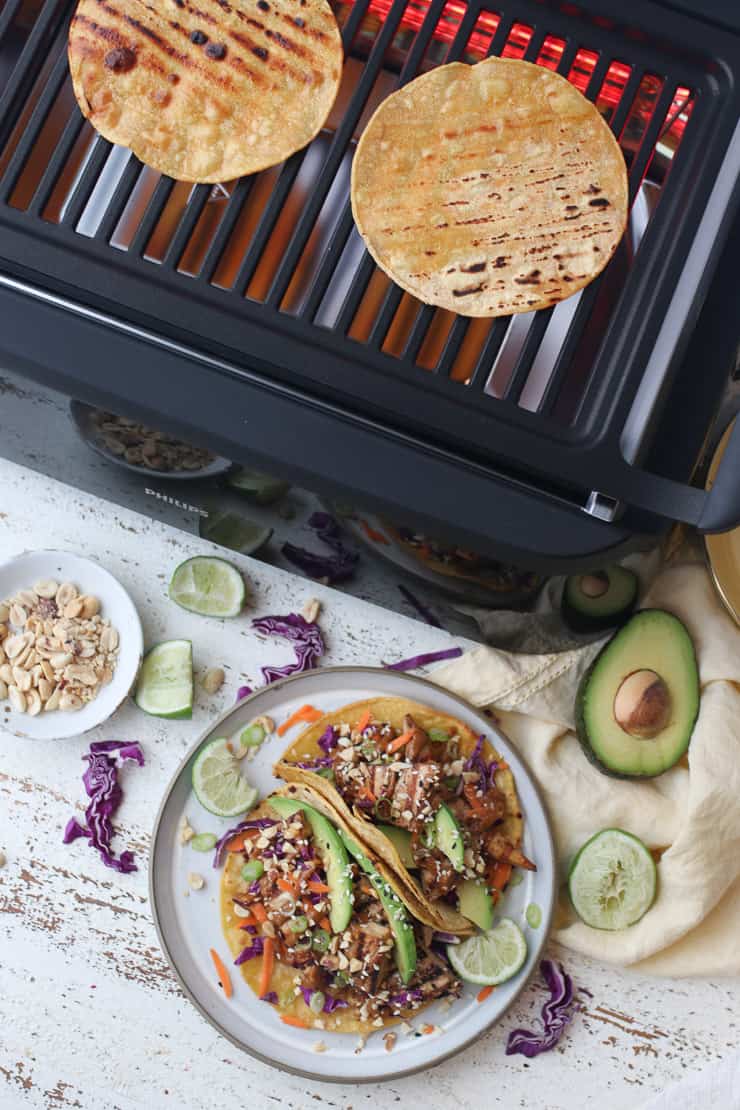
Step 3: Preheat the grill to medium high and add the corn tortillas. Toast on each side just for 30-60 seconds, and keep warm.

Step 4: Add the tofu and cook for 3-4 minutes per side until grill marks appear.

Step 5: To serve, add the tofu to the tortilla shell, top with cabbage, carrots, avocado, lime, green onion, sesame, peanuts and a generous spoonful of the peanut sauce.

Expert Tips

If you don’t want to fire up the BBQ or the grill for this recipe, no problem. To bake the tofu, preheat the oven to 400 F. I recommend brushing the marinade on and baking for 30-35 minutes until crispy. If you want it extra crispy, pop it under the broiler. To pan-fry, heat a tablespoon of oil in a large skillet (ideally cast iron) over medium high heat. Marinate the tofu and then pan-fry until golden brown on each side.

For my peanut-allergic friends, feel free to swap the peanut butter in this recipe for any other nut or seed butter of your choice. Sunbutter, tahini, almond butter, and cashew butter would all be delicious peanut free substitutes!

Recipe FAQs

What else can I put this peanut sauce with?

I’m obsessed with peanut sauce because it’s kind of sweet, savoury and super rich and creamy. It’s ideal on naturally lean foods like tofu, chicken breasts, veggies, and sweet potatoes. 

What should I serve these tofu tacos with?

Literally any kind of slaw or salad would work well here, or you could even try making cilantro lime rice to go on the side! I also love this with baked beans (vegan style of course).

Is this tofu taco recipe kid friendly?

What kiddo doesn’t love tacos? Of course this can be kid-friendly and mine loves peanut sauce! If your children are sensitive to spice, I suggest cutting back on the sriracha (you can always add it to your tacos when you serve them).

Making a tofu tacos recipe on the grill, with a plate of tofu tacos on the counter.

More Recipes You Might Like

If you liked this tofu tacos recipe, then you might also enjoy some of the other easy dinner recipes on the blog:

  • Vegan Buffalo Cauliflower Chickpea Hard Tacos 
  • Peach BBQ Chicken Tacos
  • Vegan Walnut Meat Cauliflower Tacos 
  • Roasted Broccoli Salad with Tahini
  • Vegan Baked Beans
  • Vegan Pesto Pasta Salad

What are you making for Taco Tuesday? Leave me a comment below if you tried these tofu tacos or the vegan peanut sauce!

Print Recipe
5 from 1 vote

Tofu Tacos with Peanut Sauce (Vegan & Gluten Free Summer Dinner)

These tofu tacos with vegan peanut sauce are a great grilled option for a Summer BBQ when you're entertaining friends who are vegetarian.
Prep Time1 hour hr
Cook Time10 minutes mins
Total Time1 hour hr 10 minutes mins
Course: Dinner, Lunch
Cuisine: American, Mexican
Servings: 4
Calories: 363kcal
Author: Abbey Sharp

Ingredients

Marinade:

  • 5 tbsp seasoned rice vinegar
  • 5 tbsp low sodium tamari gluten free if needed
  • 1 ½ tsp toasted sesame oil
  • 1 tsp coconut sugar
  • 1 ½ tbsp light olive oil
  • 1 clove garlic finely grated
  • 1 tsp sriracha or more to taste
  • 1 block extra firm tofu cut into 1/4″ thick triangles

Peanut Sauce:

  • ½ cup creamy peanut butter
  • ¼ cup reduced sodium tamari gluten free if needed or reduced-sodium soy sauce
  • 3 tablespoons seasoned rice vinegar
  • 3 tablespoons water
  • 2 tablespoons agave nectar or maple syrup
  • 1 teaspoon grated fresh ginger
  • 2 cloves garlic pressed or very finely minced
  • 1 tsp sriracha or more to taste

For serving:

  • 8 small corn tortillas for serving
  • Shredded red cabbage
  • Shredded carrot
  • Avocado thinly sliced
  • Lime
  • Thinly sliced green onion
  • Sesame seeds
  • Crushed peanuts

Instructions

  • To a large plastic bag, add in the marinade ingredients and the tofu. Allow to marinate for at least an hour, up to overnight.
  • Meanwhile, in a bowl mix together the peanut sauce ingredients.
  • Preheat the grill to medium high and add the corn tortillas. Toast on each side just for 30-60 seconds, and keep warm.
  • Add the tofu and cook for 3-4 minutes per side until grill marks appear.
  • To serve, add the tofu to the tortilla shell, top with cabbage, carrots, avocado, lime, green onion, sesame, peanuts and a generous spoonful of the peanut sauce. Enjoy!

Notes

If you don’t want to fire up the BBQ or the grill for this recipe, no problem. To bake the tofu, preheat the oven to 400 F. I recommend brushing the marinade on and baking for 30-35 minutes until crispy. If you want it extra crispy, pop it under the broiler. To pan-fry, heat a tablespoon of oil in a large skillet (ideally cast iron) over medium high heat. Marinate the tofu and then pan-fry until golden brown on each side.
For my peanut-allergic friends, feel free to swap the peanut butter in this recipe for any other nut or seed butter of your choice. Sunbutter, tahini, almond butter, and cashew butter would all be delicious peanut free substitutes!

Nutrition

Calories: 363kcal | Carbohydrates: 20g | Protein: 17g | Fat: 25g | Saturated Fat: 5g | Sodium: 1466mg | Potassium: 449mg | Fiber: 2g | Sugar: 11g | Vitamin C: 2mg | Calcium: 64mg | Iron: 3mg
Abbey Sharp

Abbey Sharp is a Registered Dietitian (RD), regulated by the Ontario College of Dietitians. She is a mom, YouTuber, Blogger, award winning cookbook author, media coach specializing in food and nutrition influencers, and a frequent contributor to national publications like Healthline and on national broadcast TV shows.
www.abbeyskitchen.com/about-abbey/

Last Updated September 28, 2023. Published September 8, 2023 By Abbey Sharp 16 Comments

Slow Cooker Shredded Chicken Tacos with Peaches

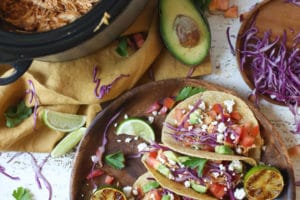
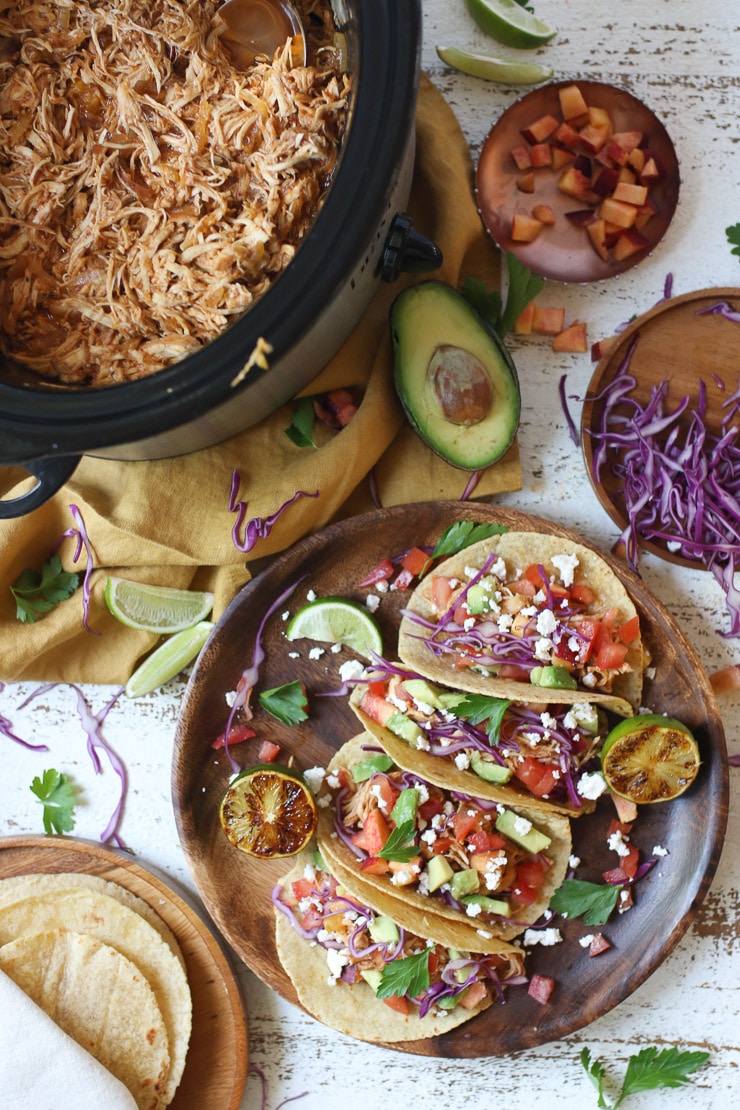
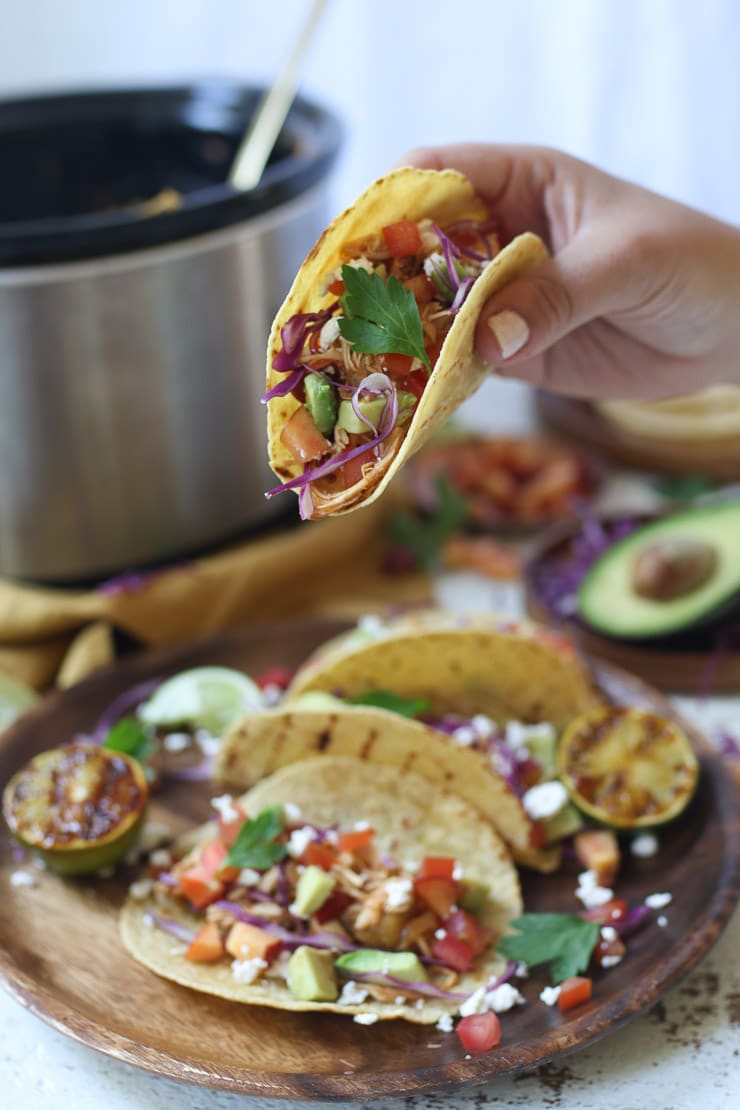
Chicken tacos on a wooden plate next to slow cooker with pulled chicken.

These slow cooker shredded chicken tacos is an easy, healthy gluten free dinner recipe that will help get you OUT of the hot kitchen!

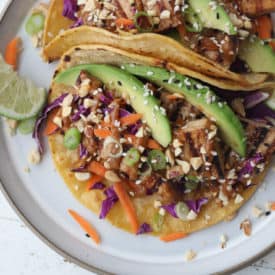
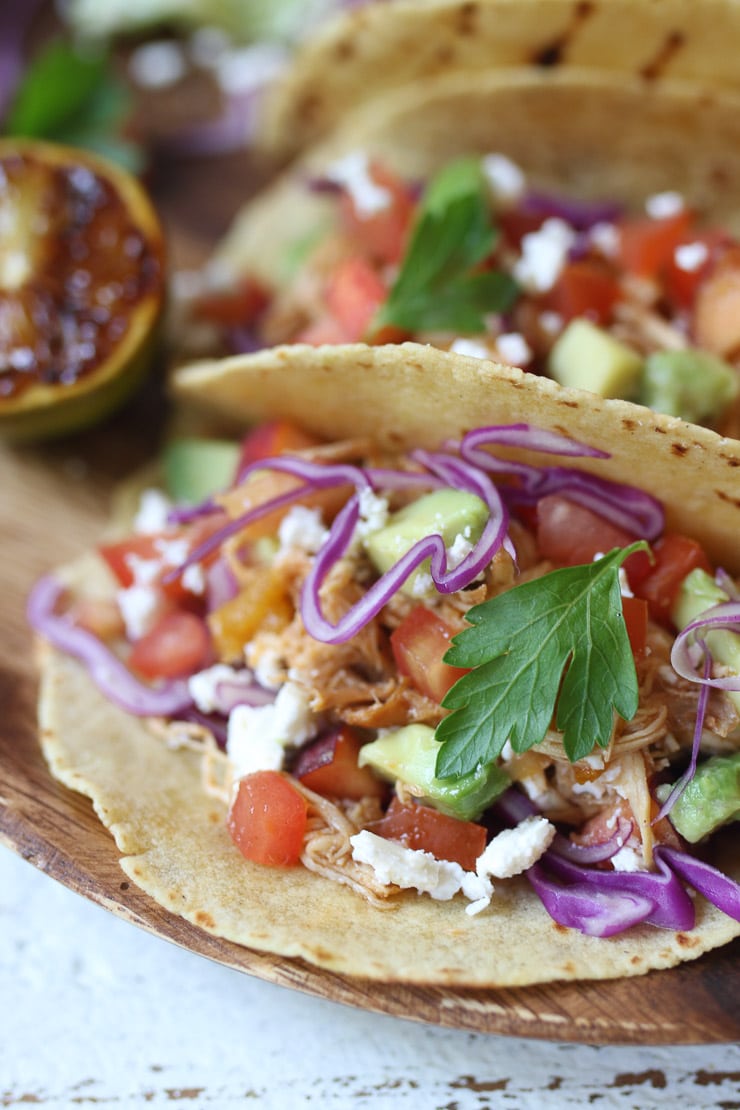
Close up of pulled chicken tacos with peaches.

When I think of summer, I think BBQ and I think seasonal produce like peaches, so it was only a matter of time that put these two delicious warm-weather staples together into these awesome slow cooker chicken tacos. This sauce is delicately sweet and mildly spicy without being overly sauced, gloopy or sugary.

Table of contents

  • Why This Recipe Works
  • Key Ingredients
  • How to Make This Recipe
  • Recipe FAQs
  • More Recipes You May Like

Why This Recipe Works

I LOVE the idea of using the slow cooker in the summer because it’s a great way to avoid heating up the whole kitchen with the stove or oven.

This recipe simply calls for chicken breasts (but, like I said, thighs would also work really well), and a combination of low sugar BBQ sauce, some diced peeled peaches and minced up chipotle in adobo sauce. It legit takes a few simple steps to whip this up. The best part is that you can do this in like 15 minutes, walk away and have an amazing meal ready at 6 PM when everyone is losing their shit.

Key Ingredients

Chicken – I use skinless boneless chicken breast for this recipe, but chicken thighs would also work very well in this recipe. 

Peaches – Peaches are the key ingredient in this recipe that really makes the tacos sing! The natural sweetness and texture of the peaches really brings out the zesty bbq flavour and ugh. just. delish. 

BBQ Sauce – BBQ sauce all day everyday, am I right?? I am pretty much obsessed with this stuff but I make sure to opt for a low sugar variety. 

Chipotle Peppers in Adobo Sauce – Friends, if you are not already using chipotle peppers in adobo sauce this is the perfect recipe to introduce this magical spicy ingredient to you all! These chipotle peppers give the tacos such a rich depth of flavour. However, it can be easy to go over board on the spice so if you can’t tolerate spice very well I would introduce them slowly. 

Corn Tortillas – We use corn tortillas to make this recipe gluten free, but you can absolutely use flour tortillas or lettuce cups instead. 

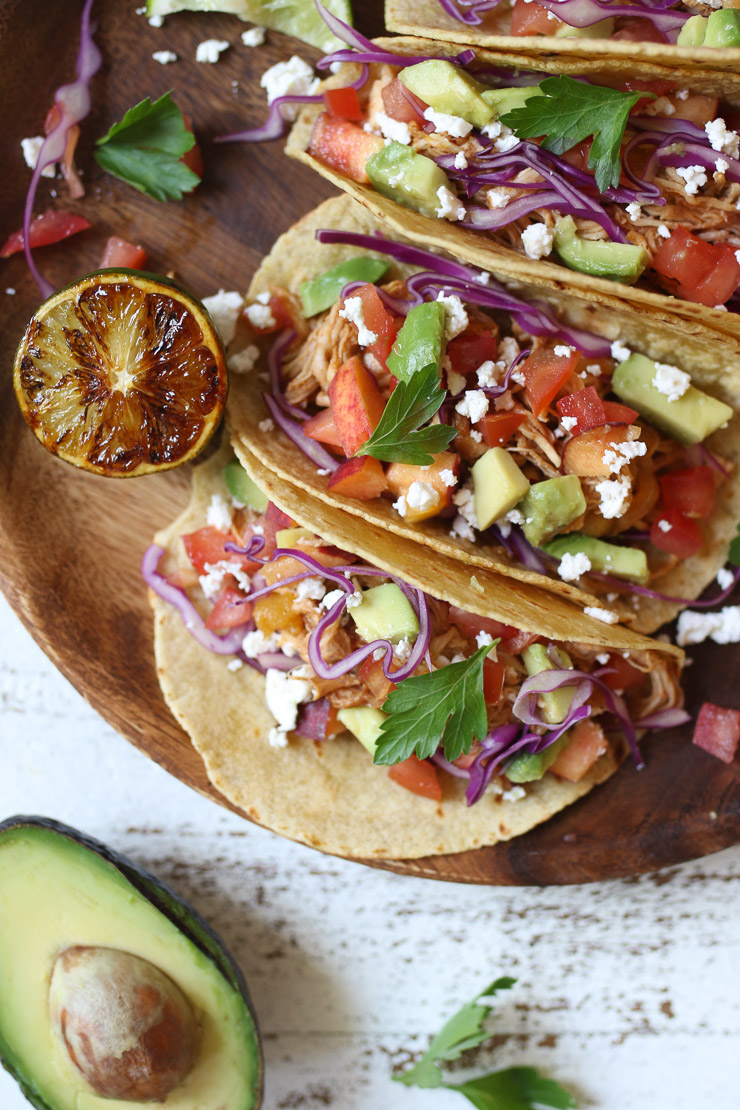
Toppings – For this recipe I like to top my peach BBQ chicken taocs with shredded cabbage, diced tomato, avocado and feta cheese with a squeeze of lime juice. Feel free to play around with whatever toppings you have on hand. 

How to Make This Recipe

Chicken tacos on a wooden plate next to slow cooker with pulled chicken.

Step 1: Heat the olive oil in a nonstick skillet over medium high heat. Pan fry the chicken and onions just until the chicken is golden brown on each side.

Step 2: Put the peaches into the slow cooker and add the chicken, onions, BBQ, apple cider vinegar and chipotle. Cook on high for 3-4 hours or low for 6-7 hours.

Step 3: Remove the lid and continue to cook the sauce on high. Remove the chicken and pull it into shreds. Return to the slow cooker to toss with the sauce. Adjust with salt and pepper, to taste.

Step 4: Assemble your tacos! Pile the chicken into the taco shells and top with cabbage, peaches, tomatoes, avocado, feta, lime and cilantro, to taste.

Pulled chicken tacos topped with slaw and cilantro.

Expert Tips

If you don’t have the time to make your own homemade BBQ sauce, not to worry, there are so many great options on the market nowadays! I personally love the FODY brand of BBQ sauce, especially for those who are sensitive to garlic and/or onions.

This recipe would also be a great addition to any sort of harvest bowl if tacos aren’t your thing. You could use the exact same ingredients for the tacos and put them over rice or quinoa, instead of tortillas! The perfect easy weeknight meal.

Recipe FAQs

Can you make these peach bbq slow cooker chicken tacos without a crockpot?

Yep! The pulled chicken and peach BBQ sauce could easily be done in a dutch oven and baked in the oven until tender and cooked through. I recommend setting the oven to 325 F and baking for about 90 minutes or until the chicken reaches an internal temperature of 165 F.

Can you make chicken sandwiches instead of tacos?

For sure! Super easy to throw slow cooker pulled chicken and peach BBQ sauce onto a fluffy brioche and forgo the tacos. Just keep in mind that if you want to keep it gluten free, you’ll have to choose a gluten free bun.

What can I use instead of peaches for this recipe?

Any sweet summer fruit like pineapple or mango would be absolutely divine in this recipe! 

Hand holding a pulled chicken taco.

More Recipes You May Like

If you liked this recipe for slow cooker shredded chicken tacos, you might enjoy some of the other taco recipes on the blog!

  • VEGAN BUFFALO CAULIFLOWER AND CHICKPEA TACOS 
  • VEGAN WALNUT MEAT CAULIFLOWER TACOS WITH PICKLED BEETS 
  • VEGAN TACO CASSEROLE 
  • BEST HEALTHY TACO RECIPES FOR CINCO DE MAYO 
  • SLOW COOKER TOFU TACOS WITH VEGAN PEANUT SAUCE

So tell me, do you use your slow cooker in the summer? What do you like to make?

Leave me a comment below with your favourite slow cooker recipes. 

Pulled chicken tacos topped with slaw and cilantro.
Print Recipe
5 from 9 votes

Slow Cooker Shredded Chicken Tacos with Peaches

These slow cooker shredded chicken tacos is an easy, healthy gluten free summer dinner recipe that will help get you OUT of the hot kitchen!
Prep Time15 minutes mins
Cook Time3 hours hrs
Total Time3 hours hrs 15 minutes mins
Course: Dinner, Lunch
Cuisine: American, Mexican
Servings: 8 people
Calories: 272kcal
Author: Abbey Sharp

Equipment

  • slow cooker

Ingredients

Pulled Peach Chicken:

  • 1 tbsp Extra virgin olive oil
  • 2 lb Skinless boneless chicken breasts cut in half
  • 1 Sweet onion thinly sliced
  • 2 cups Peeled peaches thinly sliced
  • ¾ cup Low sugar BBQ sauce
  • ¼ cup Apple cider vinegar
  • 2 Chipotle in adobo sauce minced
  • Salt and pepper to taste

For Serving:

  • Corn tortillas toasted
  • Shredded red cabbage
  • 1 Peach diced
  • 1 Roma tomato seeded and dicedd
  • 1 Avocado diced
  • Feta crumbled
  • Lime wedges
  • Cilantro

Instructions

  • Preheat the slow cooker on high.
  • Meanwhile, heat the olive oil in a nonstick skillet over medium high heat. Pan fry the chicken and onions just until the chicken is golden brown on each side. Set aside.
  • Put the peaches into the slow cooker and add the chicken, onions, BBQ, apple cider vinegar and chipotle. Cook on high for 3-4 hours or low for 6-7 hours.
  • Remove the lid and continue to cook the sauce on high. Remove the chicken and pull it into shreds. Return to the slow cooker to toss with the sauce. Adjust with salt and pepper, to taste.
  • Pile the chicken into the taco shells and top with cabbage, peaches, tomatoes, avocado, feta, lime and cilantro, to taste.

Notes

If you don’t have the time to make your own homemade BBQ sauce, not to worry, there are so many great options on the market nowadays! I personally love the FODY brand of BBQ sauce, especially for those who are sensitive to garlic and/or onions.
This recipe would also be a great addition to any sort of buddha bowl if tacos aren’t your thing. You could use the exact same ingredients for the tacos and put them over rice or quinoa, instead of tortillas! The perfect easy weeknight meal.

Nutrition

Calories: 272kcal | Carbohydrates: 23g | Protein: 26g | Fat: 9g | Saturated Fat: 1g | Cholesterol: 73mg | Sodium: 460mg | Potassium: 785mg | Fiber: 4g | Sugar: 8g | Vitamin A: 570IU | Vitamin C: 10.9mg | Calcium: 28mg | Iron: 1.1mg
Abbey Sharp

Abbey Sharp is a Registered Dietitian (RD), regulated by the Ontario College of Dietitians. She is a mom, YouTuber, Blogger, award winning cookbook author, media coach specializing in food and nutrition influencers, and a frequent contributor to national publications like Healthline and on national broadcast TV shows.
www.abbeyskitchen.com/about-abbey/

Last Updated September 28, 2023. Published September 6, 2023 By Abbey Sharp 11 Comments

Supplements and Diet for Hypothyroidism | Tips from a Registered Dietitian (Free E-Book!)

I discuss a diet for hypothyroidism, supplements, and highlights from my e-book which you can download from this post!

GET THE E-BOOK

I have gotten TONS of requests to address a diet for hypothyroidism, as well as specific questions about the condition and how to manage it. I assure you; I hear you and I have been gathering all these questions and have come up with an “all-in-one” resource to answer just about any question you may have! All of your questions, as well as an extensive overview of hypothyroidism and how to manage it with medicine and nutrition, have been addressed in the new virtual e-booklet that is now available for download! 

We are currently experiencing technical issues with the e-book. If you have not received it after signing up, please email [email protected].

This post is a very condensed version of the types of content you will find in the e-booklet (but of course, we go into the research and a lot more detail), so if there is anything you want specific answers to or clarification on, refer to FULL book!

What is the Thyroid & What Does it Do?

The thyroid is a small gland that is a massively important part of our everyday lives. It is responsible, in part, for maintaining a healthy metabolism, hormone functions, energy levels, and MUCH more. The way it does all this is by producing our two thyroid hormones: triiodothyronine (T3) and thyroxine (T4). Our thyroid hormones closely regulate our body weight as well as our metabolism.

What is Hypothyroidism?

Hypothyroidism refers to the underproduction, or reduced levels, of these thyroid hormones. It is also commonly referred to as an “underactive thyroid”. In Western society, 1-2% of the population has been diagnosed with this condition.

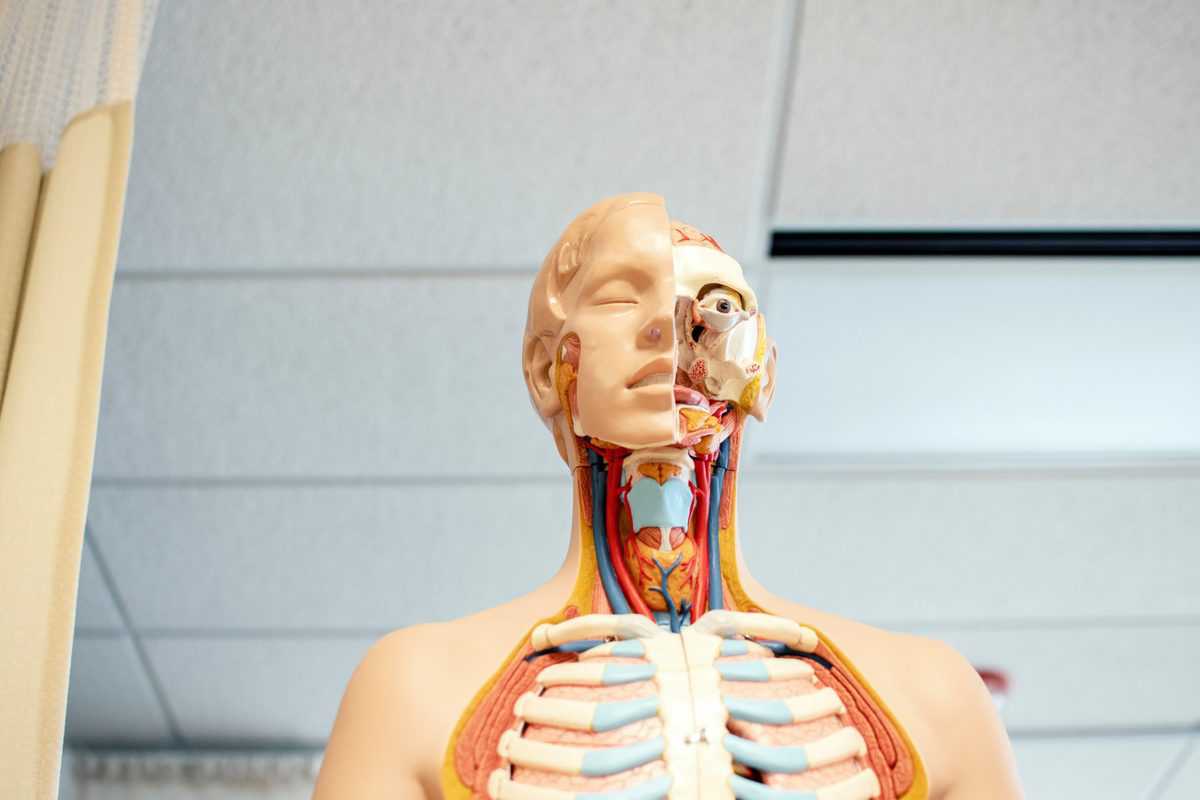
A medical dummy showing the location of the thyroid gland.

Symptoms of Hypothyroidism

Hypothyroidism is associated with a slowed metabolism, changes in energy storage and use, and an increase in cholesterol levels. These changes within our body can influence an array of symptoms, including tiredness, mental slowness, impaired memory, lethargy or sluggishness, feeling intolerant to the cold, unexplained weight gain, dry skin or hair, hair loss, and irregularities with bowel movements and/or menstrual cycles.

Weight gain and appetite will be highlighted in much greater detail in the virtual e-booklet.

What Causes Hypothyroidism?

Hypothyroidism is most commonly caused by an autoimmune disease which impacts the thyroid (i.e. Hashimoto’s), but may also be influenced by other diseases that predispose individuals to other autoimmune diseases (i.e. Celiac), an inflamed thyroid (i.e. Thyroiditis, which can happen postpartum or due to a viral infection), iodine deficiencies or toxicities, external radiation therapy, trauma, or a tumor of the neck or head, various drugs, and/or an underdeveloped thyroid.

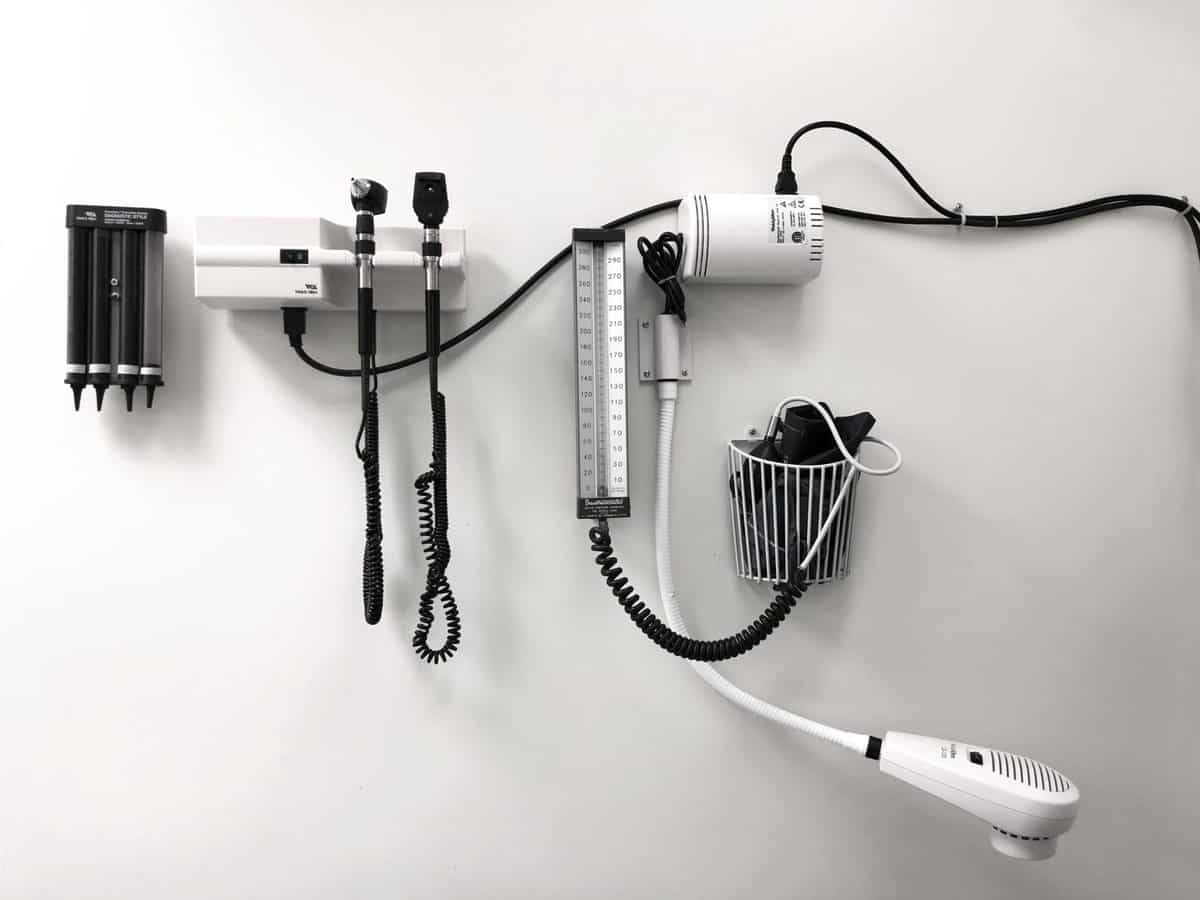
A doctors office with equipment to diagnose hypothyroidism.

 How to Get Diagnosed with Hypothyroidism

A proper diagnosis for hypothyroidism can only be made with a medical professional (i.e. a doctor), using a patient’s history and laboratory measurements (i.e. blood and urine samples). Several blood tests that are regularly ordered to assess thyroid function, including T3, T4, Thyroid Stimulating Hormone (TSH), as well as tests for the antibodies that may be present in the case of an autoimmune disease.

Other Potential Connections Involved in Hypothyroidism

An underactive thyroid has been tied to MANY different disturbances that can occur in our body – which go above and beyond the list of common symptoms. These include, but may not be limited to:

  • Complications with pregnancy and postpartum thyroiditis
  • Poor digestion and unique issues with the digestive tract
  • Hypertension and high blood pressure
A black stethoscope on top of a brown case.

If you are interested in finding out more about how an underactive thyroid may impact any of these things, there is an extensive look into each in the e-booklet.

Medical Interventions and Diet for Hypothyroidism

While following a diet for hypothyroidism is recommended for those with an underactive thyroid, in most cases it is not enough to cure the condition – but a healthy diet filled with the right nutrients for your body’s needs, as well as medication or supplements prescribed by a medical professional, can help to restore the normal functioning of your thyroid.

Medications

For those people living with hypothyroidism, thyroid hormone replacement therapy is the gold standard for treatment. The most commonly recommended medications are aimed at supplementing the body with T4 – the common name for the medication is Levothyroxine.

Levothyroxine can have diverse side effects, including increased appetite, weight loss, heat sensitivity, mood alterations, and fatigue. If your side effects last more than a few days or weeks, or are impacting your quality of life, reach out to your health care provider to discuss the problems you are experiencing with them.

There are also special considerations that should be considered when taking these medications, as several nutrients can interfere with their absorption. These include:

  • Calcium
  • Iron
  • Fibre
  • Soy
  • Coffee
A cup of coffee on a table.

If you are taking thyroid hormone replacement medications and are at all concerned with the timing of your medication use interfering with one or more of the above nutrients, please see the detailed list of recommendations in the linked resource.

Diet for Hypothyroidism

What to Eat

There are several important nutrients that should be included in your diet to maximize your thyroid and overall health, these include:

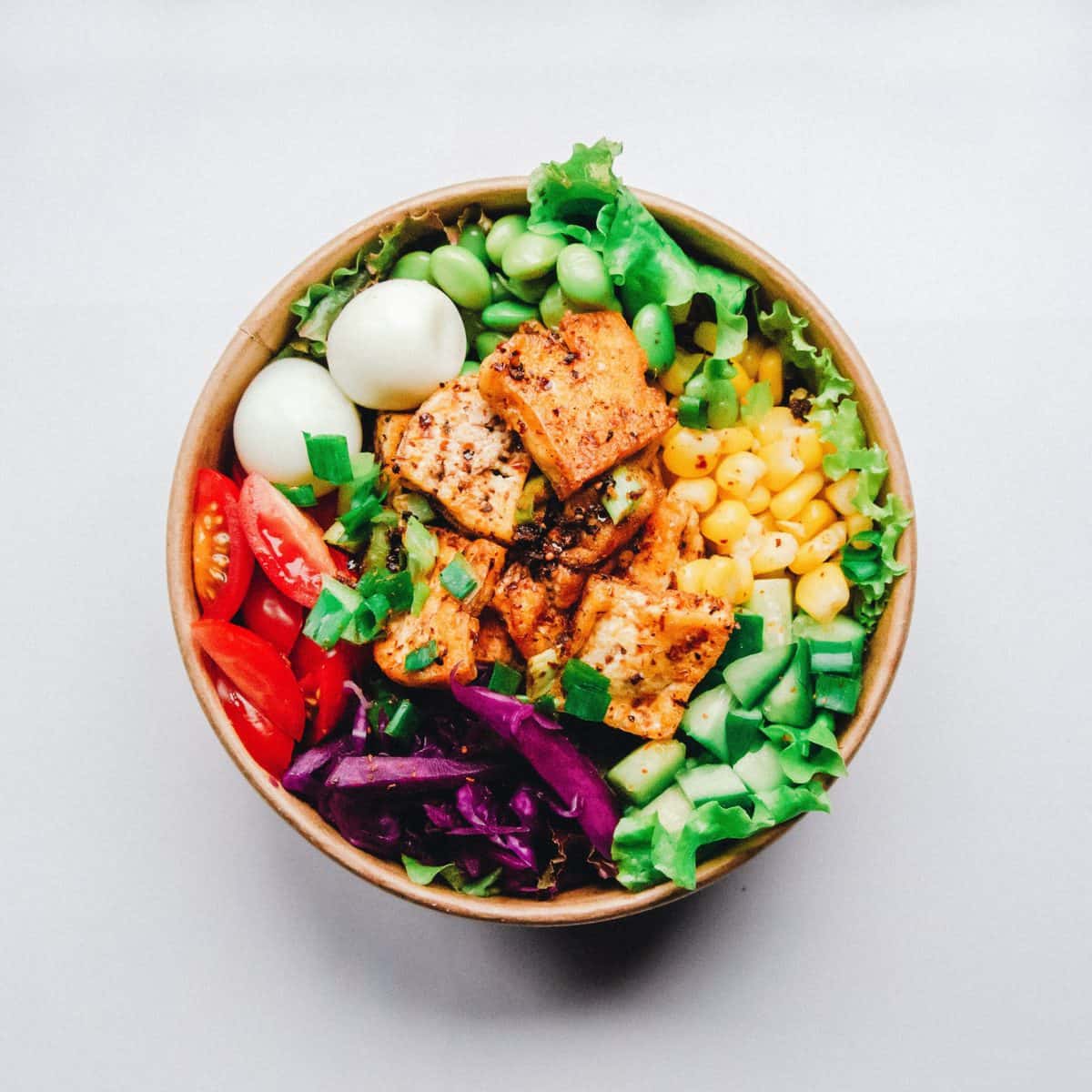
A bowl full of colourful vegetables to eat on a diet for hypothyroidism.
  • Iodine
  • Selenium
  • Zinc
  • Copper
  • Vitamin B-12
  • Iron
  • Tyrosine

It is important to also understand why these nutrients are important to include in your diet, so refer to the e-booklet to get more information on why we need these nutrients, how they interact with our thyroid, how much we need, as well as which foods offer the most concentrated sources of each one!

What to Avoid

There are several foods that should be eaten in moderation if you have been diagnosed with hypothyroidism and/or have an iodine deficiency. These foods include:

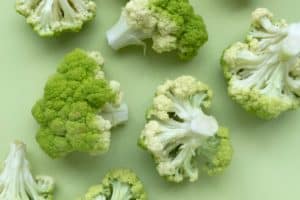
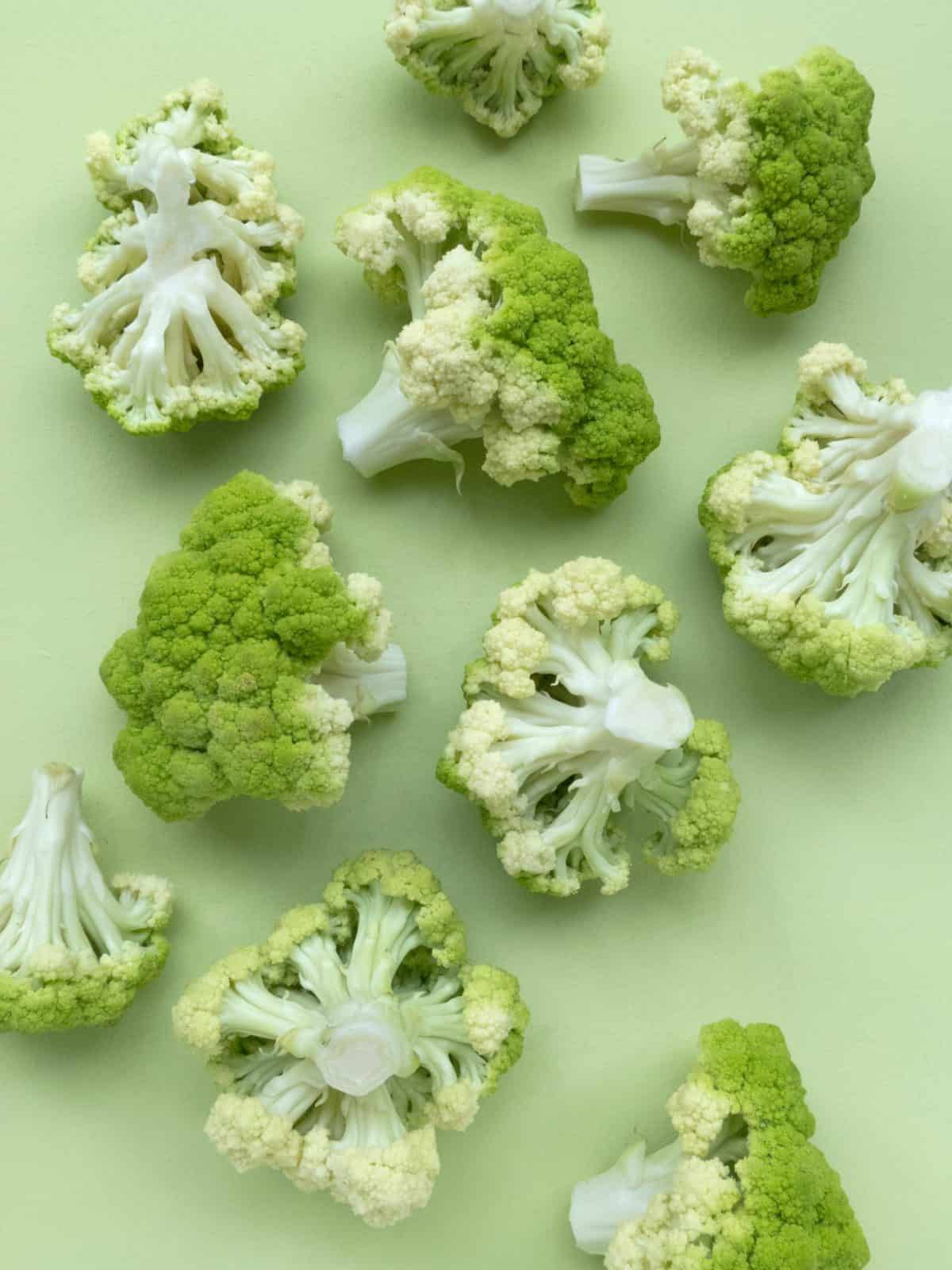
A variety of broccoli florets which should be avoided with hypothyroidism.
  • Raw cruciferous vegetables
  • Excessive soy-products
  • Certain fruits like almonds, cherries, and peaches
  • Certain starches like millet, sweet potato, and tapioca
  • Alcoholic beverages

There are also certain diets, which have been promoted as beneficial for an underactive thyroid, which should actually be avoided – unless counter-indicated by a doctor or a diagnosed condition. These include:

  • The ketogenic diet
  • A gluten-free diet (unless celiac or gluten-sensitive)

If you are interested in finding out more about why these are not supported by the evidence, the e-booklet highlights this.

Natural Supplements

There are several natural supplements or alternative medicines that have been popularized for their supposed thyroid stimulating abilities. These include:

  • Ashwagandha
  • Coleus
  • Gota Kula
  • Guggal
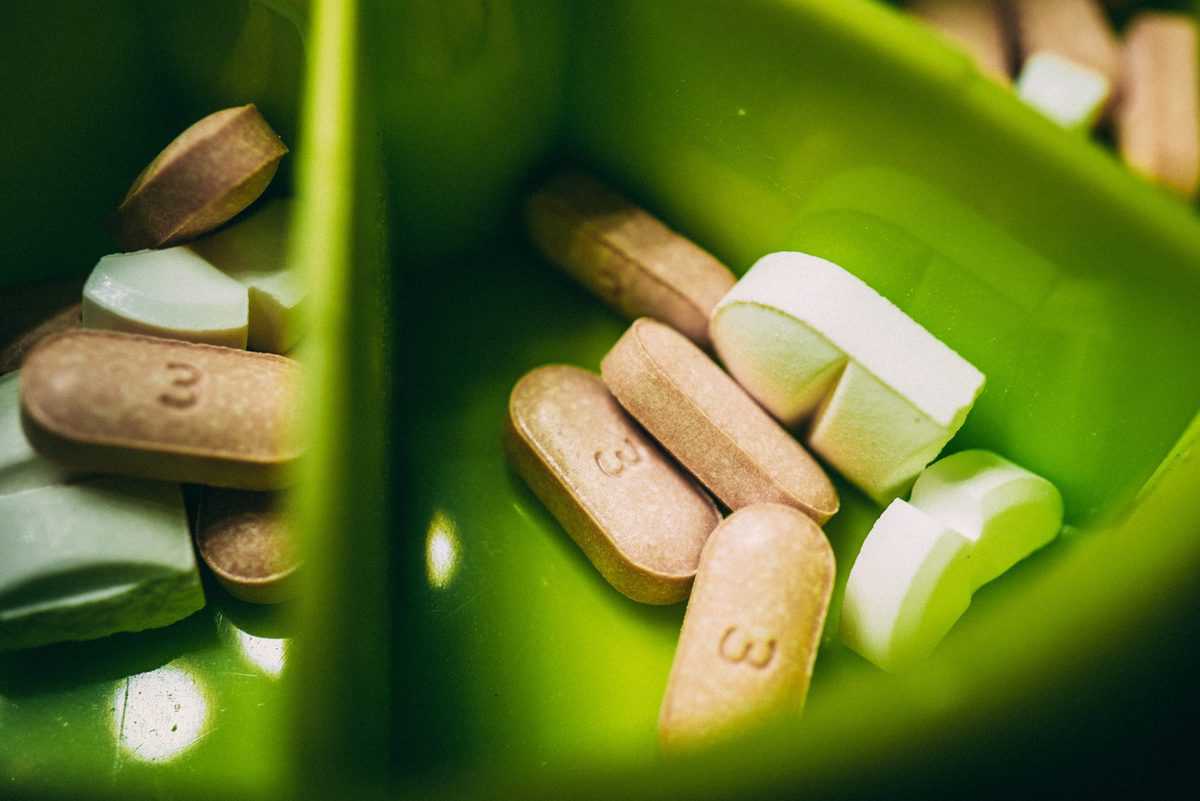
A bunch of pills and supplements.

However, because that there is limited scientific evidence to support the supplementation of most of these natural remedies for the treatment of an underactive thyroid, and because these herbs interact with various medications, their use should always be overseen by a medical professional.

Getting the FULL E-Book on Supplements and Diet for Hypothyroidism

Hypothyroidism, an underactive thyroid, can cause an array of metabolic and overall health disturbances. The most common symptoms include fatigue, cold intolerance, hair loss, and weight gain. This condition can be linked to many different health concerns, including gastrointestinal problems, hypertension, infertility, anemia, and more.

Luckily, there are tests that can effectively diagnose this condition and medications to treat it. In addition to taking medications, there is an abundance of foods that can be incorporated into the diet to help optimize your recovery from hypothyroidism. Following a “hypothyroid friendly” diet, in combination with medications like Levothyroxine, is the best-known way to alleviate symptoms and effectively treat an underactive thyroid.

For more details on any of the topics touched on in this post, and more, refer to the extended version that is now available as a downloadable e-booklet!

Contribution by Amber Whittemore 

More Blog Posts You Might Like

If you enjoyed this post, check out these next:

  • The Hormone Balance Diet | Are Your Hormones Causing Weight Gain?
  • How to Speed Up Metabolism | Best Metabolism Boosters
  • Sugar Bear Hair Gummies | Do They Work?
  • Are Supplements Safe? (How to Choose the Right Supplement)

Now, I want to hear from you: have you found supplements and diets for hypothyroidism management? What works for you?

Abbey Sharp

Abbey Sharp is a Registered Dietitian (RD), regulated by the Ontario College of Dietitians. She is a mom, YouTuber, Blogger, award winning cookbook author, media coach specializing in food and nutrition influencers, and a frequent contributor to national publications like Healthline and on national broadcast TV shows.
www.abbeyskitchen.com/about-abbey/

Last Updated September 3, 2023. Published September 4, 2023 By Abbey Sharp 16 Comments

Peanut Butter and Jelly Cookies (Vegan & Low Sugar)

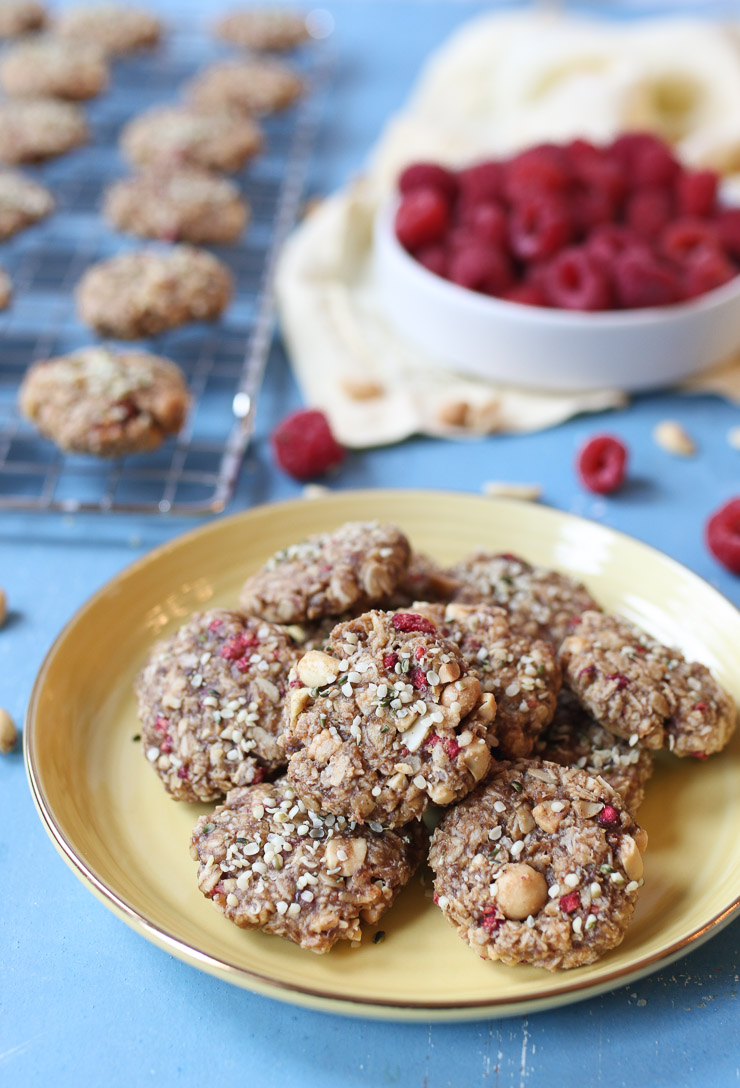
Hand holding a cookie near a yellow plate with cookies.

These Peanut butter and Jelly cookies are delicious low sugar healthy cookies that you will be happy to offer morning, noon, or night!

A picture of the peanut butter and jelly cookies on a yellow plate, and a hand holding one cookie.

When I was a kid, I saw a commercial on TV for “Cookie Crisp” breakfast cereal and BEGGED my mother to find it for me. When she reported back that it was an American thing, and unavailable in Canada, I was CRUSHED. Naturally, I’ve since made it my mission to make breakfast cookies a reality AND to do it in a legitimately balanced way. These peanut butter and jelly cookies are so nutrient-dense, they’ve become my go-to snack morning, noon and night

Table of contents

  • Key Ingredients 
  • How to Make This Recipe
  • Expert Tips
  • Recipe FAQs
  • More Recipes You Might Like

Why This Recipe Works

There are so many reasons to become obsessed with these cookies and ensure they’re suitable to serving for breakfast. First of all, they’re naturally low in added sugars, with just a bit of maple syrup, sweetened naturally with banana and freeze-dried raspberries.

I also love that these vegan breakfast cookies are loaded with lots of fibre from oats, hemp hearts, and nuts, as well as healthy fats (both omega 3s and monounsaturated fats). The result is a healthy cookie that won’t spike your blood sugar and leave you ravenous by 10 AM raiding the lunch room snack box. Here are a few more reasons why I love this recipe:

  • Toddler approved! Perfect for baby-led weaning
  • Vegan-friendly
  • Low in sugar
  • Perfect for snacking
  • Contains 6g of protein and 3g of fibre per cookie

Key Ingredients 

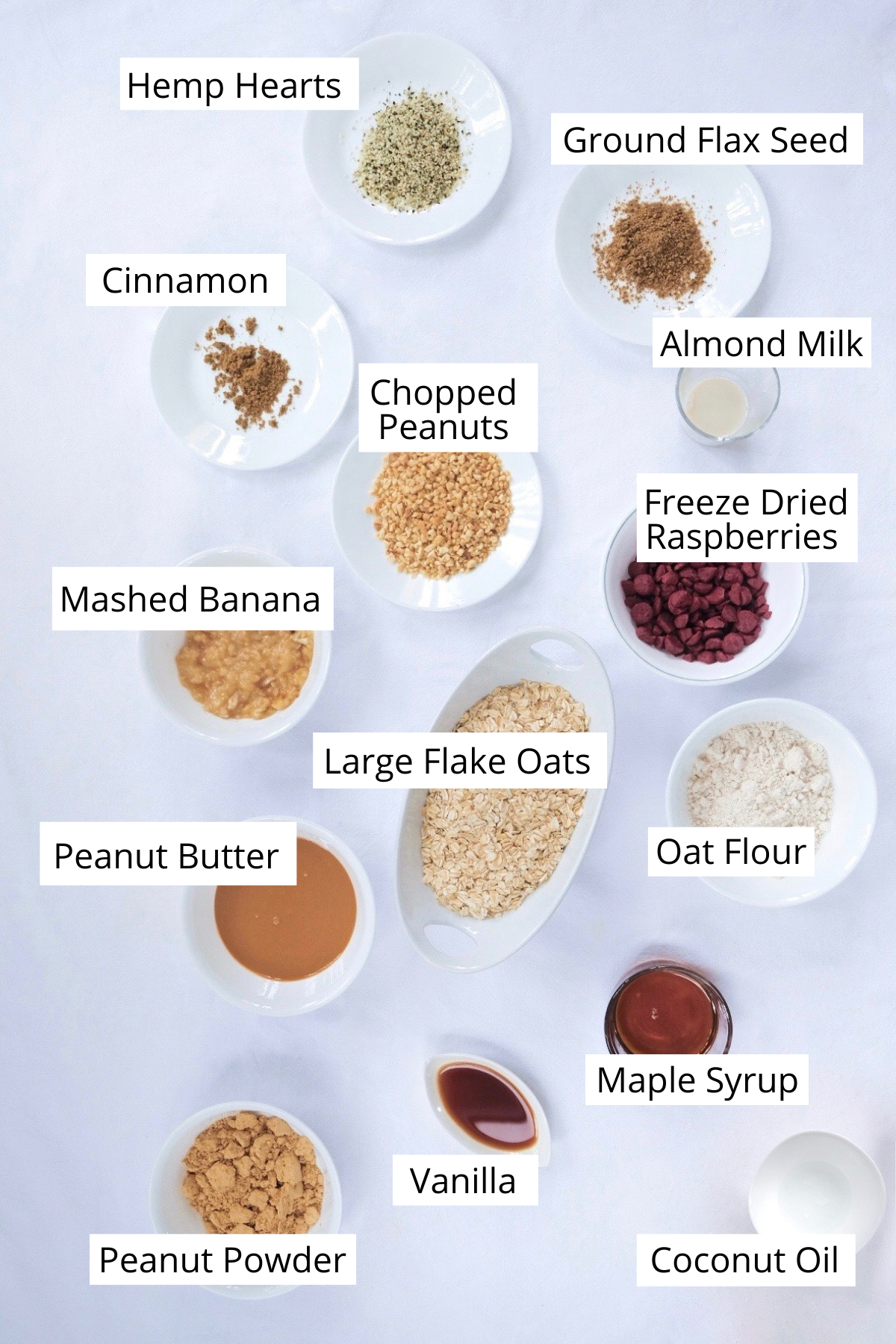
A birds-eye view of the ingredients used to make the peanut butter and jelly cookies, including peanut powder, vanilla, coconut oil, vanilla, maple syrup, oat flour, large flake oats, peanut butter, mashed banana, freeze dried raspberries, chopped peanuts, almond milk, ground flax seed, cinnamon and hemp hearts.

Large flake Rolled Oats – I use rolled oats over quick oats since it provides the perfect amount of firmness to hold the cookie together while also making it a great teething cookie. If you choose to use quick oats instead, it will make the cookies a little more softer since it’ll soak up the banana and is ideal for babies who are just starting solids.

Peanut Butter – I love adding peanut butter to any baking recipe since for starters, I love the taste and, have you ever heard of anyone complain about too much peanut butter! I prefer the natural (meaning it usually only contains nuts) unsweetened creamy peanut butter here.

Powdered Peanut Butter – This powdered peanut butter adds some extra protein to these breakfast cookies and a nutty flavor boost. It’s also dairy, soy and gluten free, and doesn’t clump which makes it perfect to add to a baking recipe!

Oat Flour – Oat flour is a great gluten-free sub for flour. Oats are also a whole-grain nutritious food, and a great source of carbs and fiber. If you don’t have oat flour on hand, you can actually make it yourself by simply blending up oats. I’m not kidding, it’s that easy!

Freeze Dried Raspberries – These freeze dried raspberries are perfect for baking and add just the right amount of tartness and sweetness to the breakfast cookies. Not to mention the pretty pop of colour.

How to Make This Recipe

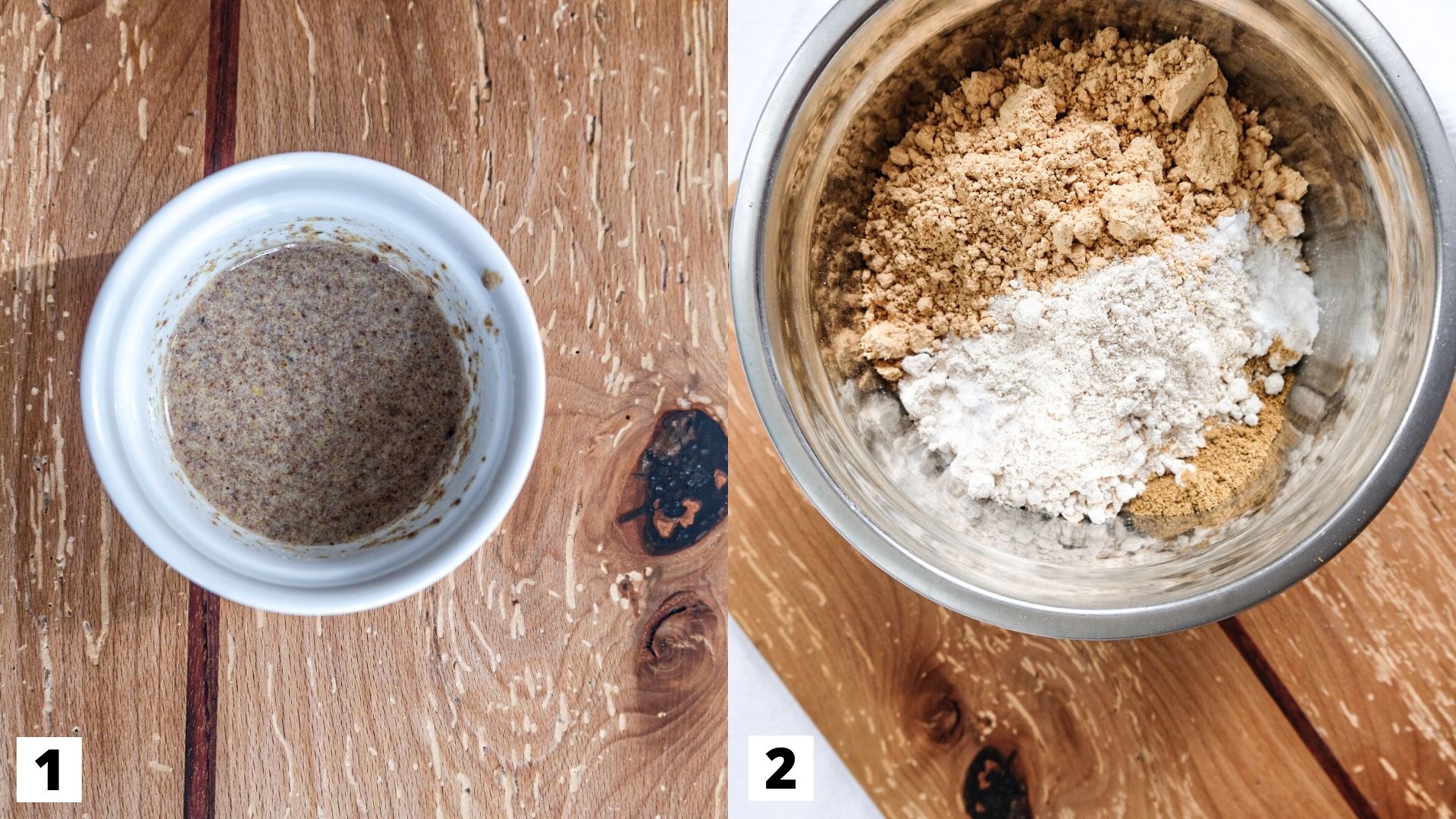
A process shot of the peanut butter and jelly cookies with step one showing the preparation of a flax egg in a ramekin dish, and step two showing the mixing of the dry ingredients in a mixing bowl.

Step 1: In a small ramekin, mix together the flax and almond milk or water. Stir with a fork until combined  and sit in the fridge for an hour to form a flax egg.

Step 2: Mix the quaker large flake oats, oat flour, powdered peanut butter, baking powder, cinnamon, and salt together. 

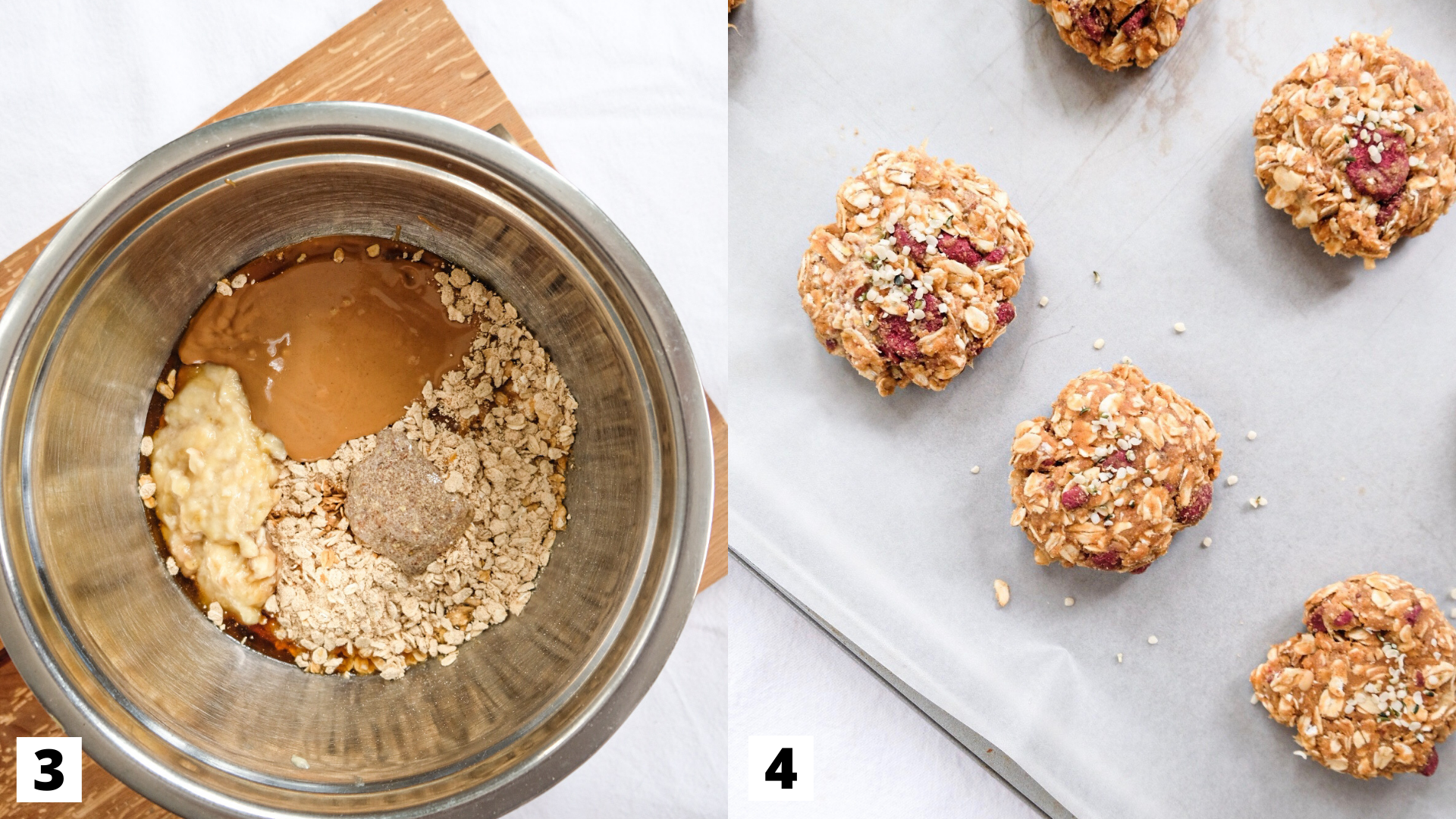
This is a process shot of steps three and four of the peanut butter and jelly breakfast cookies, with step three showing a mixing bowl with the wet and dry ingredients together and step four of the cookies rolled out into small balls on a baking sheet.

Step 3: Once the flax egg is thickened, combine the flax egg, peanut butter, coconut oil, banana, maple, and vanilla. Add the wet to the dry, then fold in the freeze dried raspberries and peanuts.

Step 4: Form into 1 ½ tbsp balls and transfer to baking sheets set 1 cm apart. Sprinkle with hemp hearts and bake for 10 minutes. 

Expert Tips

When mashing up your bananas, you don’t actually need to mash the bananas completely, I personally like having some chunks throughout the cookies as they add some nice texture!

You can control how sweet you’d like the cookies to be by choosing the right bananas. Through using a more ripe banana the cookies will be sweeter. You can also use frozen bananas and either thaw them on the counter or reheat for 15-20 seconds until they’re mash-able or not completely thawed!

After you’ve mixed all your ingredients together, let it sit for around 5 minutes, this will help soften the oats! Also, these cookies will not change their shape during baking, so make sure to create the cookie shape you desire and don’t flatten them too much.

A picture of the peanut butter and jelly cookies on a yellow plate, with a blurred background involving a bowl of raspberries and a baking tray with the cookies.

Recipe FAQs

Are these vegan breakfast cookies gluten free?

They are! If you use gluten free oats, these breakfast cookies are completely gluten free AND vegan.

Are these peanut butter and jelly cookies kid-friendly?

Yes! My kiddos LOVE them and because of the peanuts, they’re a great way to maintain peanut allergen tolerance which is really important to me. Of course, they wouldn’t be safe for a nut-free school but still, a really great nutritious option at home.

How long can I store these cookies for?

You can keep the cookie fresh in a cookie jar for up to 3 days, in the fridge. Another option is to freeze the cookies in an airtight container or bags and thaw a few hours at room temperature before eating.

Can I use another substitute for peanut butter?

You bet! You can use almond butter too, or try sunflower seed butter for a nut free option.
These are very forgiving and adaptable. Use add ins of your choice, just remember to keep the total to around 1/2 cup because if you add to much the dough won’t stay together.

I don’t have freezer dried raspberries, is there something I can use instead?

One of the reasons why I love these baby friendly cookies is because they are so customizable. You can replace the freezer dried raspberries with any of your favorite toppings like dried cranberries, dried blueberry, any type of nut, and more to make this cookie recipe never lose its yumminess! If you want to use fresh fruit, go with blueberries. Gently stir them in so they don’t turn the batter purple.

More Recipes You Might Like

Craving more vegan-friendly recipes like these peanut butter and jelly cookies? Check out these!

  • Vegan Salted Tahini Cookies
  • Vegan Hemp Hearts Breakfast Cookies
  • Best Banana Oatmeal Cookies

What are some of your favourite treats you want to see turned into breakfast?
Leave me a comment below about these healthy vegan breakfast cookies!

Cookies on a yellow plate next to a bowl of raspberries.
Print Recipe
5 from 4 votes

Peanut Butter and Jelly Cookies (Vegan & Low Sugar)

These Peanut Butter and Jelly Cookies are delicious Low Sugar Healthy Cookies that you will be happy to offer morning, noon, or night!
Prep Time1 hour hr
Cook Time10 minutes mins
Total Time1 hour hr 10 minutes mins
Course: Breakfast, Snack
Cuisine: American
Servings: 16 cookies
Calories: 175kcal
Author: Abbey Sharp

Ingredients

  • 1 tbsp ground flax
  • 2 tbsp unsweetened almond milk or water
  • 1/2 cup natural peanut butter
  • 1/4 cup melted coconut oil
  • 1/2 cup ripe mashed banana
  • ½ cup maple syrup
  • 2 tsp vanilla
  • 2 1/2 cups Large Flake Oats
  • ½ cup oat flour made by processing Large Flake Oats
  • ½ cup powdered peanut butter
  • ½ tsp baking powder
  • 1 tsp cinnamon
  • ¼ tsp salt
  • ¾ cup freeze dried raspberries crushed
  • ¼ cup minced peanuts
  • 2 tbsp hemp hearts

Instructions

  • Preheat oven to 350 Line two baking sheets with parchment paper.
  • In a small ramekin, mix together the flax and almond milk or water and sit in the fridge for an hour to form a flax egg.
  • In another bowl, mix the Quaker Large Flake Oats, oat flour, powdered peanut butter, baking powder, cinnamon, and salt.
  • Once thickened, combine the flax egg, peanut butter, coconut oil, banana, maple, and vanilla. Add the wet to the dry, then fold in the freeze dried raspberries and peanuts.
  • Form into 1 ½ tbsp balls and transfer to baking sheets set 1 cm apart. Sprinkle with hemp hearts and bake for 10 minutes. Allow to cool and enjoy.

Nutrition

Calories: 175kcal | Carbohydrates: 23g | Protein: 6g | Fat: 7g | Saturated Fat: 3g | Cholesterol: 1mg | Sodium: 89mg | Potassium: 140mg | Fiber: 3g | Sugar: 8g | Vitamin A: 35IU | Vitamin C: 1.9mg | Calcium: 42mg | Iron: 1.1mg

Abbey Sharp

Abbey Sharp is a Registered Dietitian (RD), regulated by the Ontario College of Dietitians. She is a mom, YouTuber, Blogger, award winning cookbook author, media coach specializing in food and nutrition influencers, and a frequent contributor to national publications like Healthline and on national broadcast TV shows.
www.abbeyskitchen.com/about-abbey/

Last Updated September 17, 2023. Published August 30, 2023 By Abbey Sharp 29 Comments

Birth Control and Weight Gain | What the Research Says + Best Birth Control Options

Does the birth control pill cause weight gain? I look at the research and share the pill options that are the best and worst for weight gain.

Does birth control make you gain weight? I look at the research and share the research on birth control and weight gain + options to prevent weight gain.

Let’s be honest, ladies- going on the birth control pill is the pits. We’ve heard from family, friends and the media about all the unwanted side effects of the pill, yet the alternative (unwanted babe, anyone?) makes it seem worth the risk. While everyone has their own horror stories, it seems that nausea, spotting, breast tenderness, depression, decreased sex drive and the scary one for many women – weight gain, are all fair game when you play Russian Roulette with your hormones. The idea that a pill you’ll be on for (potentially) many years may cause uncontrollable weight gain often deters many women from going on the pill, but is this true or just an old wives tale? And what about the new male birth control pill that’s been swirling the media recently- Is that a better answer? I’m going to investigate the research to decode fact from fiction to answer the question, what is the correlation between birth control and weight gain?

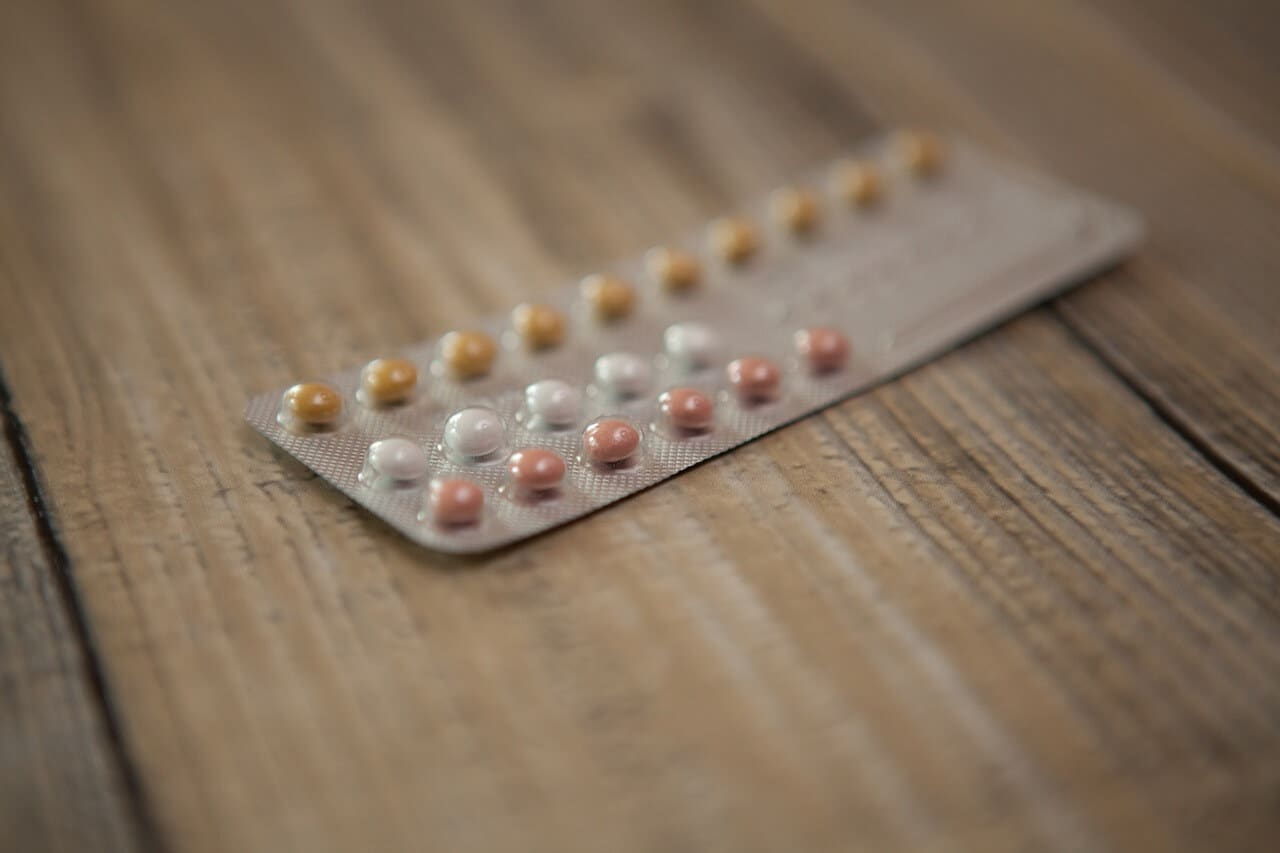
birth control pack

 History of The Pill

First I’ll give you a quick history lesson on how we got to this magical little pill. The birth control pill, the pill as often affectionately called, has been around since 1960 and initially only contained synthetic progesterone. Estrogen was later introduced into the pill since it was found to reduce breakthrough bleeding from the original cocktail. The birth control pill skyrocketed into popularity, and by 1965 almost 6.5 million American women were on the pill. In 1969, Barbara Seaman released The Doctors Case Against the Pill, a controversial book on the side effects of the pill including blood clots, heart attack, stroke, depression, loss of libido and you guessed it… birth control and weight gain.  By 1988, they realized that these side effects were due to the high dosing of the pill, and lower dose variations were soon released. Since then, and through extensive research, they’ve developed a safer birth control pill with fewer side effects. Some newer versions include those to help treat acne, pills you only take a few times a year, and most recently a continuous birth control pill with no more periods! 

What’s Going on in My Body Naturally?

In adult women, ovaries do the work of producing the sex hormones estrogen and progesterone, and a very small amount of testosterone. Along with a few other key players, namely lutenizing hormone and follicle-stimulating hormone, these hormones regulate the menstrual cycle every month. So here’s how your hormones change based on the time of the month:

  1. Levels of progesterone and estrogen are low at the start of a menstrual cycle.
  2. In the first half of a womens cycle, levels of estrogen begin to rise until day 14 when high estrogen levels cause an egg to be released, known as ovulation.
  3. Progesterone and estrogen both begin to increase, preparing the womb for pregnancy until around day 22.
  4. If the egg isn’t fertilized by a sperm, levels of estrogen and progesterone drop again.

So in a quick recap, both your hormones are naturally highest at around day 14 and 22 and estrogen is also high around day 14. Birth control pills work by leveling out the levels of hormones. So no peak in estrogen = no release of the egg, but we’ll talk more about this in a minute. Basically, we all naturally produce different amounts of estrogen and progesterone, just as the pill varies in what they contain – this is why one specific pill does not effect all women the same- you are basically trying to figure out what is best uniquely for you. And that, my friends, is tough stuff.

Current Birth Control Options

As of 2015, more than 70% of Canadians use contraception and more than 75% of women will use oral contraception at some point in their lives. The variety of birth control pills can seem pretty confusing, so I’ve broken it up into some easy to follow categories.

Combination Pills

Combination pills contain estrogen and progesterone – this is the most common type of pill. They work by preventing ovulation, or the release of the egg from the ovary. They also thicken the mucus of the cervix, making it harder for sperm to enter. They can vary based on how often you want to have your period or whether the dose of the pill stays the same or varies.

  • Conventional
  • Usually contains 21 days of active pills and 7 days of inactive pills, bleeding occurs every month.
  • Continuous Dosing/Extended Cycle
  • Usually contains 84 days of active pills and 7 days inactive pills, bleeding only occurs four times a year.
  • Monophasic: Each pill contains the same amount of estrogen and progesterone.
  • Multiphasic: The amount of hormones in each pill varies.

Progesterone Only

Progesterone only pills work by thickening the cervical mucous and thinning the endometrium (the lining of the uterus), which prevents the sperm from reaching the egg. They sometimes also stop eggs from leaving your ovaries, and no egg = no pregnancy.

  • Mini Pill: Contains progesterone only in a single active dose, which is taken everyday.

More Hormonal Birth Control

As you may remember from high school health class, there seem to be about a million alternative types of birth control, so I break them down for you into two easy categories:

  1. The pill, the patch and the vaginal ring all contain estrogen and progesterone, which I talked about above.
  2. The birth control implant, birth control shot, and hormonal IUD only release progesterone, similar to the mini pill.

Does the Birth Control Pill Cause Weight Gain?

Now that we have had our mini sex-ed lesson, it is time to dig into whether birth control and weight gain come hand in hand. There are two main hormones at play here, estrogen and progesterone. I summarized the type of birth control into the two hormonal variations estrogen AND progesterone, and progesterone only. So, let’s look at the effects of these two forms of birth control and see if they cause weight gain.

Estrogen and Progesterone

In 2014, Cochrane conducted a large review looking at combination (estrogen and progesterone) birth control pills and weight gain. Four of the studies looking at birth control in comparison to a control trial found no significant difference in weight gain. The rest of the studies, which compared two different types of combination birth control, showed that the birth control pill didn’t cause weight change. The largest difference in weight gain was about 4 pounds after 12 months. This is important because if estrogen were the cause of weight gain in the pill, when comparing the combination birth control which both contain estrogen, we would expect the higher dose group to gain more weight. However, this was not the case. Interestingly, the only study that found a weight gain was in the group with the LESS estrogen, not more. Another study from Cambridge University looked at the effect of oral contraceptives on young women’s metabolism and found the women taking the pill have a 5% higher metabolic rate. Additionally, there have been two randomized control trials (a great evidence source!) that found no significant evidence of weight gain using combination contraceptives (here & here).  Remember when I talked about the history of the pill? Well initially, the pill contained a high dose of estrogen, which was linked to weight gain along with some scary side effects. However, they have much lower doses of both estrogen and progesterone.

Progesterone Only

A comprehensive review of 16 studies looked into the effects of progesterone only birth control and weight gain. They found that on average, the weight gain was modest about 5 pounds over 12 months. When comparing progesterone only contraceptives to another form of birth control, there were no differences in weight gain. However, when comparing progesterone contraceptives to a control group of non-hormonal birth control users, the progesterone group had increased body fat and decreased lean body mass. Overall, it should be noted that the studies were mostly moderate to low evidence, so we need to take them with a grain of salt.

Of note, there is one method of progesterone-only birth control directly linked with weight gain – depot-medroxyprogesterone acetate, or DMPA. For those of us who have trouble even thinking of how to say that, it is more commonly known as the Depo-Provera shot. One study found an average weight gain of 10 pounds among adolescent girls during the first year of use. There has been extensive research pointing to similar results (here, here, here & here). It has been shown that this weight gain is specifically linked to fat gain, and sadly, not water retention.

Conflicting Side Effects Related to Birth Control and Weight Gain

We need to remember that despite what the evidence suggests, everyone’s body is different and may react to the hormones offered by the birth control pill differently. Many of the studies found some participants lost weight while others gained a few pounds, showing that women may react differently to each type of birth control. If you yourself have tried different pills, you may have noticed this yourself. On one pill you feel like ripping your partner’s head off, on another, you lose 5 lbs! This is why side effects can’t be generalized to everyone, including weight gain.

I looked into a few possible reasons women may feel that their birth control pill is causing weight gain, and lo and behold, there is even more conflicting research!

The birth control pill causes increased appetite?

One study found that half of the adolescents on the pill believed their appetite increased, however this is only their perception and wasn’t tested against actual caloric intake. Another study looked at the Depo shot (which we know causes weight gain) to see if increased appetite and calorie consumption were the reason for weight gain, however they found appetite was not a factor. Unfortunately, there hasn’t been much research in this area because appetite is so variable among women. Overall, there isn’t enough research to prove that increased appetite is linked to birth control and weight gain.

The birth control pill causes bloating?

Historically, the high-dose estrogen pills that first came onto the market were shown to cause water retention. This is why many women feel bloated before their period, as estrogen levels are higher. More recently, research has emerged that the dosing of hormones on the pill does not cause water retention. Another study found that no significant weight gain was found, however in those who did gain weight, it was from fat mass. A study on young women found that neither combined nor progesterone-only birth control increased blood pressure (aka bloating.)  The key to estrogen causing bloating, breast tenderness or general water weight gain is high dose estrogen. For those concerned about water weight gain, make sure you ask your doc about the lowest hormone dose pill that will work for you.

The pill causes insulin resistance?

What is insulin resistance anyway? Think of it like a lock and key. Insulin is the key that opens our cells to let sugar in. When we have insulin resistance, its like keys are trying to open a lock that they don’t fit. This means we’ll have more sugars circulating in our blood, similar to what happens in diabetes. This is another area where it does not seem we have a clear-cut answer yet.  One study found that DMPA (the injectable progesterone shot) caused higher levels of fasting glucose and insulin levels, however, this same result wasn’t seen with a low dose pill. Similarly, a study this year found comparable results of increased BMI, waist circumference and insulin resistance with DMPA. Additionally, a study found that combined estrogen and progesterone pills reduced insulin sensitivity by 30-40%. Overall, a review released in 2014 concludes these results stating that hormonal contraceptives do have an influence on blood glucose control, however likely to a small degree because of the very low doses of hormones. They conclude that more research is necessary to determine how this will affect women long-term.

The pill causes weight gain that may be clinically small but to you feels huge?

I hear you. The research may not point to these massive jumps on the scale, but maybe to you- an extra 5 or 10 lbs seems like a world of a difference. I get it because I’ve been there myself. Even though I practice from a health at every size standpoint, I am in no position to tell you that an extra 5 lbs is a good trade-off to avoid an unwanted pregnancy. Ultimately, everyone has to evaluate the pros and cons for themselves.

Is the Male Birth Control Pill the Answer?

So if there was even a possibility that your birth control pill caused weight gain, and you had another option- would you take it? Introducing the male birth control pill. Currently, the only male contraception options are condoms and vasectomies…Could there be another solution emerging?

To start, one last sex-ed review, I swear. In men, new sperm are constantly being created in the testicles triggered by the hormone testosterone. These sperm travel down the vas deferens to the base of the penis and then, well, we all know what happens next.

The goal of the male pill is to stop testosterone from creating these healthy little sperm.  This is where male backlash came flooding in because if testosterone levels are artificially lowered, the concern is that men will lose their sex drive. Interesting, right? Considering a known side effect from the female pill is loss of sexual desire, however, this didn’t seem to condone the same criticism as the male pill (cue MASSIVE eye roll).

close up image of the biology of conception

Moving along, the solution they introduced is a pill with a combo of testosterone and progestogen, or the synthetic progesterone sometimes found in the female pill. This creates a happy environment where the testes stop producing testosterone (and healthy sperm) while allowing levels of testosterone in the blood to remain normal. Sounds perfect to all the women sick of trying to remember that tiny pill everyday, right? Well, some men still produce enough sperm to get a woman pregnant, which is obviously not ideal. To create a further challenge, the suppression of sperm happens at different rates for men of different ethnicities. Despite Universities researching this for years, it does not seem like big pharma companies are willing to step up to fund this product quite yet.

The largest study of 320 men who first tried an estrogen-testosterone injection every 8 weeks found promising results with only a handful of pregnancies and significantly decreased sperm count. The side effects men reported included loss of lean body mass, increased acne and changes in mood halted this research and the study was cut short. The challenge with creating birth control for men is really a numbers game- we are talking about 1 egg and a regular monthly cycle for women versus millions of sperm for men. Researchers say we are going to keep trying,but the research is still very early on. Ultimately, I would guess that if men deem this pill as undesirable, and are perfectly happy letting women absorb the burden of birth control, pharmaceutical companies won’t think this will sell. And if it won’t sell, they probably won’t pump millions into the research to get it to market.

image of a person getting an injection in their arm

It seems like the majority of the little research money available is now moving towards non-hormonal male contraception such as funded by the Parsemus Foundation. I guess we have to wait and see what happens with that.

Bottom Line

The pill has been around for a long time and a lot of research has been ongoing since the first pill was introduced. The new generation pills vary in the type and amount of hormones estrogen and progesterone they contain, just as our bodies naturally produce different amounts of these. This is why side effects that women experience can be as varied as the options on the market. Don’t be afraid to talk with your doc about side effects your experiencing- there may a better birth control option for you!

red condoms on a pink table

The effects on birth control and weight gain can be summarized as:

  1. Combination birth control with estrogen and progesterone has been shown not to cause weight gain in most
  2. Progesterone only pills have no been shown to cause moderate weight gain, about 5 pounds over a year.
  3. DMPA, or the Depo-Provera shot has been shown to cause weight gain on average of 10 pounds over the first few years of use.
  4. There is conflicting research whether the pill causes increased appetite.
  5. To help with bloating, ask your doc about the lowest dose of estrogen pill that is right for you.
  6. The pill likely effects insulin sensitivity in some way (though likely small). If blood glucose control is a concern for you, talk to your doctor about non-hormonal contraceptive options.
  7. The male pill and other hormonal contraceptive options may not be released any time soon, however other non-hormonal options such as Vasalgel may be the emerging answer.

More Blog Posts You May Like

Did you find this blog on birth control and weight gain interesting? Check out some of my other favorite blogs on my page right now!

  • WHAT NOT TO SAY TO A PREGNANT WOMAN ABOUT HER BODY
  • GOING ALL IN TO GAIN WEIGHT TO GET PREGNANT AND GET BACK YOUR PERIOD WITH HA VS PCOS
  • FOODS AND SUPPLEMENTS FOR FERTILITY AND GETTING PREGNANT

What are your thoughts on the birth control pill? Did you experience a correlation between birth control and weight gain? Have you found a better solution that has helped you manage your cycle and weight? Would your partner likely opt for the mail birth control pill? Leave me a comment below!

Contribution by Tiffany Schebesch, RD


Abbey Sharp

Abbey Sharp is a Registered Dietitian (RD), regulated by the Ontario College of Dietitians. She is a mom, YouTuber, Blogger, award winning cookbook author, media coach specializing in food and nutrition influencers, and a frequent contributor to national publications like Healthline and on national broadcast TV shows.
www.abbeyskitchen.com/about-abbey/

Last Updated November 17, 2020. Published August 28, 2023 By Abbey Sharp 6 Comments

Carrot Cake Baked Oatmeal Recipe (Vegan & Gluten Free Breakfast)

This vegan carrot cake baked oatmeal recipe with cream cheese drizzle is the perfect healthy gluten free meal prep breakfast to make on the weekend and eat all week!

Carrot cake baked oatmeal on a white plate topped with raisins.

Carrots are one of those veggies that are pretty much available all year round here in Canada, so I love finding new ways to use them. I was actually inspired to make this baked oatmeal recipe from my Carrot Cake Protein Parfait from Mindful Glow. The combination of sweet carrots, California raisins, walnuts and cream cheese is heavenly to say the least.

Table of contents

  • Why This Recipe Works
  • Key Ingredients 
  • How to Make This Recipe 
  • Expert Tips
  • Recipe FAQs
  • More Recipes You Might Like

Why This Recipe Works

This vegan carrot cake baked oatmeal recipe has very quickly become a staple because you can make a big batch for the week and rewarm it on busy mornings, or serve it as a special family meal for a spring brunch (like Easter!) I also love this recipe because its:

  • Vegan
  • Gluten free
  • Family friendly
  • Relies on pantry staple ingredients
  • ANY excuse to make a cream cheese frosting drizzle is a great reason to cook. RIGHT?!

Key Ingredients 

Birds eye view of baked oatmeal recipe topped with walnuts and raisons with a bowl of raisins and sheet pan in the background.

Oats- I do prefer to use rolled large flake oats for this. You can buy gluten free if you have any guests avoiding gluten.

Carrots- Obviously you need carrots to make a carrot cake baked oatmeal recipe. I prefer to use the pretty orange heirloom carrots (compared to the super huge ones) as I find they’re more flavourful and sweet.

California Raisins- Raisins are such a versatile ingredient for baking and cooking, and are such a great way to add some natural sweetness to oats. Like a lot of produce, the best raisins definitely come from California, so as the weather warms up, I’m definitely hoping to channel a little sunshine with this recipe.

Walnuts –Walnuts are rich in plant based omega 3 fats, making them a nutrient rich, crunchy addition that is traditional in carrot cake.

Ripe bananas – I love the natural sweetness that ripe banana brings to recipes. It’s a great way to cut back on the added sugars in recipes without losing out on flavour.

Vegan Cream Cheese – This is really the key to getting that characteristic cream cheese glaze on top of this baked oatmeal. I really don’t think carrot cake anything is worth eating without the cream cheese frosting glaze.

How to Make This Recipe 

Process images of the first three steps for making the baked oatmeal recipe including how to make the wet and dry mixture.

Step 1: Mix together the oats, cinnamon, nutmeg, baking powder, and salt.

Step 2: In another, mix the almond milk, maple, flax eggs, vegan butter, vanilla, banana, ginger, and carrots.

Step 3: Mix wet mixture into the dry ingredients.

Process images showing the last three steps for making the recipe including adding in dried fruit, pouring into baking dish, and drizzling with frosting.

Step 4: Fold in the walnuts, raisins, 3 tbsp hemp hearts, and candied ginger.

Step 5: Transfer the mixture to the baking dishes. Sprinkle with hemp hearts. Bake for 22-25 minutes or until golden brown on the outsides and firm to the touch.

Step 6: Meanwhile, in a food processor, puree the yogurt, cream cheese, lemon juice, and sugar until smooth. Transfer to a piping bag and drizzle on top of the baked oatmeal.

Expert Tips

I am a big brunch entertainer so I have my usual brunch menu staples, and this is definitely one of them. For a nice spring brunch, I would serve this with a light salad topped with radishes, strawberries and goats cheese (if you’re not vegan). I would also likely do a nice fruit salad, and then have some yogurt (dairy and non-dairy) on the side.

I’ve been making a lot of baked oatmeal recipes and I have found that adding bananas really does help moisten the filling, without making it fall apart. The flax eggs (or regular eggs, if you’re not vegan) are also really important for holding this all together.

The instructions otherwise are pretty straightforward – you basically are going to want to mix everything together in a bowl until well incorporated, transfer to a 13×9″ pan and bake until you see nice browning around the edges. It still may be moist and soft in the centre, but it will firm up as it sits over time.

Birds eye view of baked carrot cake oatmeal breakfast topped with walnuts and raisins.

Recipe FAQs

Is this baked oatmeal recipe safe for kids, toddlers and BLW?

Because of the nuts and raisins, I would avoid giving brand new eaters this baked oatmeal. Toddlers however can absolutely enjoy this (just mince up the walnuts very fine), and kids will love it too.

How long will this last in the fridge for meal prep?

If you’re entertaining, of course, you’re going to hope for leftovers, but whenever I make this on a Sunday for the week, I tend to get about 4-5 days out of it.

Can you freeze baked oatmeal?

Yes! If you know you can’t finish this in a few days, I would cut it into squares and wrap each individually in plastic wrap before putting in a freezer safe container or bag in the fridge.

Can I make this oatmeal non vegan if we eat animal products?

Absolutely. Feel free to use regular cream cheese, eggs and milk if that’s what you have on hand. I do love the added omega 3s that flax eggs offer, but there are already heart-healthy walnuts in here to provide that if you want.

More Recipes You Might Like

Take a look at this round up of some of my favourite carrot cake themed goodies!

  • CARROT CAKE WAFFLES 
  • CARROT CAKE SMOOTHIE
  • VEGAN CARROT CAKE COOKIES 
  • CARROT CAKE CUPCAKES WITH YOGURT CREAM CHEESE FROSTING

What are your go-to meal prep breakfasts? Leave me a comment below!

Print Recipe
4.86 from 7 votes

Vegan Carrot Cake Baked Oatmeal | Gluten Free Meal Prep Breakfast

This vegan carrot cake baked oatmeal with cream cheese drizzle is the perfect healthy gluten free meal prep breakfast to make on the weekend and eat all week!
Prep Time25 minutes mins
Cook Time25 minutes mins
Total Time50 minutes mins
Course: Breakfast
Cuisine: American
Servings: 12
Calories: 268kcal
Author: Abbey Sharp

Ingredients

  • 2 1/2 cups rolled oats
  • 2 tsp cinnamon
  • 1/4 tsp nutmeg
  • 1 1/2 tsp baking powder
  • 1/2 tsp salt or less for babies
  • 1 1/4 cup unsweetened vanilla almond milk
  • 1/4 cup maple syrup
  • 2 flax eggs 2 tbsp ground flax + 1/4 cup water set in fridge 1 hour
  • 3 tbsp melted vegan butter
  • 2 tsp vanilla
  • 2 ripe bananas mashed
  • 1 ½ tsp grated fresh ginger
  • 2 cups lightly packed grated peeled carrots squeezed lightly
  • 1/2 cup walnuts finely minced
  • 1/2 cup California Raisins
  • 3 tbsp hemp hearts plus more for sprinkling
  • 2 tbsp Candied ginger finely minced (optional)

Drizzle:

  • ¼ cup non-dairy plain yogurt
  • ½ cup cream cheese
  • Juice from a ¼ of a lemon
  • ¼ cup powdered sugar

Instructions

  • Preheat oven to 375 F. Grease two 9″ square baking dishes.
  • Mix together the oats, cinnamon, nutmeg, baking powder, and salt.
  • In another, mix the almond milk, maple, flax eggs, vegan butter, vanilla, banana, ginger, and carrots. Mix into the dry ingredients.
  • Fold in the walnuts, raisins, 3 tbsp hemp hearts and candied ginger.
  • Transfer mixture to the two baking dishes. Sprinkle with hemp hearts. Bake for 22-25 minutes or until golden brown on the outsides and firm to the touch. Allow to cool before cutting into pieces.
  • Meanwhile, in a food processor, puree the yogurt, cream cheese, lemon juice and sugar until smooth. Transfer to a piping bag and drizzle on top of the baked oatmeal. Enjoy at room temperature.

Video

Nutrition

Calories: 268kcal | Carbohydrates: 34g | Protein: 6g | Fat: 13g | Saturated Fat: 3g | Cholesterol: 10mg | Sodium: 203mg | Potassium: 371mg | Fiber: 4g | Sugar: 16g | Vitamin A: 3857IU | Vitamin C: 4mg | Calcium: 120mg | Iron: 2mg
Abbey Sharp

Abbey Sharp is a Registered Dietitian (RD), regulated by the Ontario College of Dietitians. She is a mom, YouTuber, Blogger, award winning cookbook author, media coach specializing in food and nutrition influencers, and a frequent contributor to national publications like Healthline and on national broadcast TV shows.
www.abbeyskitchen.com/about-abbey/

Last Updated August 16, 2023. Published August 23, 2023 By Abbey Sharp 24 Comments

Smart Watch Dangers | Why I Broke Up With My Fitbit

Four colourful fitbits.

Sorry Fitbit. It was fun while it lasted but we’re breaking up. Let me tell you a little story about my love affair with smart watches and how it all fell apart.

Four colourful fitbit smart watches.

Image: Mouthshut.com

I’m a real fitness enthusiast. I spin, train heavy, run, do pilates, barre, Lagree, tabata and everything in between. I am one of those rare people who legitimately love to sweat, feel the burn and work hard. So when I started to see those Fitbit commercials and all of my (Registered Dietitian) friends wearing their smart watches with pride, I rushed to order mine online.

My smart watch allowed me to track my steps, distance, calories burned, sleep quality and active minutes. It also let me log in my food to track my caloric intake and compete with my friends for the most steps taken. Thankfully, I never got into the sleep or food tracking (I didn’t need to fall back into orthorexic territories). I didn’t even pay attention to how many calories it said I burned (we all know those tend to be well off base), but I did get uber competitive with myself on those steps. To me, it was a fun little game that motivated me and also made me realize how inactive I was when I wasn’t in the gym. I mean, I often sit at a desk all day writing and only get up to pee and eat. That was a bit of a (good) wake up call for me!

Smart Watches & My “Goal”

Like a lot of smart watches, the Fitbit automatically sets you a goal of 10,000 steps. This number was originally created by the Japanese as part of a marketing campaign to sell pedometers, but it’s since become the gold standard in activity recommendations despite the research being shoddy at best. Sure, we know that 10,000 steps a day is probably good for you, but is it much different then getting 9,000 or 11,000 steps? We don’t really know. The American Heart Association uses the 10K step guideline to help reduce the risk of heart disease, and countless studies have linked this number to a reduced risk of blood pressure, body fat, heart disease, and insulin resistance. I could see why 10,000 steps (about 5 miles) would be a challenge for someone who sits at a desk all day, but for a gym bunny like me, I figured I could raise the bar.

Woman doing sit ups and wearing a smart watch.

I quickly realized that I was already doing at least 13,000 steps doing a 15 minute warm up, 30 minutes of interval running and 15 minute cool down on the treadmill. So yay for me, I was stepping more than the average person. But being a highly competitive person, I was always challenging myself to just add a bit more. I started to notice that jogging was getting me to my stepping goal faster than intervals so I slowly changed my technique and raised my step goal accordingly. With my new steady-state cardio routine, I consistently logged in at least 18,000 and was out-stepping all of my Fitbit buddies on my app. When I went on holiday in Florida and enjoyed long walks on the beach (yes, actually), I was able to surpass 20,000 and even on rare occasions, 25,000 if I was touring around a new city. Hell, yeah! I was feeling pretty darn good about myself.

How Smart Watches Made My Fitness Decline

But then I started to notice something unexpected considering all my “progress” with my steps. All of those casual long walks that were helping me log in those steps were coming at the expense of hard strength training work-outs or even high intensity spinning or intervals. Sure, a smart watch lets you log in your strength training and other daily activities, but it doesn’t really do a good job awarding them same way it does with steps. I clearly bought into the award system.

Woman doing yoga.

I also was not listening to my body’s own needs for activity. Even if I woke up and thought, “You know, I really could go for a nice barre class” or “I really feel like lifting heavy today,” I probably would have talked myself into getting my steps in first. Without the visual cue of my smart watch, I felt lost and completely unaware of my own fitness status. Was I tired? Was I sore? Did I have more energy? Was I more hungry? While I had worked so hard to improve my relationship with food and tune into my innate hunger and satiety cues, I was struggling to apply those same mindful techniques to my activity.

The result? My fitness level was rapidly declining and I was falling out of touch with my body. I was losing conditioning, I was losing muscle, and I was actually gaining fat.

My Fitbit was quickly making me un-fit.

Hand holding a dumbbell.

The Break Up

It all blew up on my vacation to sunny California. I was walking through Carmel by the Sea, a sweet little town on the coast when I went to check on my step progress for the day. But it wasn’t working. I knew I had just charged it so it wasn’t a dead battery – my Fitbit had conked out. Apparently, smart watches were tired of counting my steps – and ironically, so was I.

This was the turning point for me.

Picture of fitbit smart watches.

Why Smart Watches Failed Me (and May Fail You)

I’ve written about exercise mistakes before (it’s a great article – check it out here), largely because I made so many of them myself out of my own stubborn nature and reluctance to change what wasn’t working. But in general, the research is clear- extended periods of low intensity cardio can sometimes do more harm than good. Not only will your body adapt to any calories you may be burning and use less energy to do the same workout, but it’s also not uncommon to “cut into your gains” with excessive cardio. What does that mean? Well, essentially that all that pounding cardio without any compensating strength training is burning through your muscle mass. So even if you do burn calories walking away as you watch your steps climb, the loss of muscle (which boosts metabolism and burns more calories even at rest) is being compromised. And the more you do that steady state cardio, the fewer calories you will burn.

Wrist with apple watch during exercise.

Thankfully, I wasn’t paying much attention to the calorie burn numbers or tracking my caloric intake, because if I had I would have been in even more trouble. Apparently a lot of smart watches, like the Fitbit, can be off by between 9-23% for aerobic exercise. That could mean that your supposed 600 calorie blast actually burned only 460 calories. Those discrepancies really do add up if you’re depending on them to balance or offset your food intake. There’s a lot of research that suggests people tend to compensate for the perceived calories burned by eating even more with the idea that they “earned it” . You can see how things can go South from here.

What I Did Wrong With Smart Watches

A lot of things. First, I let my own competitiveness for some arbitrary number cloud my own knowledge and judgement about getting a high quality workout.

It’s not that I didn’t know the research behind doing High Intensity Interval Training (HITT- aka the cardio I had been doing pre- smart watches days) was supportive for conditioning and fat loss, and that strength training was absolutely key. Of course I knew that. But it’s just my damn stubbornness and competitive personality that made it easy to just set that knowledge aside while I beat my own records. Admittedly, it was a fun little challenge that made working out more exciting (albeit, a lot less beneficial).

Woman exercising with smart watch in a gym.

Second, I stopped doing the things that were helping me grow lean muscle, get stronger, and burn fat. That is, my HIIT, strength training and conditioning. My workouts were consisting of lots and lots of walking, which is great for beginners, but not for those of us with goals to build lean muscle and lose fat.

Third, I was relying way too much on my smart watch to tell me when I had had enough activity and what kind of activity to do. My routine was getting boring and that was taking the pleasure out of activity for me. There is also a really interesting exercise phenomenon called Non Exercise Activity Thermogenesis (NEAT) where we tend to balance out the conscious, purposeful exercise we do by sitting and relaxing more. In contrast, people who don’t think so hard about doing planned “exercise” just tend to fidget, dance, move, play more. In the end, they end up burning the same amount of calories through movement. So I very likely may have been been burning the same amount of calories that I had been while stepping less, but also missing out on those metabolism-boosting muscle-building benefits. Ugh.. damnit!

How to Make a Smart Watches Work For You

So yah, my Fitbit and I didn’t really work out. I think it’s sitting in one of my many desk drawers, dead, cold and alone. But just because my relationship didn’t work out, doesn’t mean yours wont! Smart watches, like the Fitbit, may be beneficial but ultimately there are some ways to increase your chances of success with yours.

Close up of Apple watch.
  1. Don’t Pay Attention to the Calories Burned – Listen to your body, not the number on the device. It’s very likely it’s off base and you may use that as an excuse to eat more, offsetting your progress.
  2. Input Strength Training Activities – They don’t burn as many calories or add any steps, but I would try setting a goal to increase the reps, weight or both in your strength training sessions. If logging things in helps you with your goals, then seeing those reps or weights go up may be motivating.
  3. Use it As a Guide to Build Habits – My Fitbit did open my eyes at how little I move when I’m not purposefully exercising so it was a good reminder to do things the hard way some times (like take the stairs or park further away). Having said that, once you build these into your normal routine, you likely won’t have to rely so heavily on the device.
  4. Think Quality Over Quantity – Set your goal a little lower than normal with the knowledge that some of your activities may not log in as many “steps” but may be better fat burners or muscle builders. For example, you may do a session of intervals on the treadmill for a shorter amount of time than a long leisurely walk, and that may result in fewer steps taken, but it’s far better for your muscles, metabolism and fat burning.
  5. Don’t Get Obsessed – If you find having an external indicator of physical activity is getting in the way of your intuition with your body, then just put that bad boy to bed. This to me, was one of the biggest problems between my Fitbit and I, and I ended up having more success without it.

Do you have a Fitbit or a similar smart watch? Have you had success with it? I would love to hear your personal stories! Leave me a comment below!

More Blog Posts You Might Like

If you enjoyed this blog post discussing why I broke up with my Fitbit, you might enjoy some more posts discussing health and wellness:

  • Are Supplements Safe? | How to Choose the Right Supplement For You
  • Can Collagen Supplements Tighten Skin?
  • Fertility Supplements and Foods for Getting Pregnant
  • What to Look for in a Protein Powder
  • Intermittent Fasting and Working Out: Will it Help or Hinder Your Performance?
  • Is Shakeology Worth It?
Abbey Sharp

Abbey Sharp is a Registered Dietitian (RD), regulated by the Ontario College of Dietitians. She is a mom, YouTuber, Blogger, award winning cookbook author, media coach specializing in food and nutrition influencers, and a frequent contributor to national publications like Healthline and on national broadcast TV shows.

www.abbeyskitchen.com/about-abbey/
  • Previous Page
  • Go to page 1
  • Interim pages omitted …
  • Go to page 14
  • Go to page 15
  • Go to page 16
  • Go to page 17
  • Go to page 18
  • Interim pages omitted …
  • Go to page 89
  • Next Page

Get started with

Eight Free Recipe Books

From the co-founder of Neue Theory and creator of the Hunger Crushing Combo

Sign me up!
Abbey smiling at table
Abbey Sharp

“Foods may never be nutritionally equal. But we can make them morally equal by recognizing that our worth is never determined by what's on our plate.”

— Abbey Sharp, RD About Abbey ◥

Books

  • HCC™
  • Mindful Glow
  • Free E-Books

Blog

  • Nutrition
  • Recipes
  • Motherhood
  • Life

Explore

  • Neue Theory™
  • Bite Back
  • YouTube

Abbey

  • About
  • Coaching
YouTube TikTok Instagram Facebook X Pinterest
Abbey Sharp - The No BS Dietitian From Abbeys Kitchen

© Abbey's Kitchen 2026  All Rights Reserved •  ACCESSIBILITY STATEMENT •  Privacy Policy

This site uses cookies. By continuing to browse the site, you are agreeing to the use of cookies Accept Privacy Policy
Privacy & Cookies Policy

Privacy Overview

This website uses cookies to improve your experience while you navigate through the website. Out of these, the cookies that are categorized as necessary are stored on your browser as they are essential for the working of basic functionalities of the website. We also use third-party cookies that help us analyze and understand how you use this website. These cookies will be stored in your browser only with your consent. You also have the option to opt-out of these cookies. But opting out of some of these cookies may affect your browsing experience.
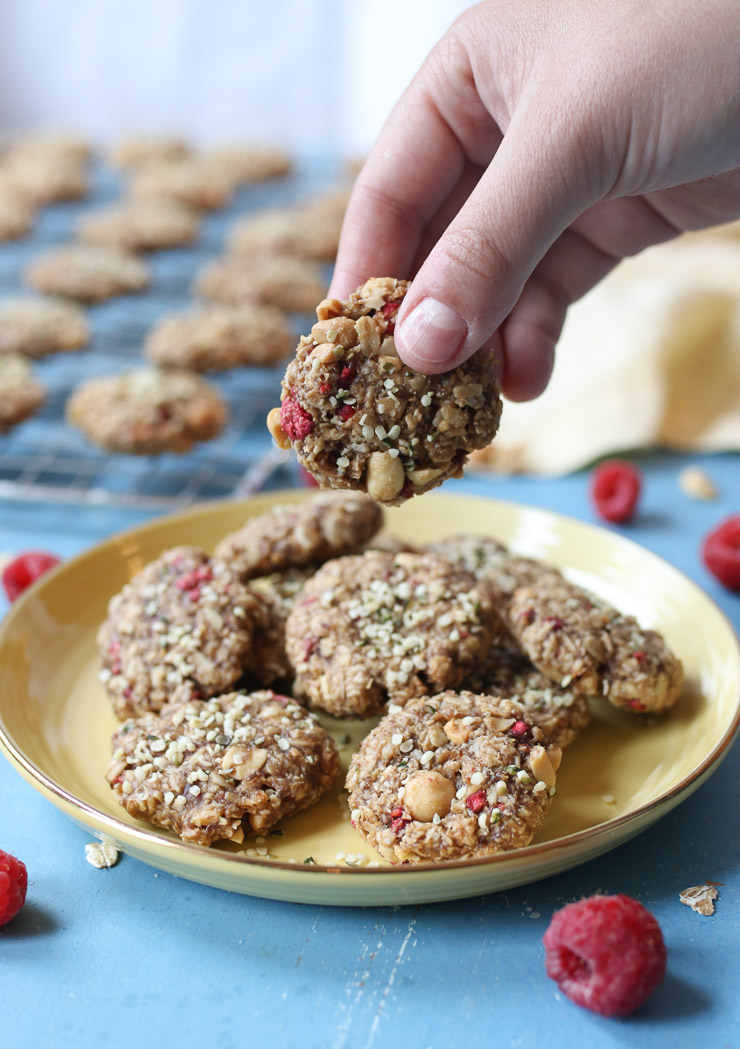
Necessary
Always Enabled
Necessary cookies are absolutely essential for the website to function properly. This category only includes cookies that ensures basic functionalities and security features of the website. These cookies do not store any personal information.
Non-necessary
Any cookies that may not be particularly necessary for the website to function and is used specifically to collect user personal data via analytics, ads, other embedded contents are termed as non-necessary cookies. It is mandatory to procure user consent prior to running these cookies on your website.
SAVE & ACCEPT

Rate This Recipe

Your vote:


A rating is required
A name is required
An email is required